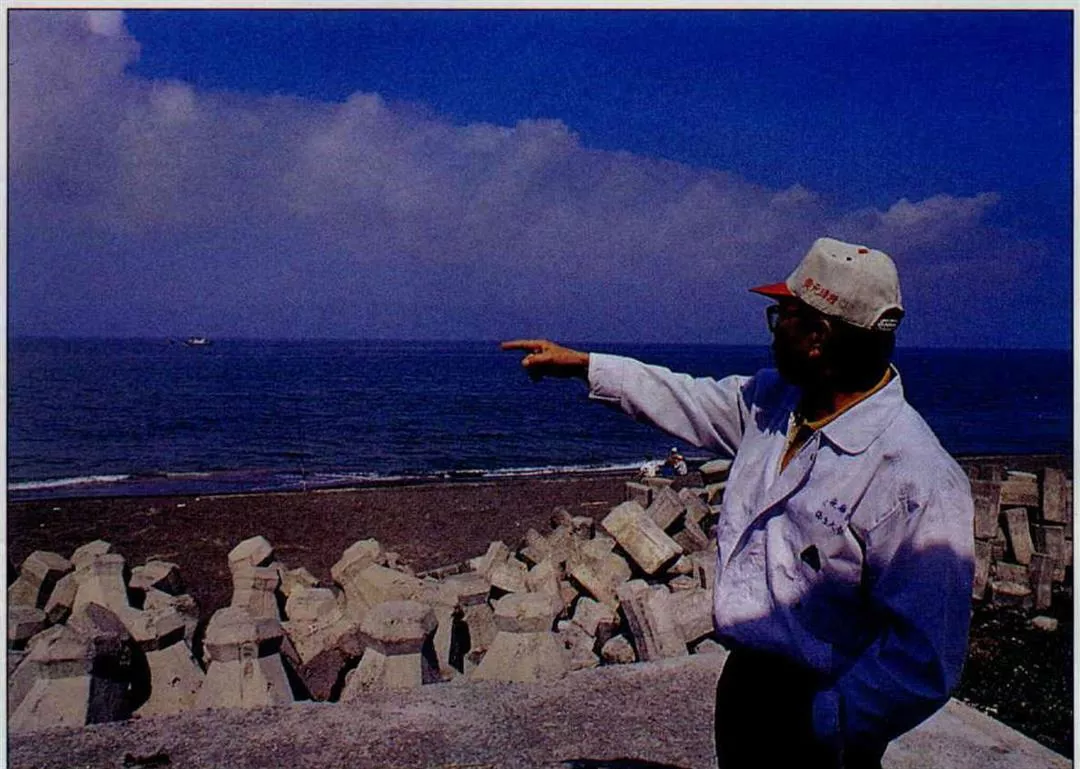
"My old house is two kilometers out to sea," says Liu Chin-chuen, mayor of Chih-hsi Village, pointing out over the boundless ocean. His village is on the coast of Kaohsiung County at Ketsai Liao in Tsukuan Rural Township.
In April at Ketsai Liao, as in most typical fishing villages along Taiwan's west coast, as midday draws near the muggy heat rises and the hot, damp, brineladen air brings on a befuddled drowsiness. Although tucked away in a quiet corner of southern Taiwan, the village leads an unsettled life. Over the past 20 years its sandbanks, its windbreak trees and much of its land have been washed away.
Were it not for the huge sums spent each year on strengthening the sea walls, Ketsai Liao would have long ago been swallowed by the sea, and would have disappeared from Taiwan's map. But the walls have continually been moved inland and have been repaired 27 times, and countless concrete blocks have been laid down to break the force of the waves. Today the area of Chih-hsi is only half what it was 20 years ago. "We've been shaved bare by the waves," says the mayor, whose domain is growing smaller and smaller. The people have almost all moved away, and he looks like becoming the most leisured village mayor in all Taiwan.

"My old house is under the sea," says the mayor of Chih-hsi village in Kaohsiung County, pointing out over the ocean. Because the land is being washed away, most of the villagers have moved out. (photo by Cheng Yuan-ching)
The conquering sea:
Chih-hsi is not the only village to be disappearing.
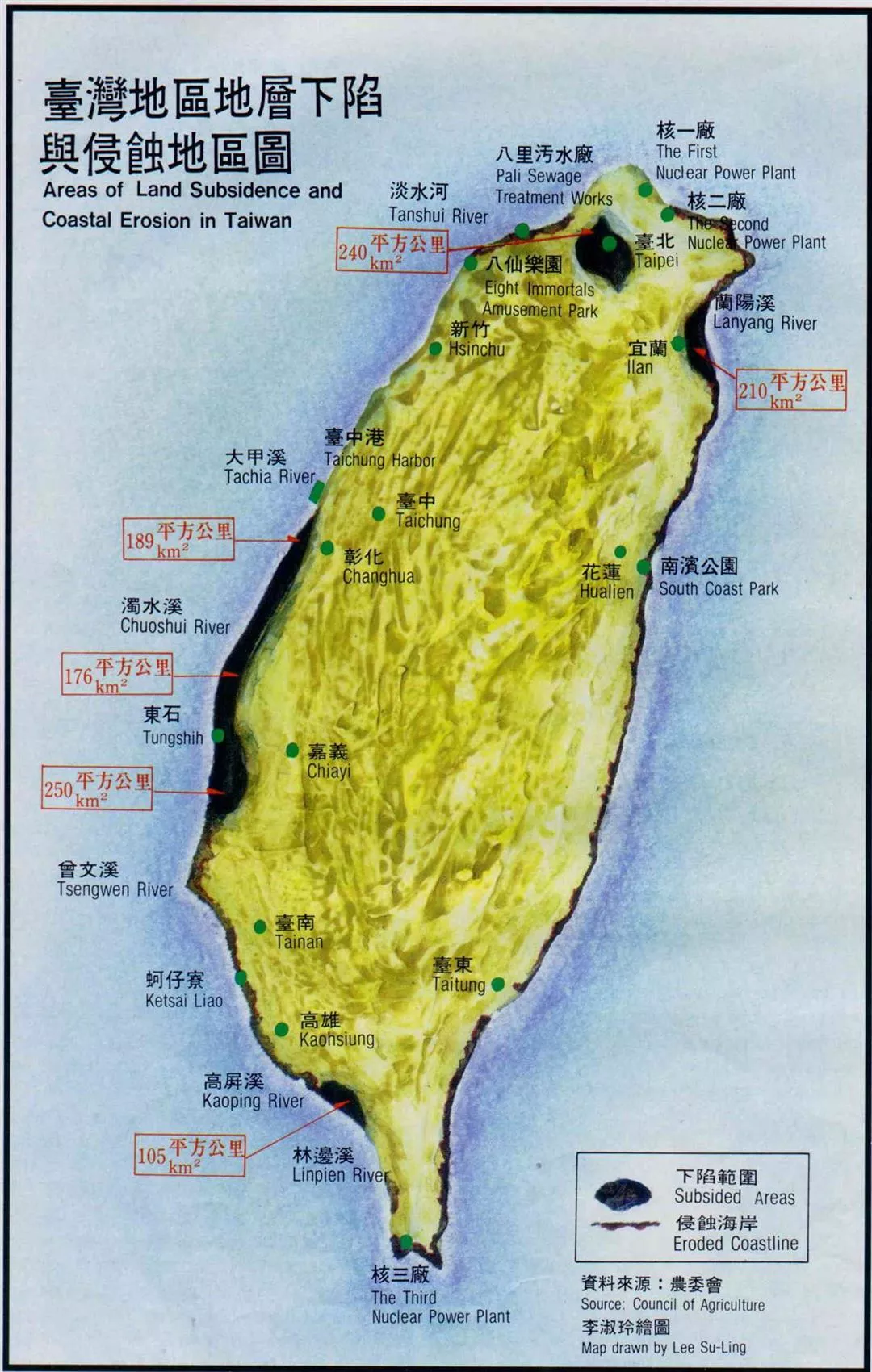
Three years ago, the Taiwan Provincial Government's Department of Agriculture and Forestry made an aerial topographic survey of Pingtung County, an area severely affected by subsidence The survey revealed that since 1976 the coastline has been continuously retreating inland, by up to 200 meters in some places. The coastal plain in Pingtung County is only two kilometers wide at its narrowest point, so at this rate, in 10 times 15 years, the waves will be lapping at the feet of the mountains. Over the last 10 years, Pingtung has given up 38 hectares of land to the sea, a loss equivalent to nearly 50 soccer pitches. In future, people wanting to go to Kenting at the southern tip of the island may be forced to make their way there via Taitung.
"To exaggerate a little, southern Taiwan is close to being swamped," says Professor Kuo Chin-tung of Cheng Kung University, who over recent years has been making a comprehensive survey of land loss from Taiwan. He has found that land is being swept away or sinking into the sea along over 1000 kilometers of the island's coastline.
On the east coast, under the precipitous cliffs which face into the vastness of the Pacific Ocean, it took the Lanyang River a million years to build up the Lanyang Plain, where the people of 12 townships today live and work; but sadly the land along Ilan County's coastline is now gradually being returned to the sea. Over the last five years, the coastline in Toucheng Township in the far north of the county has retreated 200 meters, while the whole county has lost an average of eight meters each year. Was all the river's work for nothing?
The Tanshui River has played a pivotal role in the development of bustling Greater Taipei, which is home to one-third of Taiwan's population. But today the shoreline of Pali on the south side of the river's estuary is continuously receding, the pillboxes of the coastal defenses are sinking down, and even the Pali Sewage Treatment Works, originally 250 meters from the shore, is gradually moving closer and closer to the water's edge. This project, built at a cost of tens of billions of NT dollars and soon to be processing sewage for four million people, has recently been issuing frequent calls for help. On the other hand, the nearby Eight Immortals Amusement Park is trying to save itself by its own efforts. Engaging the sea in a head-on battle, it has dumped earth dug from elsewhere in a bid to replace the land which has been washed away. But as a result, it is being prosecuted for unauthorized coastal dumping. "All I'm trying to do is get my land back!" complains the park's operator Mr. Chen, feeling he is being unjustly treated.

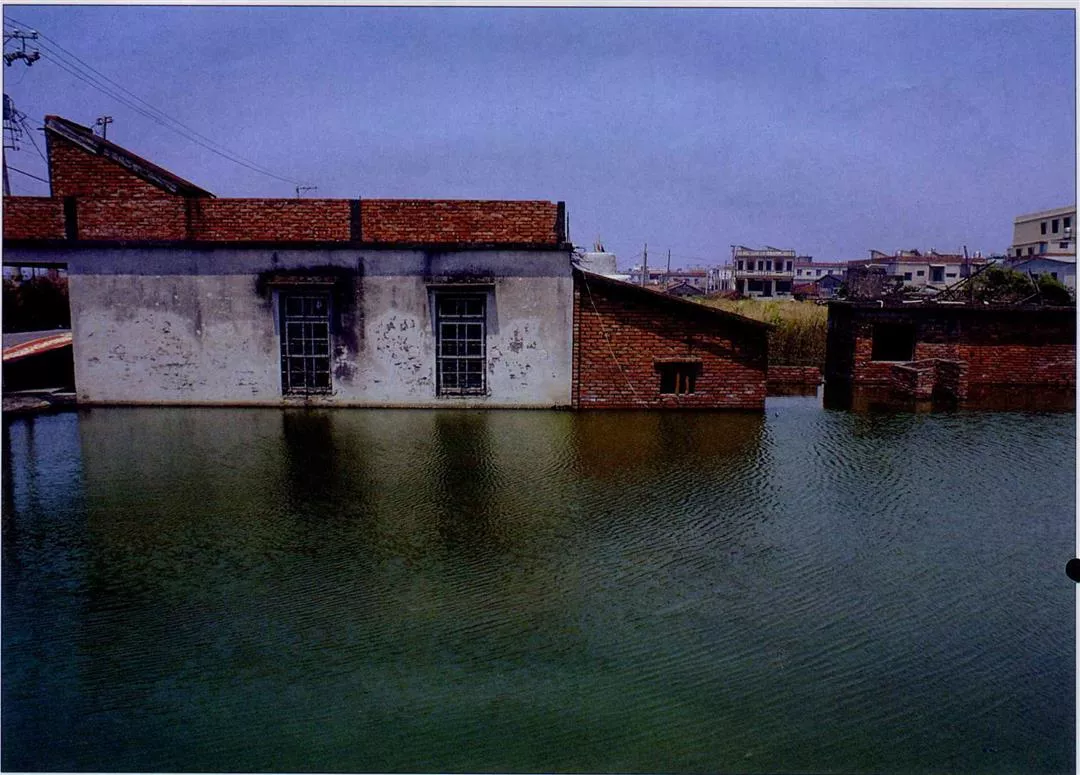
If the land sinks 2 cm, the shoreline may retreat 30 cm. Severe subsidence along Taiwan's coasts puts the land in danger of being engulfed by the sea. (photo by Cheng Yuan-ching)
Is the "fat yam" becoming a "thin yam"?
How can such severe coastal erosion be happening in a place which once had one of the fastest land accretion rates in the world?
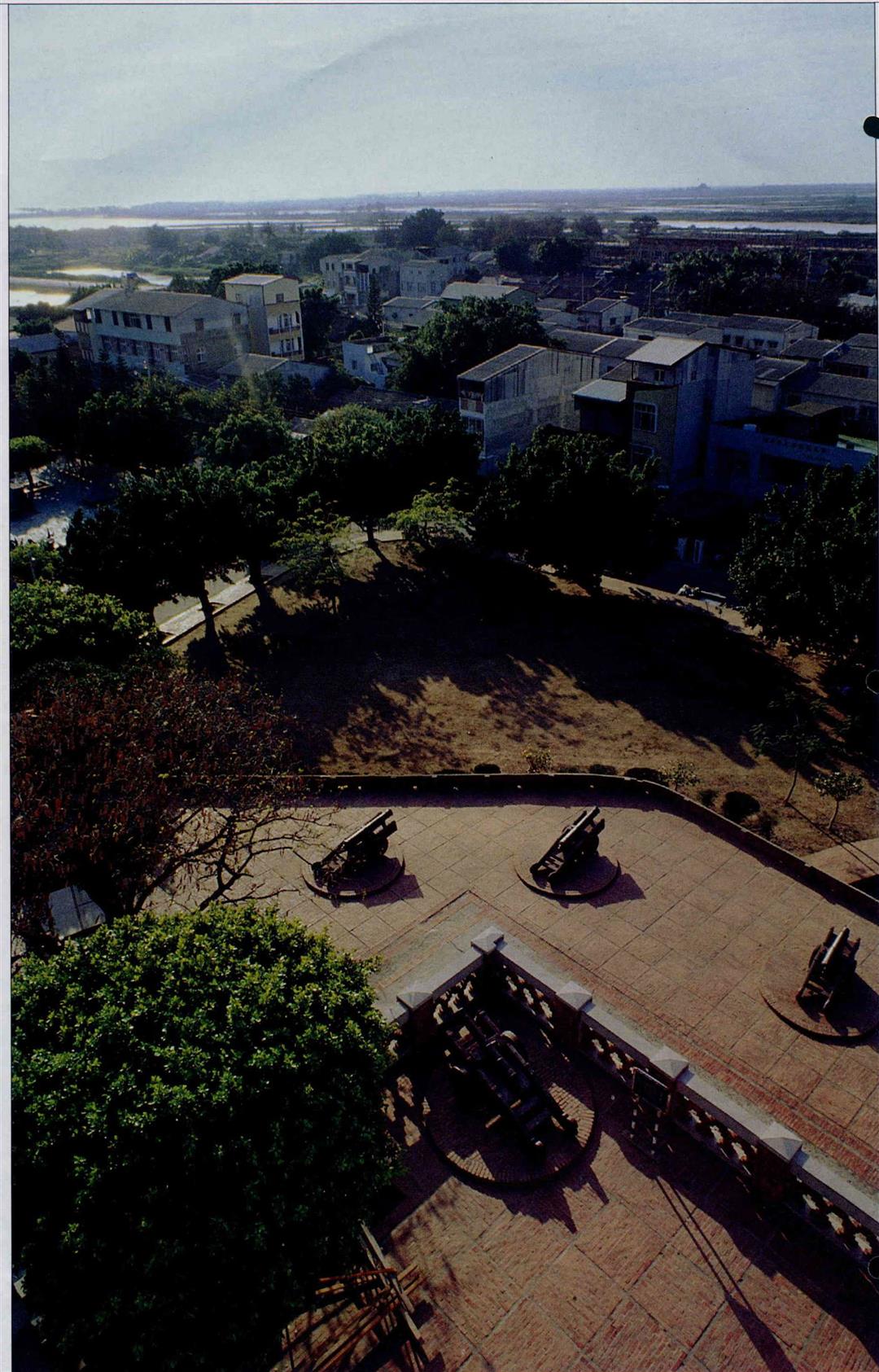
In the 16th century, the Dutch built the fortress of Zeelandia on a sandbank in the sea off Tainan City, but the fortress long ago became landlocked and today stands within the city itself, well away from the shore. In the 300 years since Cheng Cheng-kung recovered Taiwan from Dutch rule, the western plain has been growing like a vigorous youngster, expanding its area by one third.
The land which forms the site of Kaohsiung commercial harbor, Taiwan's busiest port, was not laid down until after the middle of the 18th century. "Our ancestors naturally had their reasons for choosing places like Tainan, Lukang and Ilan as the first areas to develop," says Wu Chuan-an, a senior specialist at the Ministry of the Interior's Construction and Planning Administration. Seventy percent of Taiwan is mountainous, and the hinterland along the eastern coast is very narrow, so it was natural for the broad sedimentary plains to become the focus of early development.
According to statistics published in 1986, the west coast from Nankan in Taoyuan County in the north to the mouth of the Tsengwen River near Tainan in the south still has over 50,000 hectares of tidal land, which is the envy of other nations. Although parts of the east coast have not been able to accumulate new land in the way the west coast has, the east coast loses only limited amounts of land area by natural wave erosion of its cliffs. "Although Taiwan does have some coastal areas with an eroded topography, overall its coastline is typified by accretion, in which land is gained rather than lost," says Kuo Chin-tung. But if that is so, why is land always being swept away from one place or another along the coast?

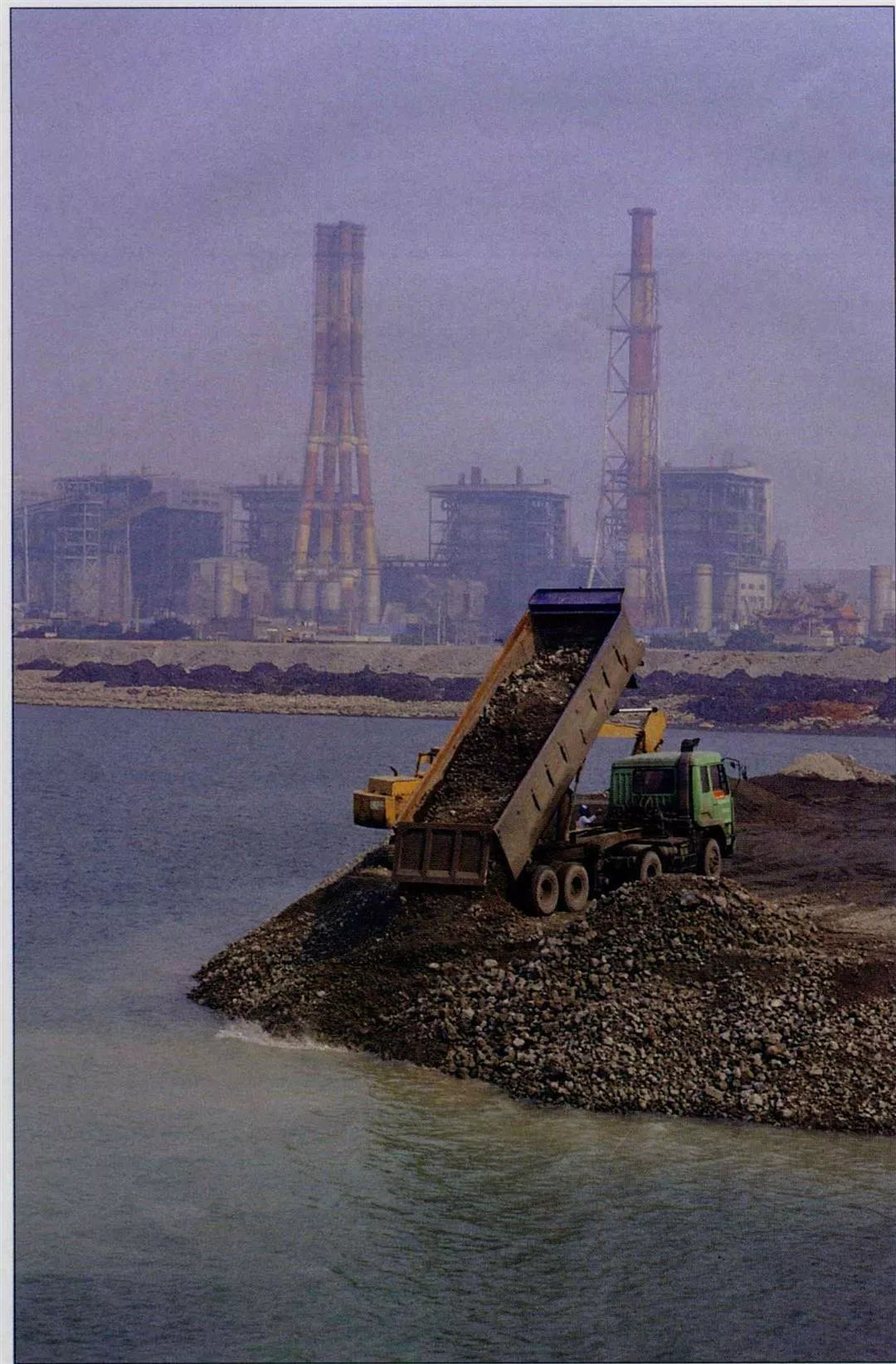
Taiwan is suffering continuous coastal erosion, and some have suggested that spoil from engineering projects can be used to reclaim land from the sea. But is this enough to slow the loss of land, let alone increase its area?
Robbing the gravel bank:
The land and the sea provide homes for all the earth's living creatures. Where the two meet, the land is constantly exposed to the relentless attack of the waves, which are always washing material away. But the land also has the power to heal its own wounds. On the island of Taiwan, 157 rivers work night and day carrying down silt to replace the sand and stones carried off by the waves. Kuo Chin-tung likens Taiwan's west coast to a sediment "bank." The Taiwan Strait is no more than 100 meters deep at its deepest part; if more silt is washed down from the mountains than is carried away by the sea, the surplus is deposited along the two coasts, and more is paid in than withdrawn. Thus the land spreads outwards in the same way that living cells ceaselessly grow and multiply. In this way, with the passing of the seasons, new land appeared from the sea, the western plain was formed, and the Lanyang Plain was born.
Nature has not changed her way of working from that which originally created this land; but now many human hands are interfering in nature's work.
For today, "the deposits are stolen on the way to the bank, before they can ever be paid in," says Kuo Chin-tung. First in line to hold back the material from which nature modelled Taiwan, are the reservoirs.
The youthful and highly unstable geology of Taiwan, with its steep, loose terrain, sudden downpours and high temperatures, means that dams can not hold back much water, but have a great propensity to retain silt, so that before the silt can be carried downstream to the sea, it is all filtered out by the reservoirs. If the waves that rise and fall along the coast have no river silt to feed on, then they can only eat at the shoreline, gnawing into the land itself.

The shoreline at Pali on the south bank of the Tamshui River is receding too. In future when people from Taipei go to see the sunset at Tamshui, perhaps they won't have so far to go.
New land in the reservoirs:
After Taiwan reverted to Chinese rule following the Japanese occupation, the first reservoir was built on the Akungtien River in Kaohsiung County. The five fishing villages of Ketsai Liao bore the full brunt of its impact, becoming the first area in Taiwan to suffer severe land loss due to coastal erosion. "It's the same thing every time. When they built the Shihmen Reservoir on the upper Tanshui River, the coastline downstream at Pali began receding immediately," says Hsu Shih-hsiung, director of the Water Conservancy Bureau department responsible for water conservancy engineering in the Greater Taipei area. Wherever a dam is built upstream, the downstream coast suffers the same fate.
We asked the Tainan Wild Bird Society, whose members have been watching the birds at the mouth of the Tsengwen River for the last ten years, what the greatest change in the local environment has been. "In short, the sandbanks have grown smaller and smaller," replied veteran birdwatcher Kuo Chung-cheng, who was the first to spot the blackfaced spoonbill, which recently made the news for a while, at that location. Only 200 of the birds are left worldwide, and when their overwintering place at the mouth of the Tsengwen River was designated by the Tainan County government as the proposed site for developing the Chiku Industrial Zone, people discovered that they could not find another natural area of tidal land on which the birds might settle. Why is there less and less tidal land? Weng Yi-tsung, a teacher at Tainan's Kunshan Institute of Technology and Commerce and another amateur ornithologist, says that there is a dam on each of the two main tributaries of the Tsengwen River, so that all the silt is held back. In fact the area designated for the Chiku Industrial Zone is now also receding, and is under water for more time each day than it is exposed; someone has even "suggested" that it might be more practical simply to relocate the proposed site upriver to one of the reservoirs.
Taiwan has more than 50 existing or planned major dams, and countless smaller dams and weirs. And with water shortages occurring frequently, building reservoirs is seen as the main solution. President Li Teng-hui recently stated that in the future a reservoir will be built every year. Someone has commented that "in the future people wanting to find new tidal land will just have to look for it in the reservoirs."

The Chuoshui River's "Double Six:"
In fact, Taiwan has many rivers which, because of their loose geology and the volume of silt they bear, are not suitable for constructing reservoirs. Neither the Lanyang River nor the Chuoshui River, which have made the greatest contributions towards building Taiwan's plains, have reservoirs on their upper reaches. But instead people extract gravel from these rivers without restraint. It is said that the quality of the gravel from the Lanyang River is such that structures built with it are especially robust, and so although the river washes down five million cubic meters of silt each year, six million cubic meters of gravel are extracted annually. With more being taken out than is going in, the "account" is constantly being overdrawn.
The silt which originally created the land we live on is now being turned into public works projects. As we rob Peter to pay Paul, the bigger our construction projects become, then the more our land shrinks. Some large rivers are entirely "spoken for." The gravel from Tachia River is completely monopolized by the Taichung Harbor project, being used for its breakwaters and other civil engineering works; rights to the Chuoshui River, which carries the largest volume of silt of all, are given up to the various projects in the Six-Year National Development Plan and to the land reclamation project for the 6th Naphtha Cracker in Yunlin County.
"That's two sixes, but I don't see anything lucky in it," comments one local resident. The town of Hsiluo on the river's bank has been plagued by gravel truck traffic, and the removal of gravel from under the bridges near Hsiluo has already undermined the piers of the Sun Yat-sen Highway's Chungsha bridge and caused the exposure of an oil pipeline, with a recent leak resulting in a fire and pollution of the river.

With coastal erosion changing the island's outline, will the next generation living on Taiwan still be called "yams"?
Reservoirs and gravel extraction--a double whammy:
With large-scale building and civil engineering projects simultaneously pressing ahead night and day, over recent years sourcing gravel has become one of the construction industry's biggest headaches. The only way to get gravel is to queue up with cash, and this has fostered the unauthorized mining of gravel from rivers and coastal areas, which has followed illegal pumping of underground water by the aquaculture industry as the activity causing the most serious damage to publicly-owned resources.
Receding of the coastline as a result of gravel extraction upstream is most obvious at Taipei. Gravel extraction from the Tanshui River reached its peak in 1977, and the period from 1978 onward has seen the greatest loss of land to the sea. "The first step towards preventing coastal erosion in this area should be to control the extraction of gravel from the Tanshui River," is the urgent warning made by Hsu Shih-hsiung in his report. In the interests of protecting the lives and homes of its six million inhabitants, the year before last the Taipei City government ordered a complete ban on taking gravel from the river. "The gravel trucks had no choice but to come here instead," comments a Water Conservancy Bureau associate engineer, standing by the mouth of the Chuoshui River, adding: "Taipei people's lives are worth more than other people's."
Damming large numbers of rivers and unrestrainedly taking gravel from the river beds combine to strike a double blow at the coastline's ability to resist erosion; and subsidence of the land itself further compounds the problem.

Seeing our country in all its beauty, can we help but wonder who makes the crashing tides flow and holds the land above the water?

What if there were no sea walls?
Surface subsidence has been caused by the aquaculture industry pumping out too much underground water. Taiwan's underground water resources are replenished at a rate of 4 billion cubic meters per year, but last year as much as 7 billion cubic meters was actually extracted, more than half of it pumped by illegal fish farms which pay neither water charges nor taxes.
"Furthermore, one third of all water extraction on the island is concentrated in strips of land within two kilometers of the coastline," Associate Professor Chou Nai-fang of Cheng Kung University points out in his report "Water Resource Development Prospects." Of these areas, those where the overextraction of underground water is most extreme are along the west coast from Changhua County to Chiayi County and in the south around Linpien in Pingtung County.
Surface subsidence is a major cause of coastal retreat. Kuo Chin-tung says that for every two centimeters by which the land subsides, the sea advances inland 30 centimeters. Since 1976, Pingtung has sunk by 2.54 meters, while Yunlin has sunk by 1.5 meters. Flat, low-lying Yunlin and Chiayi Counties are still subsiding by 20 centimeters every year. Their coastal areas have all sunk below sea level, creating "unlimited potential" for further land loss.
With the coast being eroded and land sinking, without the sea walls such areas would long ago have returned to the sea. According to Professor Hu Nien-tsu of Sun Yat-sen University, if the sea walls were removed, 1170 square kilometers of land in areas of excessive ground water extraction, equivalent to one tenth of Taiwan's flatlands, would go the way of Atlantis.
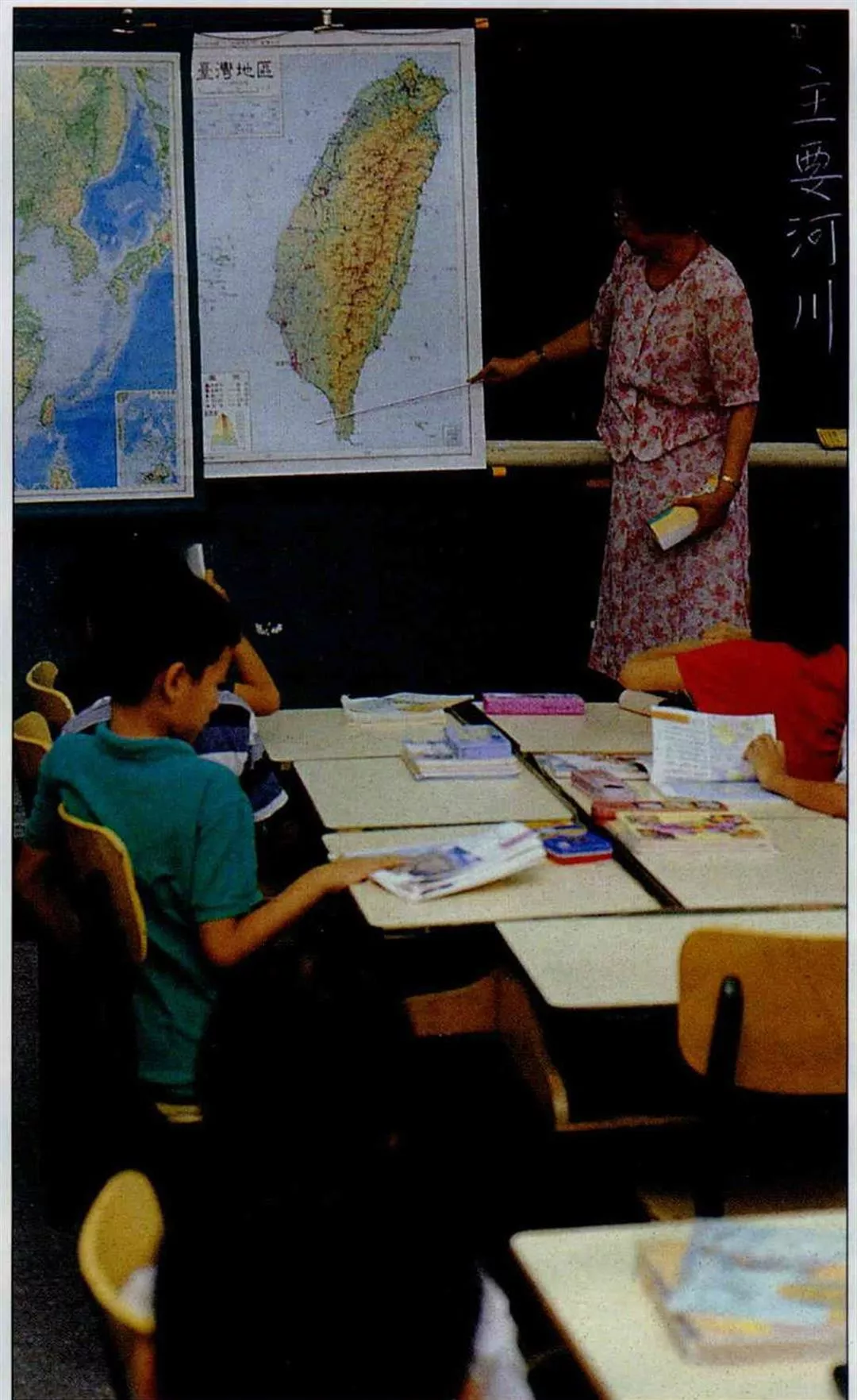
"But if you raise the sea walls by one meter, in five years they are under water again," says Lin Yung-teh of the Executive Yuan's Council of Agriculture. If it were only a matter of coastal erosion, then building sea walls could still slow the loss of land to the sea. But if the land subsides below sea level, then where tide levels are high, even if the land is surrounded by sea walls on three sides, water will still slowly seep through, and it is impossible to guarantee that the sea will not overtop the walls and flood in. Dealing with this kind of land loss is like a desperate fight with one's back to the wall, and not at all like the story in primary school textbooks where the little Dutch boy stops a hole in the dike with his finger, waits for a passerby to call help to mend it, and the whole village is saved.
My home has water all around:
Nowadays people building houses along the coast of Yunlin, Chiayi or Pingtung have to build in an allowance for future subsidence. One farmer who was once chosen as one of the country's "Ten Finest Young Farmers" likes to take people to his house to see the "marvelous undersea world." Going down into his cellar with a diving mask on, one can watch the fish swimming about between the wine cabinets.
By the time the symptoms of land subsidence appear, the disease is already beyond treatment. In the Kouhu and Ssuhu areas of Yunlin County, over 2000 hectares of land are submerged under the sea at high water, and only exposed at low tide: an area of land 3000 times the size of the Tokyo Dome "Big Egg" baseball stadium has become part of the intertidal zone, washed by the rising and falling tides; and there are 200 hectares in Hukou which are completely under water, not having broken the surface in the last five years. Although the submerged land is still surrounded by a useless sea wall, one can basically say that it has disappeared from the map.
Subsidence once provided a use for the China Steel Corporation's blast furnace slag, which was used as landfill in sunken areas, but the cost was horrendous, and it tied up large numbers of men and vehicles. Recently it has been suggested that if the Yunlin Litao Industrial Zone development really goes ahead, as the area lacks water, one need look no further than the region's own areas of subsidence, which could be dug out and used as artificial lakes to store water. This proposal has not so far been acted upon, but it would seem to make little difference whether one digs them out or not: haven't the subsided areas become "artificial lakes" already? It's just that like Lake Qinghai in mainland China, they are salt lakes!
Where land has subsided one can recognize past mistakes and try to make the best of the situation, but how can lost land be recovered?
The great period of land growth is over:
The book "The Authentic Story of Taiwan," published by scholars of Taiwanese history at the Academia Sinica, when describing the development of the island by the early immigrants, does not forget to mention that Taiwan's western coast is a plain formed by the accumulation of waterborne sand, mud and gravel, and that the coastal plain is still rising upwards.
But although this is true, measured against the fleeting timescale of a human lifetime, the rate is extremely slow. Kenting is rising by no more than 1 millimeter per year, so there is no way that the increase in area generated by this mountain-building process can keep pace with the loss of land caused by human activity. Land is hardly likely to suddenly burst from the ocean, and if it did the shock of such a sudden rise would be too much for its flora and fauna. Today geologists are also worried that additional extraneous factors of environmental change, such as the possible melting of glacial ice due to the greenhouse effect, leading to a worldwide rise in sea levels, may further exacerbate the problem, causing land to sink into the sea even faster.
The great period of "growth" for Taiwan's land area is over. "It has passed from the youthful stage of development into the mature period, and now artificial factors are pushing it towards premature old age," says Lin Yung-teh, explaining that even in the early period after Cheng Cheng-kung arrived in Taiwan, the clearing of land for farming, the quarrying and mining and the steps taken to control the wild rivers quickly began to affect the supply of silt downstream; however, the potential for creating environmental disasters was very limited compared with today's development.
Our land, surrounded as it is by the sea, depends for its existence on maintaining a dynamic equilibrium between the forces of the sea and the land. If today we make abrupt changes by such actions as building dams and extracting gravel, and thereby weaken be forces of the land, then the sea will gain the upper hand, and the land will be forced to beat a retreat. The vitality of the accretive coast, with new land constantly appearing, was an asset which other nations can only dream of, yet we are destroying it without a thought.
A new dam every year--a worrying prospect:
We seem to be caught between the devil and the deep blue sea. If we don't build reservoirs, with our unevenly distributed water resources and our dry autumns and winters, where is our drinking water to come from? If we don't mine gravel, how can our public works projects be completed? If we don't pump water from the ground, how will our people, who love seafood and need fish protein in their diet, be able to live happily? To live our modern lives, mustn't we make some unpleasant sacrifices?
Geologist Chang Shih-chiao, who twenty years ago questioned the wisdom of building the Tseng-wen Reservoir on the grounds that it would lead to coastal erosion downstream, says that we have been pushed onto the horns of this dilemma entirely by our own actions. In view of the difficulty of securing water resources, which gives us no choice but to build some reservoirs, one would think that we would be especially careful of those resources. But we all recklessly pollute the abundant water resources of the middle and lower reaches of our rivers, and wilfully build roads, sports grounds and so on in the water catchment areas of our reservoirs, thus shortening their lives so that we have to keep on building new ones. A reservoir only has a life of 40 to 50 years, and Taiwan only has some 40 remaining sites suitable for building new reservoirs. If we are to build a new one every year from now on, then 90 years from now all Taiwan's reservoirs will be silted up, and there will be nowhere left to build more.
Many countries today have recognized that reservoirs can be used sustainably, allowing dambuilding programs to be cut back. They also make long-term studies and measurements of how much silt a dam will hold back and what the results will be in terms of coastal erosion, in order to take preventive action such as adding supplementary silt downstream. Only in this way can one avoid the double loss caused by reservoirs becoming choked with silt and land being swept away.
Hsu Shih-hsiung cites Japan as an example: the Japanese long ago recognized the dangers of excessive gravel extraction; there was a period when they did not use their own gravel, but sent ships to carry from Hualien. Hsu says: "Its not that one can't extract gravel, build reservoirs or use ground water at all; its just that we have shown no restraint in the way we have taken gravel from the river and water from the ground, believing it is there for mankind to take willy-nilly."
The gifts of nature are not inexhaustible. The changing shape of Taiwan is demonstrating this only too eloquently.
A complete lack of coordination:
"Does it really take that much specialist knowledge to understand that taking gravel will affect the coast downriver?" asks Chang Shih-chiao. Because everyone assumes that some other agency downstream will sort things out, the agencies charged with managing water resources and building reservoirs do not worry about the coastline, while the Water Conservancy Bureau, which is responsible for the coast, simply spends money building sea walls. Because of the lack of tidal land on the east coast, the Regional Planning Commission opposes the development of new fish ponds on the Lanyang Plain, yet in recent years the number of fish ponds in Ilan County has been growing at the highest rate anywhere on the island. Everyone is working busily, but the left hand doesn't know what the right is doing, so in the end all their efforts come to nought, and the resources are just wasted.
For this reason no one is keeping count of just how much land has really been lost to the sea. Faced with such loss, we can only rely on the Water Conservancy Bureau spending hundreds of millions of NT dollars on repairing and strengthening the sea walls. Chang Shih-chiao worries that with so much money being spent on the breakwaters, if adequate funds are not available for just a few years, then we will be in big trouble.
The retreating coastline affects us all, whether in cities or hamlets, in agriculture or industry. But those who suffer first are the disadvantaged areas nearest the water's edge, such as the poor fishing villages of Tungshih, Putai or Chinhu. :”Unless land prices rocket and the speculators buy their way right to the edges of the island, no one's going to worry about the problem of coastal erosion," comments Wu Chuan-an bluntly.
Large-scale loss of land to the sea is something we may not see in our own lifetimes, and anyway we still have the chance to move inland. "Those who will suffer will be the later generations," says Chang Shih-chiao, adding thoughtfully: "Actually I think it may not take that long. It may not be more than a few years before we see all kinds of ill effects in places like Kaohsiung, Taichung Harbor and Hualien Harbor, or Ilan and Taipei."
What's a country without its land?
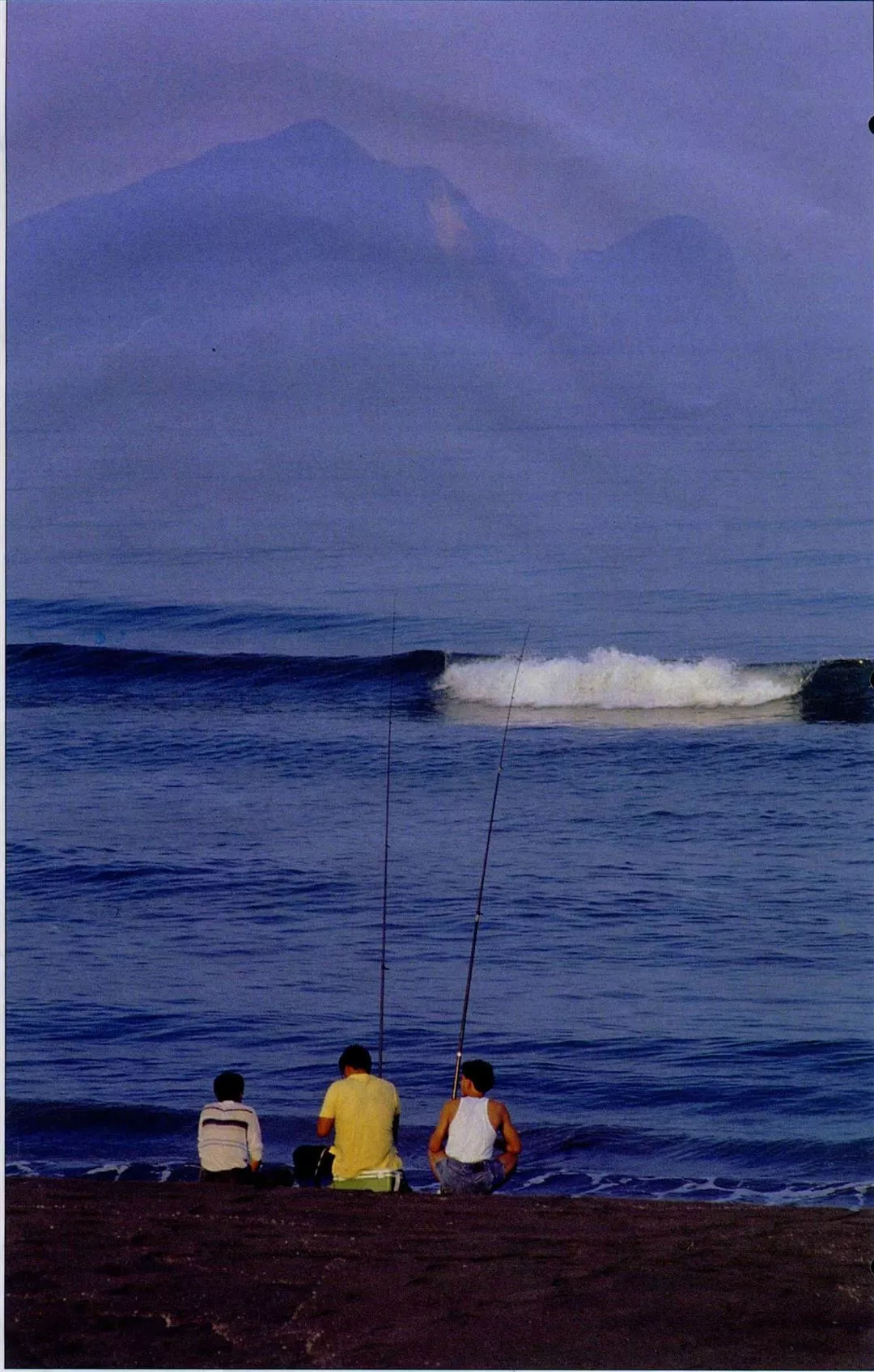
Listen to the tide ebb and flow, watch it rise and fall... At low tide along the coast of central Taiwan, the level mudflats stretch as far as the eye can see, and the visiting anglers walk far out to the water's edge to squat down and cast their lines. When they look behind them, the land is on the distant horizon. Formerly, the difference between high and low tide off Taichung Harbor was 4.6 meters, making it one of the best potential sites for tidal power generation in Taiwan, which has few natural resources. But now the coast of Taichung County has been washed away to form cliffs, and the gently-sloping beaches, the sandbanks, the dunes and the intertidal zone are all gone. At Taichung Harbor, only recently opened to visitors, "future children will be able to look at the port, but there will be no beach for them to play the sand," says Hwang Ching-her, chief of the Coastal Engineering Division at the Institute of Harbor and Marine Technology.
Today geologists no longer tell their joke about "national reunification." In their new joke, looking at the way the Industrial Development Bureau is rushing to invade the tidal lands and busily planning coastal industrial zones on paper, scholars wonder: "Do they really think Taiwan's tidal lands can be extended all the way to the mainland just at the stroke of a pen?"
[Picture Caption]
p.8
Western Taiwan used have one of the fastest rates of new land accretion anywhere. Fort Zeelandia, built on the coast in the days of the Ming Dynasty general Cheng Cheng-Kung, is now landlocked and stands within Tainan City itself. (photo by Cheng Yuan-ching)
p.9
"My old house is under the sea," says the mayor of Chih-hsi village in Kaohsiung County, pointing out over the ocean. Because the land is being washed away, most of the villagers have moved out. (photo by Cheng Yuan-ching)
p.10
If the land sinks 2 cm, the shoreline may retreat 30 cm. Severe subsidence along Taiwan's coasts puts the land in danger of being engulfed by the sea. (photo by Cheng Yuan-ching)
p.12
Taiwan is suffering continuous coastal erosion, and some have suggested that spoil from engineering projects can be used to reclaim land from the sea. But is this enough to slow the loss of land, let alone increase its area?
p.13
The shoreline at Pali on the south bank of the Tamshui River is receding too. In future when people from Taipei go to see the sunset at Tamshui, perhaps they won't have so far to go.
p.15
With coastal erosion changing the island's outline, will the next generation living on Taiwan still be called "yams"?
p.16
Seeing our country in all its beauty, can we help but wonder who makes the crashing tides flow and holds the land above the water?