Peking Opera—Seeking New Stages for New Times
Jackie Chen / photos Chin Hung-hao / tr. by David Smith
December 2012
A young female performer moves slowly toward center stage on tall, spiked wooden clogs. The combination of clogs and costume is hardly ergonomic, yet the actress moves with grace as she hops up onto a long row of narrow benches and makes her way along. All the people in the audience hold their breath in rapt attention as she nimbly alights from the end of the last bench.
She is performing the GuoGuang Opera Company’s famed One Hundred Years on Stage, and this particular part demands especially good acrobatic skill. No one would guess that the woman tottering along on the clogs is actually afraid of heights, or that in training to perform this particular feat, her legs often tremble from exhaustion.
For each new generation of Peking Opera performers, overcoming psychological and physical barriers to put on a beautiful show is but one of many challenges that must be faced.
Peking Opera fans excitedly spread a piece of news on Facebook: “Huang Yu-lin is going to appear in Princess Flowers in late October!”
Huang had originally been scheduled to appear in Princess Flowers with the GuoGuang Opera Company in July, but the show was postponed after Huang developed facial paralysis. But after a period of convalescence, “the princess” was ready to give it a go.
People were looking forward for very good reason to seeing Huang in Princess Flowers. For one thing, Huang is a formidable singer and acrobat, and very pretty, to boot. Among the younger generation of Peking Opera performers, she is considered one of the biggest up-and-coming stars. It was thus unfortunate that she fell sick just as GuoGuang was getting ready to put on her opera. It was the first time in 17 years that the troupe had had to switch operas at the last minute. Small wonder, then, that disappointed fans were so excited when the postponed performance was worked back into the schedule.

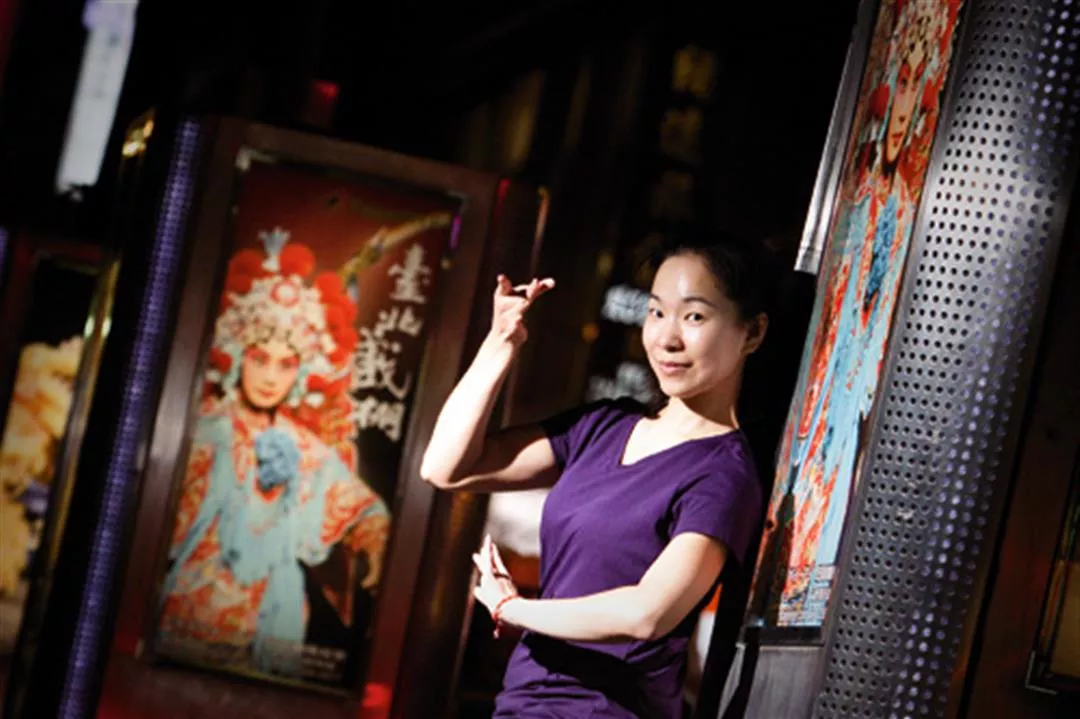
The first person from Taiwan ever to perform with the Cirque du Soleil, Yang Shu-chin often performs with TaipeiEYE, for which foreigners are the main audience. She practices her skills every single day.
The career of a performing artist is fraught with peril. The loss of physical vigor as one ages is always troublesome, especially in Peking Opera, which places a premium on feats of athletic derring-do.
In One Hundred Years on Stage, a new work created by GuoGuang, there is one place where the actors discuss a particularly challenging part in The Tale of the White Serpent where the actress, wearing clogs, does a one-handed handstand atop a tall bench, maintaining her body in a horizontal position for a spell before vaulting back down to the stage. Acrobatics like this are common in Peking Opera, which is why, in One Hundred Years on Stage, an actor says: “We opera performers put it all on the line. We feel that to die on stage would be an honorable way to go.”
Says Huang: “I often feel that a Peking Opera performer is tougher to kill than a cockroach. Perhaps because I went through rigorous training from a young age, when I run into difficulty, I don’t give up. I just tell myself I’ve got to give it a try.” Having just finished a tough rehearsal, her cheeks stained with sweat, Huang relates that Peking Opera has given her a positive outlook on life: “For me, there’s nothing in life that you can’t deal with.”
Compared with other performers now in their 30s, Huang has had lots of opportunities to display her skills on stage, but the fact remains that her chosen career path has been anything but easy.
In 2009, GuoGuang invited Huang to play the part of Yan Xijiao in Capturing Zhang Sanlang Alive. Before the opera opened, Huang broke a pinky finger in a traffic accident, but she still went on with the show before her finger had completely healed. Playing the part of a ghost required a lot of demanding clog walking and flicking of long silk sleeves. Due to her injury, she was limited to flicking just one of the sleeves.
Huang feels that all these problems were just challenges that she was meant to endure. After she developed a problem with her vocal chords, for example, she learned how to use her diaphragm to achieve resonance. And it wasn’t until after her traffic accident that she came to better understand how to protect her body.

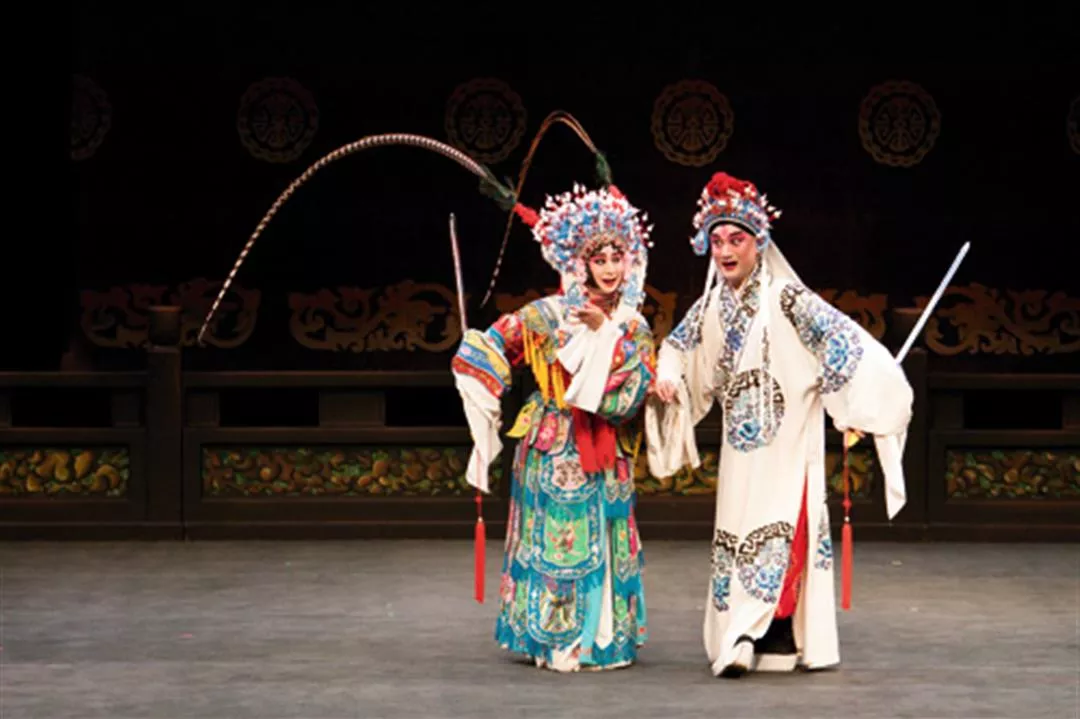
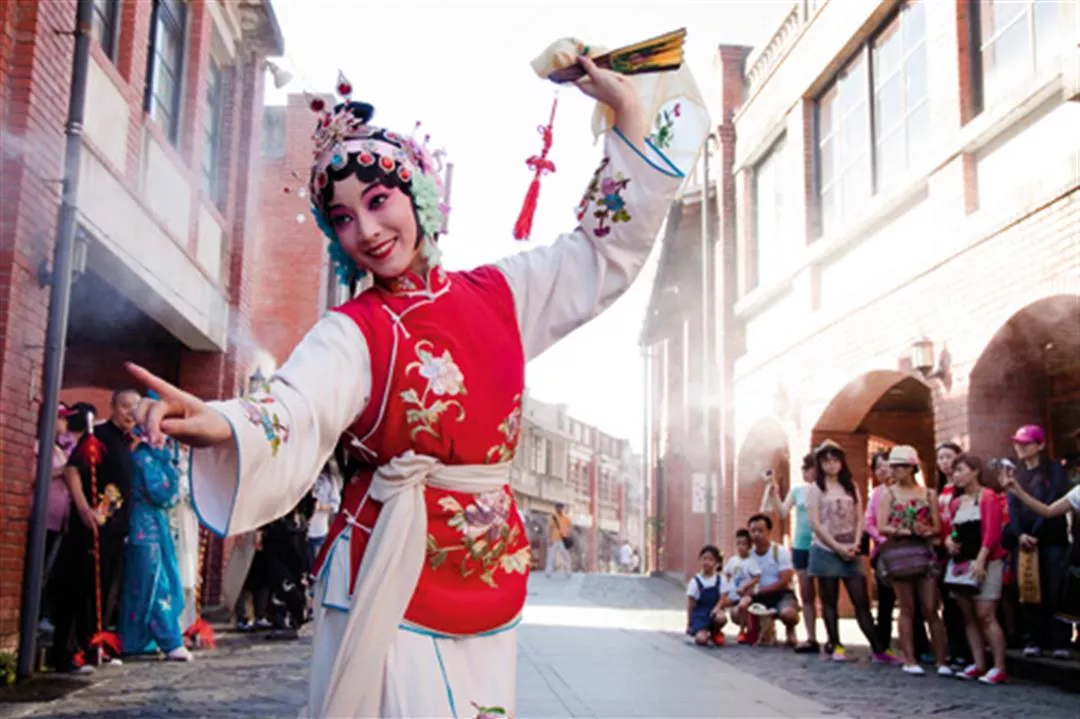
Huang Yu-lin, one of the younger generation of Peking Opera performers, is shown here in Princess Flowers playing the part of a formidably talented woman with fiery passions and a strong sense of justice.
The difficulties faced by today’s new generation are not limited to the ups and downs that an individual experiences. Conditions in society at large pose more serious problems. There are few chances to perform, for example, and troupes have got to find a way to appeal to young audiences.
Says Huang: “People in my generation have gone through years of training and are ready to take over from the previous generation, but Peking Opera has already gone into decline. We’re not sure whether to question ourselves, or to question the larger environment. Is Peking Opera declining because we just aren’t good enough? Or is the larger environment the culprit?”
Immediately upon graduating from the Fu-Hsing Chinese Opera School in 1997, Huang had opportunities to appear on stage alongside famous Peking Opera actors Chu Lu-hao and Wu Hsing-kuo. Within a short time she was recruited by Li Pao-chun, another famed Peking Opera actor, into Taipei Li-yuan Chinese Opera Theatre. From the start, she was tapped for leading roles.
Even to this day, Huang’s scintillating performances with Taipei Li-yuan as Jinzi in The Wilderness, and as Qiao Ruofan in The Jester, are still discussed with relish by those who saw her in those roles. Particularly impressive was her mastery of “hard clogs,” which at one time had almost passed into oblivion in mainland China. It is an extremely difficult technique used to mimic the gait of women with bound feet, with the performer tiptoeing along in a pair of tiny wooden clogs. For difficulty, it goes even beyond ballet, and requires tremendous dedication from the actress.
Even so, Huang was reduced to working as a store clerk for a time after graduation for lack of performing opportunities. She didn’t pick back up with her stage career until Li Pao-chun invited her to join Taipei Li-yuan.

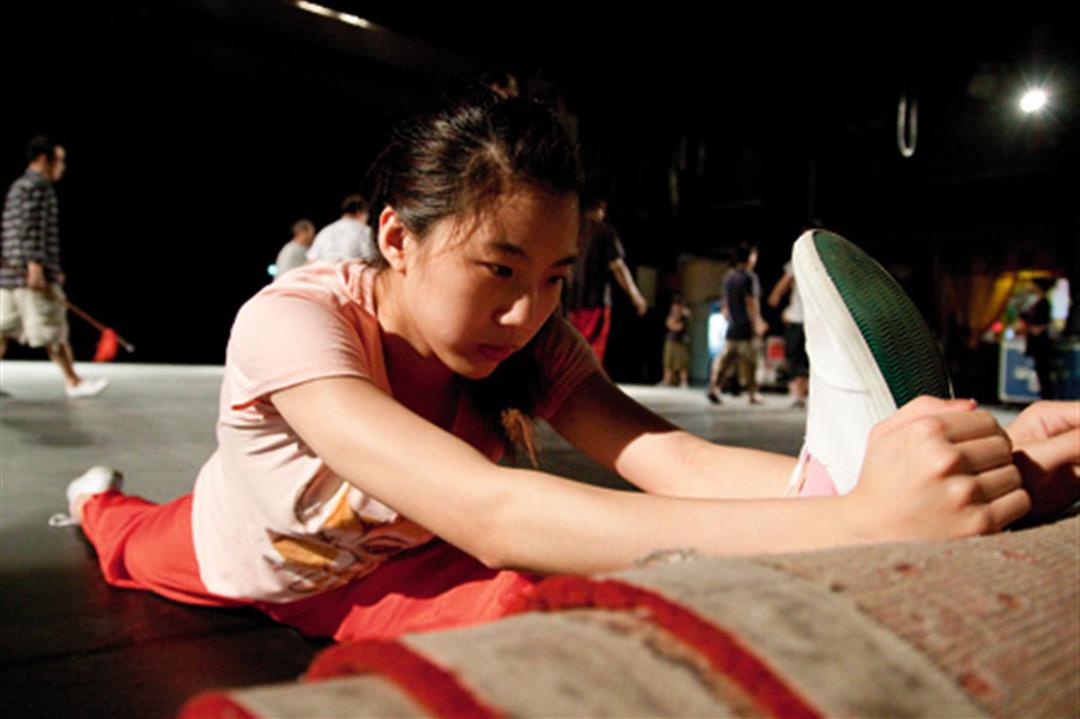
A Peking Opera performer must work hard to develop a strong and limber lower body. It takes years to achieve.
Another big star from Huang’s generation is Yang Shu-chin, who did a stint with the Cirque du Soleil in Las Vegas in 2009 before returning to Taiwan. Now she is with Taipei Li-yuan playing wudan (“martial female”) roles.
Born in 1976, Yang was often praised by instructors at school as someone with a great work ethic who had trained her mid and lower body into very good condition. Yet after graduating from Chinese Culture University, she failed to gain admittance to either the National Fu-Hsing Chinese Opera Theater or the GuoGuang Opera Company. She ended up working stints as a university teaching assistant, and as a part-time performer in a Taiwanese Opera troupe, but it was not stable employment.
Fortunately, however, Li Pao-chun invited her to tour in Europe, and she later found full-time employment when Li arranged for her to work as a part-time administrator and part-time performer with Taipei Li-yuan. After the Cirque du Soleil decided not renew its contract with her at the end of 2009, Taipei Li-yuan welcomed her back into the fold. Li, as a Peking Opera performer himself, has a special soft spot in his heart for people of talent.
Says Yang: “Peking Opera performers are very tough and adaptable, but we need more stages where we can ply our craft.” When the Cirque du Soleil came to Taiwan to recruit talent in 2006, she adds, out of hundreds of applicants they chose just seven, of whom six were graduates of traditional opera schools, an indication of just how good the training is.
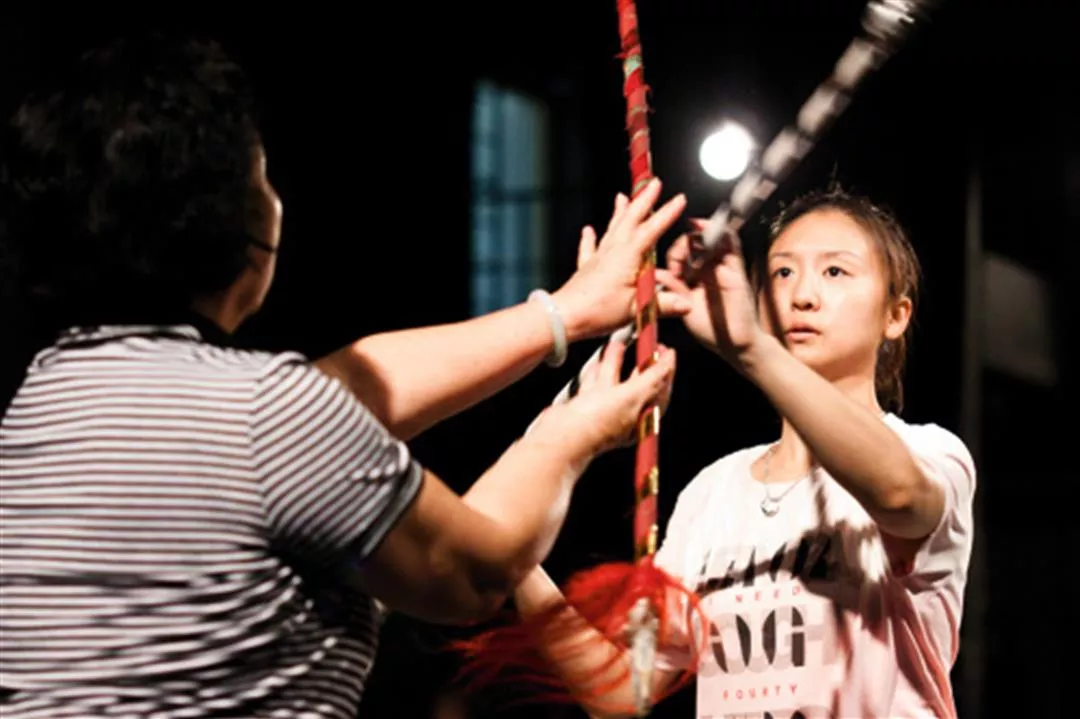
After joining the Cirque du Soleil in late 2008, she had no major problems with the trampoline, stage flying, or pendulum training. And together with fellow troupe members she performed a Peking Opera ti chu shou routine (in which performers throw and kick javelins back and forth). Taking part in this sort of fusion between different performing arts traditions was thoroughly exhilarating.
At the Cirque du Soleil, the atmosphere was very collegial. Technicians and performers all enjoyed equal respect. Everyone helped each other out, and concentrated on doing their jobs to the best of their abilities. This aspect was especially moving for Yang. “We’d all give each other encouragement before each performance by saying ‘good show’ to one another, and it was sincere.” Before she took to the stage, other performers would always say, “Have fun, Shu-chin.” “In that global village of ours, everyone went about their tasks with dead seriousness, but the most important thing of all was simply to have fun.” The atmosphere is rather different in Taiwan, where people generally just say “Thanks for your hard work” after a performance. Nowadays Yang reminds herself to “have fun.”
Though it may seem odd, Yang says that when she was selected in 2006 to be a backup performer in the Cirque du Soleil, it was the first time she had ever felt like her theatrical skills were being appreciated in the 20 years since she had first entered the opera school. But when she returned to Taiwan as “the first Taiwanese performer ever to have been admitted as a regular member of the Cirque du Soleil troupe,” it still didn’t open many new doors for her career-wise. Now 36 years of age, she must deal with the many physical injuries she has suffered on the stage.
Describing the “Catch-22” of playing martial female roles, someone once said, “When you’re young you’ve got the physical prowess but don’t understand the role, then when you’re older you’ve got the understanding but lack the physical prowess.”
No different than during her days as a student, Yang still finds time every day to practice her vocals and stage techniques. The routine has now gone on for decades. “As a Peking Opera performer, if you don’t practice, you’ve got no business on stage. The trick, however, is how to keep at it day after day, to maintain your enthusiasm, and to learn something new each day.”
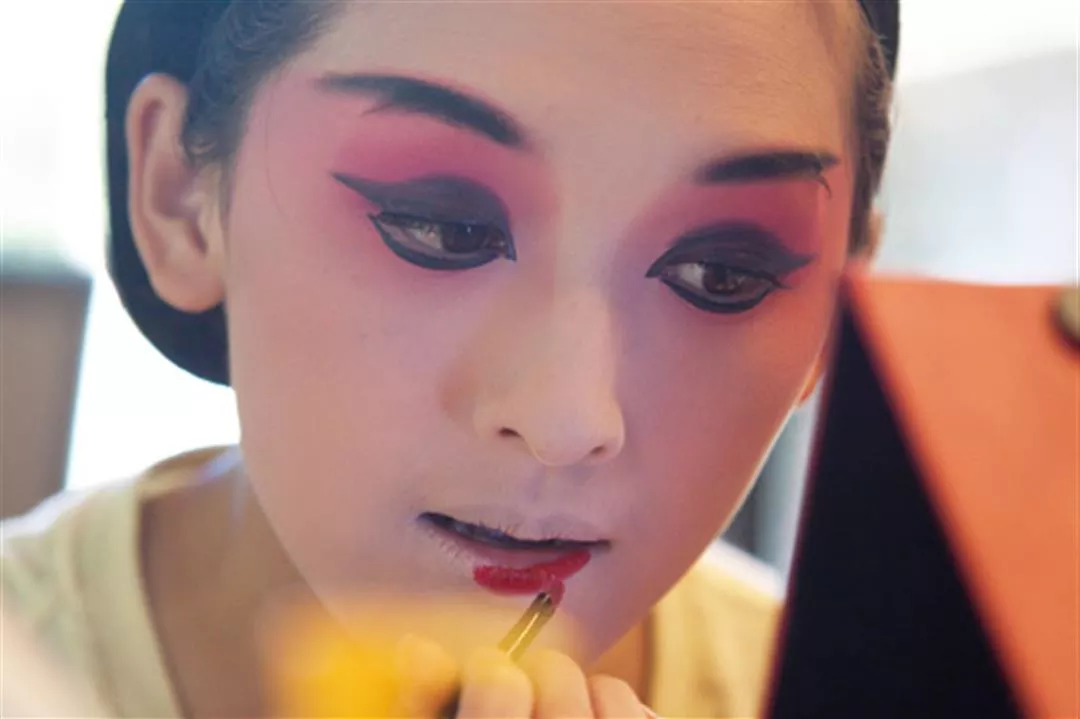
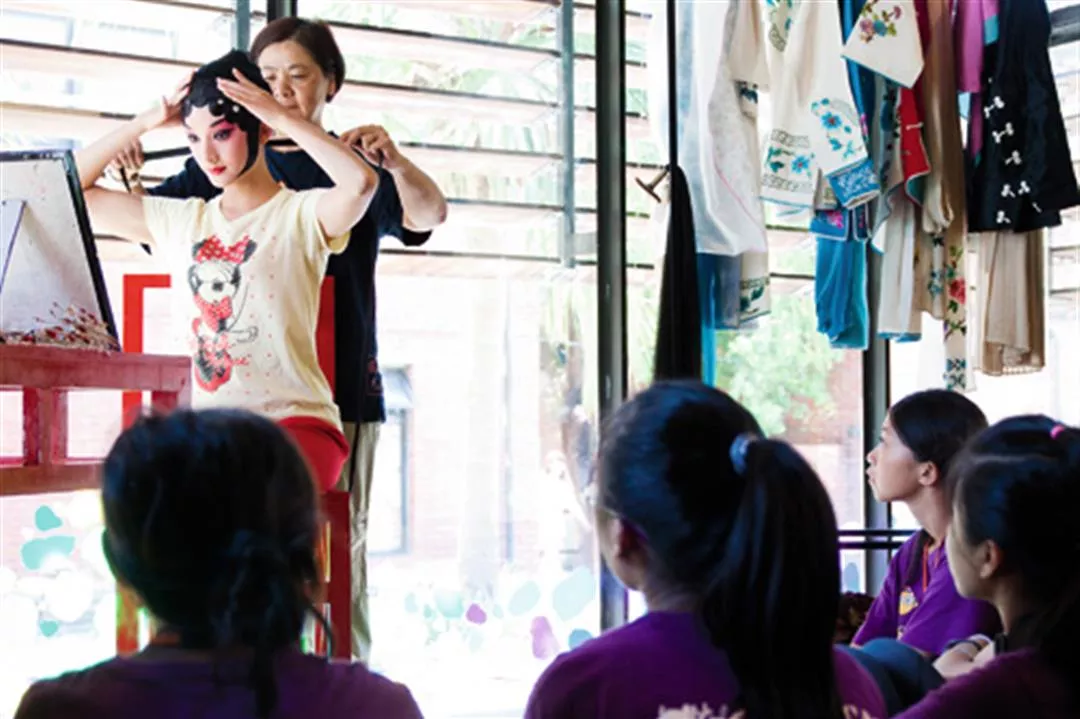
Painted up with long, slender eyebrows and big, round eyes, this young Peking Opera performer looks for all the world like a beauty from centuries past.

“Peking Opera is no longer the mainstay in the entertainment world,” says GuoGuang rehearsal director Wang Kuan-chiang. “In the past, veterans would tell students that if they would just do a good job learning their craft, they would make their way, and even make big names for themselves. But those days are gone.”
“There was a time when the more techniques you mastered, the more money there was to be made. That’s no longer the case,” reports Wang. Now, he says, the market has shrunk, and opportunities to perform are few. After many long years of training, the return no longer matches the investment.
Unlike modern theater, performances of traditional opera require singing, recitation, acting, and martial routines. Such a wide-ranging skill set requires training from an early age. Peking Opera performers have to do back arches, leg stretches, splits, and other demanding tasks. Once you go into a split, the teacher will step on your thighs and keep on them for an hour. Once you’ve been through that, your two legs are no longer your own.
A Peking Opera performer usually starts regular training in the fifth year of elementary school, which means that one goes through at least eight years of training, and if you go on after high school to major in traditional opera at university, your professional training in Peking Opera ends up lasting 12 years. At the publicly supported GuoGuang Opera Company, which has more resources than other traditional opera troupes, most of the performers specialized as students in traditional opera and are quite well trained, but even under such circumstances, many performers are haunted by nagging doubts that “there’s no future in the theater, so it might be best to find some other line of work.”

Big-name older performers don’t often appear off stage, but it’s different for the younger generation of performers. In addition to performing, they must also shoulder the task of promoting Peking Opera by explaining it to members of the public.
The uncertainties and challenges posed by the larger environment are always present, always gnawing away at today’s younger Peking Opera performers.
Director Fang Zhi-xu of the National Center for Traditional Arts (NCTA) notes that Peking Opera used to be more strongly supported by the government. In the 1950s and 60s, in order to relieve the homesickness of military officers and soldiers who had come to Taiwan from the mainland, the government established a traditional opera troupe in each of the three branches of the armed forces, and each troupe supported a school. At that time, a young student in any given military-run theater school would perform with the associated theater troupe, and anyone showing special promise would naturally take a job with the troupe after graduation as a professional performer. People with this background were well trained and had little reason to worry about an uncertain future.
Things began to change in the 1980s as a “Taiwan-first” consciousness began to assert itself throughout society. People began to question whether the government ought to be supporting Peking Opera. In 1995, the three military-run opera troupes were consolidated into a single entity—the GuoGuang Opera Company. After that, the only remaining school for professional training in traditional opera was Fu-Hsing Chinese Opera School, which was founded privately and later turned public. Now known as the National Taiwan College of Performing Arts, it has the affiliated National Fu-Hsing Chinese Opera Theater, but this latter group doesn’t maintain a very big stable of performers.
Fang acknowledges: “There’s a big mismatch between the people we’ve got graduating from traditional opera school and the positions that are available in our public opera troupes.” The NCTA does have a plan to address the situation. The basic approach is to turn out better trained young performers and provide more opportunities to perform.
Director Fang suggests that the Ministry of Culture ought to single out especially promising new talent for special training, which would include studying in the mainland where Peking Opera was born. Taiwan’s special strength, meanwhile, is on the creative side, so she feels that leading mainland performers could be invited to Taiwan to collaborate on the creation of new operas. This, in turn, would hopefully attract talented young performers.
The NCTA in Yilan is doing well as a business concern and could be used as a platform to create more performing opportunities. The NCTA currently attracts about 1.1 million visits per year, and if young performers could be put to work there it would provide a venue for interaction between veterans and new talent within the various branches of traditional opera.

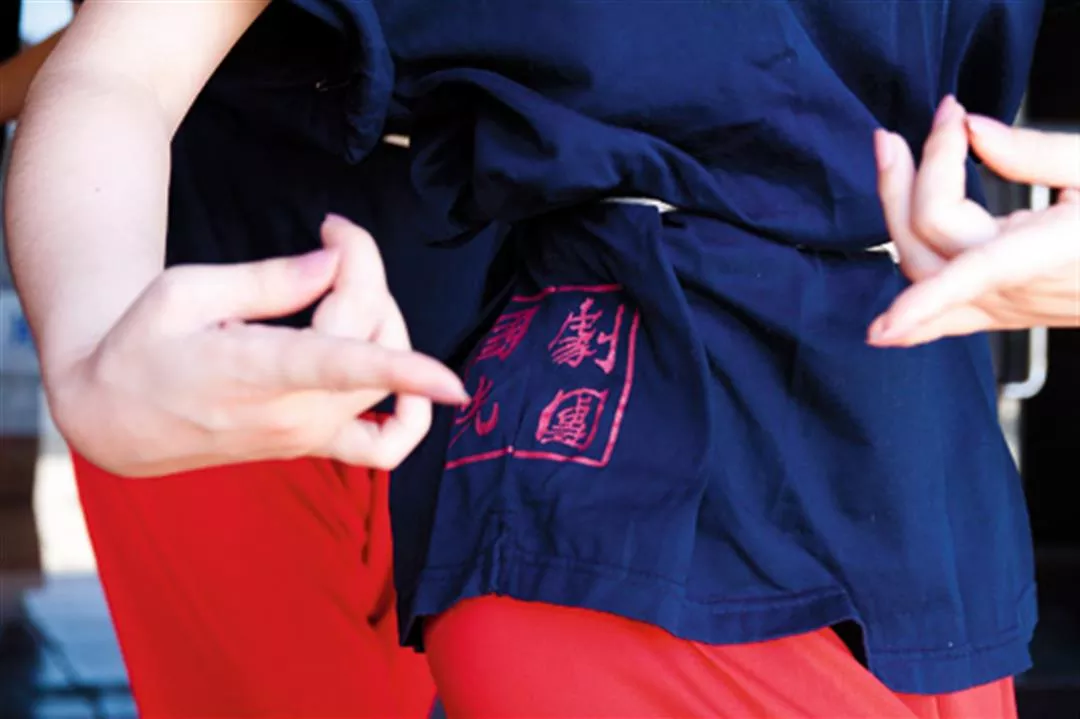
Every single part of the body must be used correctly. Therein lies the beauty of a Peking Opera performance.
“To put it in the starkest terms, the very survival of traditional opera is at stake.” So says GuoGuang’s rehearsal director Wang, who adds that audiences are changing. No longer are they interested solely in the performance itself. They also care about the atmosphere of the theater. Audiences are also growing younger. In the past, everyone was very familiar with the storylines and songs, but that is no longer necessarily true.
In 1986, Wang was part of the first cast to perform Contemporary Legend Theatre’s The Kingdom of Desire, in which he played the part of an assassin who was gripped with fear each time he killed. Already a veteran at the time with more than 10 years of Peking Opera experience, Wang paced the stage for an entire afternoon trying to get the right feel for the assassin’s appearance on the scene, and he refused to call it quits until he had gotten the “thumbs up” from Li Kuo-hsiu and Wu Jing-jyi, both of whom had been through Western theatrical training.
Wang confides: “For a Peking Opera performer, getting into character really is quite difficult.”
Huang Yu-lin, who has appeared in Apocalypse of Beijing Opera with the Ping Fong Acting Troupe, agrees. In her view, the big revelation that modern theater has brought to Peking Opera performers is the realization that “you’ve got to go beyond the formalism of Peking Opera and get into character; beyond technique, we’ve got to be in touch with emotion if we’re ever going to have anything in our ‘bag of tricks’ to deal with the challenges of a new environment.”
Incorporating elements of modern theater into traditional Chinese opera is the direction in which things are heading.
GuoGuang performer Hsu Hsiao-tsun opines: “Performing an old opera requires excellent technique, while performing something new challenges the performer to delve into new possibilities.” In his view, the point of all the tumbling and jumping of martial and clown roles was traditionally to display technical mastery, but nowadays performers do it because the storyline requires it or the director asks them to.
“The mission of the contemporary actor is to keep alive the skills of the past for the next generation,” says Hsu. Many troupe members still feel that they’re far from mastering the old operas and really want to keep working on them. But, argues Chen Yuan-hong, another GuoGuang performer, “Regardless whether you’re doing traditional opera or something new and experimental, there’s no getting away from the essence of Peking Opera. You’ve still got to work on your craft and understand every little detail.”

Princess Flowers requires considerable acrobatic skill, while Huang Yu-lin’s strength lies elsewhere, but she gave it her all as she went well beyond her comfort zone.
Wang An-chi, the artistic director at GuoGuang and a professor in the Department of Drama and Theatre at National Taiwan University, has written that Peking Opera long ago ceased to be entertainment for the masses. In her opinion, in addition to preserving Peking Opera as a piece of cultural heritage, it is even more important that this art form continue forward as a highly developed branch of modern theater, and that it interact in that capacity with other types of performing art.
Declares Wang An-chi: “The world of Peking Opera today is not what it was in the early years of the republic. Red-hot rivalry between different traditions within the art form is no more. And it’s not just competing anymore with Henan Opera, Kun Opera, or Taiwanese Opera. These days, the competition includes Ping-Fong Acting Troupe, Performance Workshop, Cloud Gate Dance Theatre, Godot Theatre Company, and Greenray Theatre Company.”
Bold thinking, to be sure, but not outlandish. She is simply giving a factual description of the position of Peking Opera in today’s society. For young Peking Opera performers, there is no other choice but to do what has to be done.
To describe the situation in which younger performers find themselves, Wang Kuan-chiang uses an old saying that is often repeated within the theatrical community: “In this line of work, the old and the young don’t get any special breaks.” Hard work is the only answer.
It is often said that 10 years of training go into a single minute of performance on stage. Therein lies a cue for the younger folks: You’ve got challenges? Then get cracking!

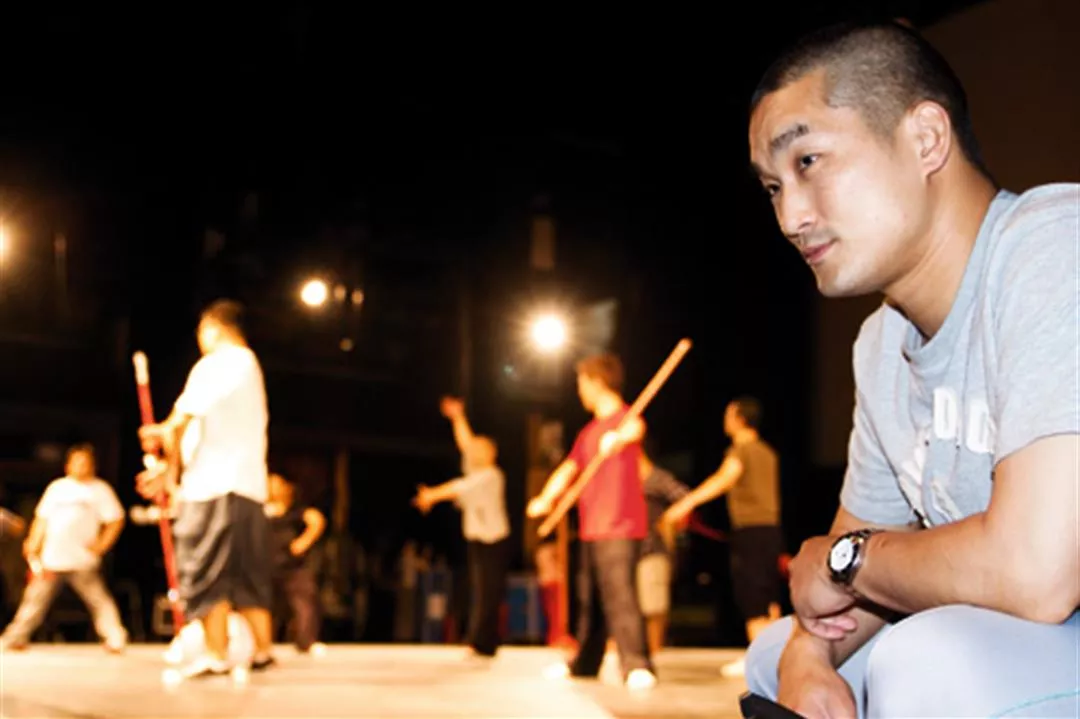
Even as a play is being rehearsed, members of the cast must be ready when they're not on stage to give interviews and provide explanations of Peking Opera.