Living in the Past--A Museum of Chinese Life
Cheng Yuan-ching / photos Cheng Yuan-ching / tr. by Robert Taylor
November 1993


Unlike some well-known museums, it doesn't enshrine its exhibits in glass cabinets where one can only peer at them from a distance.
This museum, called the "Kam Wah Chung Company," is very "human" and close to life, and one can touch things and took at them close up. It preserves a picture of the life lived by Chinese people in America a hundred years ago. Not only ornaments, furniture and kitchen utensils from those days are on show; even a mousetrap, a spittoon and a complete herbal pharmacy are there, looking as good as new. For people of Chinese descent, the museum is a real treasure-house in which they can study and trace back their roots.
Setting out from the city of Portland in the thickly-wooded western part of Oregon in the USA and crossing the snowy passes of the central uplands, one arrives in the rocky, arid eastern part of the state.
Driving at dusk into the town of John Day, which was a center of Chinese population over a hundred years ago, you can see the crystal-clear drops of water sprayed by the irrigators onto the fields along the roadside turned by the setting sun into a long avenue of rainbows, which seems to tell of a glittering past.
Indeed, from its boom days to its decline, John Day has shared a similar fate with many other towns of the old West. But luckily, just as the little town was about to fall into ruin as the Chinese left it behind, the State took over and renovated the Kam Wah Chung Company, which had originally been run by two Chinese, in order to commemorate Chinese people's contribution and give visitors a taste of the past by presenting a picture of the life of the Chinese in bygone days.

A bird's eye view of the little town of John Day.
A town born of the Gold Rush:
Dr. Jeffrey Barlow, Who teaches at the Department of Asian History at Oregon's Lewis and Clarke College, has been researching the history of the Chinese in America for many years. He tells how the Gold Rush began in 1848 in California on America's West Coast, and later spread to Idaho. In 1862, gold was found near Canyon Creek in Eastern Oregon. When news of the discovery spread, it attracted many prospectors pursuing dreams of riches.
In those days, the white prospectors mainly lived in the area around Canyon City. The US Government would not allow a Chinatown to be set up there, and so the 600 or so Chinese prospectors settled by the John Day Creek a few miles out of town. The settlement was first known as the Lower Town, but was later named John Day after the creek.
Like a powerful magnet, the Gold Rush in the American West drew Chinese across the Pacific Ocean to seek new opportunities. In China the Ching Dynasty was drawing to a close. Many people from Canton and Fujian Provinces came to John Day, with the largest numbers coming from Canton. The original owners of what is now the Kam Wah Chung museum--Wang Liang and Hai Ying--made the long journey to America during those Gold Rush days.
Professor Barlow devoted several years to personally interviewing local people in John Day before writing his book China Doctor of John Day, which recounts the history of the two owners of Kam Wah Chung and of the Chinese people of the locality. The book contains vivid descriptions of Hai Ying and Wang Liang.

Hai Ying's fame as a Chinese doctor spread far and wide, and even many white people travelled long distances to seek treatment.
Known far and wide:
Many members of Hai Ying's clan were disgusted by the tyranny of the Ching Dynasty government, and during the 1870's five of his uncles went to America to seek a new life. In a letter sent home in 1880, they said they were living very well, and that people were needed for the development of the West, so they suggested that Hai Ying should also come to America.
At that time Hai Ying already had a son and a daughter, and in 1883 they went with their father to the State of Washington, moving on to John Day in 1887. For lack of written records, we do not now know how Hai Ying came to master the diagnostic skills of Chinese medicine and to learn to mix and prepare drugs. Some say that he had already studied the practice of medicine back home in China, while others maintain that he learned his craft from an old Chinese doctor in America.
In those days Chinese overseas lived by the sweat of their brows and could not afford to fall ill for fear that they would no longer be able to feed their families or themselves. In the early days very many Chinese laborers were crippled when they were injured in tunnel collapses or other accidents. Other people were in no position to look after them, and to avoid becoming a burden many finally took their own lives by swallowing poison.
For the Chinese in the area, the appearance of the Chinese doctor Hai Ying came like manna from heaven.
Wang Liang came to John Day in 1882. A quick learner with a cheerful disposition, by 1887 he could speak fluent English. Among his possessions people have found some famous literary works in English, such as novels by Dickens, Maupassant and others, along with an English dictionary.
Because he loved meeting people, was a good linguist, and was happy to help other Chinese with their correspondence in English, Wang Liang quickly established a good reputation locally, and this helped his business activities to thrive. He even became the first motor car dealer in Eastern Oregon.
After Wang Liang and Hai Ying met, they got along famously and set up in business together. Hai Ying's English was poor, and he could neither ride a horse nor drive a car; so whenever he went to visit patients Wang Liang would drive him there by horse and buggy or by car. If the patient was a white person, Wang Liang would also act as interpreter.

The kitchen, which retains its original appearance, was formerly used to prepare Chinese medicines.
Breaking down racial barriers:
Because the medical profession was not well developed in America at that time, many doctors had only rudimentary training, or had even gained all their knowledge from books, so that for many people being treated by a Western doctor was a hit and miss affair.
Professor Barlow believes that Dr. Hai's greatest achievement was in breaking down the barriers of mistrust and misunderstanding between Chinese and white people. On one occasion, the son of a local rancher suffered blood poisoning after a wound on his upper arm became septic, and misdiagnosis by a Western doctor allowed his condition to become worse.
Seeing that his beloved son's life was in danger, and having heard of Hai Ying's skill as a doctor, the rancher called him out to see his son, without stopping to worry about whether he was a Chinese or Western doctor. Dr. Hai spent six days and nights at the ranch, until his patient was finally out of danger.
He also cured the mistress of another ranch in similar circumstances.
These incidents established Dr. Hai's reputation for treating difficult and hard-to-diagnose cases, and from then on not only Chinese people but also many white people came to him for treatment. This also changed the stereotyped and hostile attitudes which white people had held towards the Chinese. In later years, when a violent wave of anti-Chinese sentiment swept through the whole of the United States, it left Eastern Oregon untouched, and many Chinese from Northern California even fled to Oregon to escape the troubles.

After aging for many decades this rice wine must surely be as mellow asthe finest brandy.
Decline as the gold ran out:
But just as Wang and Hai's business was flourishing, Chinese people gradually began to move away from John Day to larger cities such as Portland, as the gold in John Day ran out and work became scarcer and scarcer.
In 1896 the Union Pacific Railroad reached nearby Prairie City, and would only have had to cross the Blue Mountains to reach John Day. But to take this route the tracks would have had to pass through tunnels and span ravines. The cost would have been enormous, and finally a detour was chosen, so the chance of a revival in John Day's fortunes was lost forever.
By the 1940's only 20 Chinese were left in the town. Wang Liang died in 1940, leaving an estate worth nearly US$90,000.
Dr. Hai passed away in 1952, but although he had children living in mainland China, because relations between Communist China and the United States were not good at that time, his children were unable to inherit his property, all of which finally passed to the Oregon State Government. The State Government renovated Dr. Hai's old home and in 1977 opened it to visitors as a museum.

The wide variety of goods from around the world which fill the shelves give an idea of the thriving business which the Kam Wah Chung Company once was.
Built like a fortress:
The four walls of the Kam Wah Chung museum are built entirely of stone blocks and are about one foot thick with only a small entrance and little windows, so that from the outside it looks rather like an impregnable fortress.
Why make the house so invulnerable? According to Professor Barlow's research, apart from keeping out thieves and bandits, perhaps it was because at that time the company still provided food and temporary lodging to new immigrants; after the passing of the Chinese Exclusion Act, the house was built especially strong to prevent immigration officers and law enforcers from entering to arrest people.
Another version has it that gambling was carried on at Kam Wah Chung and that white gamblers who had caused trouble had been beaten and injured by Chinese; it is also said that opium was smoked there. The Company house was built so solidly in order to shield these two illegal activities from the eyes of the law.
It was just this durability which enabled the house to last to become the museum which it is today.
The museum measures around 20 yards long by 10 yards wide, and has a very simple, unornamented exterior. Inside the entrance are a few display cabinets holding tools such as saws and sickles formerly used by Chinese laborers.
On the right a number of photographs are reproduced, including pictures of Hai Ying and Wang Liang, the two main characters in the house's history. A full view of the building shows what a bustling place the Kam Wah Chung Company was in bygone days, and the car seen parked in the space outside may well have been the very vehicle in which Wang Liang drove Dr. Hai far and wide to visit patients.
On a table is a scrapbook containing newspaper and magazine reports about the museum, and even photographs and information about Chinese medicines provided by Sinorama. They have all been carefully preserved by Carolyn Micnhimer, the old lady in charge of the museum.
One rather surprising exhibit is a collection of old bank checks. Ms. Micnhimer says that the checks were found under Dr. Hai Ying's bed and are made out for sums ranging from 50c to several hundred dollars. Their combined value totals around US$23,000, an enormous sum of money for those days. Perhaps they were gambling debts, but why Dr. Hai did not cash them remains a mystery.

Copper coins from the Ching Dynasty are now very rare.
A fine collection of medicines:
The left side of the first room on the left is a kitchen, while on the right there stands a bunk bed. Over the long years the four walls, the ceiling and the furniture have all gradually become almost black from the smoke, giving the room a solemn, mysterious and ancient feeling.
On the kitchen's big iron range stands a tablet in honor of the Kitchen God, showing that the Chinese brought the beliefs of the time with them from China. This is the place where Dr. Hai used to brew Chinese medicines. Looking back to those days, when a constant stream of patients kept the stove's fire busy, to see it now standing cold and forlorn brings a sigh of regret.
The dining table is laid with bowls and chopsticks. but who will sit down to eat? Also on the table are pot after pot of condiments, and even a bottle of liquor dated 1920, which by now must surely have aged to become more mellow than the finest brandy.
The walls close to the bunk bed are plastered with American fashion pictures cut from magazines of the 1920's and 30's, while by one end of the bed there lies a mousetrap.
The next room in is the pride of the Kam Wah Chung museum: on the left is a herbal pharmacy, while on the right is the area where goods for sale were displayed.
Just as in a pawnshop, the doctor entered the pharmacy through a side door, while the front is glazed up to the ceiling, with only a small opening through which the medicines were passed out.
On the table lies a pair of bear's paws, which at first glance appear rather frightening. Perhaps they tell us of the importance in Chinese culture of eating foods with tonic or curative properties to maintain or restore one's health.
The jars and packets of medicines on the shelves are marked on the outside with the drugs' names in Chinese. There are around 500 different materials here, of which around half can be identified and are of known application. In those days, the doctor would always first take the patient's pulse, make his diagnosis and then immediately prescribe and prepare the appropriate medicines, all in one session.
In the shop area opposite, fine goods of every description fill the shelves, including foodstuffs in cans, jars and tins, and wines and spirits. In the adjacent storeroom there are boxes of goods shipped in the 1930's from as far away as the Chinese mainland and Japan. Some of the cases have never even been opened.
The last room is Dr. Hai's bedroom which has not been renovated, but has been kept just as it was, along with everything in it. Standing still in the doorway with eyes closed, one can almost see the shadow of Dr. Hai coming and going.
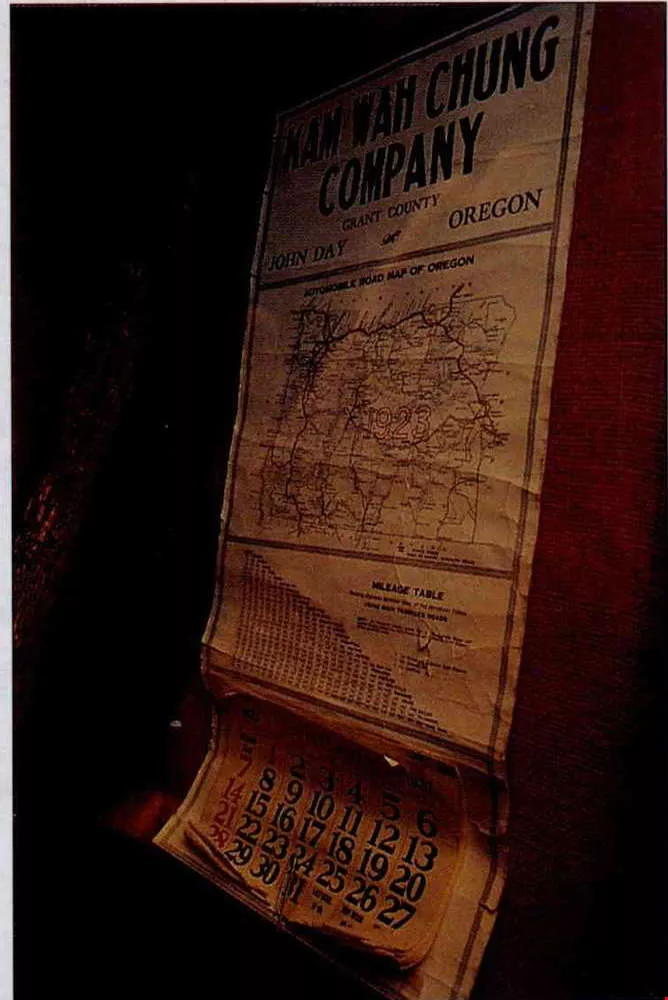
Kam Wah Chung used to have calendars printed to give to customers. Thisone is for the year 1923.
The shadow of the doctor:
A tour around the museum with accompanying explanations shows clearly the hard work of the two former owners, and it is a pity that all the Chinese have left John Day, for their children and grandchildren could learn so much here.
And surely in all America there cannot be another museum of Chinese life which recreates those past days so well.

The bedspace adorned with posters and newspapers is also a window on history.
Postscript:
Five years ago, Sinorama received a letter from the curator of the museum in John Day, Oregon, USA, asking for pictures of Chinese medicines with an explanation of their medical properties, from a certain issue of the magazine. In the spirit of promoting Chinese culture we were naturally happy to supply this material, while at the same time our editorial department noted this as a potentially interesting topic on Chinese people overseas.
This year, a visit to the USA by one of our writers has finally enabled us to follow up that five-year-old lead and present this report.
[Picture Caption]
p.90
From the Kam Wah Chung Company and Chinese herbal pharmacy of old to today's museum, its exterior and interior remain fascinating.
p.91
A bird's eye view of the little town of John Day.
p.91
Hai Ying's fame as a Chinese doctor spread far and wide, and even many white people travelled long distances to seek treatment.
p.92
The kitchen, which retains its original appearance, was formerly used to prepare Chinese medicines.
p.93
After aging for many decades this rice wine must surely be as mellow asthe finest brandy.
p.94
The wide variety of goods from around the world which fill the shelves give an idea of the thriving business which the Kam Wah Chung Company once was.
p.95
Copper coins from the Ching Dynasty are now very rare.
p.95
Kam Wah Chung used to have calendars printed to give to customers. Thisone is for the year 1923.
p.96
The bedspace adorned with posters and newspapers is also a window on history.
p.97
A mousetrap lies by the bed: were rodents really so rampant?
p.98
Dr. Hai's bedroom has been kept just as it was. US$23,000 was found under the bed.
p.99
Bears' paws were traditionally used in Chinese medicine.
p.99
The pharmacy contains around 500 different medical raw materials.

A mousetrap lies by the bed: were rodents really so rampant?

Dr. Hai's bedroom has been kept just as it was. US$23,000 was found under the bed.