The Onliness of a Long-Distance Runner:The Unique Chang Chia-che
Eric Lin / photos Chin Hung-hao / tr. by Phil Newell
February 2014
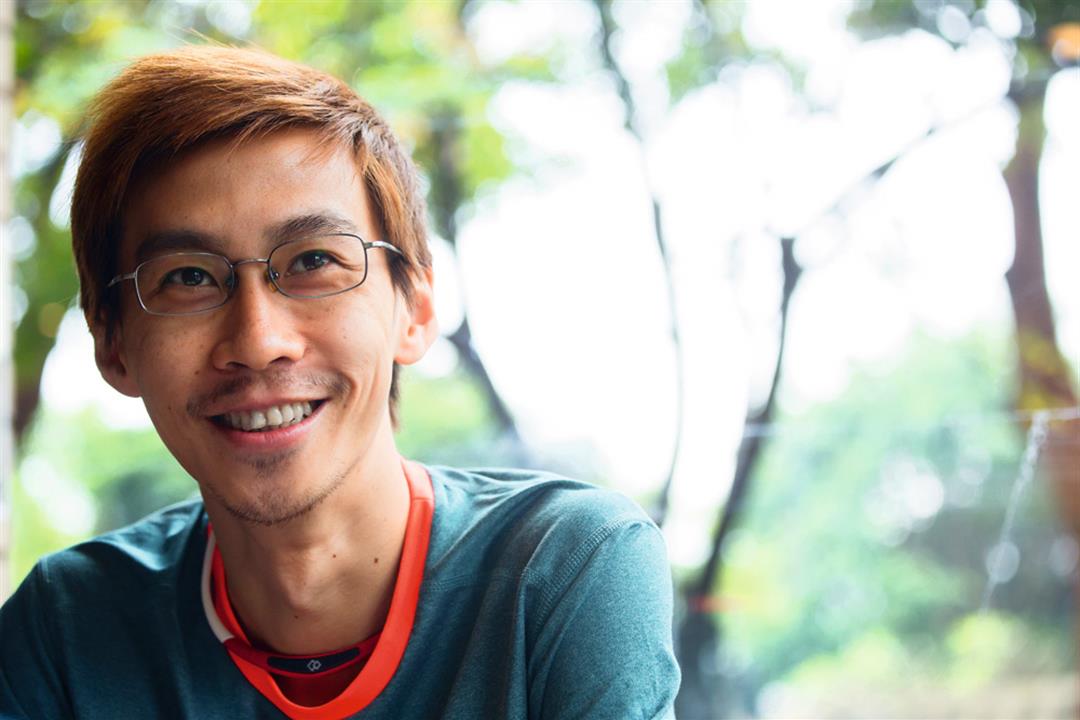
In Taiwan, Chang Chia-che is a household name. This long-distance running star for the new generation leapt to instant fame when he displayed great composure in the face of the controversial “watering station incident” during the 2012 London Olympics marathon.
Unlike other celebrity runners in Taiwan such as Kevin Lin and Tommy Chen, who have made their names doing ultramarathons that push the mind and body to their absolute limits, Chang has turned his high profile toward reviving interest in traditional track and field, which has long been neglected in Taiwan, and toward encouraging athletes in these sports. For example, he displayed remarkable selflessness in a recent 10,000 meter event when he raced out in front as the pacesetter, helping fellow runners to achieve new records.
Aiming to carry on the “sustainable management” spirit of the London games, Chang has devoted himself to informing people about running and spreading the word about how pleasurable it can be. Amazingly, a number of his personal observations, collected together by Internet users as “the sayings of Chang Chia-che,” have gone viral. What is it about Chang that people find so fascinating?
It is early December of 2013, and Chang Chia-che has just returned from the international marathon in Fukuoka, Japan. His face still bears traces of post-race exhaustion, but he doesn’t for this reason interrupt his training routine.
He gets up at six o’clock each morning and leaves his home in the Yonghe District of New Taipei City, right across the river from Taipei City. He runs across the Fuhe Bridge, does two laps around the campus of National Taiwan University, and then follows his original route back home, for a total of 15 kilometers.
At four in the afternoon, Chang again heads out the door, this time going under the Fuhe Bridge to the roadway that follows the dike next to the Xindian River, where he trains with a group of marathoners from university teams. As they lope along through sunset into the dark of night, for an instant a distant streetlight casts long shadows of their forms.
Chang has maintained this meticulous and rigorous schedule for over a decade virtually without interruption. It may appear rather monotonous to the ordinary person, but Chang manages to find something new about each and every day, and spends at least three hours a day on line blogging about the new experiences, thoughts, or realizations he has had.

Coached by his father Chang Pao-tsai (left), Chia-che follows a disciplined and patient training routine day in and day out.
The “Chang Chia-che craze” started with the London Olympics in 2012. The marathon was the final event for any athlete on the Chinese Taipei team, with Chang the sole Taiwan runner. As the TV cameras followed Chang, he passed the water station belonging to the Chinese Taipei team, and viewers could see that it was deserted, with no one there to hand him a bottle of water. This caused an immediate uproar among sports fans, with many accusing the national team of abandoning Chang.
Commentators weighed in with this opinion and that, and many people vented their feelings at the national team’s overall disappointing performance by focusing on this single image. But Chang quickly went on Facebook and posted an explanation saying that the reason there was no one there to give him water was that not enough staff people were available, and anyway this had been his customary way of running for his whole career. He said that people needn’t feel sorry for him, and he had been very happy while doing his event. “There have long been many aspects of Taiwan sports that are in need of improvement,” he wrote, “but during this phase when we need to take it up a level, rather than bemoaning the past we should be continuing to push forward with our transition.”
Chang’s remarks, which were written in a touching and lighthearted vein, not only provided closure on this embarrassing episode, they also caused a lot of people to sit up and take notice of this little-known long-distance runner. After returning to Taiwan, everywhere he went people jokingly offered him bottles of water, and he was often asked to take commemorative photos with people who then proudly posted them online. Within a short time, Chang’s face—which looks pleasant and affable but also clearly belongs to a man who listens to the beat of his own drum—had become widely known.
Chang says that after running in obscurity for over a decade, he feels it is his duty to use the recognition that has finally come his way for good. He hopes to revive interest in track and field (also called “athletics”), which in the 1960s had briefly spiked in popularity in Taiwan with the success of decathlete Yang Chuan-kuang and hurdler Chi Cheng, two unheralded Aboriginal athletes who unexpectedly won Olympic medals for the ROC. Chang also wants to raise morale among track and field athletes themselves, and to refocus their attention less on Olympic gold and more on personal, meet, and national records.
Over the past decade or so, two distinct phenomena have characterized track and field events in Taiwan. The first is that no one goes to see them. Even if they are open to the public free of charge, attendance is sparse at best, and no broadcasters are interested in carrying them. The second is that long-distance runners compete against one another for prominence, with no one willing to take on the thankless task of pacesetter. Everyone saves their energy for the final sprint as the end of the race approaches. This is one major reason why the national record for the 10,000 meters has stood unbroken for so long.
.jpg?w=1080&mode=crop&format=webp&quality=80)
Chang gets pleasure out of all kinds of running. This photo was taken after he participated in the race up the stairs of Taipei 101.

In an effort to alter this culture, Chang, who had already decided to focus exclusively on marathons, signed up for the 10,000 meters at the 2013 National Games and then personally wrote to media, corporate sponsors, and fans inviting them to come out to the event. Hundreds of curious spectators showed up at Taipei Stadium on October 20, 2013, to see the 10,000-meter finals, a crowd of rare size indeed these past few years. They were not disappointed.
When the starting gun was fired, a group composed of Chang Chia-che, Chiang Chieh-wen, and two others immediately pulled out front. Chang then picked up the pace, taking the lead by himself, not giving the other runners any chance to slack off. It was only in the final 3000 meters that his strength gave out and he was passed by other competitors. The end result was that Chiang Chieh-wen set a meet record of 30:07.81 for the event, a time that is also his personal best to date.
Chang only finished fourth, but he was nevertheless hailed by the crowd, because he demonstrated the spirit of athletes pushing each other to give their best and set higher standards for the sport as a whole, regardless of who wins.
.jpg?w=1080&mode=crop&format=webp&quality=80)
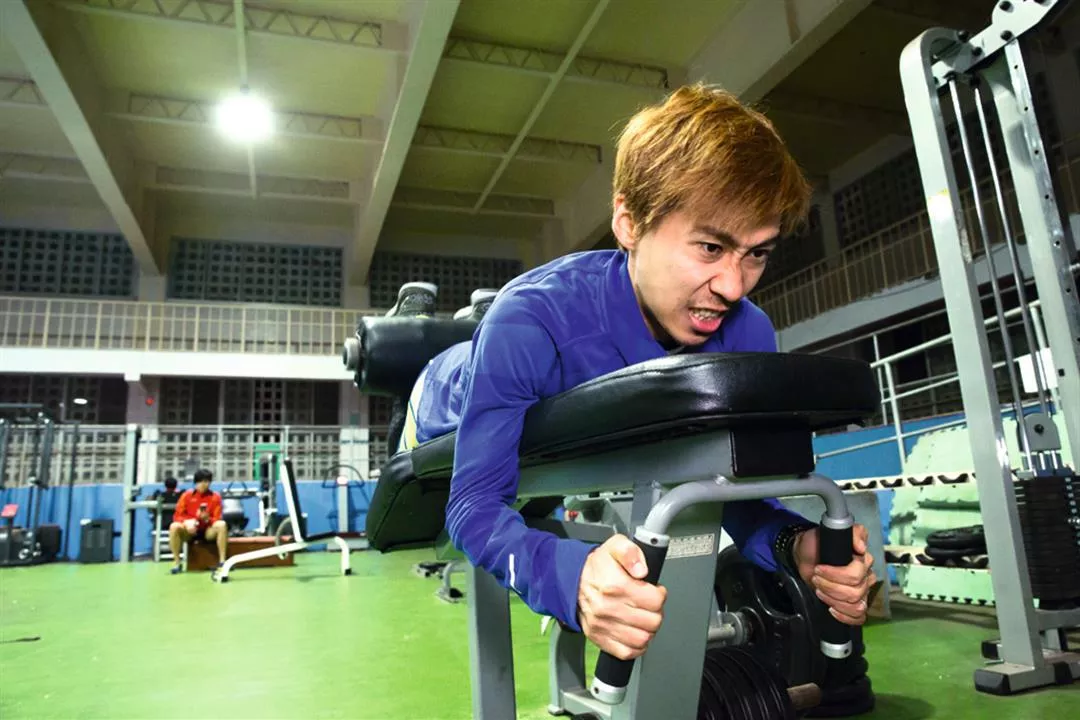
Hoping to attract more popular interest to track and field, Chang has even written personally to invite the media and sponsors to major events.
Marathoners reach their peak at about 30–35 years of age. Chang, born in 1983, is just hitting this phase. Each and every move he makes is shaping public perceptions about marathon running.
Chang Chia-che grew up in a family of running enthusiasts. His father, Chang Pao-tsai, took up the sport at age 30, and later formed a long-distance running club with other amateurs to compete against one another. His mother and brother, as a matter of general health and fitness, also got into the habit of jogging. Chia-che, oddly enough, originally felt no interest.
But when Chang reached middle school, and entered a rebellious phase, his worried parents tried every way they could to persuade him to join the running club. “My grades in school were poor, and one day out of every weekend I spent the entire day in supplementary school classes. What a drag! But I figured that if I could get out of supplementary school by running, why not? So I did what my father asked, though I can’t say I did it willingly.”
That decision changed Chang’s life. He got such an adrenaline rush from competing and such a sense of achievement after each race that he just wanted to keep on running and running. With his father taking an active role in his training, as a senior in high school he won gold medals for 5000 meters and 10,000 meters at the national middle-school sports meet. Then as a sophomore in college he competed in the 10,000 meters and half-marathon at the World University Games.
In his junior year in college, Chang began to switch to the marathon, and put up one good result after another. In 2005, he won gold in the men’s marathon at the National Games. In 2008, he finished third in the Hofu Yomiuri Marathon in Japan. And in 2012, he finished seventh in the Pyongyang Mangyongdae Marathon with a time of 2:16:06, thereby qualifying under the B standard for the Olympic marathon event, which in turn launched him into the public eye.

For Chang, weight training develops more than muscle; it also develops will power.
Chang’s blog has become a favorite among marathon lovers in Taiwan. Indeed, some enthusiasts have even gone so far as to collect together some of his comments into “the sayings of Chang Chia-che,” which have been widely circulated on the Internet. For example:
•“What gives the marathon meaning is to find and enjoy the pleasure that is enfolded in the process of going through so much pain.”
•“The marathon is all about searching for a more distant horizon, in patiently making progress and moving ahead.”
•“Marathon runners often have to go back to their initial inspiration and ask themselves why they began running to begin with.”
•“Running teaches us that through hard work we can become stronger, faster. It also allows us to become conscious of the fact that our bodies are not made of iron and steel. Finally, it produces self-discipline, self-control, humility, and contentment.”
Chang’s personal favorite is this thought: “First seek to run with panache, and only then seek to run with speed. It doesn’t matter if you win or lose; it’s enough if you make a statement about who you are.” He explains that every athlete wants to construct their own niche, persona, and physical image. Only if you like yourself can you, working from outside in, continually take yourself to the next level, and enjoy what you are doing in a positive atmosphere. In other words, it’s not how fast you run, but how cool you feel doing it—only then will you have the motivation to keep working at it.
So, when he gets up early in the morning and sees that it’s raining outside, while other people would sigh and whine, he thinks: “Isn’t running in the rain just like a scene from a movie?” If it’s a real scorching day, while others will complain about the heat, he happily says: “Here’s my chance to wear my sunglasses and look hip!”
.jpg?w=1080&mode=crop&format=webp&quality=80)
At the 2013 National Games, Chang (second from left) decided even before the starting gun that he would sacrifice himself in the 10,000 meter event in order to help others achieve record-setting performances.
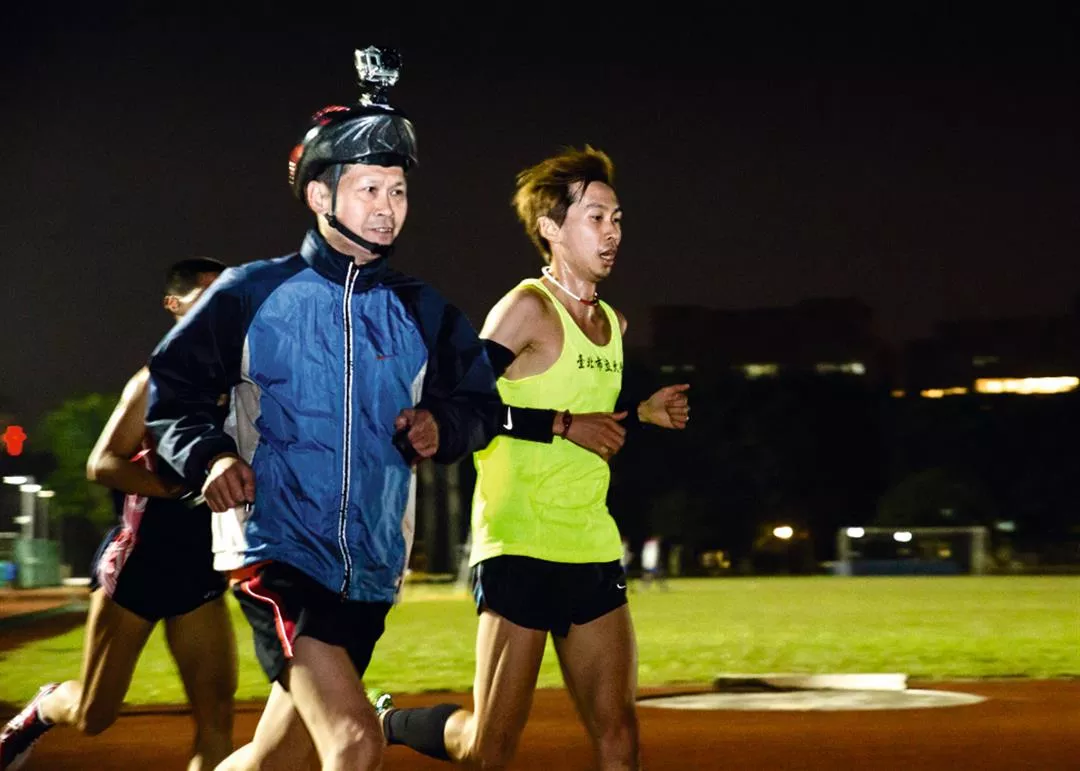
Chang’s optimism and individuality owe a lot to his father Chang Pao-tsai. Early on, the elder Chang accompanied his son in training every day, though these days he limits himself to going out twice a week for “interval training.” On these days, father and son head out at dusk to the sports field at the branch campus of National Taiwan Normal University. Dividing their workout into 400-meter units, Chang Pao-tsai—wearing a video recorder on his head—first runs alongside his son for 100 meters, then observes his son’s speed and physical conditioning for the remaining 300 meters. They do this over and over until both are bathed in sweat, and then, after a break to stretch and relax, they go into the gym for weight training.
On the day we watch them train, Chang Pao-tsai stands in the cold wind with a determined look in his eye as he says: “You won’t find any coaches out there who will run with you side by side, but do you know why I insist on doing so? Because I’m also a father who loves his son!”
“Competitive athletics is a personal challenge, and also a kind of performance. Of course I aspire to win gold medals and to compete in the 2016 Olympics in Rio,” says Chang Chia-che, “But what I care about even more is to express the inner meaning of the marathon through my running, so that everyone will get even more enjoyment out of sports!” It is not short-term personal gain that matters most to Chang; he is most focused on...
The long run.