Children That Refuse to Be Hugged
Chang Chung-fang / photos Vincent Chang / tr. by Peter Eberly
February 1993


Autism?
"Autistic children are very intelligent!" "Autistic people are aloof and eccentric!" Most people aren't unfamiliar with the term, but their understanding of it is limited to a superficial impression acquired from the film Rain Man.
That sort of understanding is a far cry from reality. Just what is autism really like? How does Rain Man play out in real life? And how should ordinary people get along with the autistic?
Mrs. Kao took her son Hsiao-ming to the hospital for a shot. He fidgeted around, and the nurse tried several times to put in the needle without success. He started to get impatient and lost his temper, jumping up and down, shouting and screaming and then running right out the door. Terrified, Mrs. Kao grabbed him on the street. She gave up on the injection and caught a taxi to take him home.
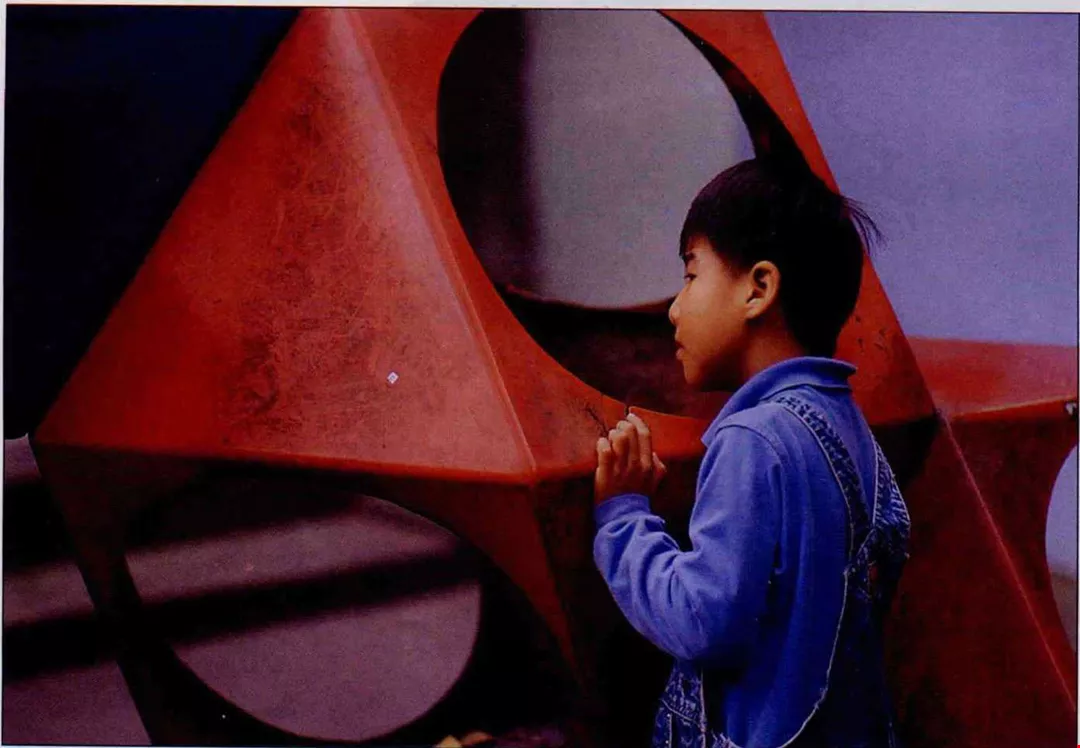
Autistic children are shut off in their own parivate worlds. Even in a crowd they seem as distant and isolated as a star in the sky.
Cities under siege:
In the taxi, Hsiao-ming flung an ashtray and ripped up a magazine. Mrs. Kao kept apologizing to the driver and trying to explain. In return, she received a look of sympathy and the suggestion that she "take the kid to see a psychologist."
She had no choice but to get out of the cab early, at Chiang Kai-Shek Memorial Park. Hsiao-ming ran in, spat, tore up some leaves and lay on the ground howling, drawing a crowd of onlookers. Even a policeman came over and asked if she needed help. After being coaxed for half an hour, Hsiao-ming finally consented to go home with his mother.
He was quiet for a while in the cab. Suddenly, when they stopped at a red light, he became impatient and started to make a racket. Mrs. Kao quickly apologized to the driver and tried to explain.
Isn't this story from real life a far cry from Rain Man? Hsiao-ming is an autistic child in third grade.
Autistic people look no different from normal people. But the world of their psyche is like a city under siege, where those outside can't go in and those inside can't get out. Someone once likened them to stars in the the sky, remote and distant. Sung Wei-tsun, a child psychologist at National Taiwan University Hospital, makes another analogy: "The brain of the autistic is like a computer, where you have to find the right key code to give it input. . . ."
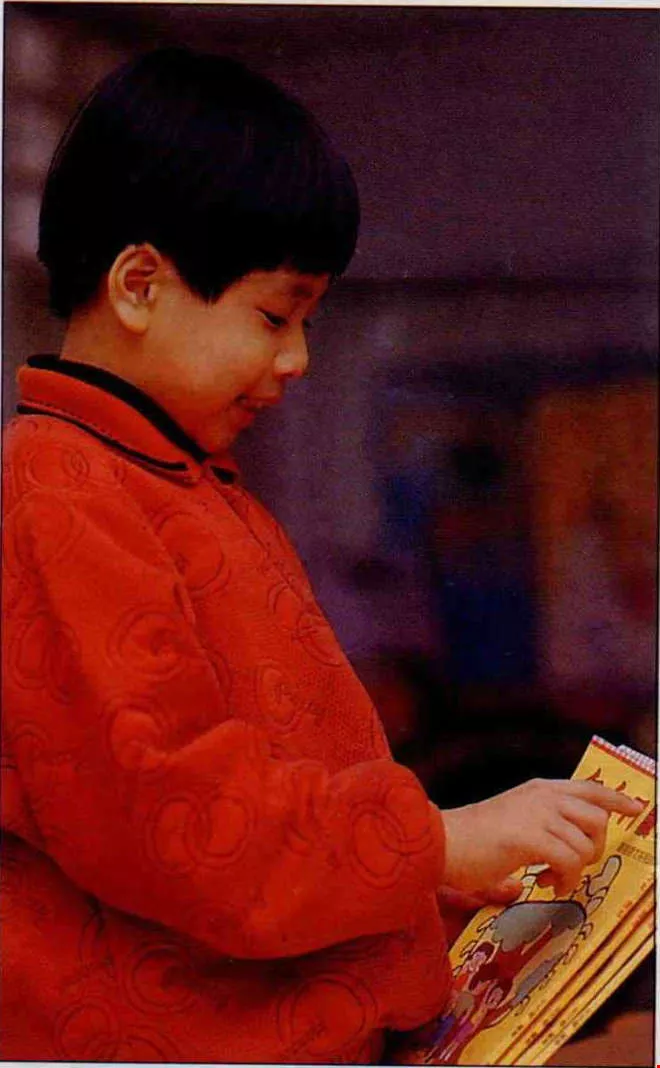
Eight-year-old Wei-wei has a photographic memory for Chinese characters. He likes to read and wants to take home every book he sees.
Does my child have a problem?
Although the cause of autism remains a mystery, it has been determined that it is not caused by the social or psychological environment and the vast majority of cases are congenital. Since the afflicted are healthy and normal in appearance, autism is difficult to detect in early infancy. Most parents of autistic children don't realize there is anything wrong until their children are one or two years old or even two or three.
Chang Mei-ying, of Kaohsiung, had two girls before giving birth to a boy, named Hao-chun. He was cute and plump, quiet and easy to care for. In his second year he still couldn't talk or react to his own name, and he liked to stand on his tiptoes and turn in circles. Chang Mei-ying felt this was a little strange and took him to see a pediatrician and an ear, nose and throat specialist, but the doctors told her not to worry; nothing was wrong with him.
As a two year old, Hao-chun began to scream, bite himself and bang his head against the wall. He would play the tape recorder all day long and open and close the closet or the screen door hundreds of times a day. "I sensed more and more that there was a problem, but my mother-in-law said I was just a worrywart."
When he was sent to nursery school, the teacher also felt something was wrong and suggested she take him to National Taiwan University Hospital to see a child psychologist. Subsequent examinations confirmed that he was autistic. By then he was nearly three years old.
A certain Mrs. Hu discovered when her son was two that he wouldn't play with other children and liked to watch rotating things like the blades of the fan all day long. He could talk but was stuck at the level of one syllable words. The doctor examined him and said he was "retarded." It wasn't until he was six that she confirmed he was autistic.
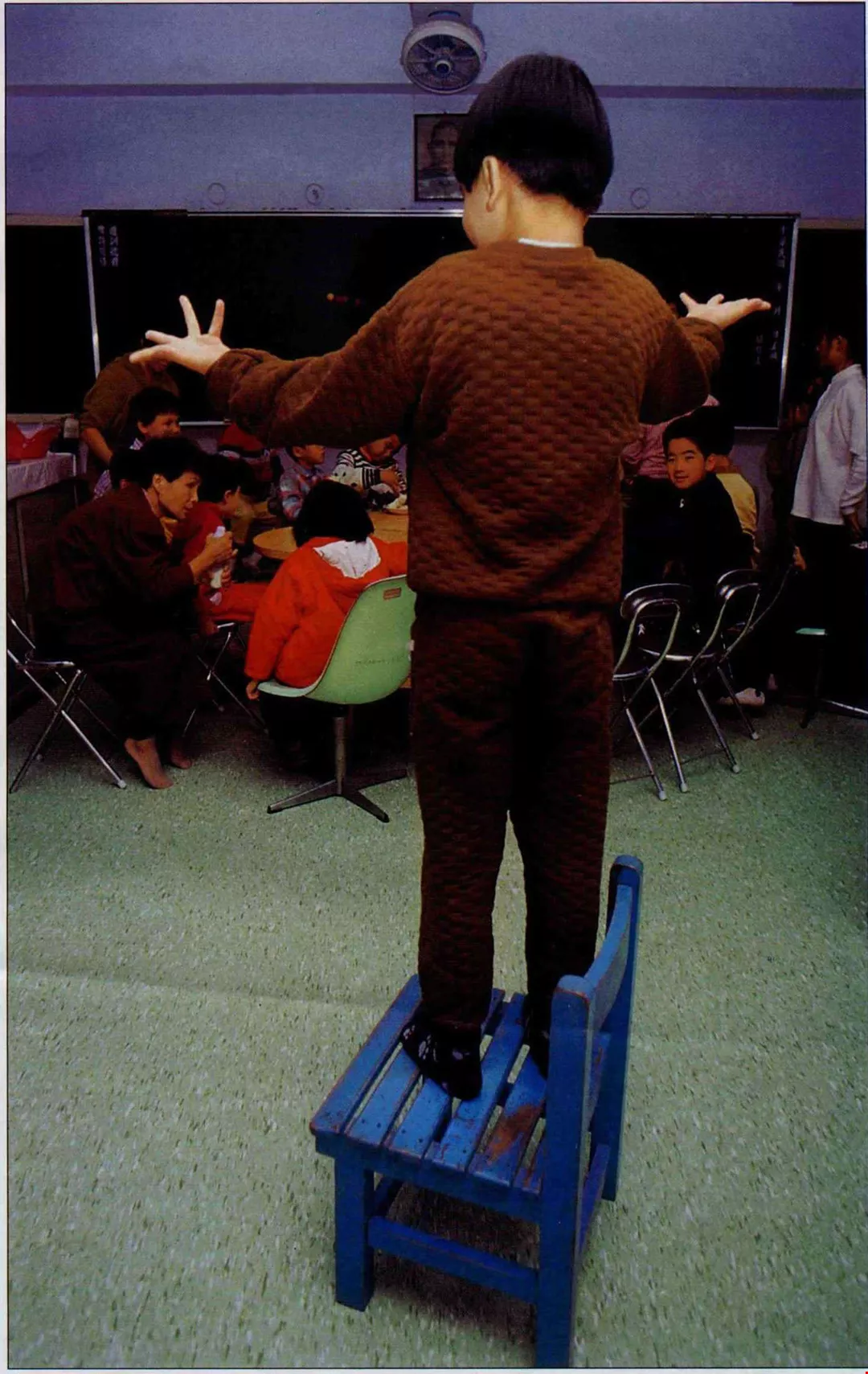
Ordered to stand on a chair for misbehaving, he doesn't seem to mind the punishment a bit and goes right on playing by himself.
Banging her head along with him:
When parents find out that their children are autistic, they always wonder, "Why us?" Many refuse to believe it. Li Wei-chuan, president of the Taipei Educational Association of Autism, relates that the husband of one member still won't admit that his son is autistic. He tried to stop his wife from joining the foundation, and he even called her up and put the child on the phone to prove he could speak because in his mind autistic children won't speak.
Even parents who accept the fact that there's a problem usually nurture the hope that their child is just temporarily maladjusted and will soon recover. A Mrs. Hsu, who runs her own business, freely admits, "I was very optimistic. I was sure my child would get better--maybe he was a genius! It wasn't until he was 13 and had epilepsy that I realized my son really was sick."
Indeed, the more parents understand about the affliction, the more fearful they are, and the older the child, the more stress and helplessness they feel. One mother was so distressed when her son banged his head against the wall that she banged hers right along with him. Another was so desperate she jumped from her third-story apartment. And a father who didn't know where to turn left wife and child and committed suicide. Autism is not a fatal disease, but the parents of an autistic child feel isolated and helpless. For them, the future is a long, hard road ahead.
The only treatment center in the country for preschool autistic children at present is the Child Psychology Health Center at National Taiwan University Hospital. Part of the tuition is paid by the government, but openings are limited and there's a long waiting list.
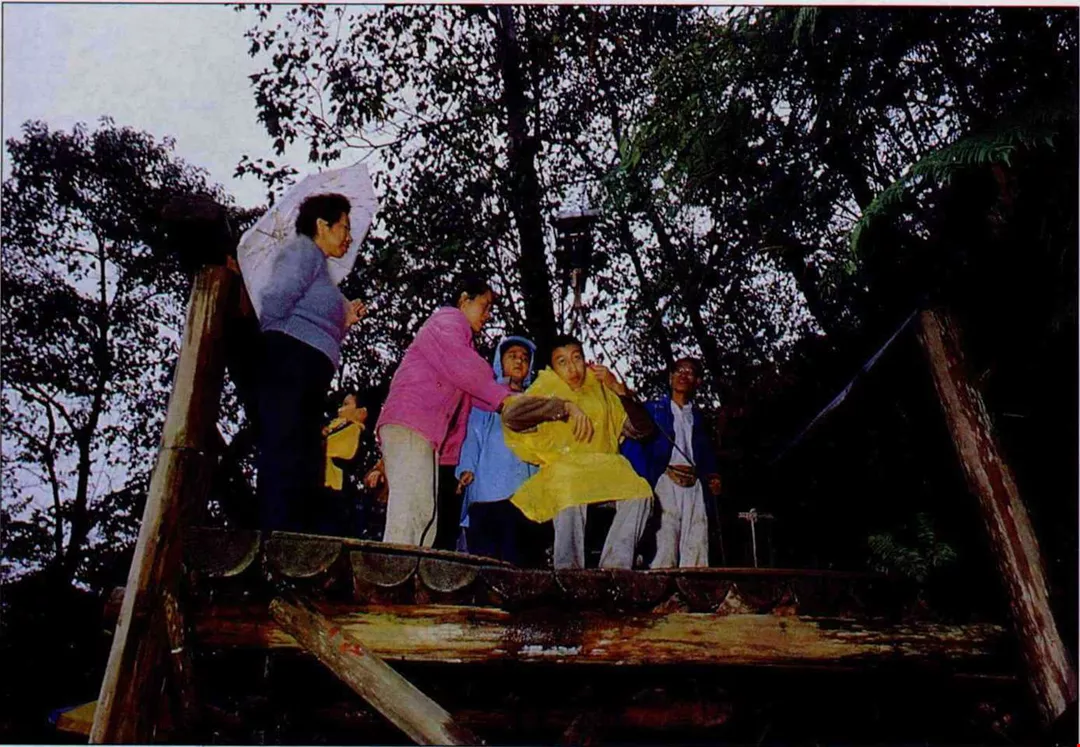
Autistic children are often terrified of the unknown or unfamiliar. The parents have try some outdoor activities at a barbecue. The children are scared and the parents are nervous.
Each case different:
The center has over 20 children in therapy at present. Each child must be accompanied by a parent. Health worker Chan Ho-yueh says, "Parents learn the knack of teaching their children here so they can do it themselves when they go home."
Using group activities and various toys and games, the children are taught to interact with others and stay in order. "A hundred autistic children come in a hundred different kinds. Each of them differs in personality and learning ability. Some learn in a few months, while others can't get anywhere even after a year or two," Chan says. In better cases, the parents are asked to take them home and teach them themselves.
The difficulties and hardships of teaching an autistic child are beyond the grasp of someone who hasn't been through it. A Mrs. Yu used blowing out a candle, blowing bubbles and sipping a drink to teach her son pronunciation, but it still took three years before he could say such simple words as Mama and Papa. It took eight months of teaching before he could go to the toilet, and buttoning a shirt took a full four years. When Mrs. Hsu tried to teach her son to tie his shoelaces, she worked at it from six in the morning to 11 at night.
Given that effort, just a little progress makes parents wild with joy. Mrs. Sun would ask her son questions and answer them all day long. When she asked him, "What's your name?" one day and he answered correctly, she was so happy her eyes filled with tears.
Even though parents work so hard at teaching them, in many people's eyes autistic children are "just plain spoiled."
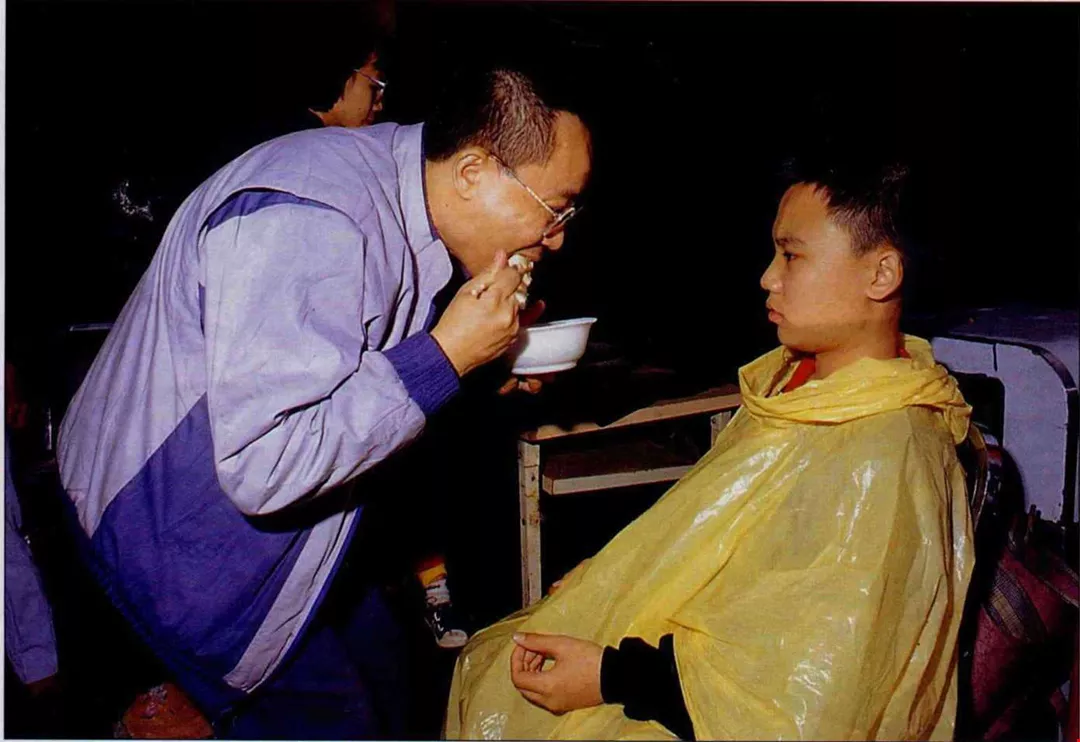
"A loving father's heart is as tender as tofu," the Chinese saying goes. Autistic children are picky about food. A father eats a piece of tofu, which his son doesn't like, to get him to finish to his soup.
Swearing not to take him out again:
When a Mrs. Tsai took her son to Yangmingshan, he ran all over the place and she followed closely behind, afraid that he might get lost. An old man said to her, "Why don't you just spank him? He's so naughty! Even if you're not tired, I am just watching him!" Mrs. Tsai explained to the old man that he was like that because he suffered from an illness. "What illness?" the old man replied. "Why he's as healthy as can be. It's just that you parents have been so lenient you've brought him up like that!"
Every time Mrs. Kao takes her son out of the house, she always brings along a lot of money to pay in compensation. In a restaurant, her son may turn over someone's table if the mood strikes him. In the vegetable market he pinches the tofu or smashes a watermelon. . . . "If he breaks something, I can pay for it. But when people look at me or ask me in so many words how he can be that way, I don't know where to start," she says helplessly.
Chang Mei-ying says that Hao-chun acts up every time she takes him out. If they're in a store, he runs around and snatches this or wrecks that, upsetting the owner. If they're in the market, he has to pick up everything and smell it, and she winds up hurriedly buying whatever he touches. "Each time I swear to myself not to take him out again."
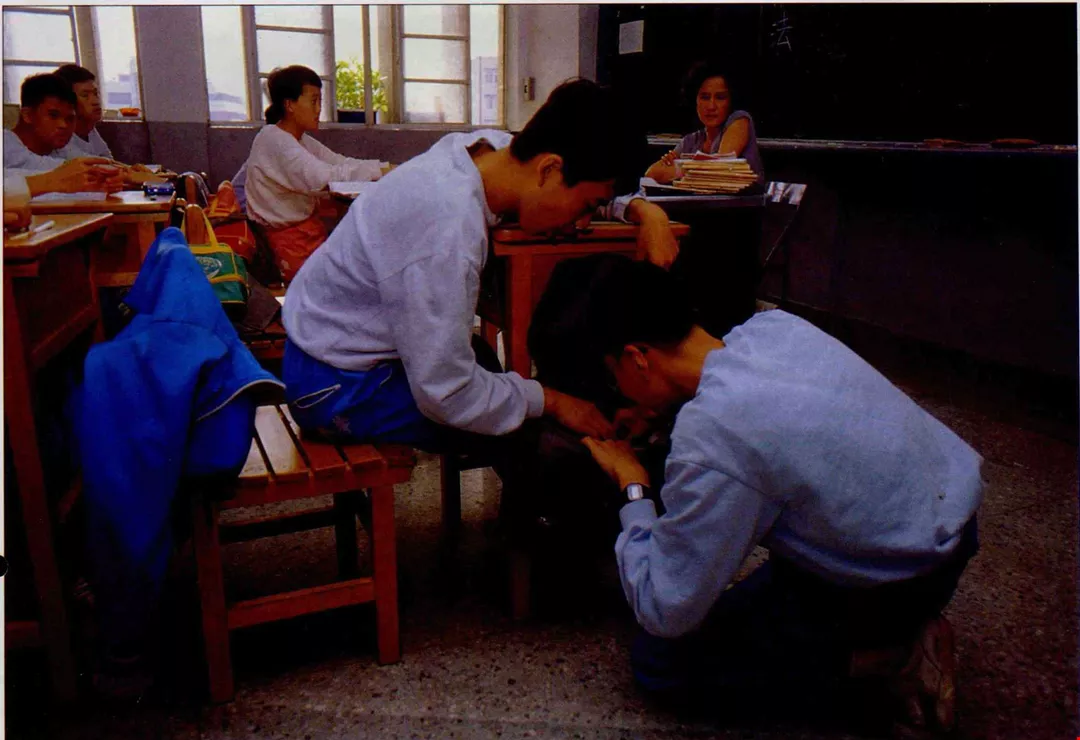
Halfway through class and Wei-ming still hasn't even taken out his textbook. A classmate helps him rummage through his book bag.
Complications:
That sort of behavior, at most, costs parents money or causes them to be accused of lax discipline. But what really frightens the parents of autistic children are severe reactions to emotional distress and epilepsy, which may occur with the onset of puberty.
Autistic children handle frustration poorly. Whenever they encounter a setback, such as interruption of a fixed behavior pattern or being misunderstood, an emotional reaction may be triggered. Chan Ho-yueh cites an example. An autistic child who constantly repeats, "When I grow up I want to go shopping on my own," may actually be worried that when he grows up he will in fact have to. If people answer, "That's right. You can go shopping on your own when you grow up!" he'll become distressed and angry, whereas an answer like, "I'll go shopping with you when you grow up," will assuage his anxiety.
Each child reacts differently. In severe cases, they may cry, make a racket or hurt themselves by biting an arm or banging their head against something. Mrs. Kao says that when her son loses his temper he goes completely out of control. "Hell on earth? It's right here in our home. If I dream of my son in the middle of the night, I wake up and can't get back to sleep." Even though her son suffers severe lapses, she says that he tries hard to control himself and has gradually been making improvement.
As for the second complication--epilepsy--that depends entirely on luck. Epilepsy strikes about one fifth to one third of the autistic, Sung Wei-tsun says, usually during puberty. A younger son in the Yu family had it even as a child. Attacks came once or twice a week, although now that he takes medication to control it they occur only once every two weeks. "Whenever an attack is due, I'm on tenterhooks." Mrs. Yu says. "I'm afraid it'll strike when he's out on the street or going up or down stairs."
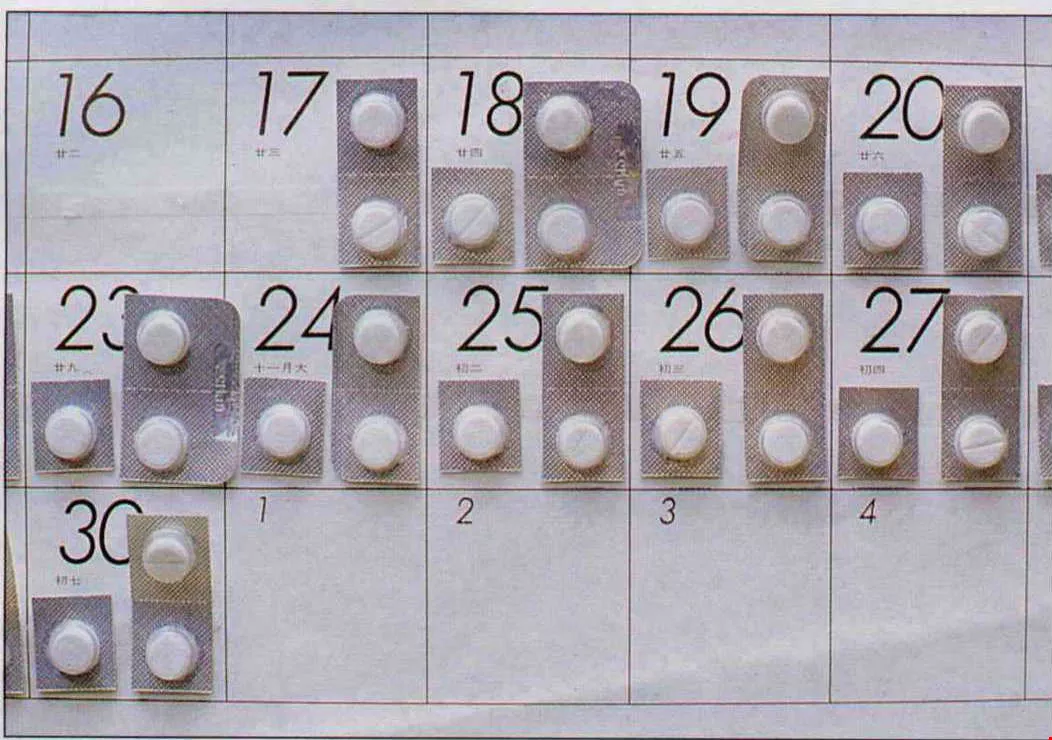
So that Wen-lung won't forget to take his anti-epilepsy medication, Mrs. Hsu tapes each day's dosage on the calendar as a constant reminder.
Sharing the burden:
Having put up with so much, most parents are relieved when their child is old enough to enter grade school, and the teacher can help share the educational burden.
Doctors recommend that autistic children who have been treated as preschoolers and are comparatively stable should be enrolled in a regular class to help them learn about normal language communication and personal relationships. Entering a regular class can be a mixed blessing, however; it all depends on the teacher.
When he was in third and fourth grade, Sun Ming would come from school every day in a temper, fussing that they should move to Africa, "where you don't have to go to school." It wasn't until he was in fifth grade and got a new teacher that the situation improved and his mother found out that his previous teacher used to spank him and pinch him and warn him not to tell her mother when he got home.
Kun-yen was lucky enough to find a good teacher. She stood by him even though he threw a tantrum on parent-teacher day and one of the families demanded the next day that their child be transferred to a different class.
Since they can rely on memory, autistic children are usually pretty good at learning to read and don't do too badly in a normal class during the first couple of years. But by third and fourth grade, when applied thinking problems come up, they clearly begin to fall back. Even though their parents may work with them at home, they often can't keep up in math and science. By middle school, few of them remain in regular classes. Most change to remedial groups or special education schools.
Sun Ming, who is a third-year middle schooler this year, is one of the few "high-functional" autistic children. He not only manages to maintain mid-level grades in regular classes; he's getting ready to take the high school admission examination next summer. Mrs. Sun refuses to apply for a disabled card for him. "Your autism is all better now," she tells him. "We'll leave the slot for someone else."
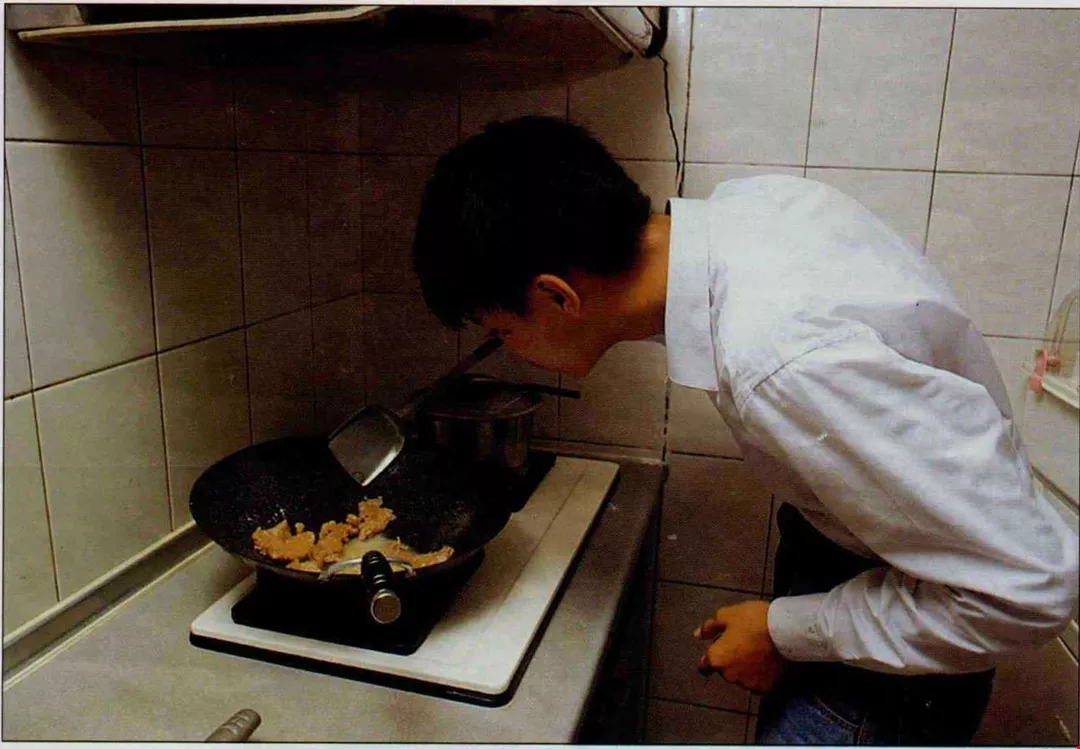
Wen-lung, 16, helps with the housework each day after school. When frying meat, he likes to scrape of the crispy edges for himself.
Can it get better?
Even "high-functional" autistic children like Sun Ming persist in certain forms of compulsive behavior, such as insisting on reenacting what went on in school every day after coming home. He also has a problem in expressing himself. When he's concerned about his grandmother in the United States, for instance, he may say, "I wonder if she's going to get run over by a car?" Or if his father is getting ready to go on a business trip, he may ask, "Will the plane crash?"
The only sufferer from autism to graduate from a university in Taiwan, who is now studying computer science in the United States, still has a problem in communication and emotional adjustment. He once wrote a letter telling his classmates in Taiwan that he would be arriving at the Taipei train station at such-and-such a time, expecting they all would come to meet him. When he got off the train and not one was in sight, he was greatly upset.
But autistic people who are able, like them, to live normal lives are few and far between. After graduating from a special education school, most have no idea where to go. The burden and stress their parents feel doesn't let up. Relax a bit, and their child will start to regress.
Hsu Wen-lung, who is a first-year student at a special education high school, has regressed recently, making his mother very worried. Because of his epilepsy, Mrs. Hsu had been rather lenient on him and wouldn't demand too much. Unfortunately, his abnormal forms of behavior have been increasing lately--touching little girls, pulling the hair on people's bodies, staring at the numbers on his classmates' school uniforms, reaching out and touching people . . . actions that frighten others.
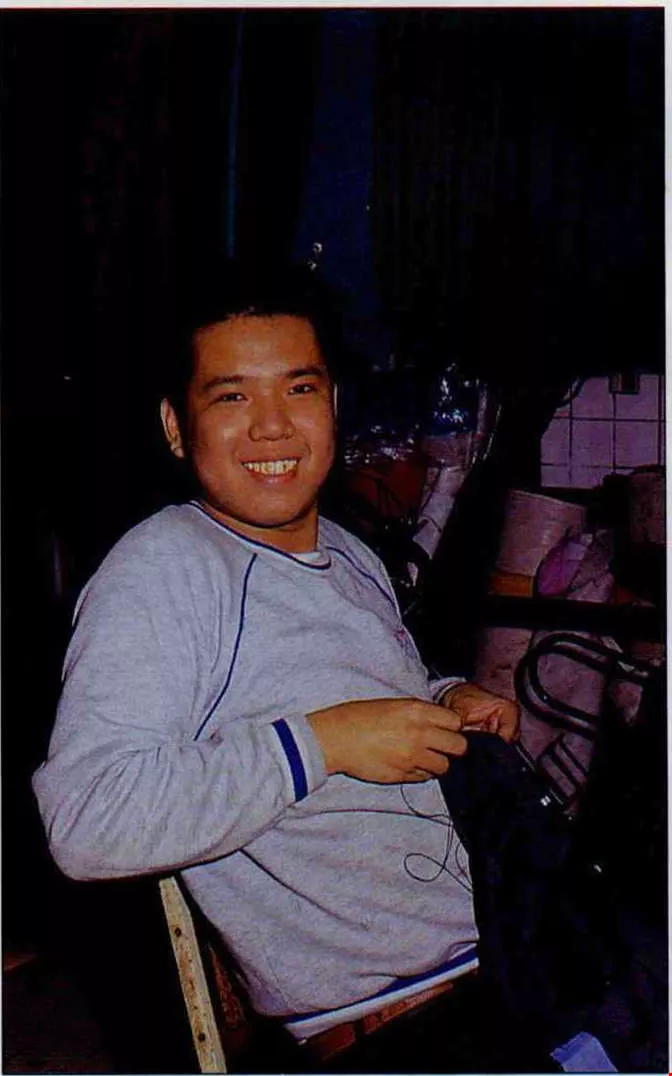
It's difficult for the autistic to find suitable jobs. Po-yen, who works as a garment worker in his family's factory, is one of the lucky ones.
Forgotten group:
Parents with an autistic child have not a moment's rest. Even finding a sitter can be impossible. "Friends and relatives all think our child is 'awful,'" Chang Mei-ying says. "They don't understand him and they're afraid to help look after him."
Their total commitment to caring for the child may lead to complaints from their other children. "Mommy, why doesn't Little Brother hurry up and die?" "Am I your real daughter, Mommy? Why is it you only love my brother?" When a mother hears her children talking like that, she can't help feeling miserable and bitter.
"What do you plan to do in the future?" is a question that friends and relatives commonly ask. "It's really tough!" is the consolation frequently on their lips. The first comment is no solution; the second is no help.
"God sent me a child like this to show that I'm strong," is how one mother consoles herself. For a long time now, the parents of autistic children have been a forgotten group, groping alone in the dark, trying to deal as best they can with an affliction whose causes are not known and whose treatment is still in the experimental stage.
What can the public do to help autistic children and their families, you may ask. Give them a chance and give them space, Chan Ho-yueh says. It all begins with respect and understanding.
[Picture Caption]
p.98
Autistic children are shut off in their own parivate worlds. Even in a crowd they seem as distant and isolated as a star in the sky.
p.98
Eight-year-old Wei-wei has a photographic memory for Chinese characters. He likes to read and wants to take home every book he sees.
p.99
Ordered to stand on a chair for misbehaving, he doesn't seem to mind the punishment a bit and goes right on playing by himself.
p.100
Autistic children are often terrified of the unknown or unfamiliar. The parents have them try some outdoor activities at a barbecue picnic. The children are scared and the parents are nervous.
p.100
"A loving father's heart is as tender as tofu," the Chinese saying goes. Autistic children are picky about food. A father eats a piece of tofu, which his son doesn't like, to get him to finish to his soup.
p.101
Halfway through class and Wei-ming still hasn't even taken out his textbook. A classmate helps him rummage through his book bag.
p.102
So that Wen-lung won't forget to take his anti-epilepsy medication, Mrs. Hsu tapes each day's dosage on the calendar as a constant reminder.
p.102
Wen-lung, 16, helps with the housework each day after school. When frying meat, he likes to scrape off the crispy edges for himself.
p.103
It's difficult for the autistic to find suitable jobs. Po-yen, who works as a garment worker in his family's factory, is one of the lucky ones.


