Navigating through Happiness-The Taipei World Design Expo 2011
Lin Hsin-ching / photos Jimmy Lin / tr. by Geof Aberhart
November 2011


2011 is Taiwan's Year of Design. As the Republic of China celebrates its centenary, Taiwan's design world has been celebrating as well, with the IDA Congress and Taipei World Design Expo the twin crowns atop the year. Having kicked off in late September, in barely a month the expo has already attracted around a million design fans eager to sample the latest the international design scene has to offer.
Tying together past, present, and future, the Taipei World Design Expo 2011 (TWDE 2011) is being held at the old Songshan Tobacco Plant, Nangang Exhibition Hall, and the Taipei World Trade Center. The expo presents the history and future of industrial design and design trends.
The first site to be unveiled, the Songshan Cultural and Creative Park, is also a highlight of the exhibition-the Taipei City Government has spent two years and NT$400 million renovating the venue, which started life as a Japanese-era tobacco factory. The result is the transformation of an old, abandoned site into a historical and practical exhibition location.
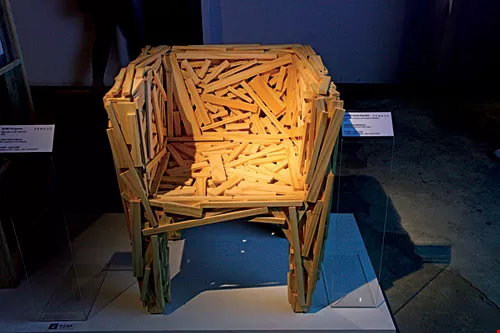
Now that "green" thinking has been internalized by designers, attention is turning to more community-friendly options like the Brazilian "favela chair," pieced together, using hand-made glue, from pieces of scrap wood gathered from shanties.
What is "good" design? What is the ultimate mission of the designer?
Where once designers aimed for aesthetic perfection or practical problem solving, in recent years the focus has moved to creating safe, universal, green design concepts that contribute to happiness.
Take architecture: While the construction industry strives to use the highest quality materials to build amazing homes, those homes aren't necessarily good homes. Architecture should, instead, be focusing on adapting to local climates and environmental concerns.
Finnish designer and architect Marco Casagrande has put on display his new architectural ideas in the Theme Exhibition section of the expo. That idea: "ultra ruins." In Casagrande's own words, "When a man comes to the jungle he cleans up a spot and builds his house. The walls of the house and the hard surfaces are constructed to keep nature out. When man moves away from his house the jungle will come in. Nature reads the house and step by step the architecture will become part of nature." The Earth's resources are limited, and microclimate-based structures should be the focus of the next generation of urban planners. As part of that, old or long-abandoned buildings do not necessarily need to be entirely torn down and rebuilt, but rather can have their component parts repurposed, giving Nature space to grow, allowing weeds and vines to thrive and form a play of light and shade. Such would be a potentially ideal living environment for mankind.
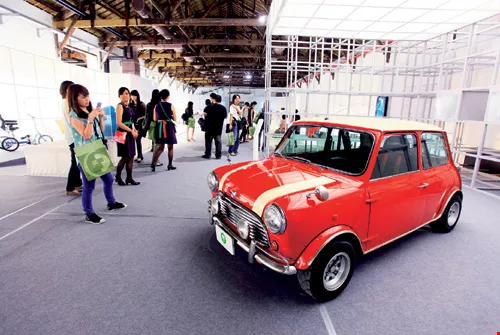
Launched in the UK in 1959, the Mini used a front-wheel drive system to save fuel as a response to the shortage that followed the 1956 Suez Crisis.
Along a similar line are the "humane architecture" ideas of Taiwan's own Hsieh Ying-chun. After the 921 Earthquake, Hsieh got involved in the recovery effort, helping the people of the affected area rebuild with low-cost, environmentally friendly materials that would both meet the residents' needs and fit in with the local environment. The new homes were designed in such a way as to make it easy for the locals to take part in the rebuilding work. Later, Hsieh left his mark helping out similarly in the wakes of the 2008 Sichuan Earthquake in China and Typhoon Morakot in Taiwan. In 2011, the Taipei World Design Expo is displaying the light steel structure Hsieh is a strong proponent of, adorned with photos of rebuilding efforts and results.
Many more of these "happiness in design" concepts are developed from similar life experiences.
In Brazil, for example, two designer brothers have used hand-made glue to piece together chairs made from cast-off pieces of wood from shantytowns. These chairs, known as "favela chairs" for the shantytowns that provide the wood, now fetch over NT$100,000 in the marketplace for their unique style and the way they preserve the wear and tear on the wood.
American brand Ecoist, meanwhile, is promoting a line of purses and bags called "Baguette," hand-woven in Mexico from trashed newspapers. Despite this humble origin, the bags are well made, practical, and every bit the match fashionability-wise for "higher-class" bags. These bags, transformed from trash to flash with a bit of handicraft, sell for as much as NT$6,500 a piece, bringing in valued extra income for the people who make them.
"Red is the new green," says curator Sean Hu. With environmentalism already largely internalized in much of the first world, there is now a move toward humaneness and fair trade in design, with less overt emphasis on the green aspects. One example is a rolling water barrel light enough and small enough for a child to easily push, helping ease the burden of Africans who traditionally need to carry heavy water barrels on their heads to bring water home. Another example is the "LifeStraw," a point-of-use water filter that passes water through seven different filters, including activated carbon, providing a lifeline for people in the third world that lack potable water.

The International Industrial Design Exhibition in Section 2, meanwhile, is focusing on "trans-evolving," looking over a century of industrial design and production through classical styles, modern perspectives, and future possibilities.
Amongst the people being remembered is the "father of industrial design," the late German designer Peter Behrens. In 1906, Behrens designed an electric kettle for home appliance company AEG, taking into account the needs of standardized mass production to create a specification for kettle design including handles and lids that could be interchangeably used with different models of kettle.
Another notable historical design is the legendary Mini. Launched in Britain in 1959, as the country was in the grip of a fuel shortage, the Mini saved fuel by using a front-wheel drive system, more efficient than traditional rear-wheel drive systems.
In Section 6, the Interdisciplinary Creative Works on Asia's Cultural Creativity Exhibition, the traditional art form of calligraphy is being put to poetic use.
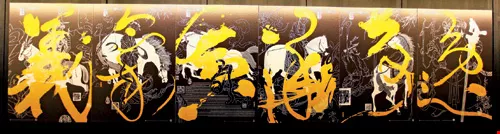
Taiwanese designer Xiao Qingyang produced his own interpretation of the calligraphy of Master Tung Yang-tzu, an innovative take on historical Chinese art entitled Ingenuity Follows Nature-White Horse.
Eighty-two-year-old Japanese poster designer and "living national treasure" Kazumasa Nagai drew on Tung's work Sheng Sheng to create a humorous take using animals running to and fro to express the concept of growth and prosperity.
Chen Jun-liang's Purifying the Six Sensory Faculties looks to be comprised of six characters at a distance, but close up it is just a series of brush tips. Chen and his team spent three days shooting photographs for the piece, which is made up of approximately 10,500 individual brush tips "transplanted" to create six calligraphic characters. The concept behind the piece is one of paying tribute both to Tung the calligrapher and the brushes that are the foundation of the art of calligraphy.
Once the expo is finished, this showcase of Asia's cultural and creative industries will move to Macao and Japan, giving these other character-using locales a chance to experience this once-in-a-lifetime multidisciplinary exhibition.
Also of note is the opening of the Taiwan Design Museum, located in the Songshan Cultural and Creative Park, as the first design-oriented museum in the Greater China area. The museum showcases 300-plus pieces of Taiwanese design from agricultural to industrial society. Take the bamboo stools so commonly seen in Taiwan's rural villages: when stood upright, they function as stools for adults, and when lain down, they become a convenient chair to place children in for feeding, like a legless high chair. Such stools have even gone on sale in Japan and earned praise from French designer Charlotte Perriand. Another example is the 1930s Fuji King bicycle, which cost as much as a farmer at the time could make in a year, and became known as "the Mercedes Benz of bikes."
This is the largest design exhibition in Taiwanese history, and it is an excellent illustration of the fact that design is not just about solving life's little problems, but about expressions of social issues and environmental concerns. To Asia's rapidly developing economies, this is a realization of profound import.

@List.jpg?w=522&h=410&mode=crop&format=webp&quality=80)

@List.jpg?w=522&h=410&mode=crop&format=webp&quality=80)


