Our Neighbor the Weather Man, Jen Li-yu
Jenny Hu / photos Hsueh Chi-kuang / tr. by Sophie S.F. Tuan
May 1994


Quite a few people in Taiwan regard Jen Li-yu as a weather prophet; however, they do not know that with the onslaught of a typhoon, the family members of the prophet are far worse off than the average person.
In October of last year, Mr. Jen Li-yu, widely known to Taiwan's TV viewers as the weather man, quit his job with the Central Weather Bureau after working there for twenty-five years, and formally reported for work at the news department of the Taiwan Television Enterprise.
Rumors spread that TTV had successfully enticed him away with attractive offers of a fabulous salary and high rate per appearance causing him to retire prematurely with the prospect of a new spring in the offing. But Jen Li-yu only said casually: "All I am doing is to continue in my favorite employment of weather forecasting." What does Jen Li-yu have which other people don't? Apparently for more than a year already, Jen Li-yu had been transferred from the weather forecasting center to serve as chief of the research and evaluation section of the natural disaster monitoring division. A heavy load of paper work, mostly administrative in nature, stirred in him strong feelings of nostalgia for the simple life he led as a straight weather forecaster. Hence, when a television station invited him to serve primarily as a weather forecaster, this tallied with his special interests, and after only a moment's reflection he agreed.
Basically, this signifies nothing more than a personal choice of livelihood. However, quite unexpectedly, it has become the focus of attention for the mass media, especially television news. And this state of affairs has thoroughly perplexed this common or garden public functionary.
According to his viewpoint, one must follow one's intuitive reactions in everyday life with out being too mercenary. He was at a loss as to why his abandonment of one position in favor of another should have aroused so much speculation and disturbance. He declared. "I'm not a TV star, so why is there so much fuss? Furthermore, I'm only an average employee of TTV now, so how on earth could I be paid the astronomical sums claimed by the media?"
While Jen Li-yu was still employed by the Central Weather Bureau, he enjoyed a reputation which was greater than that of the Director himself, serving as a public advertisement for the Central Weather Bureau for over a decade. Whenever the seasons arrived for typhoons, drought, or massive showers, his weather forecasts and explanations continued to correspond to the expectations of the general public. His public image as an authority and specialist turned him into the idol of primary school children.
As for Jen Li-yu's choice of weather forecasting as a career, he claims that it is entirely accidental. His father was an engineer in the textile industry, and Jen Li-yu was thoroughly impregnated by this atmosphere, for his powers of reasoning far surpassed his capacity for memorizing. It was therefore quite natural that he should choose to study science. He claims that as a child he was totally without any form of overriding ambition, and while attending the Joint College Entrance Examination, he wrote on his application form seventy or eighty departments, and was finally accepted as a student in the earth sciences department of the newly founded College of Chinese Culture.
"At that time, meteorology as an academic discipline was unpopular." But since he lacked any special interests, he decided to study it and see. As a result, after a great deal of metamorphosis, the world of meteorology with its emphasis on the rich and rewarding processes of deduction and induction, attracted him magnetically. In a class of students where it was fashionable to transfer elsewhere, he and sixteen fellow classmates decided to stay the course.
In his eyes, to observe the movements of the earth's upper atmosphere, its longitude and latitude, temperature, and the changes of cloud into rain and vice versa . . . . such interaction wove a rich tapestry of natural phenomena, providing a fascinating form of knowledge. Practical classes taught them to attempt a chart of the weather, and the task of analyzing a weather forecast was fraught with interesting challenges. And so, although at the time he did not decide definitely to make meteorology his life's work, he never thought of changing his academic discipline.
Prior to this pioneering class of theirs, only the meteorological division of the geography department of National Taiwan University had trained and educated a handful of graduates. And so, after they had graduated, they became the largest group of weather men in Taiwan at that time. When drafted for military service, they were all sent to work as weather forecasters at the meteorological center of the armed forces. Jen Li-yu gained admission to the navy's meteorological center, and every day he predicted the weather as well as the velocity of the prevailing winds and the strength of the waves for the benefit of all military vessels.
Weather forecasts over the sea were more influential than those over the land, and he reminisces that his one year's stint in the navy meteorological center, and the fact that no mishap occurred, can certainly be attributed to his good luck. Subsequently, in order to attract this bunch of talented young people, the Central Weather Bureau specially arranged an entrance examination timed to coincide with their withdrawal from the military ranks. And so a troupe of classmates laughingly toed the line again this time as colleagues.
This bunch of first graduating members could practically organize a class reunion. From 1968 onwards, this group of young men launched their careers as weather forecasters, but none of them ever dreamed that Jen Li-yu would become the magnetic center of attraction and attention in the eyes of the world and become a public figure.
The section chief of the division for agricultural weather forecasts, Liu Fu-cheng, nicknamed "the old turtle," has known Jen Li-yu for thirty years as classmate, fellow conscript, and colleague. He laughingly commented on the fact that Jen Li-yu was a mild-mannered civil servant, always meek and always humble. But because the timbre of his voice was clear and resonant, far more so than the average, he gained enormous popularity.
Apparently the work of weather forecaster was divided into 12 hr. shifts on a rotational basis. And every five persons constituted a section, administered and governed by a head forecaster. After Jen Li-yu was promoted to serve as head forecaster, an unexpected turn of events turned him overnight into a star media performer. At the time, the Chinese Television System had decided to arrange a more factual and scientific weather forecast after the evening news broadcast. The Central Weather Bureau promised to provide qualified personnel to carry out this task for a few months. So then auditions were held at the forecasting center, and every forecaster enjoyed the opportunity of walking onto the podium to explain the weather forecast charts to the audience of judges. Jen Li-yu, with his distinct and well modulated voice stood out above all the others. So he took it in turns with the two other section chiefs to broadcast over the Chinese Television System network for several months. This was his first appearance before a TV camera lens.
Jen Li-yu recalled that because the electric lighting in the TV studio was different from that in his office, and the shooting was "live," with no chance of rerecording, he quite naturally felt somewhat tense and nervous. But because he had a good stage presence, everything went smoothly and he fulfilled his job with no hitches.
By 1981, Jen Li-yu was promoted to chief of the weather forecasting division. And he began to assume responsibility for giving interviews to visitors from the media. The journalists discovered that this mild and courteous gentleman had no trace of professional haughtiness. In addition, he was blessed with the ability to reduce to an understandable and popular idiom the complex scientific jargon of meteorology, and so they often came to be briefed by him. At the same time, because all three television stations began to lay great emphasis on the importance of weather broadcasting, Jen Li-yu's exposure to the public gaze increased by leaps and bounds.
From that time onwards, every time a typhoon,a drought, a downpour, or sudden fluctuations of temperature occurred, Jen Li-yu would put in an appearance on the television screen. The organization and tenor of his speech were rational and logical, backed by an appearance of staunch sincerity. And a slight wrinkle on his brow added to the somber honesty of the mentor and guide which form part and parcel of the "specialist" personality. He was highly photogenic, which made him very popular with public audiences. In the eyes of the general public, Jen Li-yu is not only a prophet of wind and rain, for during baneful typhoon days, one can tell from the television dispatches that he is standing guard at his post, sharing a common fate with his viewers, and warning them to take all the necessary safety measures. However, if you reckon that because of this his house will escape the common fate of other people's when confronted by natural disaster, then you will be mistaken. On June 3, 1984, while Jen was on the screen warning his people to take strict measures to guard against floods, his second-storey apartment was turned into a watery lagoon when surplus water caused by blocked pipes surged up through the floorboards from the storey below. During all this time, he was at the bureau preoccupied with office affairs, unable to help out at home, and this caused his wife, Yang Yu, to say half in jest that she wanted to pick a fight with him and beg him to resign immediately in order to return home and help her sweep the floor.
Despite the difficulties of weather forecasting, in the minds of the people Jen Li-yu is still an authoritative specialist. During 1986, a survey undertaken by a magazine to ascertain which men in the hearts of the women of Taiwan possessed the greatest sex appeal, Jen Li-yu's name appeared side by side with such political celebrities as Sun Yun-suan and James Soong.
The women's assessment of him was that he belonged to the serious type: steady and stable, loyal and responsible, a man who could be depended upon to take care of his home. Amongst the choice of husbands he was the most to be admired and emulated. Furthermore, his specialized knowledge made women feel on the whole that this was the source of a deep-seated sense of security.
Jen Li-yu's reaction to this type of survey was extremely bashful, and he repeatedly stated, "But I am only an ordinary person, so where is my much vaunted personal attraction?" But the women's program "Women, Women" once planned on inviting him to appear to discuss the sex problems of mankind and womankind. And what is more, women's magazines tried to recruit his services, but although he turned down all these offers, this could be counted as displaying to everyone at large one aspect of his attractiveness. He modestly remarked, "All I know is how to interpret the weather."
Everybody trusts his weather forecasts. But weather forecasting is in essence only a risky form of prediction. Jen Li-yu points out that with the help of modern science and technology, accuracy in weather forecasts has reached an overall level of eighty-five percent, and this is not bad at all. But all too many average citizens still believe that his weather forecasts should be one hundred percent fool proof.
Jen Li-yu describes the function of the weather forecaster as comparable to the man at the counter, the weather station's first line of defence against the man in the street. As it just so happens, weather forecasting has its limits, and when the globe is under the pervading influence of an outer layer of atmosphere, then the weather is as changeable as a stepmother's face, almost impossible to fully grasp, and this gives rise to pressure on the job. For example, on occasion the Central Weather Bureau will make a special broadcast warning of impending heavy downpours of rain, but on the succeeding day, everybody will enjoy perfect sunshine. He will still have to be brazen-faced, go up to the counter and explain: "Because of a sudden increase in the high atmospheric pressure over the Pacific Ocean, the heavy downfall of rain was prevented from coming down."
Sometimes with the announcement of a typhoon warning, offices and schools close down, and even the stock market takes a breather. But quite unexpectedly upon the threshold of arrival, the typhoon suddenly changes its direction, with the result that employees and students enjoy a free holiday, with the bosses fuming away. And once a stockholder called Jen Li-yu over the telephone and poured out a torrent of four-letter words at him. In order to preserve the public image of the weather bureau, he was obliged to listen quietly to this lecture, accompanied by repeated affirmations of "I am so sorry, I promise to improve in the future, thank you . . . ." And very recently, with the arrival of spring, climatic conditions are highly unstable, so it is very difficult to ascertain whether it will rain or not. After his weather forecasts have turned out to be totally incorrect, a patient afflicted with bronchitis could not resist calling up TTV in order to complain. "Jen Li-yu's ability to forecast the weather is not half as accurate as my own bronchial tubes."
On the other hand, on the occasion of the military parade held in commemoration of the National Day of the ROC, or when moon lovers celebrate the Mid-Autumn Festival, or when touring lantern displays during the Lantern Festival, all these special events put our weather forecasters on their toes. And extra pressure is exerted when important political personalities ask for the weather forecast prior to carrying out their mountain climbing activities on their days off.
But there are heart-warming stories as well. The director of the Central Weather Bureau, Tsai Ching-yen, recalls that once he was sent on an official mission to the Taitung countryside with Jen Li-yu. Many farmers and fishermen recognized their "weather man," and rushed up to him to thank him for providing them with weather forecasts and an understanding of meteorology. Such a warm outburst of gratitude moved him most deeply. One year, during the Mid-Autumn Festival, an elderly lady in her sixties specially paid a visit to the weather bureau in order to present him with a gift of moon cakes, and this left a deep impression on him.
Fame has truly brought him a good deal of convenience. Once when he wanted to return to Taipei from Kaohsiung, the train tickets were all sold out. But the minute the ticket vendor raised his head and saw in front of him none other than Jen Li-yu, he straightway provided him with an extra ticket.
And once, when Jen Li-yu was riding on a city bus, an elderly gentleman with a packet of electronic watches which were destined as presents for his relatives on the mainland, which he was about to visit, suddenly recognized him, and immediately insisted on giving him one of them as a gift. Conveniences of such a nature were frequent occurrences.
Yang Yu reckons that Jen Li-yu is calmly detached by nature, and he has never deliberately struggled to wrest the laurels of achievement from Mount Olympus. He would always proceed calmly and steadily to carry out the duties of his employment. The fact that he has turned into a public figure may probably be attributed to his personal good fortune.
On the television screen, Jen Li-yu gives people the impression of a man who is steady, modest, and retiring, but from the pronouncement of an old friend, one unknown side of him can be revealed, the pensive, disturbed side of his character.
Liu Fu-cheng points out that although Jen Li-yu's calligraphy was neat and exact, his characters were written a size too large, which enabled one to perceive that within his disposition there coexisted a conflict between the qualities of steadfastness and wildness. Liu Fu-cheng recollects that when they were serving as weather forecasters at the Tsoying naval base, Jen Li-yu's favorite hobby during leisure time was to ride away by himself in a leisurely fashion on his bicycle to the Kaohsiung Sapphire Dance Club in order to listen to his favorite old songs. His other hobbies included playing go and collecting stamps, but at the same time he was king of ballroom dancing, and he also loved to sing songs. Throughout the city of Taipei, there is not a single KTV which he does not know.
Jen Li-yu's fondness for food is also famous among his close circle of friends. Yang Yu discloses that practically every day be would bring home with him a bagful of eatables. When strolling on the streets, he would like to sample some of the food provided by street vendors. And whenever his friends gathered together to dine, he would be the one to be asked to pick the dishes, so Liu Fu-cheng asserts.
In any case, in the eyes of his friends, he is a true connoisseur of the good life. As a matter of fact, Jen Li-yu has a sensitivity for the fashionable trends of our time. For example, it is very fashionable now for men to wear double-breasted coats with baggy trousers. All this he had already started to wear several years back. And as for the souvenirs presented to him by the office, he would know immediately whether its brand name was well-known or not.
In his heart of hearts, Jen Li-yu has always hoped to promote the knowledge of the general public with regard to the weather. This knowledge should be live knowledge, and this is one of the reasons why he chose to leave the Central Weather Bureau in order to work at a television station. He believes that the media exert a more direct influence than the weather bureau can.
The present-day Mr. Jen broadcasts weather reports once in the morning and once in the evening. And every afternoon has been fixed as a time to go to the weather bureau to inspect the weather charts. The rest of the time he spends writing special columns on the weather for newspapers and magazines. He also goes to the Foundation for the Promotion of Maturity in Youth and works there as a volunteer, joins in their outdoor activities high up in the mountains or down by the sea, imbuing the youngsters with an on-the-spot knowledge of meteorology in a ready-made natural setting.
When he witnesses the thriving growth of concerned weather men, he is quite naturally delighted. A boy whose home is in Taitung was attracted by Jen Li-yu's explanations ever since he was a junior high school student, and because of this he was greatly drawn to the study of meteorology. He would frequently telephone Jen Li-yu and request his advice. Subsequently they became the firmest of friends despite the disparity in age. This boy is now in his third year of senior high, and his first choice of subject for study at college is none other than the earth's atmosphere.
However the influence which he has exercised, according to Jen Li-yu, is quite fortuitous. Nor does he have a bloated image of himself; he moves along life's path peacefully and in orderly fashion. What he plans to do after retirement ten years from now is to purchase a four-wheeled vehicle with sufficient horsepower to serve as a car for recreation. He will then go up in the mountains or down by the sea,with no limits to his ventures, so that he can spend a life of freedom and leisure.
Just as his wife says, "Jen Li-yu is only a very ordinary man, and meteorology provides him with his bread and butter." However many people start from scratch, proceed apace with steadiness of purpose, in order to finally blossom into spring not only for themselves personally but also for society at large.
[Picture Caption]
p.50
He has spent a lifetime as a civil servant broadcasting the weather. Even though he has now transferred to TTV, he still has to go every day to the meteorology station in order to study weather data, and to analyze the changes in weather so as to ensure total accuracy.
p.51
The weather forecast data are changed once every six hours, and behind all this is the tough life weather forecasters must lead since they must work twenty- four hour shifts. (photo by Cheng Yuan-ching)
p.52
In order to look his very best before the camera, every time Jen Li-yu appears on screen he must first shave and spruce himself up.
p.53
Seated at the computer, Jen Li-yu plans the charts for the evening weather forecast with the help of the graphic designer.
p.54
Jen Li-yu is quite simply like our next-door neighbor. But he has become a public figure ever since he drew the attention of the media.
p.55
On the TV screen the audience sees Jen Li-yu standing in front of the weather chart explaining it in a forthright manner. But as a matter of fact, when in the studio, he stands in front of a backdrop of blue paper gesticulating in mid-air in front of the camera, like "someone demented," as he puts it.
p.56
Changes in the weather whether great or small influence the minutest details of daily life with respect to food, clothing, habitation, and transportation. And hence weather sense is something which no family can do without. (Sinorama file photo)
p.56
Of all the natural disasters in Taiwan, typhoons and floods are the most common. This makes the weather forecast all the more important. (Sinorama file photo)
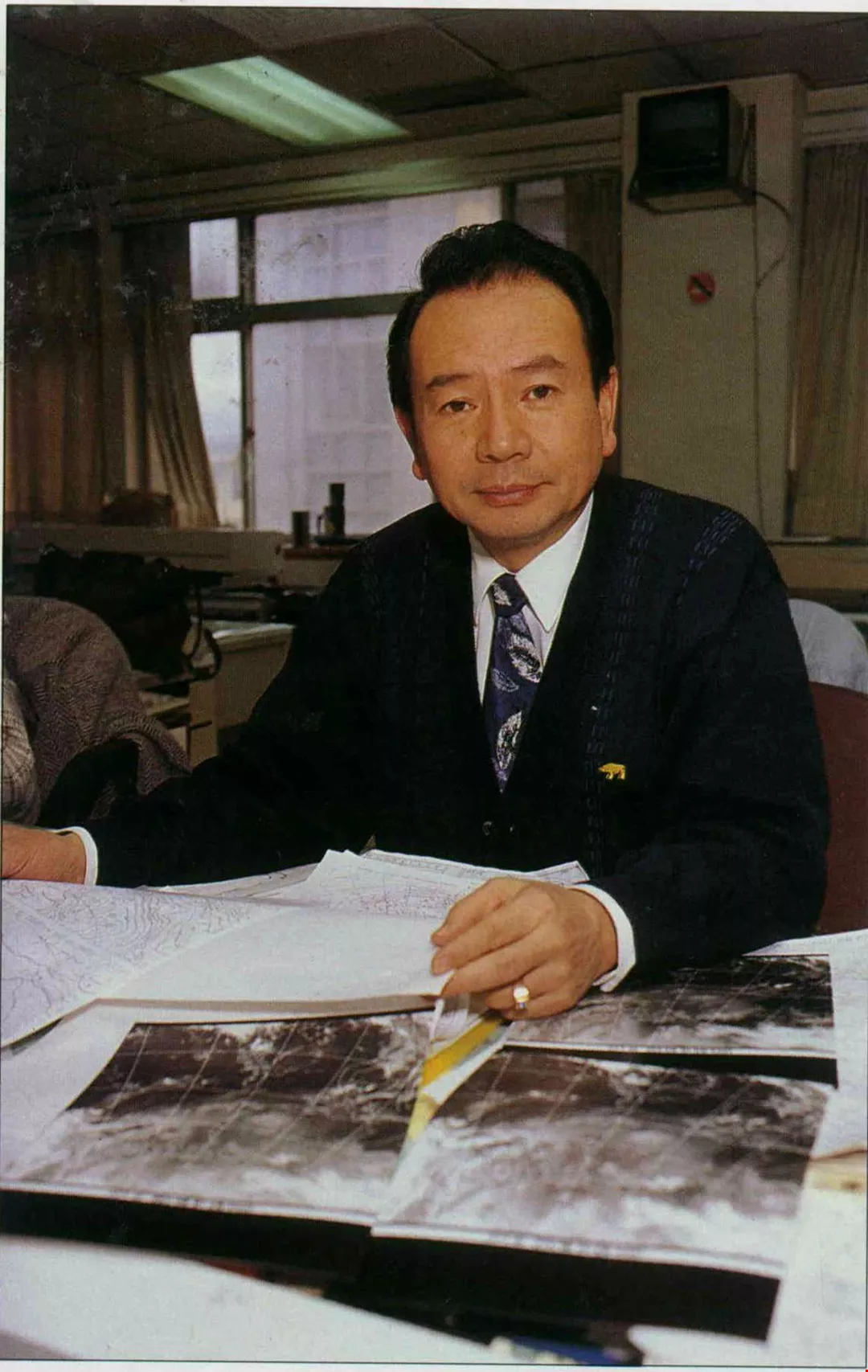
He has spent a lifetime as a civil servant broadcasting the weather. Even though he has now transferred to TTV, he still has to go every day to the meteorology station in order to study weather data, and to analyze the changes in weather so as to ensure total accuracy.

The weather forecast data are changed once every six hours, and behind all this is the tough life weather forecasters must lead since they must work twenty- four hour shifts. (photo by Cheng Yuan-ching)

In order to look his very best before the camera, every time Jen Li-yu appears on screen he must first shave and spruce himself up.

Seated at the computer, Jen Li-yu plans the charts for the evening weather forecast with the help of the graphic designer.
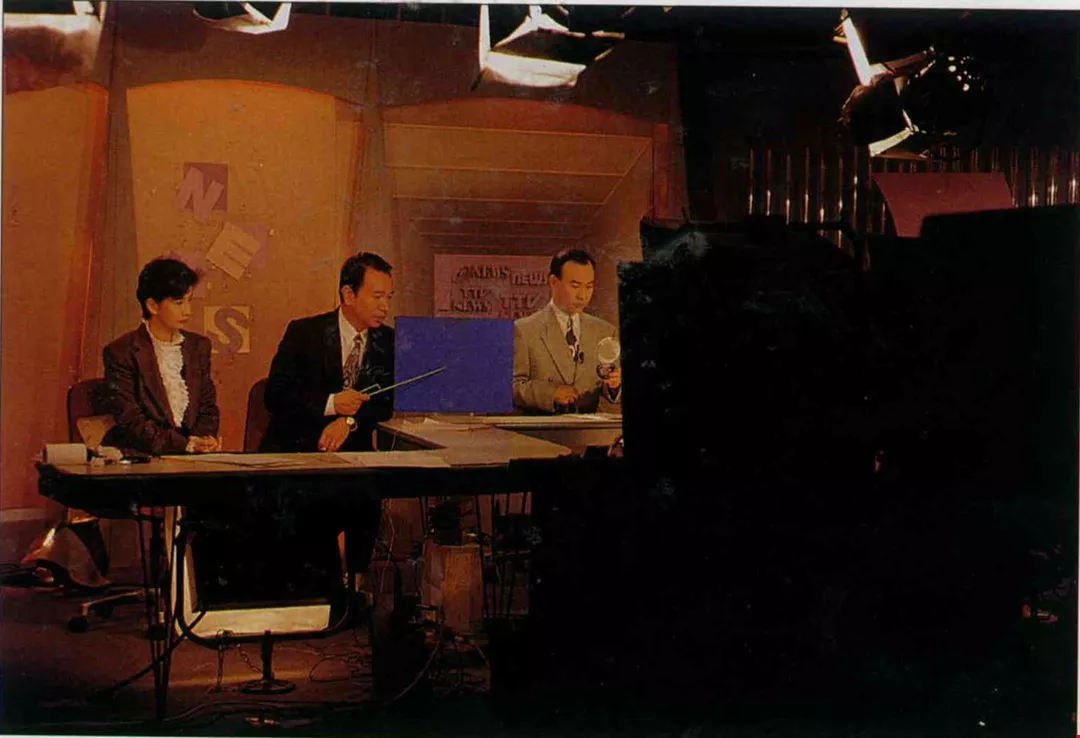
Jen Li-yu is quite simply like our next-door neighbor. But he has become a public figure ever since he drew the attention of the media.
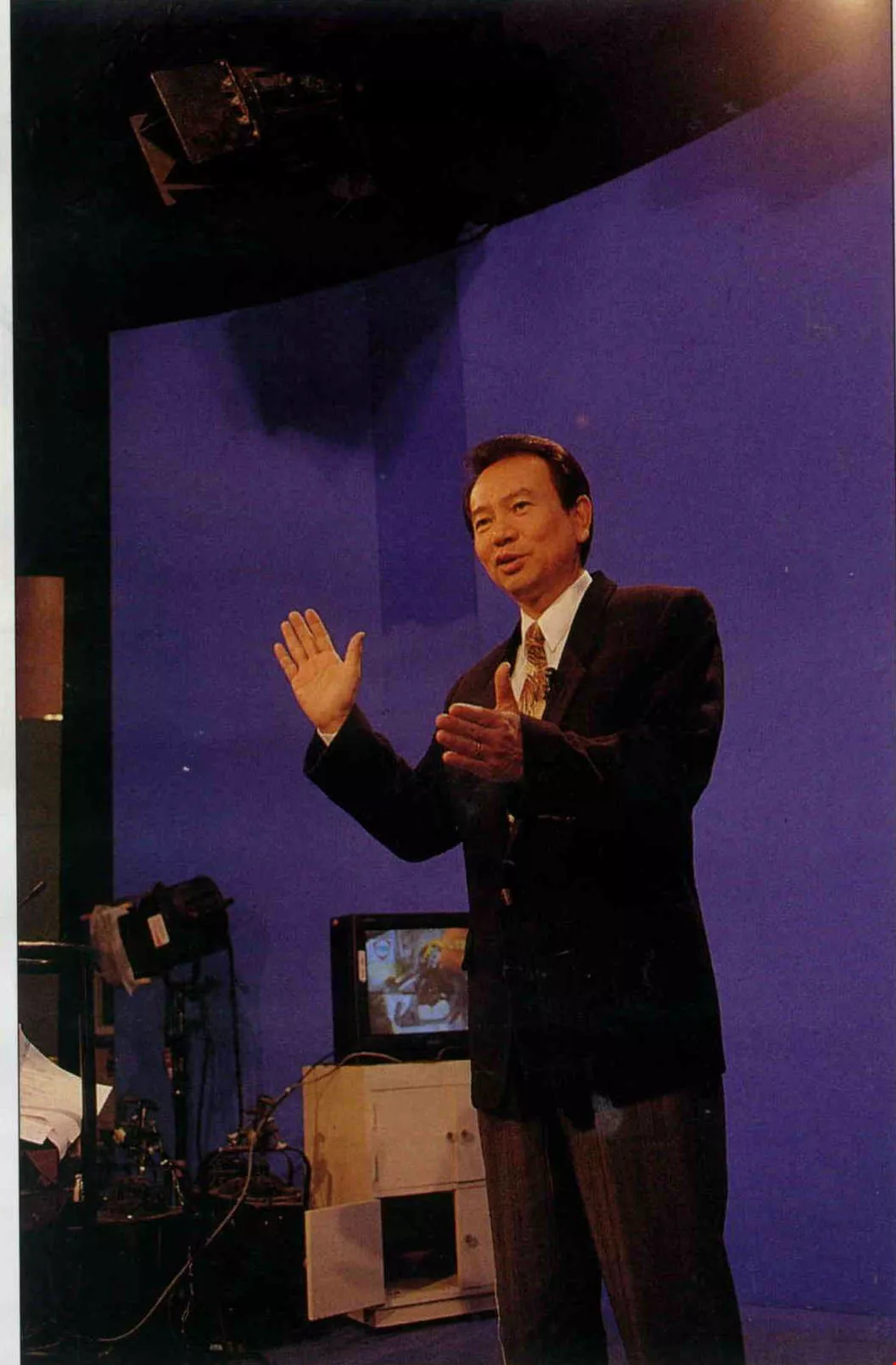
On the TV screen the audience sees Jen Li-yu standing in front of the weather chart explaining it in a forthright manner. But as a matter of fact, when in the studio, he stands in front of a backdrop of blue paper gesticulating in mid-air in front of the camera, like "someone demented," as he puts it.

Changes in the weather whether great or small influence the minutest details of daily life with respect to food, clothing, habitation, and transportation. And hence weather sense is something which no family can do without. (Sinorama file photo)

Of all the natural disasters in Taiwan, typhoons and floods are the most common. This makes the weather forecast all the more important. (Sinorama file photo)


@List.jpg?w=522&h=410&mode=crop&format=webp&quality=80)


