From Sandstorms to Dolphins--Saving Changhua's Coast
Coral Lee / photos Jimmy Lin / tr. by Jonathan Barnard
August 2007


When you mention Taiwan's west coast, beautiful sand beaches, piers and lagoon sunsets come to mind. But recently it has offered another strange and impressive vista: a desert along the Changhua coast. Particularly in the fall and winter, when the northeast winds blow, the dust and sand storms here can rival Beijing's. The desert is caused by the "groyne effect," which describes how sand accumulates on the updrift side of breakwaters. Here it has created a little desert of 300 hectares, equal in area to 12 Chiang Kai-shek Memorials. It is north of the long-deserted Lunwei Industrial Zone, site of the proposed Changkung thermal power plant, which created a lot of controversy recently when it failed its environmental impact assessment.
At 63 kilometers in length, Changhua County's coast does not even comprise 5% of Taiwan's coastline, but it includes mudflats and oyster fields that are unlike any others in Taiwan. It also is home to the controversial Changhua Coastal Industrial Park, Taiwan's largest. Over the last half century, this stretch of coast has experienced widespread land reclamation, the rise and fall of fish farming, industrial parks and pollution--all of which have brought sudden changes to the coastal ecology. Today, as we face climate change and other environmental hazards, what lessons can this coast and its history teach the people of Taiwan?
The Changhua coastal desert is all the rage in Taiwan photography circles. Its wide expanses of sand and rock, punctuated by only a few plants, may not compare with the Gobi in scale. Yet it startles people to find that such a landscape exists in Taiwan's largest industrial park. At the side of the road there is a birdwatchers' screen that used to be the height of a man but is now almost entirely buried in sand. With its forlorn beauty, the place has served as the backdrop for many a music video and television commercial in recent years. Near that birdwatching screen is a triangular sandy bay beach of 50 hectares. It is known as Joutzungchiao ("Meat Dumpling Point," after pyramid-shaped zongzi dumplings), and its yellow barren expanse is covered with small dunes.
Tsai Chia-yang, a post-doctoral researcher at Tunghai University, has conducted research into the Eurasian curlew and other water birds in the ocean nearby. He has observed continuous change to the Changhua coast over the past 20 years. With regard to the Lunwei Industrial Zone desert, he says the culprit is a breakwater sticking out into the sea at Joutzungchiao.
The Changhua Coastal Industrial Park includes three separate areas--from north to south, Hsienhsi, Lunwei, and Lukang. As part of a plan to build a water park in Lunwei, work began in 1996 to reclaim land from the sea, Tsai explains. First, a breakwater was built that stuck out into the ocean at a 90° angle. According to plan, they would have also built a sloping dike to form a triangle with the breakwater and the beach. The triangle would then have been filled with earth. But before construction was finished, the opening up of mainland China to Taiwanese investors began to have an unanticipated pull on Taiwanese investment dollars. With the project suffering from a lack of money, the Industrial Development Bureau pulled the plug on it. The breakwater from the project, however, continued to block tides from the north from entering Joutzungchiao. (See photos, below.)
Comparing an earlier satellite photograph of Joutzungchiao with a current one, Tsai Chia-yang notes, "Before they built that breakwater, this expanse was a wet tidal flat. After it was built, both its southern and northern sides were exposed to the air, and tidal water could not enter. It gradually dried up. During the season of strong northeasterly winds, sand gets blown to the southwest, accumulating at the Lunwei Industrial Zone. It has been building up for ten years, so that now it forms a 300-hectare "desert." Geographers say that unless the problem is dealt with, the "desertification" crisis will only grow worse.
Only 63 kilometers in length, the Changhua coast has unique mudflats and the controversial Changhua Coastal Industrial Park. The history of coastal development here has been subject to great vicissitudes of fate. The photo shows the desert-like Lunwei Industrial Zone.
The windier, the dustier
From the standpoint of wildlife conservation, Tsai worries that the change here is detrimental to the Eurasian curlew, a migratory bird that winters in Taiwan and whose numbers are declining. And he issues a warning about declining local air quality.
"Theoretically, when the wind is blowing, the air should be better," he says, but he notes that when you look at air quality data from the Environmental Protection Administration (EPA), you discover that the stronger the northeasterly winds, the higher the number of suspended particles. The concentration of PM2.5 suspended particles (particles with diameters up to 2.5 microns) shockingly can reach 1000 micrograms per cubic meter. That's at the level of a sandstorm.
In response, Hsu Chi-huang, chief of the air quality control section of the Changhua County Environmental Protection Bureau, notes that several air quality monitoring stations on the west coast of Taiwan have reported high levels of PM2.5 particles in the winter and that there are numerous sources of PM2.5 particles, so he contends that it is not clear that Hsienhsi's air quality problems are the result of sand and dust storms.
Yeh Hsuan-che, a renowned doctor who has worked in Lukang for more than ten years, thinks differently. His clinic has seen many more cases of asthma and allergic rhinitis in recent years. In particular, there are high rates of respiratory ailments among those who leave the area to attend college and then return on vacation. There are also people who had never previously been asthmatic but suddenly suffer bouts of asthma once they move to Lukang. These cases have alerted him to the rapid deterioration of local air quality.
"A PM2.5 particle--a particle with a diameter of 2.5 microns or smaller--is extremely small," explains Yeh (1 micron equals 1 millionth of a meter). PM2.5 particles are even more damaging to the respiratory tract than PM10 particles, which are more widely discussed. These tiny airborne particles get lodged in the capillaries at the end of the respiratory tract and are almost impossible to remove. The US Environmental Protection Agency began regulating PM2.5 particles as pollutants in 2002, but there is still limited understanding about these particles in Taiwan.
Lin Tsung-yi, a professor of geography at National Taiwan Normal University and an expert on airborne particles, points out that along the shore there are two types of airborne particles: sand and dust. Sand is larger and usually only gets kicked up a little above the surface. The dunes in the Lunwei industrial area are made of sand. But dust particles of 62.5 microns or less, which are not visible to the naked eye, float around suspended in the air. Not only can they travel much farther than sand, but they remain in the air for much longer. He believes that the sand and dust at the Changhua Coastal Industrial Park may not now constitute a clear public menace, but the problem is bad for people's respiratory tracts, and it needs a long-term solution.
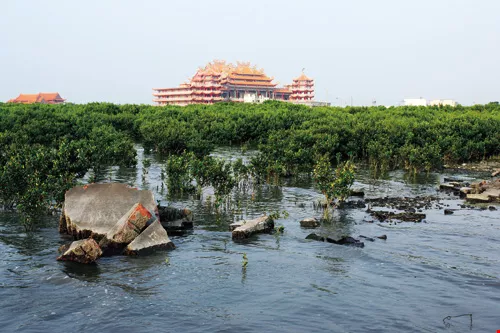
The large mangrove forests found at the mouths of rivers in northern Taiwan serve to protect the coastline there. But mangroves are destructive to the mudflats of Changhua.
Out of sight, out of mind
Tsai Chia-yang, director of Changhua Coast Conservation Action, is trying to draw attention to the health threat posed by the dust at Joutzungchiao, as well as the traffic danger it poses by limiting the vision of drivers in the industrial park. He has got in touch with relevant government agencies, and proposed several solutions that shouldn't be difficult or financially onerous, such as planting beach morning glory (Ipomoea pes-caprae) to stabilize the sand, or spreading crushed oyster shells to keep the dry sand covered. Otherwise, the government could tackle the problem at its root by demolishing the breakwater and thus allowing seawater to moisten Joutzungchiao so that it would return to being a beach. Tsai is frustrated that no one inside the government has given the problem much attention.
When there are public safety or pollution problems facing remote, sparsely populated coastal areas, few people apart from fishermen are directly affected, so it is hard for these issues to gain society's notice. Consequently, the situation can linger for a long time. Perhaps that explains why industrial parks have been gradually moving toward the shore over the last 20 years!
"Coastal land is easy to obtain and is close to ports, facilitating the transportation both of raw materials to factories and finished goods from them," writes Professor Chang Chang-yi of the geography department at National Taiwan University. "And these sites are right next to the sea, so it is easy to dispose of industrial effluent. Consequently, Taiwan's industrial parks are mostly located in coastal areas." Chang notes that the Kaohsiung's Linhai Industrial Park, Tainan's An-Ping Industrial Park, Pingtung's Linyuan Industrial Park, and the Taichung Harbor Industrial Park from the early era of industrial parks, as well as the more recently built Coastal Industrial Park in Changhua and Mailiao 6th Naphtha Cracker Industrial Park in Yunlin, were all placed on former tidal flats. These large development projects have had a much greater impact on the environment than the agriculture and fish farming that predominated along the coast in earlier years.
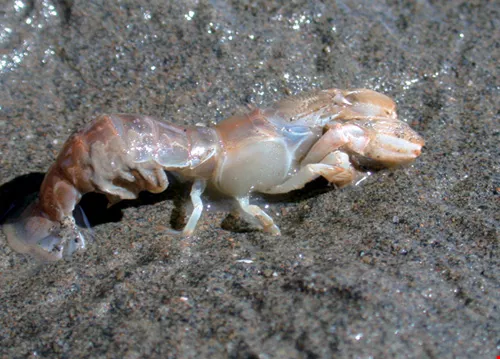
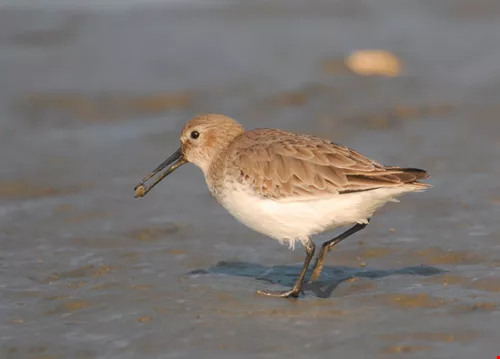
The vast mudflats of the Changhua coast are a paradise for many species of foraging water birds and benthic organisms. The photos show, from left to right, Eurasian curlews, a dunlin, a mud shrimp (Upogebia sp.), and a fiddler crab (Uca formosensis).
The goose that lays the golden eggs?
Going back through the history of Taiwan's coastal development, one sees that more than three centuries ago, during the rule of Ming loyalist Zheng Chenggong (Koxinga), Han Chinese settlers were already building dikes in the shallows to collect salt and to raise milkfish and other kinds of fish. Through the Qing dynasty and Japanese colonial rule, the shore was continually being developed. The raising of oysters and planting of sugar cane came later. Throughout those years, however, development was mostly on a relatively small scale and wasn't yet mechanized, so that "its impact on the environment was relatively minor," says Kuo Chin-tung, professor of hydraulic and ocean engineering at National Cheng Kung University.
Fast forward to 1949, when the ROC government had just decamped to Taiwan. In order to increase food production, retired soldiers were mobilized to reclaim land along the coast on a large scale. Apart from land that was used for agriculture and fish farming, they also developed residential and industrial land. Fortunately, individual plants were not allowed to surpass 1000 hectares. And when it came to fish farms, they abided by the principle of using dikes but adding no fill. Since the dikes were not particularly high, their impact on the environment was limited.
By the 1970s, Taiwan had entered the era of developing large-scale industrial parks, and the situation had drastically changed. Many huge industrial parks were within six kilometers of the shore, and the seawalls and dikes protruded 30-40 meters out into the sea. Intensively developed areas of coastline extended for ten or 20 kilometers. "It was the world's largest coastal development plan," says Kuo Chin-tung. Furthermore, most of the development involved heavy industry, such as petrochemicals, electricity, and cement; port facilities were secondary. That had far-reaching implications.
What really makes people's blood boil is that the facilities created by this large-scale construction have not been fully utilized.
"For the last 20 years, the occupancy rate in Taiwan's industrial parks has been low everywhere, and in the Changhua Coastal Industrial Park it has been less than 40%," notes Nien Hsi-lin, an instructor at Lukang Community College and a veteran of environmental movements. The desert in the Changhua Coastal Industrial Park may be the most photogenic example of this low occupancy rate, but it is hardly the only one. For the past ten-plus years, there has been an exodus of factories, leaving many areas of industrial parks to become little more than breeding grounds for mosquitoes. But lacking a comprehensive assessment of the demand for industrial areas, the relevant agencies have continued to develop industrial and science parks, causing more environmental damage.
Regarded as "remote" and "useless," the seashore has not only had to shoulder the burden of industrial production; it has also been forced to accept nuclear power plants, which most people avoid like the plague, as well as garbage dumps and sewage. The coast has also been the site of transportation infrastructure projects, such as airports, harbors, highways and so forth. All these "developments" and "uses" have wreaked havoc on the sensitive shoreline.
The vast mudflats of the Changhua coast are a paradise for many species of foraging water birds and benthic organisms. The photos show, from left to right, Eurasian curlews, a dunlin, a mud shrimp (Upogebia sp.), and a fiddler crab (Uca formosensis).
Dolphins facing extinction
Kuo Chin-tung points out where the industrial parks now stand, there were once plants and animals living on sandy beaches and seabeds. That habitat was destroyed forever. Furthermore, structures such as breakwaters that extend into the sea disrupt the action of waves, causing reflection, refraction and diffraction. When fill is added, it changes water depth and water position, altering in turn the flow rate of currents.... Shaped by nature over long periods, the shoreline has been damaged and thrown out of balance by man in various different ways. Some areas of shoreline have experienced erosion, others accretion. Everywhere the shoreline ecology has changed dramatically. Many animals and plants haven't adjusted well to these dramatic changes, and their numbers have greatly diminished or they have disappeared from these Taiwan coastal ecologies altogether.
The Chinese white dolphin is one of the casualties of shoreline development. According to a study by the Formosa Cetus Research and Conservation Group, the isolated native population of Chinese white dolphin that lives within five kilometers of Taiwan's southwest coast today numbers less than 200. The situation is dire.
The group points out that there are many large developments along Taiwan's southwest coast, and the reclaiming of land from the sea has naturally shrunk the living environment of these dolphins. Construction creates low frequency vibrations, which harms their sonar organs and can even be fatal. Moreover, effluent from the coastal science parks of central Taiwan has seriously affected inshore water quality, and the weirs on the Tatu River have reduced the volume of silt flowing into the sea. The impact of such changes has brought the Chinese white dolphin to the brink of extinction. Conservationists are raising a ruckus, but the cause is stuck in the usual debate about the environment vs. the economy.
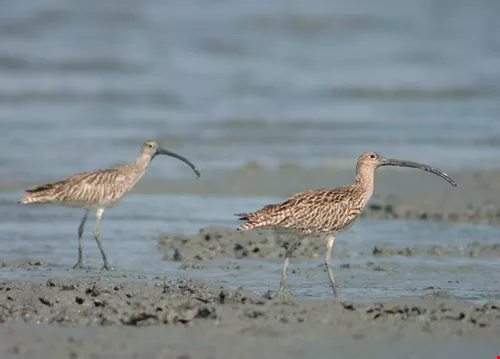
The vast mudflats of the Changhua coast are a paradise for many species of foraging water birds and benthic organisms. The photos show, from left to right, Eurasian curlews, a dunlin, a mud shrimp (Upogebia sp.), and a fiddler crab (Uca formosensis).
Garbage dumps, abandoned fields
"Although the Changhua coast is just a short 60 to 70 kilometers, there are environmental problems everywhere," Tsai Chia-yang declares. Not far from Joutzungchiao's breakwater is a landfill used by the townships of Hsienhsi and Shenkang. A pile of garbage nearly half a story high sits exposed, stinking to high heaven. Passersby just hold their noses and drive fast. The only signs of life are cattle egrets that pick at the garbage and stare out to sea.
The Changhua County Environmental Protection Bureau has long hoped to shut the landfill down, but it lacks the money to transport the garbage to incinerators. It has applied to the EPA for environmental reconstruction money, but because there are details that the two townships have still to agree on, nothing has been done so far.
When you pass the Changhua Coastal Industrial Park, you encounter, from north to south, Fuhsing, Fangyuan and Tacheng Townships. Each of these townships' coasts has its own problems.
The Fupao and Hanpao wetlands in Fuhsing were once centers of Changhua's farming and fish farming industries. Fish ponds and farmers' fields were spread throughout the area. The long-term pumping of water and consequent land subsidence and infusion of seawater salinated the soil, and since the year 2000 farmers and fish farmers have been leaving one after another. The abandoned fishponds and fields have attracted large numbers of water birds. Changhua Coast Conservation Action rented some abandoned fishponds and ran them as a water bird habitat, hoping that it would lead to the development of local eco-tourism. For a period it attracted a lot of attention and a steady stream of school groups.
But ecological tourism doesn't seek profit as its main goal, and the economic gains were not as much as residents had hoped. Seeing the constant stream of people, local critics began to ask: "Why is the community getting such small reward for it?" Furthermore, some of them had doubts about the ecological group's financial reports. It kindled great animosity on both sides. They went their separate ways, and the ideal of an ecological park fell silent for many years. This year the county government allotted some funding in the hope that a tourism center would be reestablished. It remains to be seen what will come of it.
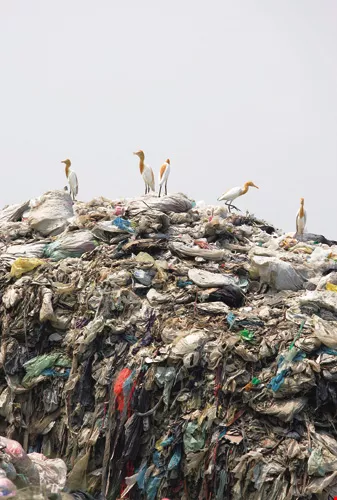
This garbage mountain juts up along the shore without anything to cover it. Beautiful cattle egrets pick at the trash and stare out to sea.
The dangers of mangroves
Driving farther south, you hit the Fangyuan coast. It's an area of broad tidal flats, where you can look out across seemingly endless expanses of sand and mud. From the coastal dikes to the water at low tide, it's six kilometers. Various kinds of shrimp, crab and shellfish live here, including many unusual species such as mud shrimp that build their nests on shore. There are also mactra and other wild clams. The rich biodiversity attracts nearly 200 species of birds each year to forage. In fact, there used to be broad tidal flats along the entire Taichung and Changhua coast. Sadly, the mudflats of Taichung were destroyed in the 1980s when they built coastal industrial parks and coal-fired power plants. Now all that's left is this area in Changhua. Ecologists see it as a great treasure.
Tsai Chia-yang explains that the tide range here along the central coast is the greatest anywhere in Taiwan, because it's where the Philippine current from the south meets the ocean current from the north. They bring in a lot of seawater, and as both tides roll out, they also pull a lot of water with them. There's a five-meter difference between high and low tide. The farther you go north and south from here, the smaller that difference becomes. At Kaohsiung and Keelung, there is only a one-meter difference. The large tidal range coupled with the flat coastal topography creates tidal flats that are more expansive than in any other area of Taiwan.
What's more, because the tidal flats of Changhua are mudflats, they are naturally used to being washed over by seawater. "There's no need for mangrove forests or breakwaters with armor blocks," says Tsai Chia-yang. He points to the large planted mangrove forests of Fangyuan with some regret. He notes that the mouth of the Tanshui River up north is sandy. It has loose soil that erodes easily, so that mangroves serve a stabilizing function there. For that sort of coast, it is an excellent tree. Yet mangroves have an altogether different effect on the mudflats here.
Mangroves moderate the tidal flow and speed the accretion of mud, so that some species of wildlife that are ill suited to this transitional mudflat ecology, such as the fiddler crabs Uca formosensis and Uca lactea, give way to other species, such as Uca arcuata. Thus, the animals and plants change, and over time the beach turns into land, and the mudflats and their special ecology are gradually eliminated.
Mangroves grow extraordinarily fast, their shoots spreading out toward the sea with the tide. Consequently, during Arbor Day last year, Chia organized local school kids to go to the shore and pull out mangroves, and he is calling for a stop to the mistaken policy of planting them here.
Tacheng Township is located at the extreme south of Changhua County. In recent years the county government pushed to get rid of its coastal conservation area designation, hoping to build a Tacheng Industrial Park that would relieve hard economic times for local residents.
The industrial park "would deal a mortal blow to the Changhua coast," says Tsai. From Fangyuan to Tacheng is the largest pristine stretch of shoreline in Changhua. Because the coast from Fangyuan northward has all been reclaimed from the sea, this original pristine beach and its ecological systems are particularly precious. Even more frighteningly, the Tacheng Industrial Park is slated to include high polluters such as petrochemical and steel plants. "As soon as Yunlin refused Kuo Kuang Petrochemical, the company turned its attention to Tacheng. If the industrial park is allowed, it will wreak havoc on the Changhua coast and the Choshui River estuary."
Having seen the Changhua coast transformed, Tsai Chia-yang has been actively working to rally related organizations around this cause, calling for everyone to make a last stand for the Changhua coast. "We respect people's right to development, but human benefit cannot trump benefit to the whole coastal ecosystem," he says.
On the way back to Taipei from Tacheng, the vast mudflats, the rows of oyster racks, and the men and women carrying them offer the very picture of a tranquil fishing life. Not far away trucks rumble on the elevated highway, bearing witness to the profit-oriented mindset of industrial civilization. How will people choose? When will they finally learn to live in harmony with nature?
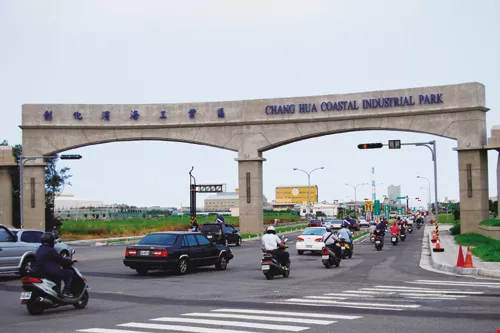
The Changhua Coastal Industrial Park at more than 3600 hectares is split into three separate areas: Hsienhsi, Lunwei and Lukang. Construction began in 1979 but was stopped amid a worldwide recession. Then, after construction had restarted, manufacturers began to pull up their stakes to head abroad in the 1990s. Currently, only the Lukang area has a relatively high occupancy rate. Here it is seen during morning rush hour.
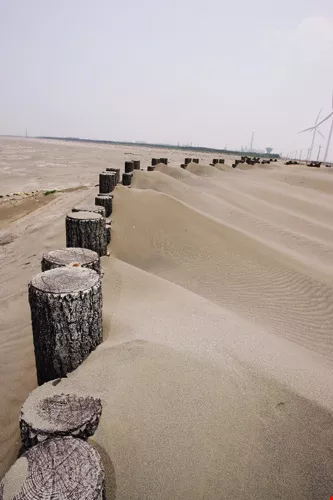
A long birdwatchers' screen that was high as a man has now been almost entirely buried by sand. The unusual landscape attracts photographers and sightseers.
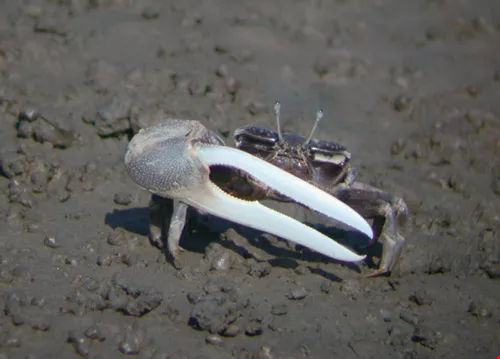
The vast mudflats of the Changhua coast are a paradise for many species of foraging water birds and benthic organisms. The photos show, from left to right, Eurasian curlews, a dunlin, a mud shrimp (Upogebia sp.), and a fiddler crab (Uca formosensis).
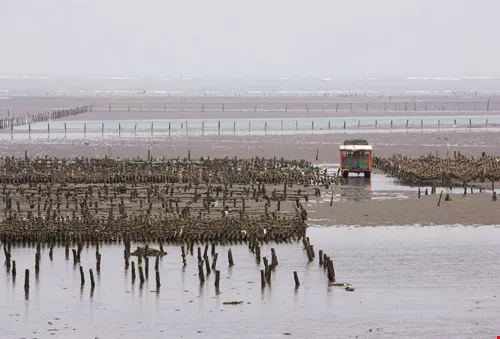
Oystermen work the coastal mudflats as they have for centuries, the very picture of tranquil fishing life. Whether they can continue to do so is a question that mankind will have to answer.

@List.jpg?w=522&h=410&mode=crop&format=webp&quality=80)


@List.jpg?w=522&h=410&mode=crop&format=webp&quality=80)
@List.jpg?w=522&h=410&mode=crop&format=webp&quality=80)
