Jason Hu: Taichung, a City for the World
Coral Lee / photos Jimmy Lin / tr. by Chris Nelson
March 2011


Jason Hu, eight-year mayor of Tai-chung City, who adheres to a philosophy of running the city like a shopkeeper, has been newly elected as the first mayor of the new Tai-chung City, a special municipality created by the old city's merger with the old Tai-chung County. Thus he takes on the great responsibility of heading the prosperous development of Taiwan's central region and facing global competition. Hu, with his international vision, has been hailed by the British media as one of the world's top ten mayors, and his good-natured personality has won him the highest approval ratings among all the heads of Taiwan's counties and cities.
Hu, who says he has been planning the course of Greater Tai-chung's development from the start, found time in his busy post-Chinese-New-Year schedule to interview with Taiwan Panorama, and outlined the three facets of his post-merger city development plans and his dream of building the Tai-chung Gateway Park City.
Will his urban development plan for Greater Tai-chung place the original Tai-chung City in the center, with the 21 cities and townships of the former county as satellite cities, or will it follow the "polycentric" model of European cities? Hu explains the three major facets of his idea:
First, the original Tai-chung City will be the city center: the better the central district develops, the better its influence will radiate out into surrounding towns and cities. He maintains that when the city and county were separated there was a constant tug of war between them, detrimental to both. Now that they're merged, they can be treated as a whole.
Next, Hu uses the analogy of the motions of the solar system. The solar system consists of more than just the sun: there are eight major planets revolving around it. Thus if the surrounding towns and cities wish to develop their strengths, they can do so without challenging the city center. For instance, there is the Hakka culture of the mountain communities, the vistas and Aboriginal culture of He-ping, the religious gatherings of Da-jia, the coastal scenery, the influence of the High Speed Rail access in -Wuri, and the development of Tai-chung Harbor, and of Taichung Airport at Qing-quan-gang: each has its advantages, and all of these should be allowed to develop on their own to preserve their natural features; the city center's radiating influence should not be the sole arbiter of their course of development.
The third is his vision for the central region of Taiwan, which includes Greater Tai-chung, Chang-hua, Nan-tou, and remoter locales such as -Miaoli and Yun-lin. While developing Greater Tai-chung, one cannot overlook Nan-tou's ample tourism resources such as the mountainous scenery of Sun Moon Lake, or the sale of agricultural products of Chang-hua like roses and fruit through the infrastructure of Greater Tai-chung. Now everyone is proceeding in pace with each other.
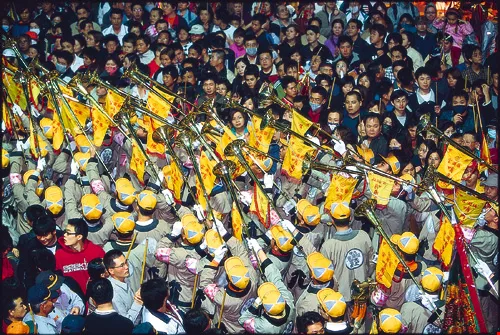
The thronging Dajia Mazu Pilgrimage has become an international-scale religious gathering in recent years. If the event can grow into a Mecca-like center for Mazu worship, some 150 million devotees around the world will make pilgrimages here.
What are the key projects involving these "planets"? Which have priority?
Hu says that from the time he was elected, he has been vigorously carrying out his plans. The first matter is to "understand the space in which we live"; in other words, to do a full review of the urban planning for the Greater Tai-chung area. In the past, Tai-chung City would implement its own plans, while those for Tai-chung County were distributed among the cities and townships, and as such there was no overall planning for the region. After the merger, however, the overall course of development needed to be reexamined.
Next is a five-part plan. The first part is a cable-car project, with the Da-keng-Xin-she line already approved, and with second and third phases comprising the Xin-she-Shi-gang and Gu-guan-Li-shan lines. The area from Dakeng to Xin-she can be thought of as Tai-chung's Yang-ming-shan, and one day Xin-she's "sea of flowers" flower festival will become an international attraction. Beyond Xin-she you can find the Hakka culture of Dong-shi and Shi-gang; indeed, the Hakka traditions of Dong-shi are resplendent, but are just not well known. The cable car can help showcase the Hakka culture of Greater Tai-chung.
Planning is already underway for -Houli's International Flower Auction Center, which is linked to the airport by the freeway. Unfortunately, the current capacity of Tai-chung Airport is too low and is no match for the Tao-yuan International Airport: items will still be shipped north for at least the next three to five years.
As to the plans to build Da-jia's Jenn Lann Temple into a mecca for Mazu worship that Hu often spoke of after becoming mayor, are there any concrete strategies in place? He says that for this year's ROC centennial celebration activities, Tai-chung offers the Da-jia -Mazu Pilgrimage. With 3 million people participating annually, it has become an important international festival, and with vigorous promotion over the long term, Da-jia has the potential to become a pilgrimage center for the world's 150 million -Mazu devotees.
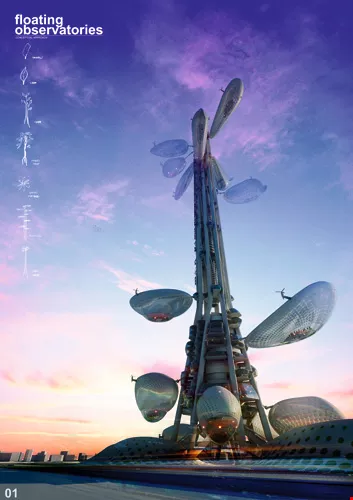
Over 300 meters in height, the avant-garde Taiwan Tower will be located in Taichung Gateway Park City. It will become a new landmark for Taichung, but once built, it will be a great challenge to operate.
On the day I conducted the interview, a splendid groundbreaking ceremony for Tai-chung Gateway Park City was taking place. It was a project that Mayor Hu had proposed during his first term, and is Tai-chung City's biggest ever construction project, with an area of 254 hectares, located at the Shui-nan Economic and Trade Park on the site of the former Shui-nan Airport. In coordination with the central government's plan to establish an airport for the central region, the airport was relocated in 2004 to Qing-quan-gang, opening up this parcel of land for use.
The overall planning for Tai-chung Gateway Park City is being done by Stan Allen, dean of Princeton University's School of Architecture, in conjunction with the local construction company Dra-gon-polis Engineering, for a total cost of around NT$100 billion. Hu hopes that having a local conglomerate pool its assets and carry out the construction will be a good local investment opportunity. With smart facilities, low carbon and harmony with the environment as its overarching vision, Tai-chung Gateway Park City will incorporate "four bigs"-a big park, a big academic center, a big stadium and a big convention center-as well as a tower representing the spirit of Taiwan to commemorate the nation's centennial. The first phase of road construction was scheduled to begin February 11, with the project expected to take six years to complete.
Hu calls Tai-chung Gateway Park City the "Eye of Taiwan." During initial planning, he encountered the greatest resistance against reserving 80 hectares for parkland in the form of opposition from high levels of government who thought that it should be sold off for revenue. They pressured him throughout the planning stage, "but I didn't budge," states Hu proudly. What other city has been able to retain such a large expanse of green parkland as the "lung of the city" after more than three centuries of development, and has managed to overcome pressure and keep it?
And in this "Central Park" of the -Greater Tai-chung area, Taiwan Tower, symbolizing the spirit of Taiwan, will be erected. Romanian architect Stefan Dorin clinched the win in an international competition for his "floating observatories." At 390 meters tall, the tower, shaped like Hometree from the movie Avatar, will include a city vision museum, and a viewing platform with vistas stretching as far as the Taiwan Strait.
After the second phase of the design feasibility assessment this year, the groundbreaking will be scheduled for Double Tenth Day. The construction cost is NT$5.9 billion and the estimated completion date is 2015.
Taiwan Tower awes the worldHu triumphantly declared that Taiwan Tower's design has awed the international community. Like the Taichung Metropolitan Opera House, he says, we want this to be built the best, or not at all.
In early February, Britain's Daily Mail printed a special on the future green cities of the world, mentioning Taiwan Tower and praising its avant-garde form. The architectural concept is based on a tree structure, with 12 leaf-like floating observation platforms filled with helium that can move up and down outside the body of the tower. Taiwan Tower boasts both solar energy and rainwater collection facilities, and the functional spaces within the tower will include offices, restaurants and museums.
Another 80 hectares of Tai-chung Gateway Park City will be College Town, a large, innovative research park. And the 80-hectare Tai-chung Gateway, a business zone, will feature a 5,000-booth exhibition center and an arena seating 15,000.
"The business facilities will foster education and the environment," says Hu. The plans for the park, integrating education, business and the environment into one, won the 2007 Progressive Architecture Award, meaning that it conforms to the spirit of progress and sustainable development
When I asked what concrete effects that park will have on the future of the Greater Tai-chung area, Hu paused a moment. He didn't need to say anything: that was "for everybody to see!

@List.jpg?w=522&h=410&mode=crop&format=webp&quality=80)


