Old Contracts--Documents with a Story to Tell
Ko Tzu-ching / photos Hsueh Chi-kuang / tr. by Christopher MacDonald
August 1995


Unlike antique vases and scrolls, which often fetch stupefying sums at auction, old contracts are generally worth no more than the price of an average tape cassette. To historians, however, the stories that such documents tell make them among the most precious of all artifacts.
It is early summertime, and historian Yin Chang-i, a professor at Fujen Catholic University, accompanies the owner of a small grocery up into the loft above the store. The owner picks a case made of premium hsiaonan wood from among the dusty miscellanca, and opens it to reveal a stack of over 100 old contracts.
These time-worn documents once represented swaths of prime farmland and heaps of harvested grain, and were hidden away as family heirlooms, but today they are virtually worthless. "They're useless to me," says the store owner, and he gives the case and its contents to Professor Yin.
For a scholar on the trail of historical records, such contracts are the most valuable form of firsthand material on local history. Yin therefore accepts the documents but returns the case, which is made of hsiaonan wood, and is likely to be worth far more to an antique dealer than the tattered papers it contained.
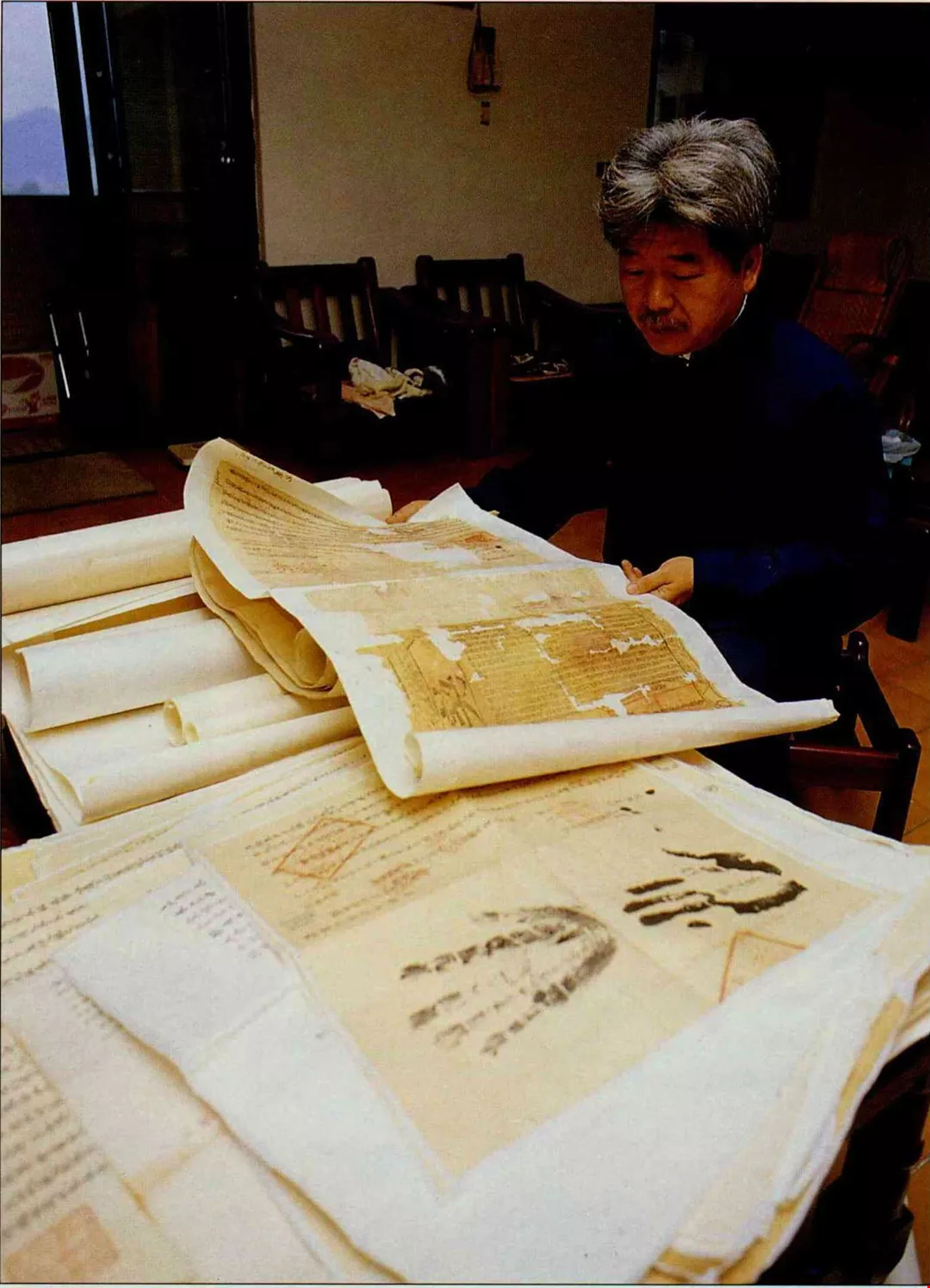
"In the field of research into Taiwanese history, old contracts have the most truth to tell,"explains academic Yin Chang-yi, whose collection numbers over 5000 contracts.
Unravelling history's mysteries
The Japanese volume A Cultural Chronicle of Taiwan makes mention of a permit that was issued in the year 1709, allowing one "Chen Lai-chang" to develop new farmland in northern Taiwan. It is the earliest record of land development in what is now known as the Taipei basin. The question is: Who was Chen Lai-chang, and how was he able to obtain exclusive rights to cultivate such a large area? For a long time there was no satisfactory answer. Both provincial and municipal records indicate that Chen came from Quanzhou in Fujian province, yet some scholars have speculated that Chen Lai-chang might not even have been a person at all.
The mystery was finally resolved with the discovery of a farming contract, the earliest such document found in Taiwan to date. The contract reveals that "Chen Lai Chang" was in fact the name of a joint venture between two main companies, Chen Tien Chang and Lai Ke. The document describes how Chen Lai Chang and its five subsidiaries cooperated to develop farming along the coastal belt from Linkou, Pali, Peitou and the entire Taipei basin, down as far as Taoyuan..
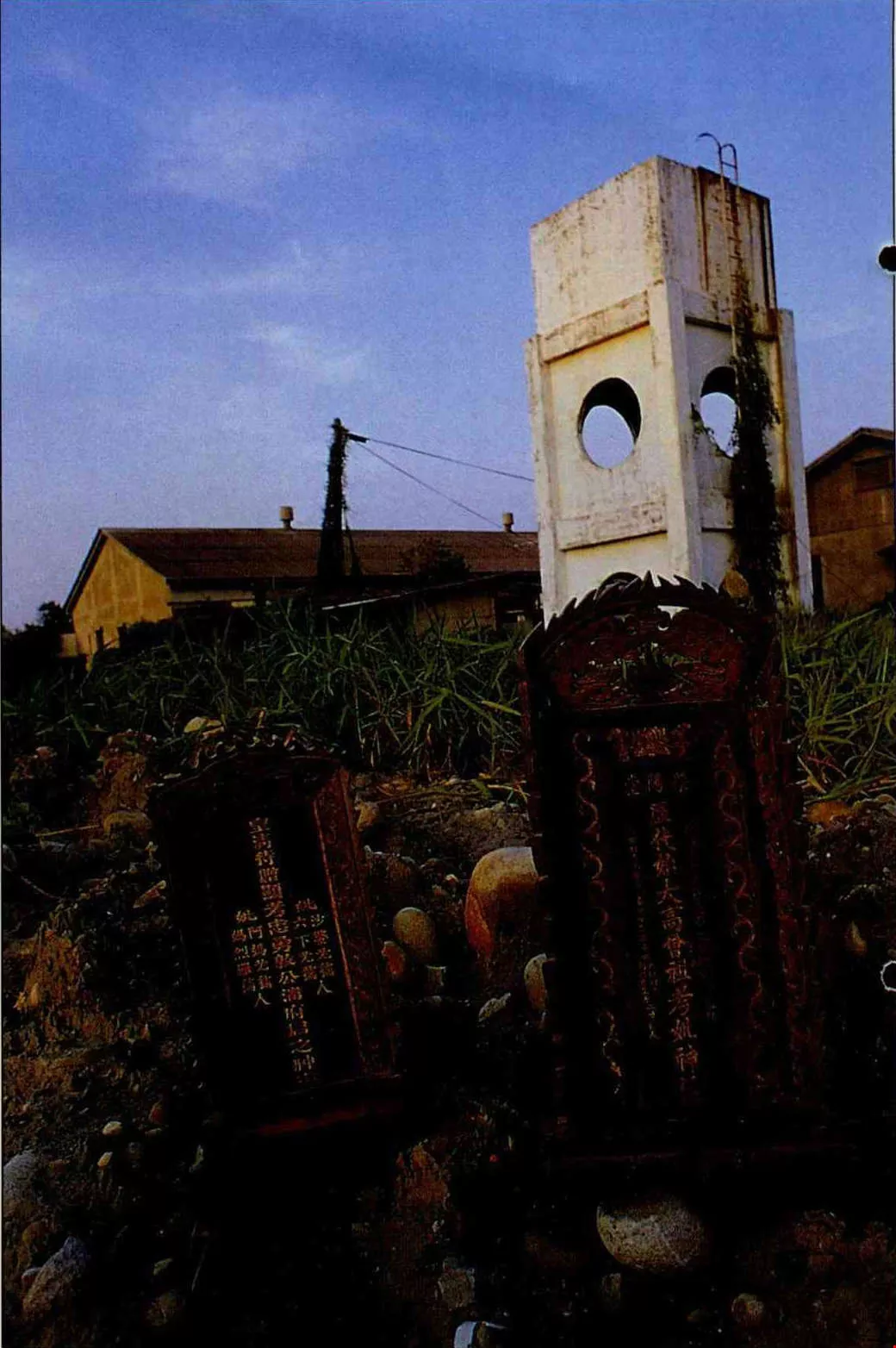
An ancestral tablet left by plains dwellers after their sinification. Research is difficult because they were highly sinified and didn't have their own written language. Contracts between Chinese and natives are thus doubly important. (photo below courtesy of Chung Chin-shui)
Processed history
The category of historical records known in Chinese as "ancient documents" includes contracts, indictments, letters and examination papers. The majority of such documents comprise fixed agreements regarding land, houses, levies, division of property, loans and indentured labor, and these are also the types of material with the highest level of historical credibility.
Yin Chang-i, who has discovered thousands of such contracts during the last few years, explains: "Among the five elements of historical research, namely people, events, time, place and artifacts, old contracts are classified as artifacts. In fact, they reveal far more than other types of artifact, and they are much more authentic than records that have been compiled by subsequent generations."
For example, the history books state that prior to 1888 there were over 60,000 jia (approx. 60,000 hectares) of land in Taiwan on which tax was being paid. When Liu Ming-chuan, the governor of Taiwan took stock of the land at the end of the 1880's, however, the cultivated area was recorded as 430,000 jia, and the figure grew to 770,000 jia ten years later when the Japanese conducted their own survey. This gives some indication of the quantity of "missing fields" that farmers left undeclared to avoid taxes. In some cases, the official records show that there was only 1,000 jia of land under cultivation in a certain district, whereas a contemporary contract reveals that at least 3,000 jia were being farmed. Yin Chang-i jokes that official records are "the processed version of history, never giving the true picture."
Contractual documents, in contrast, had an important bearing on the interests of both parties, and served as recognized certification, so they were that much harder to falsify. The fact that the documents are worth so little today also means that counterfeiters won't waste time on them. In other words, old contracts give a reliable, first-hand account of their era.
Witnesses to Taiwan's development
It was the Japanese who first discovered the value of Taiwan's old contracts, and began to collect them in volume. Considering it their responsibility as rulers to learn about the traditions, customs and systems of their subjects, the colonists launched a large-scale collection of old contracts in 1900.
"Old contracts have directly applicable value in the study of Taiwan's history, district records, society and legal system," says Wang Shih-ching, parttime researcher at the Academia Sinica's Sun Yat-sen Institute of Social Science and Philosophy. For example, contractual agreements regarding the sale of a son or an offer of marriage reflect traditions of the old society, while land titles are the best witness of Taiwan's history of development.
Settlers who migrated to Taiwan from the mainland during the Qing dynasty were not allowed to farm simply wherever they wanted. First they had to apply to the authorities for a license, testifying that the land did not encroach on territories reserved for the "recognized tribes"--the assimilated natives of Taiwan's plains. The alternative was to become tenant farmers, leasing unused land from the plains aborigines (ping-pu Tsu) and paying taxes in accordance with land area.
At every step in the process, from initial application through to lease agreement and submission of taxes, contractual documentation was used, showing the date and specifying the location, measurements and irrigation status of the land. Today, those same papers enable us to know when Han Chinese first moved into a certain area, and what names a place has been known by during its history. Furthermore, the specific figures they give for land area, sale price and taxation, make such contracts an invaluable resource for scholars researching the history of property prices and tax regimes.
Red contracts and white contracts
Some contracts were drawn up on behalf of groups of farmers, to safeguard the irrigation on which they depended in common. One such covenant from around 100 years ago, was an agreement by 13 farmsteads in the Kaomei district not to fight among themselves over water rights, which they had been entitled to since the early 18th century. The farmsteads were also obliged to act together if it was ever necessary to physically defend their water rights, and they would share any costs incurred in the campaign, resulting from injury, death, or court cases. At the same time, disputes among the families themselves had to be resolved through the intervention of a local leader rather than by resorting to the government authorities. Anyone who disregarded this rule would be penalized by the community and forced to pay for the staging of an opera by way of public apology. Life for the early settlers was tough indeed.
When land was sold, the seller would sometimes demand the payment of additional fees over and beyond the contract price.
Official approval was legally required for any transfer of title, and land belonging to the indigenous people could not be sold at all, but it was possible to bypass the regulations--to evade tax or to obtain reservation land--with private agreements known as "white contracts," in contrast to the "red contracts" that carried the seal of official approval.
The proliferation of white contracts for untaxed land sale, along with the exploding population and soaring property prices, meant that it was a sellers' market.
Signed with a circle and a dot
To guarantee the validity of a private contract transferring property rights, it was common to attach all previous contracts pertaining to that land, termed the "preceding contracts." Some old contracts have upwards of a dozen preceding contracts attached, spanning over a century of transactions, and today these are a valuable source of knowledge about the evolution of local place names. The multiplication of place names also helps researchers to know the level of development of a district at specific times, and indicates how Taiwan's cities took shape.
Since most people were illiterate in former centuries, the drawing up of a contract was usually entrusted to a professional scribe, with the contracting parties marking endorsement beneath their own names. This mark would usually take the form of a circle with a dot inside, to represent sincerity. Some people would write the character ping, expressing that the document was thereby "certified." Those wishing to be doubly sure would make a hand print, and write "freely accepted as certified" alongside, and footprints were even used sometimes, to indicate a contract that there was no running away from.
Although these contracts were really just private agreements, they carried as much weight as law. And it was not only the living who had to abide by their provisions--validity extended to the nether world, or so everyone believed. Hung Li-wan, a research assistant at the Academia Sinica's Preparatory Office of Institute of Taiwan History, has made a copy of one unusual contract for the sale of a gravesite. The text being with invocations to heaven and earth, then describes the location of the plot and explains that it is being purchased by a widower for his deceased wife. The amusing part is where the contract reports the propitious features of the surrounding terrain, and declares that if vicious demons ever seize control of the area then the contracting party will be entitled to bring an action against them in the court of the Jade Emperor. The demons will then have to be beheaded, without any clemency.
Selling sons
Contracts concerning taxes or property transfer were written on regular white paper, but the heartbreaking custom was to use red paper--of the type meant for weddings--when the object of the transaction was a person, for example a wife, child, maid, or a son- or daughter-in-law.
During the period when new territory was being brought under cultivation in Taiwan, there was always a need for more hands, and society very much favored the notion of families having numerous sons and grandsons. Contracts covering the sale of children into adoption were therefore very widespread. Poverty and hunger provided the main rationale for selling a son, along with heavy debt, and sometimes even the claim that the child was simply incompatible with the rest of the family. The contract would specify the price, and give such details about the child as his date of birth. The primary purpose of the contract was to show that the sale was final and absolute, certifying that the adopted child henceforward had no filial claims or obligations towards his natural parents, and was no longer their heir. This, according to Hung Li-wan, is what is meant by the saying: "If you sell a son you can't call his name; if you sell a field you can't walk across it any more."
Selling a child into adoption was never a matter of choice, but husbands who sold their wives usually regarded their women as chattels, and would generally blame the wife for having to be sold. One contract, which seems likely to be a wife-selling contract, records how a man named Wu Ah-huang, who had previously borrowed 100 yuan to get married with, objected to his bride's conduct and offered her for sale, on condition that the buyer paid 30 yuan in cash and took on the remainder of the original debt. Another contract tells how a 16-year-old bride in Changhua was sold by her husband's family for 30 yuan, because she had failed to produce offspring. In those days, women had the same status as beasts.
Trade in people
People could still be bought and sold like objects at that time, and the documents show cases of bonded maidservants who were free to marry out of the master's household on reaching the age of 19, but would be compelled to compensate the family by giving one of her future children to them as a replacement. The miseries of life as an indentured servant are further testified to by a "Missing Person" notice from the Japanese colonial era, seeking a maid who had fled after accidentally burning a mosquito net.
The contracts themselves were formal agreements of transaction, and did not therefore betray the distress that must have accompanied the sale of a child, but they nevertheless reveal a great deal about the misfortunes that people faced in traditional Chinese society.
The point of marriage, for example, was not the happiness of the couple so much as the need for male heirs to continue the family line. In a family with daughters but no sons, the parents would have to obtain a son-in-law able to take on the name of his bride's clan, so as to sustain the male line. In this type of "atypical marriage," explains Hung Li-wan, "the conjugal relationship was established primarily through the signing of contracts, and it was sometimes termed a 'contract marriage.'"
The contract stipulated how long the groom had to live with his wife's family, and in most cases required that the first-born son would become the male heir on the mother's side, while subsequent sons would revert to their father's family.
Bilingual contracts
There are two kinds of antique contract that can fetch four-figure NT dollar sums on the market today: those that are particularly old, and those with a dual text in both Chinese and an aboriginal language. The fascinating thing about bilingual contracts, which date from before the start of the 19th century, is that even 100 years after the Dutch left Taiwan, the Roman alphabet they introduced was still being used among the people of the plains to transcribe native languages. Effectively, it was their own form of writing, which might have survived if not for the subsequent influx of settlers and cultural assimilation by the Chinese.
Taiwanese history has become an increasingly recognized field of study during the last few years. Hung Li-wan has used information from contemporary contracts to write many papers on plains aborigines of the Taichung region. She explains: "the tenancy agreements between Han settlers and native landowners, and other native-language contracts left behind as a result of the policy of maintaining reservation lands, are a truly precious resource of information on the plains aborigines," who were already fairly sinified, lacked their own form of writing, and had lost much of their indigenous language.
These contracts cite many names of aboriginal settlements and individuals, along with local officials and Chinese interpreters, and give today's researchers valuable pointers to the distribution of settlements on the plain, their social systems, and the extent of Han Chinese encroachment on their lands. We know, for example, that plains society allowed women to inherit property, from the fact that many of the landowners referred to in tenancy agreements were female. This itself was an important factor for Chinese bachelors who migrated to the island, hoping to marry land in the form of a native woman.
The Anli settlements figure prominently in research on the plains aborigines. Because of the role they played in helping to subdue other aboriginal communities, they had land conferred on them by the Qing government, were given tax exemption, and were also granted their own Chinese surname: "Pan." Having undergone partial sinification and enjoying relative wealth, the people of Anli left reams of farm contracts behind them. Study of those documents reveals that in addition to the use of force and deception by the Chinese settlers, a major reason for the inexorable depletion of aboriginal territory was the fact that land rights were frequently ceded to the Han Chinese in return for irrigation and loans.
One pact, signed jointly on behalf of 30 aboriginal settlements, recounts how the people of the plains, including those from Anli, retreated inland en masse after losing a crucial struggle for land during the mid-19th century, and declares the Puli region their final home.
For any scholar of Taiwanese history it is of primary importance to examine contemporary materials, which is why old contracts are sought for collection by several different sections of the Academia Sinica, from the Institute of Taiwan History to the Institute of Ethnology, and by local cultural centers.
Antique dealers tend to come by the contracts unintentionally, in the course of buying articles of old furniture. Such documents may be found concealed in the bottom of a trunk, or offered for virtually nothing along with other items. Not understanding the historical value of such papers, dealers often let buyers pick out several from among a set of contracts, or only retain the ones with the most chops or patterns for decorative mounting. In fact, the real value of such contracts depends on their relation to the whole collection, through which the unbroken history of a family or place can be traced.
Chung Chin-shui, of Wuchi in Taichung County, is another purchaser of old contracts, collecting those that are of particular research value and making them available to scholars for no charge. Having once squandered a considerable sum on a job lot of fake antiques, Chung explains the pride it gives him to know that a guaranteed genuine contract he has purchased for only NT$150 can serve as source material for important work by so many academics. "I'm not in it for the money! It really feels good to see that they are referring to my documents in their research papers. The scholars of Taiwanese history put in 70% of the effort, but 30% comes from me too!"
If antique dealers could just make certain to provide photocopies for research institutions before breaking up a set of contracts or selling a whole batch overseas, then we could leave a better record for our posterity to trace the true history of Taiwan.
[Picture Caption]
p.49
"In the field of research into Taiwanese history, old contracts have the most truth to tell,"explains academic Yin Chang-yi, whose collection numbers over 5000 contracts.
p.50
An ancestral tablet left by plains dwellers after their sinification. Research is difficult because they were highly sinified and didn't have their own written language. Contracts between Chinese and natives are thus doubly important. (photo below courtesy of Chung Chin-shui)
p.51
Contracting parties needed a mediator, and would also apply their chops and make a mark of signature. In some cases a hand print was used as an additional guarantee of credibility.
p.52
Painting a circle with a dot in it testified to the sincerity of the signatory.
p.53
(Above) "Red contracts" such as this had been given the stamp of approval by officials. People often preferred to make private agreements, however, so as to evade levies or conduct illicit land transfers, on unmarked "white contracts." (courtesy of Chung Chin-shui)
p.53
(Below) A contract: essentially a commitment between two or more parties. Hence the use of documents split along a column of writing, with each side retaining half.
p.54
(Above) In an age without land surveying, it was usually trees or tracks that formed a natural boundary. Special maps were often drawn to specify the precise location of a particular plot of land. (courtesy of Chung Chin-shui)
p.54
(Below) Taiwan's oldest known contract has unravelled many mysteries about the agricultural development of northern Taiwan. (courtesy of Chang Fu-lu)
p.55
Cultivating unused land and laying irrigation. The development of Taiwan's lands is fully portrayed in the old contracts. (courtesy of Hsiung Shih Arts Monthly)
p.56
Parents with daughters but no son to sustain the male line would buy in a son-in-law to effect that purpose. A special marriage agreement was signed, binding both sides to their obligations under the arrangement. (courtesy of Chung Chin-shui)
p.56
In former times people could be bought and sold too. The children of the poor, for example, might be sold as geishas. (courtesy of Hsiung Shih Arts Monthly)
@List.JPG?w=522&h=410&mode=crop&format=webp&quality=80)

@List.jpg?w=522&h=410&mode=crop&format=webp&quality=80)


