Alliance Builder: TCU Turns Tainan Green
Liu Yingfeng / photos courtesy of Huang Huanzhang / tr. by Jonathan Barnard
July 2014


“Protecting rivers protects life.” That’s a guiding conviction of Huang Huanzhang, research and development director and organizer of the nature and ecology curriculum at Tainan Community University, who has thrown himself into environmental activism. TCU and Huang have pushed to clean up the Erren River, to monitor ocean dumping of waste and the disposal of furnace slag, and to protect the farmland green tree frog.
After 14 years of hard work, TCU and Huang have brought government agencies, NGOs and activist citizen groups together to reshape Tainan in a progressive manner. In the process, they have transformed the notion of local studies. The discipline no longer focuses exclusively on tracing an area’s historical roots. Instead it has broadened its scope to show concern for the here and now, as a clarion call for local renewal.
Originating in Kaohsiung’s Neimen, the Erren River flows through greater Tainan, passing mangrove swamps and providing refuge for mudskippers. At the helm of a sampan full of tourists, Su Shuilong, president of the Qieding Sampan Association, offers your correspondent a tour of the river and an historical introduction to its cleanup.
Seventeen years ago, the river was lined with junkyards that salvaged scrap metal, and the water was putrid. Thanks to the efforts of Tainan Community University and especially Huang Huanzhang, who is research and development director at TCU and an associate professor of nursing at Chung Hwa University of Medical Technology, the river has gradually been returning to its former pristine state.
Since its establishment in 2000, TCU has become one of Taiwan’s several “activist community colleges.” Its focus is on environmental issues such as ocean dumping of industrial wastes, furnace slag disposal and river protection. Huang, a key figure at TCU who was brought in to direct the nature and ecology curriculum, has been called the institution’s “soul.”
In 1997 Huang discovered many dead fish at the mouth of the Erren River that had been killed by water pollution from junkyards. It was a disturbing sight, and it pushed him into the environmental movement. He began calling for society to squarely face up to its pollution issues. In 2001 he urged Hau Lung-pin, then head of the Environmental Protection Administration, to come down south and shut down the 50 junkyards along the Erren River. He thus launched the movement to clean up Tainan’s rivers.
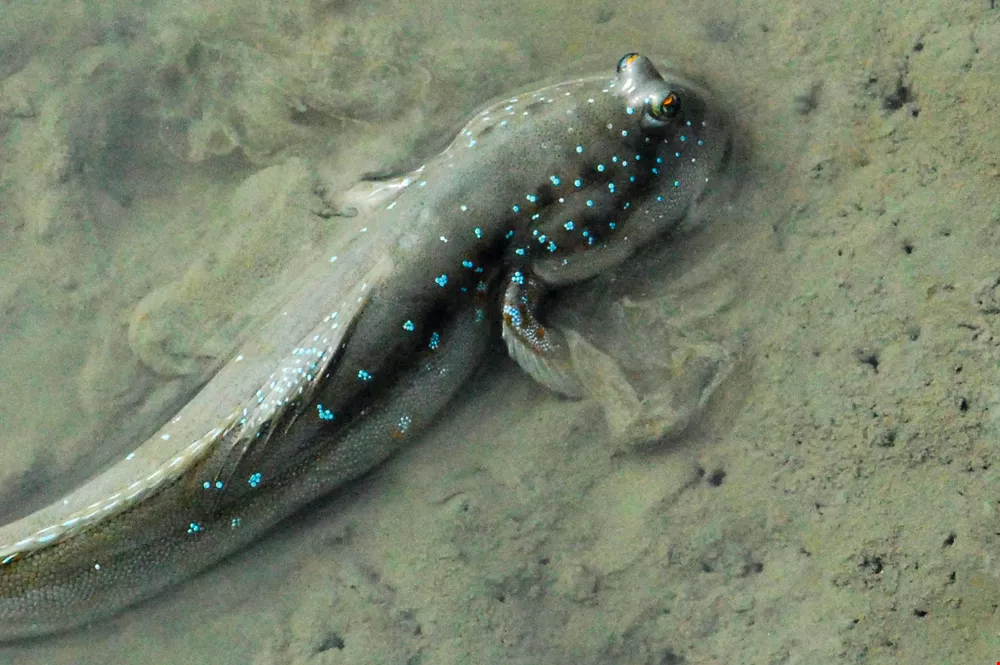
Thanks to the hard work of TCU, Erren River water, heavily polluted for many years, is growing clearer. Mudskippers, which had disappeared, have made a comeback.
TCU had been groping for an identity, but once Huang joined, environmental concerns came to the fore. After four years of gathering information, TCU and Huang uncovered dioxin pollution from China Petrochemical Development Corporation’s Anshun plant in 2004. The case is a milestone in the history of environmental activism in Taiwan.
In 2000, Huang went to Tainan’s Lu’ermen district to shoot nature and ecological photos around the Anshun plant. The abundance of silvergrass caught his eye. Huang noted that the land had been left to go wild for 20 years. So why hadn’t it recovered its ecological vitality? Silvergrass was virtually all that was growing here. Tests showed that the soil was heavily polluted.
Consequently, Huang, along with Chao Ruiguang, who was managing the nature and ecology curriculum, began to gather information about the history of CPDC’s Anshun plant. They learned that back in the Japanese era the site was used to produce caustic soda and hydrochloric acid. The factory there had been making poison gas for the Japanese navy.
After the retrocession of Taiwan, rights to the site changed hands numerous times. At first it was owned by the central government and produced pentachlorophenol, which is used both as an agricultural pesticide and as a wood preservative. Then in 1984 the site was transferred to CPDC, which was privatized in 1992. Although the plant ceased operations due to environmental and economic considerations in 1982, the dioxins from the pentachlorophenol production process remained, and they posed an environmental hazard since they had already entered the food chain.
Although Huang had evidence that CPDC had buried waste at the site, he couldn’t prove the danger it posed to nearby residents. Then one day he visited a temple in Lu’ermen, and the ward chief Lin Jincheng showed him blood test results and asked for advice. Huang discovered that the dioxin in residents’ blood exceeded ten times normal levels.
Hidden underground for 20 years, the hazard created by these buried dioxins was finally revealed. Outsiders began to refer to the case as “Taiwan’s Erin Brockovich.”
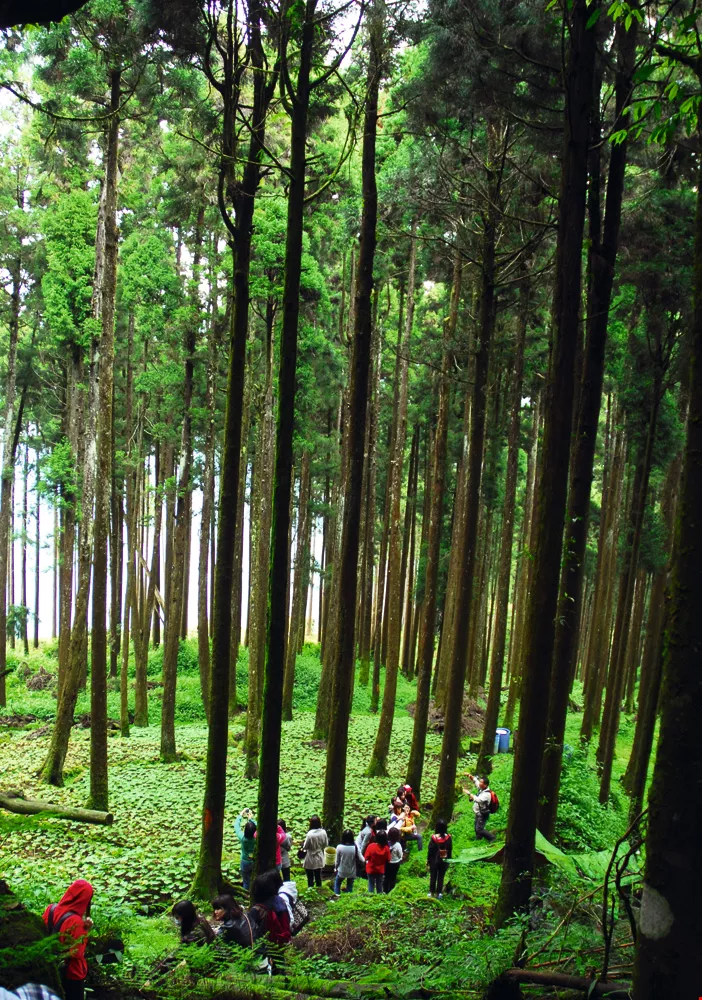
In Tainan’s mountain forests TCU students can often be seen measuring water and soil quality. They aim to keep these mountains pristine.
In 2007 TCU, working with the local public prosecutor’s office, established the nation’s first collective environmental alliance that included the judiciary, county and city government environmental agencies, and citizen groups.
“It was really infuriating!” says Huang, describing the origins of the league. “It used to be that industry along the river would release waste water once a month at most. Then production ramped up, and every couple of days you could see the river water turning red or yellow. The river mouth became a yin-yang sea.” As Huang opens up a dozen or so photos on his computer, he finds it hard to hide his anger.
After more than a year of planning, the alliance of the TCU and the public prosecutor’s office, armed with data gathered by individuals and citizen groups or collected on the Internet, established the “Greater Tainan Pollution Mapping Network.” Its mission: to keep track of all pollution in the area.
With citizen groups, government agencies and prosecutors working together, they were able to effectively check waste water releases into the Erren River. Since 2007 they have uncovered only three instances of illegal releases. The Erren is no longer listed among Taiwan’s three most polluted rivers.
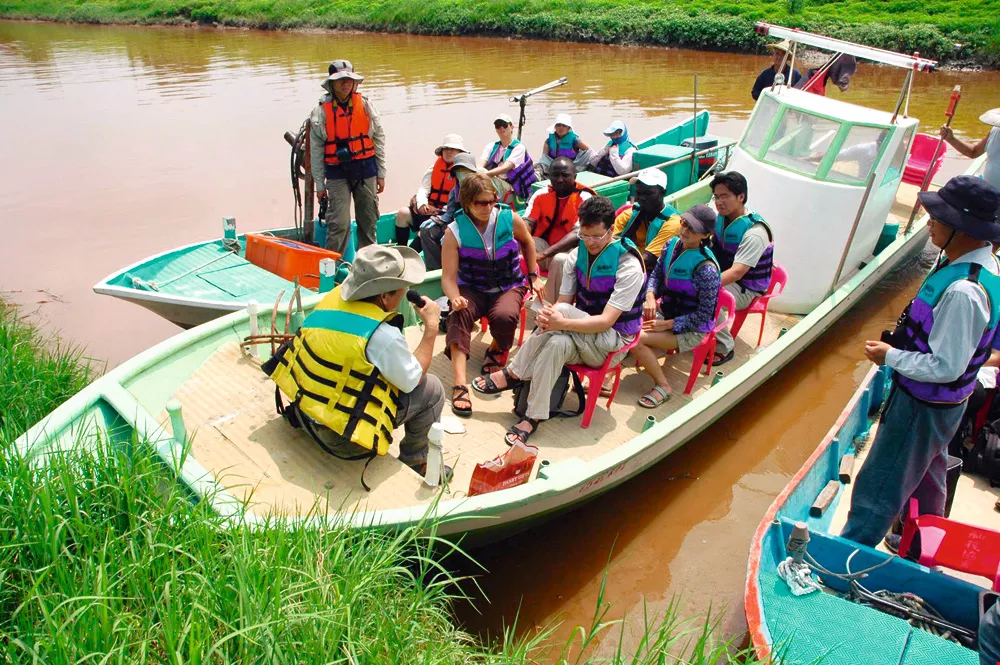
The restoration of the Erren River, which has been progressing for more than a decade, serves as an important case study in river conservation both for Taiwan and the world. A steady stream of foreign environmental volunteers have come here to observe and study.
In 2009 Typhoon Morakot caused major rockslides and mudslides in Pingtung, Kaohsiung and Tainan. From a more narrow concern with river health, TCU expanded its activism to protect upstream mountain forests and endpoint ocean ecosystems. By taking an integrated approach to watershed maintenance, the college expanded the realm of environmental protection.
“TCU is concerned about the mountains, the water, the soil and, ultimately, about biodiversity,” says Lin Guanzhou, director at Tainan Community University. After pushing to clean up the Erren River and monitor seawater quality, in 2010 TCU began to focus its efforts on the issue of illegal dumping of furnace slag at sites within Tainan along Provincial Highway 61.
Huang points out that instead of taking furnace slag and fly ash to hazardous material processing sites as required by law, industry has in recent years been recklessly dumping it in the mountains or at the seashore, or burying it on farmland. “The soil where slag has been dumped may look normal, but it has high quantities of heavy metals.”
In order to trace pollution sources, Huang and the action committee have been using a million-NT-dollar detector at a great variety of locations. He points out that current laws are extremely vague about what constitutes furnace slag, giving industry wide leeway. Consequently, the environmental committee at TCU hopes that a change in government policy can get to the root of the problem.
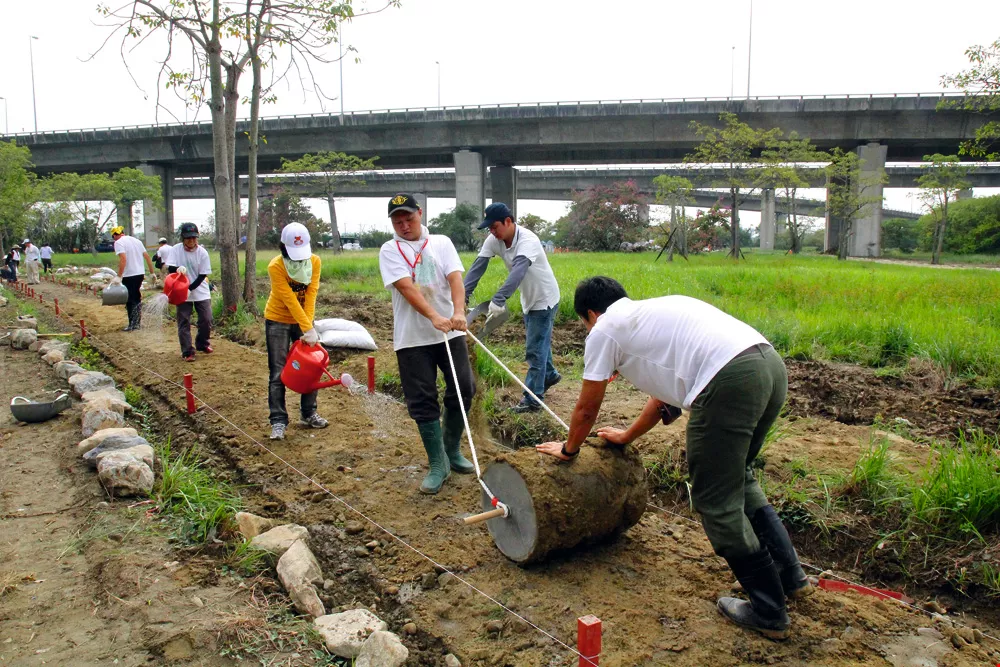
On weekends and holidays, TCU faculty and students, as well as local residents, come together to work on constructing an ecological corridor.
TCU students have written histories of the Erren and Yanshui watersheds and have set up various monitoring squads, with responsibility for patrolling rivers and monitoring river and ocean water quality. They have created an extensive network of activists.
Through its activism, TCU has redefined what is meant by “local studies.” The field is no longer just focused on tracing a place’s historical and cultural legacy, Lin explains. Rather, local studies have come to be concerned with the living history of a locale in a manner that demonstrates concern for the here and now. “Residents with feelings for a place thus make pledges and engage in activism on its behalf,” he says.
“This fight is about protecting the water, about cleaning the soil,” affirms Huang. And with many local environmental battles still ongoing, the fight isn’t over. As it continually strives to protect the land, TCU, now 14 years old, has maintained the spirit of guardianship with which it was founded.
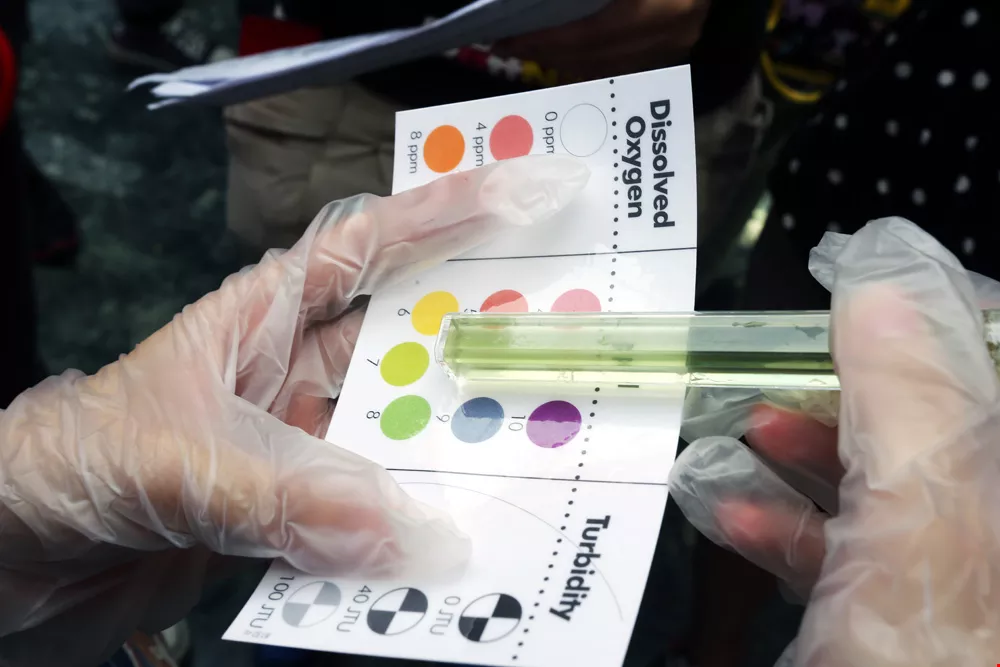
Members of TCU’s environmental action committee often bring charts out with them when they take readings at the Jianan irrigation canals.


@List.jpg?w=522&h=410&mode=crop&format=webp&quality=80)


