East Asia's Hollywood--Hengdian World Studios
Teng Sue-feng / photos Chuang Kung-ju / tr. by Phil Newell
December 2009
Hengdian in Zhejiang is just a little rural city with about 120,000 people, no superlative scenery, no rich natural resources, and not that convenient to get to or get around in. Yet for the past several years it has been the favorite outdoor setting for makers of Chinese-language films, because it has a movie studio-city-Hengdian World Studios-that traverses history and is, at about 10 square kilometers, the largest in the world (38 times the size of Taipei City's Da'an Forest Park). Each year an average of 80 filmmaking projects come here to shoot, and just walking down the street you can see world-renowned Chinese film stars like Jet Li and Andy Lau. It's as exciting and bustling as Hollywood.
And the story of Hengdian's transformation is itself equal to the most improbable of Hollywood fairy tales.
206 BCE: The Qin Dynasty is collapsing. The King of Chu has put the imperial city of Xianyang to the torch, a colossal fire that would last three months.
1959: Chinese archeologists discover the site of the Xianyang palace remnants on the north bank of the Wei River in Shaanxi.
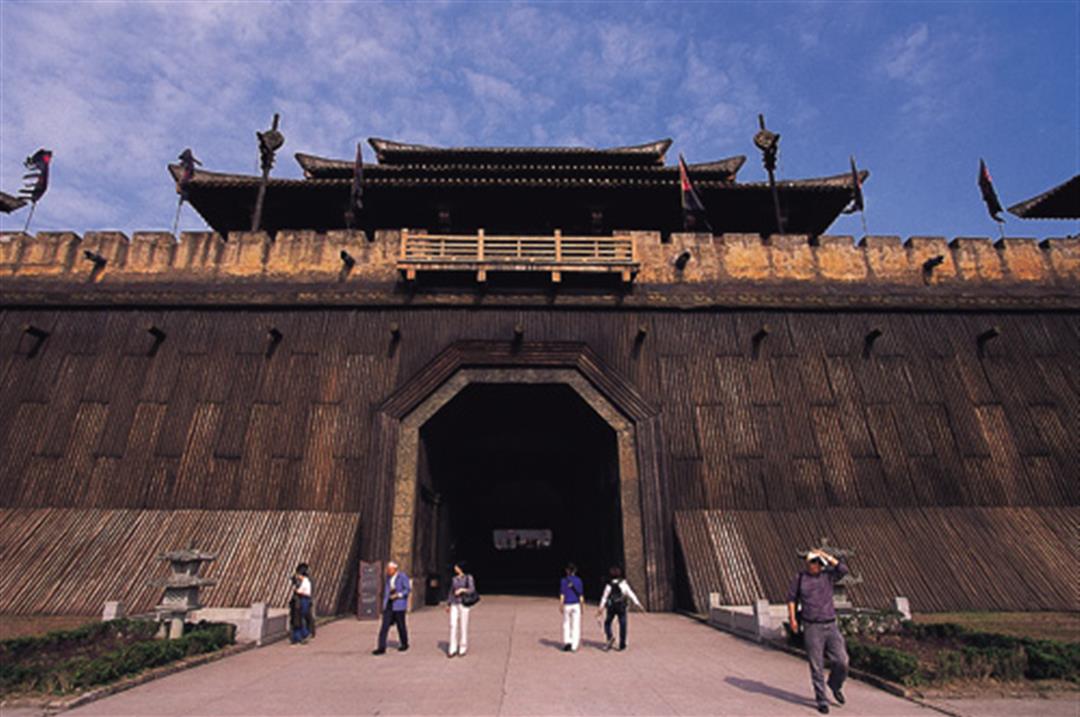
21st century: After more than two millennia, a complex like that of the Xianyang Palace is built, based on fragmentary documentary evidence. Occupying just over one-half of a square kilometer, it includes 27 separate structures, including a main gate, courtyard, main hall, side halls, residences of the empress and concubines, and more. The once great imperial city, with walls 2.5 kilometers in length, is reborn in a remote town in southern China-Hengdian.
In the film Hero, the scene in which Jet Li's character is pierced by countless arrows was filmed right in this courtyard, which is capable of holding over 50,000 people. Coming from the main entrance to the palace, crossing the courtyard, and climbing the 99 stairs upward into the forecourt of the main hall, you can get a sense of the immense power with which the founder of the Qin Dynasty, the first emperor to unify China, conquered and incorporated rival kingdoms.
After Hero was released in 2003, thousands upon thousands of visitors began taking the train to Yiwu, a tiny station on the Zhejiang-Jiangxi Railroad, then taking a bus 40 bucolic kilometers into this small mountain town, to feel firsthand the tragic desolation of the hero who sacrificed himself in a suicidal attempt to assassinate the tyrannical Qin Emperor.

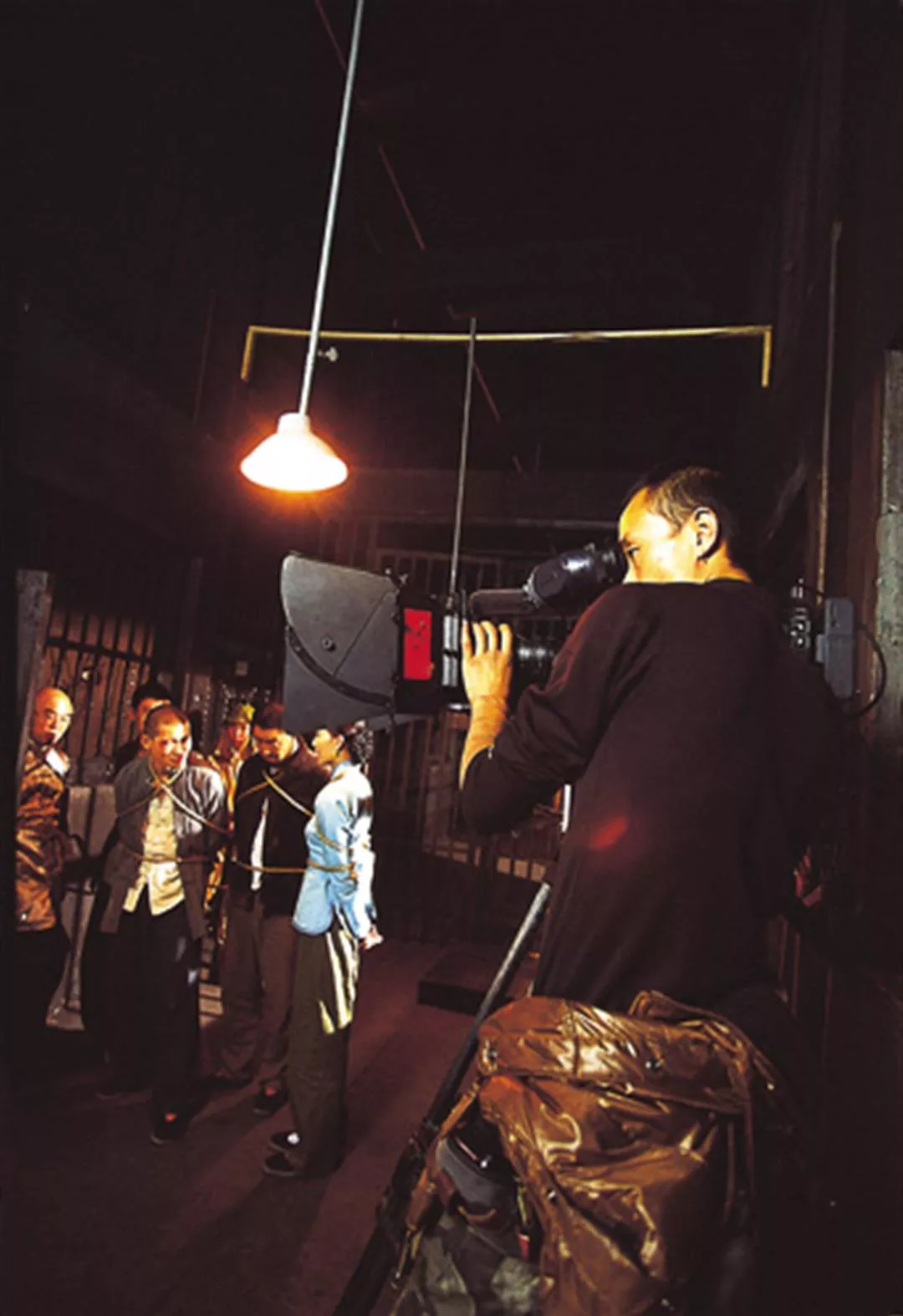
Roughly 80 film crews per year shoot at Hengdian's studio-city, and you can always see some movie in the making whenever you visit. But when the crush of fans begins to interfere with filming, the crews have to put up a yellow ribbon to keep bystanders at a distance.
Blown away
Hengdian, located next to Dongyang City in the middle part of Zhejiang Province, is 180 kilometers from scenic Hangzhou and 400 km from financial center Shanghai. Since the renovation of the highway heading south from Hangzhou was completed in 2001, the trip from there to Hengdian has been cut to 2.5 hours.
Thirty years ago, the people of Hengdian had a theme song of sorts, albeit one that told of their dirt-poor rural lives: "Everywhere you look there are barren mountains / We get through famine and hunger on thin rice gruel for three meals a day / No woman wants to marry a man from Hengdian...."
So how did Hengdian go from being a backwater to an industrial corridor and cultural powerhouse whose fame has spread not only throughout China but overseas as well? The plot has had a few interesting twists and turns.
In 1975, toward the end of the Cultural Revolution, Xu Wenrong, the then-fortysomething secretary of the local branch of the Communist Party, hoping to lift local people out of destitution, took RMB3000 and started up a township enterprise-a small silk factory. Later he invested in magnetic materials, crossing over into the industrial sector. Magnetic materials are widely used in daily life, in everything from magnets and cassette tapes to motors, televisions, and transformers. In less than two decades, the "Hengdian Group" has become the biggest supplier of magnetic materials in China, and Dongyang has been nicknamed "Magnetropolis."
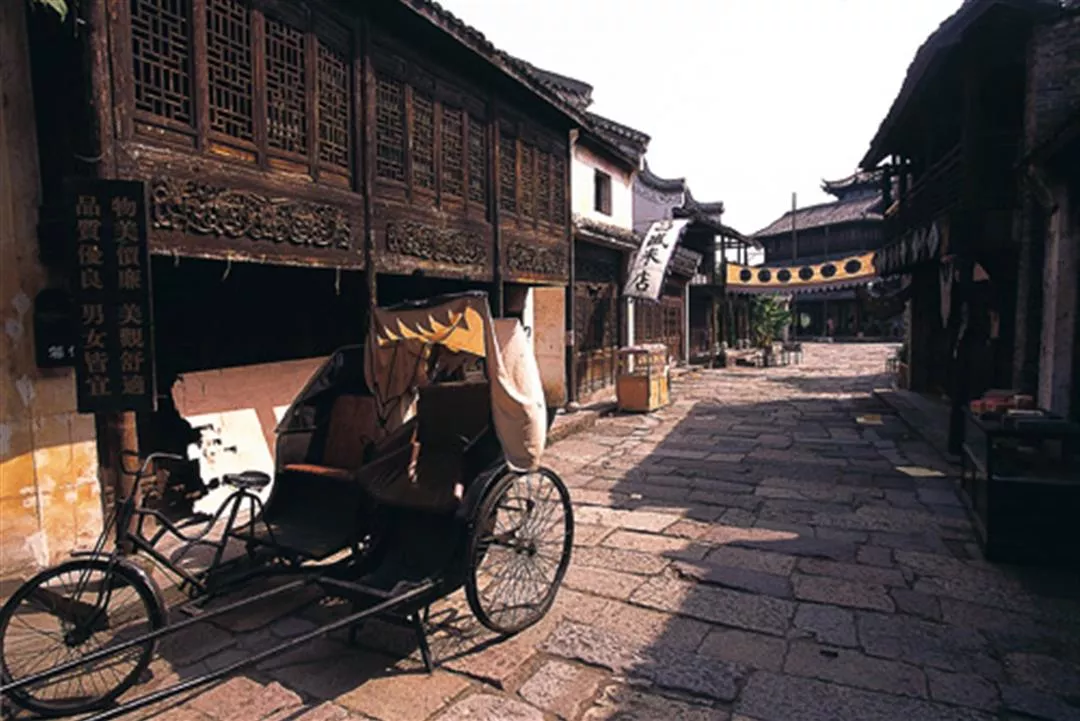
In 1994, Xu, who had never stopped thinking about how to take the local economy to the next level, visited the studios in Wuxi that provide sets for making Tang-Dynasty period films and dramas, and he was impressed by the crowds of tourists packed in there. Thereupon he had the rather crazy idea to turn Hengdian into a tourist destination, so he began building resorts, sports facilities, and movie theaters. At the end of 1995, when Xu heard that veteran director Xie Jin was having trouble finding outdoor sets for his epic film The Opium War that was to celebrate the return of Hong Kong to Chinese rule, Xu, on his own initiative, contacted Xie and promised to build him a replica 19th-century Cantonese neighborhood within six months. Under Xu's leadership, a space of 0.2 square kilometers was soon filled with traditional Cantonese tea houses, inns, opium dens, pawn shops, and the like, setting the foundations for the future studio-city.
Filming began on The Opium War on August 8, 1996, and it was released in mid-1997. The 74-year-old Xie Jin not only put Hengdian on the map by making his last film there, he also praised Hengdian to all his friends, and even brought heavyweight director Chen Kaige to Hengdian in person.
Chen, who was at that time preparing to make The Emperor and the Assassin, had trouble finding a setting for the Qin Palace that would be the location of the film's most important scene. Xu Wenrong again stepped forward and in eight months, using a ground plan drawn up by the fine arts department of the Beijing Film Studio, created a full-sized palace complex of awesome dimensions.

Hengdian World Studios includes a replica 19th-century Cantonese neighborhood, based on prints found in records now held in the British Museum. Its 15 streets and lanes and 160 structures (including inns, opium dens, and shopfronts for rice dealers, money lenders, and pawnbrokers) possess an authentically historic atmosphere.
The free filming ploy
Compared to the Cantonese neighborhood, the Qin Palace was a much vaster, much more difficult project.
Because the geology of Hengdian is very hard granite slopeland, mostly ridges with little or no vegetation, it was quite a job to blast the land flat for the Qin Palace, as well as for replica Ming and Qing-era imperial buildings that were being constructed at the same time. Says Yin Xu, general manager of Zhejiang Hengdian World Studios Company, "We used more explosives than all that had been ever used in Dongyang before that-it was really an astronomical figure."
Despite all the effort and investment, however, not many production companies trooped in, because transportation was still too much of a hassle.
In 2001, Hengdian World Studios (HWS) came up with a plan to end all plans, putting out the word that there would be no charge for using their sets for filming. Yin Xu says that at the then-going rate of RMB5-8000 per day, and based on an average of four sets rented for one month each, film companies could save RMB500-600,000-quite an inducement.
2003 proved to be a major turning point for Chinese film, and the breakthrough year for HWS as well. Director Zhang Yimou's film Hero set a new record for a domestic film by pulling in RMB250 million at the box office, and the number of visitors to Hengdian reached 1.58 million, an increase of 22% over the preceding year. That number rose by an astonishing 72% the following year, to 2.69 million, and broke through the 5 million mark in 2008.
One-stop shopping
The free filming plan turned out to be a winner, and the explosion of tourists coming to try to get a glimpse of their favorite stars has filled the studios' coffers with ticket revenues (at RMB100 to visit a single set or RMB350 for a combined pass) calculated in the billions of RMB annually.
Since 1996, HWS has invested about RMB3 billion in building 13 sets (including the Cantonese neighborhood and the Qin Palace), and the corporate group also has hotels, conference facilities, and scenery production companies under its flag. It can thereby provide "one-stop shopping" with the boast, "All you have to do is bring your script and take home the finished movie."
The Hengdian Group ranked 274th on the list of China's Top 500 corporations in 2008, with revenues of RMB17 billion. Currently the group's operations are divided into three main areas: industry, pharmaceuticals and biotechnology, and cultural production. The firm employs more than 30,000 persons, with about 2000 of these at HWS.
Besides the influx of tourists, there has also been a boom in peripheral economic activities brought by the needs of the film crews that come to make some 80 films each year.
Take for example The Forbidden Kingdom, a joint venture between China's Huayi Brothers Media and a Hollywood company. They filmed in Hengdian for four months, renting 150 vehicles, spending nearly RMB1 million on lighting for the main hall of the Qin Palace, renting luxury trailers for the two headliners (Jackie Chan and Jet Li) at RMB4000 per day, and even paying HWS workers to "plant" 10,000 artificial peach trees (made using very expensive silk) for a scene requiring a plum-blossom grove. You could say that virtually every household in Hengdian makes its living from the movies.
Floating on a rising tide
Beijing, the economic and political capital of China, has had an influx of migrant workers known as "the northern tide." Hengdian has had a similar surge. Because films require large numbers of day-players, about 50,000 of Hengdian's population of 120,000 come from elsewhere, quite a large proportion. The movie The Forbidden Kingdom, for example, employed 6,000 extras. And in fact managing all these temporary workers used to be a real headache for HWS.
As general manager Yin Xu explains, there used to be cases of day-players causing problems for production companies by coming in late, leaving early, going on strike, or demanding large bonuses if the weather got too cold, despite the fact that the company had signed contracts with them beforehand. There were also cases of companies that failed to pay wages after filming was over, leading to fistfights.
To protect the interests of both labor and management, in 2003 HWS organized a union for day-players, which provides unified management for over 4,000 extras. Since then, film companies needing extras have just needed to contact the union and sign a contract with it, with all wages being paid through the union. If there are any disciplinary problems with day-players, the union will step forward and mediate or punish the offenders.
At present there are an estimated 100 or more movie studios in mainland China, but not more than 10 are of any scale. Is it possible that the "Hengdian model" of creating something out of nothing could be reproduced elsewhere?
"Not likely," opines Yin Xu with conviction. "In those days land policy was rather lax, and the land occupied by HWS was of poor quality anyway. Now the land situation in China is tighter, residents are much more attentive to their rights, and you couldn't get the same kind of coordination. There might be enough land in someplace like the Gobi Desert, but you couldn't get film crews or tourists to go that far!"
Hengdian is very large, but it is not its size that is most worthy of emulation, but the force it radiates for cultural industries to flourish. Although there is much room for improvement in the quality of tourism there, and services need to be more refined, Hengdian nonetheless has "star power" that goes a long way.