Sparing the Rod Without Spoiling the Child-Education after the Ban on Corporal Punishment
Coral Lee / photos Chuang Kung-ju / tr. by Jonathan Barnard
January 2011


For thousands of years, the notions that "blades can't be sharpened without beating" and that "filial sons are made by the stroke of a rod" embodied the philosophy embraced by most Chinese teachers and parents. But as the shackles of authoritarianism have loosened in Taiwanese society since the lifting of martial law in 1986, liberal ideas about education and child-rear-ing have been gaining growing prominence. A case in point is the campaign to eliminate corporal punishment, which was led by the Humanistic Education Foundation and other educational groups for more than 20 years. Due to their efforts, amendments to the Basic Act on Education, which were finally passed in 2006, introduced a prohibition on corporal punishment in schools.
But old habits die hard. Four years later official statistics reveal that corporal punishment is still being used in some classrooms. What's more, some teachers, fearing legal trouble but unequipped with other effective methods of discipline, are simply turning a blind eye to inappropriate behavior or weak effort.
Excessive discipline lies at one extreme, and indulgent permissiveness at the other. How can we strike an appropriate balance between them? What challenges are being faced in the age of zero corporal punishment? And what should parents and teachers learn about raising, teaching and disciplining children in these new times?
Ironically, it was the corporal punishment that US-based Taiwanese filmmaker Daisy Lin endured in junior and senior high school that pushed her into creating Out on a Limb, a short that won "Best Animated Film" at the 2010 Marbella International Film Festival in Spain.
Selected from among 500 submissions created by filmmakers around the world, Out on a Limb tells the story of a young bird that can't keep up with its flock. Suffering social rejection and physical attacks, it leaves the flock to fly on its own. Lin describes her personal motivation in creating the film as being rooted in trying to heal the wounds from the beatings she suffered in junior and senior high school due to performing poorly in math.
"The truth is that I wanted to be a scientist," she explains. "When learning math I didn't want simply to memorize formulas. I was willing to test my own true understanding and spend more time on it than other people." Lin's older brother scored well on tests, but she worked slowly and tested poorly. Her junior high school math teacher was a neighbor she had grown up around. He would beat her in class, describing it as "for your own good." Out of school he attempted to stimulate her achievement by injuring her pride: "Are you truly stupid or just lazy?" The torment he put her through made her lose all self-confidence. And when she finally graduated and moved on to a newly established senior high school, the teachers, eager to lift test scores so as to improve the school's ranking, continued to beat her!
"In Taiwan I was always unhappy in school, but I didn't know why," Lin says. It was only after she went to America for graduate school and experienced American parenting and educational values by working as a babysitter that she slowly began to discover that the general anxiety she suffered from was connected to being threatened and physically punished when she was little.
In comparison to Lin's experiences growing up, current elementary and secondary students in Taiwan ought to have it much easier. In 2006 the Basic Act on Education was revised to say: "Students' rights to learning and education and their rights to develop mentally and physically shall be protected by the nation, which will also safeguard students from psychological abuse or corporal punishment." These days if you ask elementary or junior high school students if their palms have been beaten or their ears boxed, or if they've been forced to hold up chairs for extended periods or had some of their hair shaved off in punishment, they usually react with bewilderment. If they have suffered corporal punishment, they usually say that it has occurred at home or at cram school.
According to Ministry of Education surveys carried out yearly at various junior high schools in Taiwan since 2006 (and for which teachers are asked to step out of the room), the percentage of students who say they have not been beaten or physically punished in some way over the last two months has grown from 57.5% in 2006 to 83.1% in 2010. Of course, that means that 16.9% of students are still enduring corporal punishment despite the new legal protections. But a Humanistic Education Foundation survey puts the number of junior high school students being beaten at a much higher 42%, with schoolwork falling below expectations, and breaking school rules, ranking first and second as the reasons for punushment.
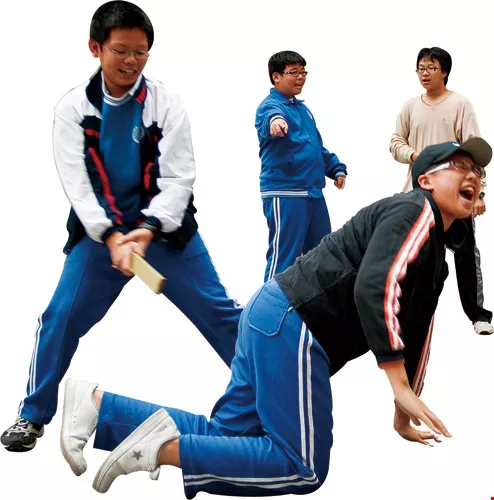
In an effort to mold children's behavior for the better and to steer them away from using curse words ("three character classics" is the Chinese euphemism), a teacher at Taipei's Muzha Junior High School has established a reading group that studies actual Chinese classics such as The Chinese Code of Success Maxims by Zhu Yongchun (1617-1688) and Standards for Students. She also uses games, competitions, and dramatic performances to increase students' interest in reading and memorizing these ancient texts, as illustrated by the photo on the facing page.
Just because open beatings have declined doesn't mean that corporal punishment has disappeared from schools.
Never mind those cases where either students or parents weren't willing to publicize a beating. In the first eight months of 2010 there have been 72 serious cases (63 in junior and nine in senior high schools) that were reported in the media or about which complaints were made to the educational authorities.
For instance, in March of 2010, a second grader named Zhang and a few classmates at the Taipei Mandarin Experimental Elementary School were scolded for pulling down their pants, laughing and touching each other's "weenies." When the teacher saw Zhang behaving the same way the following day but the boy wouldn't admit to it, the teacher slapped him nine times until the terrified child's face swelled up. The boy's parents filed charges against the -teacher. Several days later, more than 20 parents voiced support for the teacher and urged the boy's father to withdraw the charges and allow the teacher to come back to school. Describing the young Zhang as a naughty bully who was given to pulling up girls' skirts, some suggested he had "got what was coming to him."
It's a pity that the teacher, who was named Lu, lost control. But what about the vast majority of experienced teachers who have a good rein on their emotions? After the prohibition on corporal punishment, what methods have they used to establish discipline?
"I can't pick up the pointer without risking a 'misunderstanding,'" says Ms. Lin, a teacher at a Tai-pei elementary school. It used to be that grabbing the pointer had a definite warning effect. Now difficult children are given timeouts, ordered to perform manual labor, or moved to new seats instead. But even those actions can cause rumbling among parents.
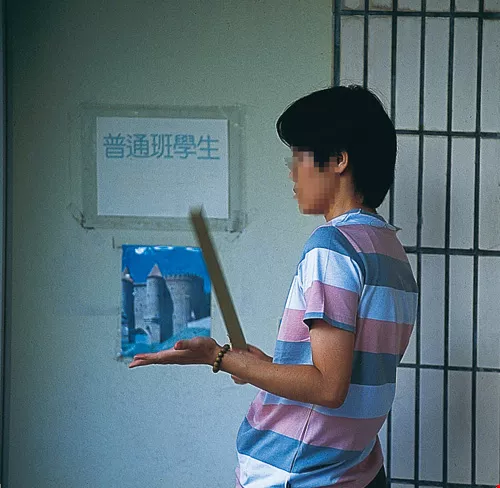
Although a ban on corporal punishment in schools was supposed to stamp out scenes like this, survey data has shown that old habits die hard. Some teachers are still resorting to beating and scolding students in order to maintain discipline.
For instance, a child in her first-grade class frequently acted out, affecting the whole class. She warned him many times, but he always laughed it off. When they lined up and went outside after school let out, he would bump into other kids next to moving cars. If she couldn't make progress in dealing with him, she felt, other children would start copying his behavior. Hence, she told the boy to come after school and serve a detention on the school's athletic field. She went with him and told him that he should stand on the spot and count to 100 before leaving. Before even starting, he burst into tears. A parent who was on the street 50 meters away saw him and immediately called the counseling office, saying that a teacher was giving a student "corporal punishment."
The thorniest problems arise when a child is engaging in dangerous behavior or needs to be immediately restrained. What is a teacher to do?
"For instance, say a child has climbed up to wipe a window and another child is bothering him. A -teacher's immediate reaction might be to pull the second child away, but taking physical action could have legal repercussions." Lin says that she has heard about a colleague who had just come back from a long maternity leave. When she came back to the school, she saw a child naughtily throw dirt into a dish of food in the lunchroom. Because she couldn't use corporal punishment and couldn't think of any other way to resolve the situation, in desperation she took string from a boxed lunch and started to hit herself with it, which temporarily put a stop to the child's behavior.
Yet, if you ask teachers about the effectiveness of corporal punishment, about whether it can put a stop to students' mischief and disorderliness, they mostly answer that it's only a "temporary solution." If you ask them if corporal punishment improves schoolwork, their answer is even more negative.
In response, people can't help but wonder: Why is it, when corporal punishment is both illegal and ineffective, that it still has a hold on our teachers like some 1000-year wizard's spell?
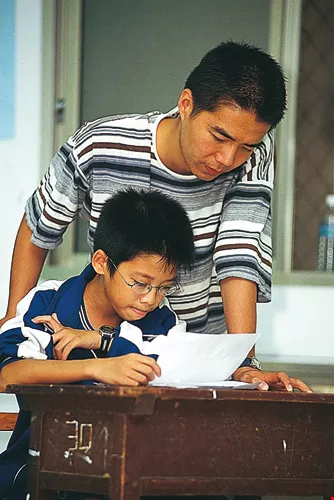
In an era of rapid change, it is more and more important to adopt humanistic educational principles that replace harsh discipline with love and compassion. The photo shows a scene at an elementary school in an Aboriginal community in Nantou County's Xinyi Township.
Prudence Chou, a professor of education at National Chengchi University, says that teachers have to deal with a much greater variety of students than they used to. This diversity reflects rapid social change. There are, for instance, growing numbers of children born out of wedlock or being raised by single parents, foster parents, or grandparents. More come from homes where one parent is a foreigner. And with the plummeting birthrate, children are increasingly spoiled and overindulged. This means that there are many holes in the first line of defense for children: the family. What's more, pollution and poor diets contribute to a growing number of students suffering from mild ADHD, emotional disorders, autism or Asperger's syndrome. Children with these common conditions are found in every class, and teachers find it exhausting to deal with them. It's very easy for their presence to lead to conflict in the classroom.
Lin Xing-hong, a senior teacher at Tai-pei City's Mu-zha Junior High School, racked her brain trying to find ways of coping with one boy who had only one parent and was living with grandparents. After school she would frequently go to pool halls and bowling alleys looking for him, and when he couldn't be found she would leave notes and request that PTA volunteer mothers pay visits to the child's home or encourage classmates to call and express their concern. When the boy said that he lacked a desk, Lin immediately requested that school workers build one for him and bring it to his home. Nevertheless, the boy ended up dropping out, and she could only comfort herself by saying, "At least other students weren't affected by him any longer!"
When dealing with problem children poses problems for an experienced teacher, new teachers, of course, will find them even more challenging. Under multiple pressures-to keep the class on schedule, to deal with class management, to meet the various demands of parents-teachers often find that they lack the time and energy to devote a lot of one-on-one attention to these children even if they would like to. Confronting these children's outbursts, they may find that corporal punishment or other strong punitive measures are the only means at their disposal.
Chan Cheng-tao, policy chief for the National Teachers' Association, explains that most of the children who act out in this way have family problems or are emotionally or academically handicapped. They cannot be educated using traditional methods and they require the help of professional social workers and psychologists. In European and American schools more than half of school employees are support personnel of this ilk. But in Taiwan most schools only have counselors. Each responsible for many separate classrooms (15 in Taipei City), they can only provide only very basic psychological counseling. Although some of Taiwan's county and city education departments employ psychologists and social workers, they are overworked. In the Zhongzheng District of Taipei City, for instance, seven junior high and elementary schools share one social worker, while five elementary schools share one psychologist. Consequently, it is hard for them to have much effect.
Teachers' associations are pushing for legislation to add psychologists and social workers to schools, with central government funding. Proposed amendments to the Children and Youth Welfare Act have been sent for discussion at the Legislative Yuan. But competing against allocations for swimming pools and free lunches, it's hard to imagine that the scheme will fare well.
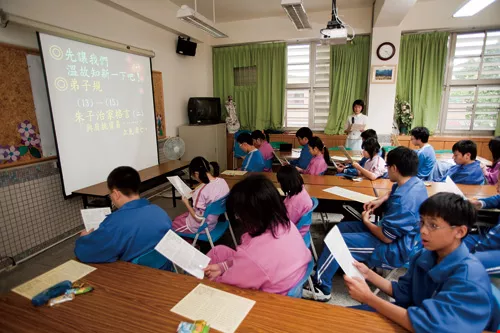
In an effort to mold children's behavior for the better and to steer them away from using curse words ("three character classics" is the Chinese euphemism), a teacher at Taipei's Muzha Junior High School has established a reading group that studies actual Chinese classics such as The Chinese Code of Success Maxims by Zhu Yongchun (1617-1688) and Standards for Students. She also uses games, competitions, and dramatic performances to increase students' interest in reading and memorizing these ancient texts, as illustrated by the photo on the facing page.
Chou explains that in the face of rapid change, when the student-teacher- relationship is being thoroughly reformulated, Taiwan's teacher training is still stuck in a traditional paradigm that stresses academic subjects and gives short shrift to cultivating professional ethics. Moreover, teachers who weren't education majors and who have only taken a streamlined education curriculum lack even more the communicative skills needed for the "life coach" side of teaching. Dealing with increasingly difficult and disrespectful students, they may end up beating and scolding students because they lack any other strategies.
"For many years teachers have been selected based on rigorous written tests," notes Zhang Lihua, a retired elementary school teacher of 30 years. "As a consequence they test well and have high IQs, but one can't help but wonder about whether they are all loving, caring and passionately creative teachers with high EQs!" What makes things even worse is that student teaching-when it is easiest to make observations about a teacher's attitude and creativity-has been reduced from a full year to half a year, and performance during that period isn't used in evaluations for hiring. That makes it even harder to pick reflective teachers who will work toward improving their pedagogical skills.
What's more, the current system is geared toward hiring full-time teachers, but there are strict limits on their numbers due to concerns about the costs of lifetime pensions and benefits. Meanwhile, there is a lack of flexibility to make good use of part-time employees, counselors, temps, or personnel that can be shared among several schools. Chou believes that the Ministry of Education ought to consider how to make best use of the large numbers of unemployed teachers to meet the diverse needs of students. If schools have increased flexibility in how they employ educational personnel, students can receive more finely delineated attention, and the physical and psychological burden on teachers can be reduced.
Chou explains that Liao Guohao, a youth who recently shot a gang boss, began to run into trouble in the classroom during junior high school. If there had been one-on-one tutoring or individualized instruction for him back then, or if steps had been taken not to allow him to give up on school in frustration, then maybe he never would have gone down that dark path.
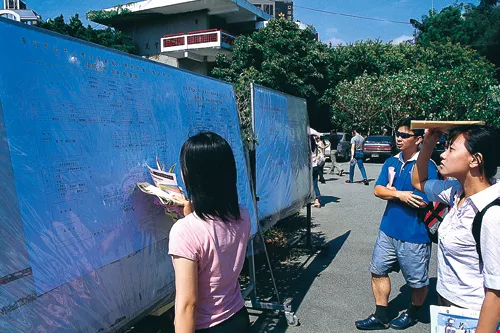
With the plummeting birthrate and the proliferation of education programs at Taiwan's colleges and universities, the supply of teachers now exceeds demand, and competition for school jobs is intense. But does the current system lead to the selection of teachers with high EQs and capacities to learn on the job and grow? Many have their doubts.
"A big problem is that Taiwan's parents are still beating their children," notes the National Teachers' Association's Chan Cheng-tao. "The law only prohibits teachers from beating children." Say a child is beaten when telling a lie at home. In school the treatment is much more lax, and that disparity could lead to children playing goody-goody at home and then releasing their pent-up emotions in the classroom. The children may sense correctly that teachers dare not act against them, so they act up. Even if they've been warned, Chan says, these students may simply not care, making them impossible to discipline or get through to.
Chan's above concerns were indeed borne out in the "nine slaps" incident at Taipei Mandarin Experimental Elementary School. Afterwards, most of the class's parents believed that the teacher acted as he did to impart a lesson to an unruly child and to protect the other children. Believing that the act didn't warrant imprisonment, they put pressure on the boy's father, and pushed for the teacher to be allowed back in the classroom. Their approach demonstrated an implicit recognition of the value of corporal punishment.
The pendulum of social mores has swung away from harsh discipline and toward overindulgence. As a result, children end up self-centered and hard to teach. Chan has seen students chatting and being unruly when crossing streets, and when students are urged to hurry up, they respond with snide looks. Even worse, when teachers inform parents that their children have been smoking and cursing, parents often just shrug their shoulders. "Faced with such attitudes, teachers find it hard to do their jobs and feel powerless."
"Many children immediately go home and complain to their parents if they don't get their way at school," says Ms. Lin, the elementary school teacher quoted above. "Without really trying to understand what happened, the parents first just blame the teachers!" She recalls that in this past year she has several times faced angry parents who were impossible to reason with. Even when fault probably lies with the student, the teacher must take it upon herself to handle the situation appropriately: First apologize and placate the parents and then communicate and explain.
"Teachers remind each other that when they encounter parents that are hard to communicate with, they shouldn't put too much energy into trying to force the child to do something; instead they should protect their own integrity!" Lin says that teachers, with no other options, have their hands tied behind their backs: They are clear about the deficiencies in some children's behavior but they are unable to stamp it out. Ultimately, however, it is the children themselves who will suffer most!
In her blog, one teacher described how she had grown weary of the classroom environment after seven years on the job. In order to recapture her passion for teaching, she took a year off and traveled to distant Africa. But after she came back and had been teaching again for two months, she said, "The light in my soul is gradually dimming. From the moment I star-ted teaching, I have reminded myself every- day without fail that I need to set a good example in both word and deed. I don't have to produce students with the highest of academic accomplishments, but I must ask that students behave properly, respect rules, take responsibility for themselves, and find joy in helping others."
But in the course of her teaching, she came across many colleagues who would say that they advocated "humanistic education" but were really just cowardly conformists. Their permissiveness made them students' favorites. But stricter teachers, who put an emphasis on moral education and believe that "they wouldn't be performing their duties as a teacher" if they were too lax, are often regarded by students as being unreasonable and out of step with the times.
In an age when teachers have lost their sticks and now only hold carrots, what educational methods can be crafted and honed so that a lack of discipline doesn't end up constituting a "triple loss" for parents, teachers and students? It's an assignment that will test the wisdom not only of teachers, but also of parents, schools and society as a whole.

@List.jpg?w=522&h=410&mode=crop&format=webp&quality=80)
@List.jpg?w=522&h=410&mode=crop&format=webp&quality=80)


