The phenomenon of the "new poor" is by no means limited to salaried employees. As the gap between classes widens and the middle class presses the panic button, the current economic storm is also now throwing into crisis the lives of many small businesspeople and self-employed individuals who once prided themselves on their abilities or trusted unreservedly that hard work would lead to success.
When white-collar workers get the boot, at least they have colleagues in the same boat who they can commiserate with. In contrast, self-employed persons who have always gone it alone feel isolated and helpless when they meet career frustrations.
Whether white-collar or blue, salary-earning or self-employed, the situation of these people who are sliding downward from the middle has been attracting the attention of various non-profit organizations in Taiwan who are trying to think up ways to help.
And following on the heels of these NGOs, in September of 2006 Premier Su Tseng-chang proposed the government's Big Warmth program, to bring the resources of the nation to bear on the problem of assisting the new poor.
Over the last two years, Kuo Feng-pao has really gotten to know well the road to the Wu family house in Wanluan Township, Pingtung County.
Kuo Feng-pao first met the Wu family in 2005, through an introduction provided by a local church, after Mr. Wu had to undergo surgery following an auto accident in 2005. At that time Kuo helped them apply for emergency assistance from the Chinese Christian Relief Association (CCRA). "This program is for emergency assistance, not poverty relief. There can be only one application for each case, because the resources are really limited," says Kuo, a social worker for the Southern Taiwan branch of the CCRA.
However, "fortune doesn't come twice, but trouble never comes alone." In February of 2006 the Wus' high-school daughter was in a scooter accident, and the other driver refused to pay any compensation because Wu's daughter had no license. "The Wu family, who get by on doing odd jobs, hadn't paid any National Health Insurance premiums in a long time, so I helped them again apply for one-off emergency assistance, so they could pay up their health insurance; otherwise they would never have been able to afford the enormous medical bills."

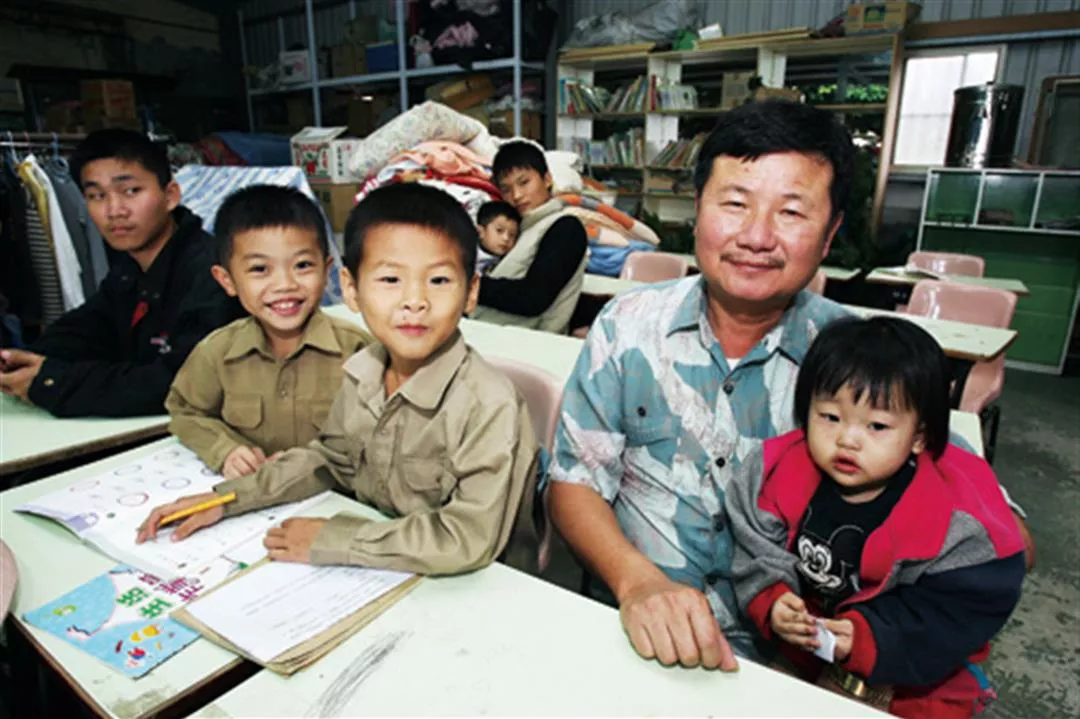
In recent years there has been a sharp increase in the number of households headed by single or unemployed parents. The Executive Yuan's new "Big Warmth" program aims to lend a timely hand. The photo shows the Enhui children's refuge in Changhua County. The little girl at right is Mr. Hung's daughter, while at center is Mr. Huang, a priest.
Blocked by a car
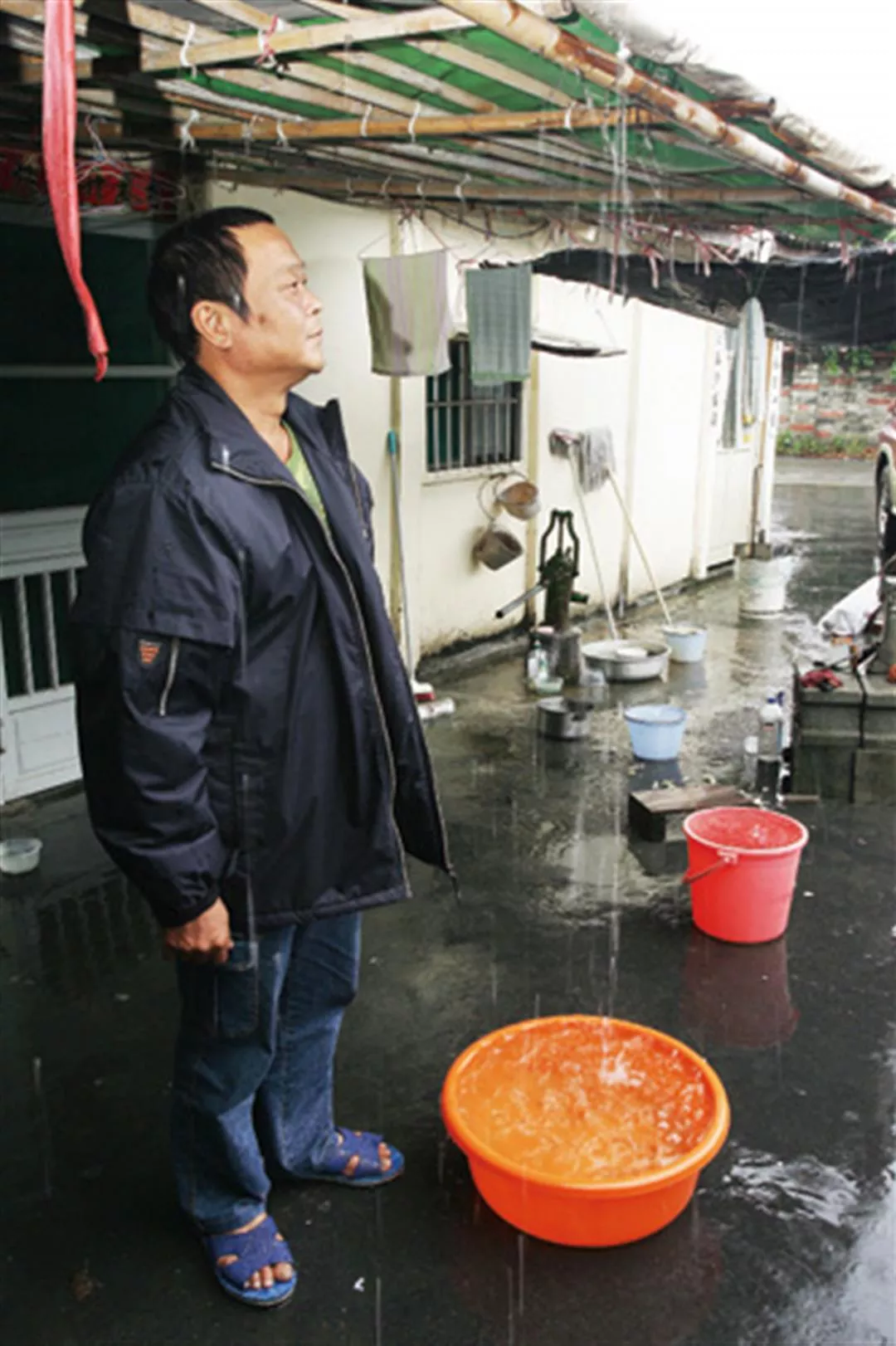
"At first I owed somebody money, so I gave him a car to be counted against the debt," explains Mr. Wu. The car changed hands four years ago, but unfortunately Wu never transferred ownership legally by registering the name of the new owner with the local motor vehicles department, "So now if we want to apply for help as a low-income household, we can't meet the requirements. And the guy who has the car even still owes taxes on it, and that is also charged to me!"
Though he only graduated from high school, Mr. Wu's job as a construction-site foreman could earn him more than NT$100,000 a month when times were good, allowing him to maintain a middle-class standard of living. But then he had a run of bad luck. The 921 earthquake of seven years ago dragged the economy down, creating hard times for the construction industry. Under heavy economic pressure, Wu had to borrow money to cover daily expenses, and eventually piled up a huge debt. Then Mrs. Wu was half-paralyzed by a stroke and Mr. Wu and his daughter had their accidents.
After this series of disasters, the bank foreclosed on the Wus' mortgage. Their home was put up for auction, and their car also went to cover debts. They even went so far as to pick up and leave Taoyuan and move to remote Pingtung, to escape both their creditors and the eyes of their concerned--and nosy--neighbors.
At present, the Wanluan Township administration is asking Mr. Wu to urgently find the creditor who drove his car away so that ownership of the vehicle can be legally transferred. Once the Wus have no assets under their own name, such as a house or car, they can apply to be registered as a low-income household. According to the rules of the Pingtung County Government, each household can get NT$4800 per month in assistance. In addition, Kuo Feng-pao plans to help the family's two school-aged daughters apply to WorldVision to become student aid recipients, and will help Mrs. Wu apply for certification of handicapped status, with the attendant benefits that come with it.

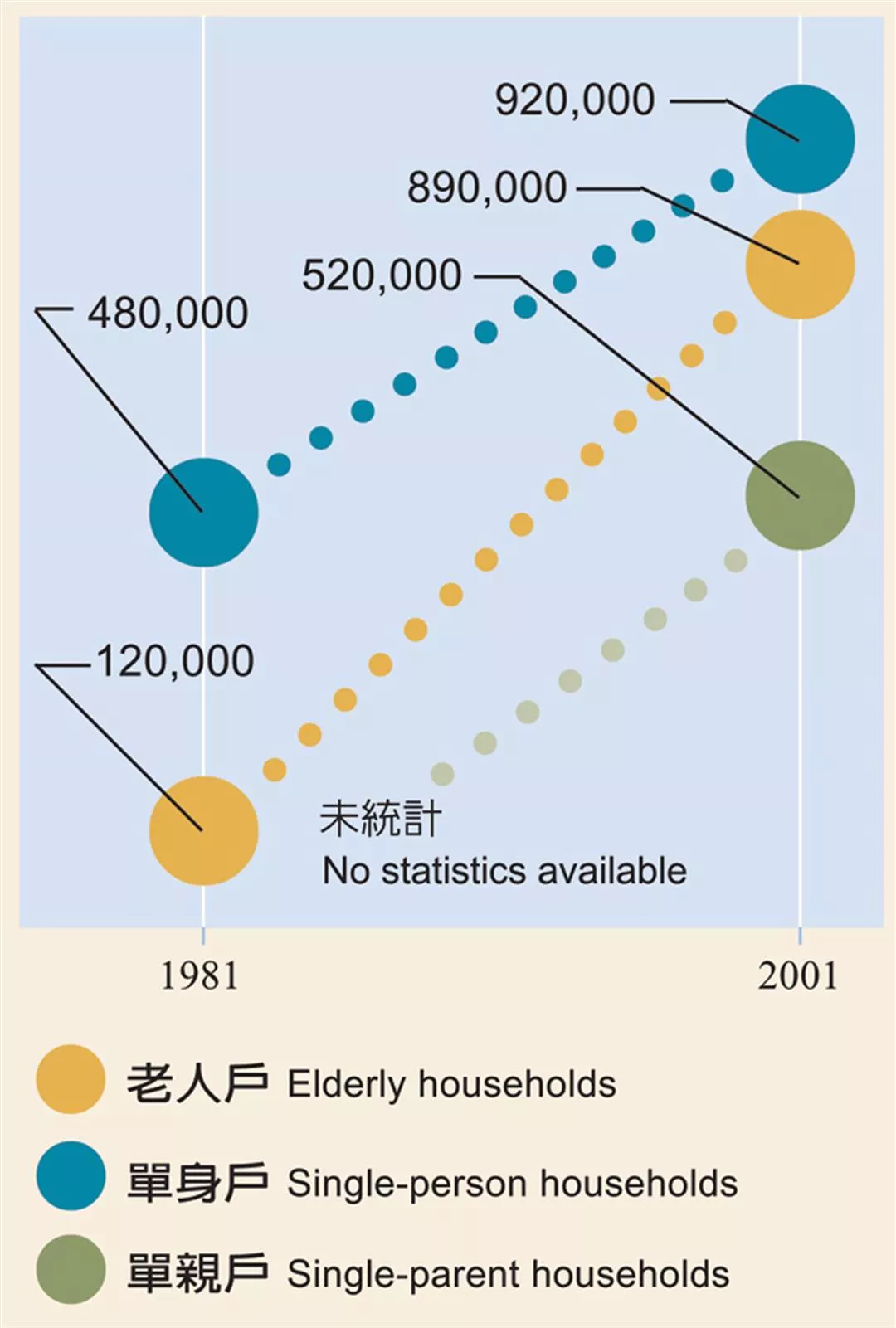
Older, more alone, more helpless--from 1981 to 2001 there was a great increase in the number of potentially disadvantaged households
A cry for help
Since being initiated in October of 2003, the CCRA emergency relief program "has helped in a total of nearly 400 cases in our area in Southern Taiwan as of the end of September of 2006," says Kuo. While most involve classic problems of the elderly, handicapped, and single parents, there are more and more cases such as that of the Wu family involving a slide downward from the middle.
"Regardless of whether it's blue-collar or white-collar workers, experiences like that of the Wu family have definitely shown a significantly increasing trend in recent years," agrees Minister without Portfolio Lin Wan-i. Some middle-income households that once enjoyed a certain economic status have been struggling to stay afloat in an environment of ever-intensifying competition, while some have even found themselves on elevators whose lines have snapped, sending them plunging downward at speed.
"In contrast to those who have always been poor, these middle-class people have always had tremendous confidence in their ability to make a living, so when they hit trouble a yawning gap appears in contrast to their life expectations, their sense of self-esteem plummets, and sometimes they prefer just to turn their backs and go somewhere where they can hide away. They are not accustomed to being in the role of the disadvantaged, nor are they accustomed to accepting help," says Iris Lee, executive editor at the CCRA. These new poor, whose thinking is still locked into their old values, can easily reach breaking point if they hit any compounding crises, such as divorce or illness.
The numbers say that in the past three years, an average of 70,000 new people have been added each year to the ranks of the poor, single parents, or the unemployed, and the total number now exceeds 1.1 million. Many of these less fortunate households have fallen into the category of "lowest-income households." If you were to divide their total annual household income by the average number of persons in the household, the individual average incomes would in fact be very close to the "minimum living standard" as defined in the Public Assistance Act. But since they often have the ability to work, some assets, or some support from relatives, they are excluded from the current social safety net.

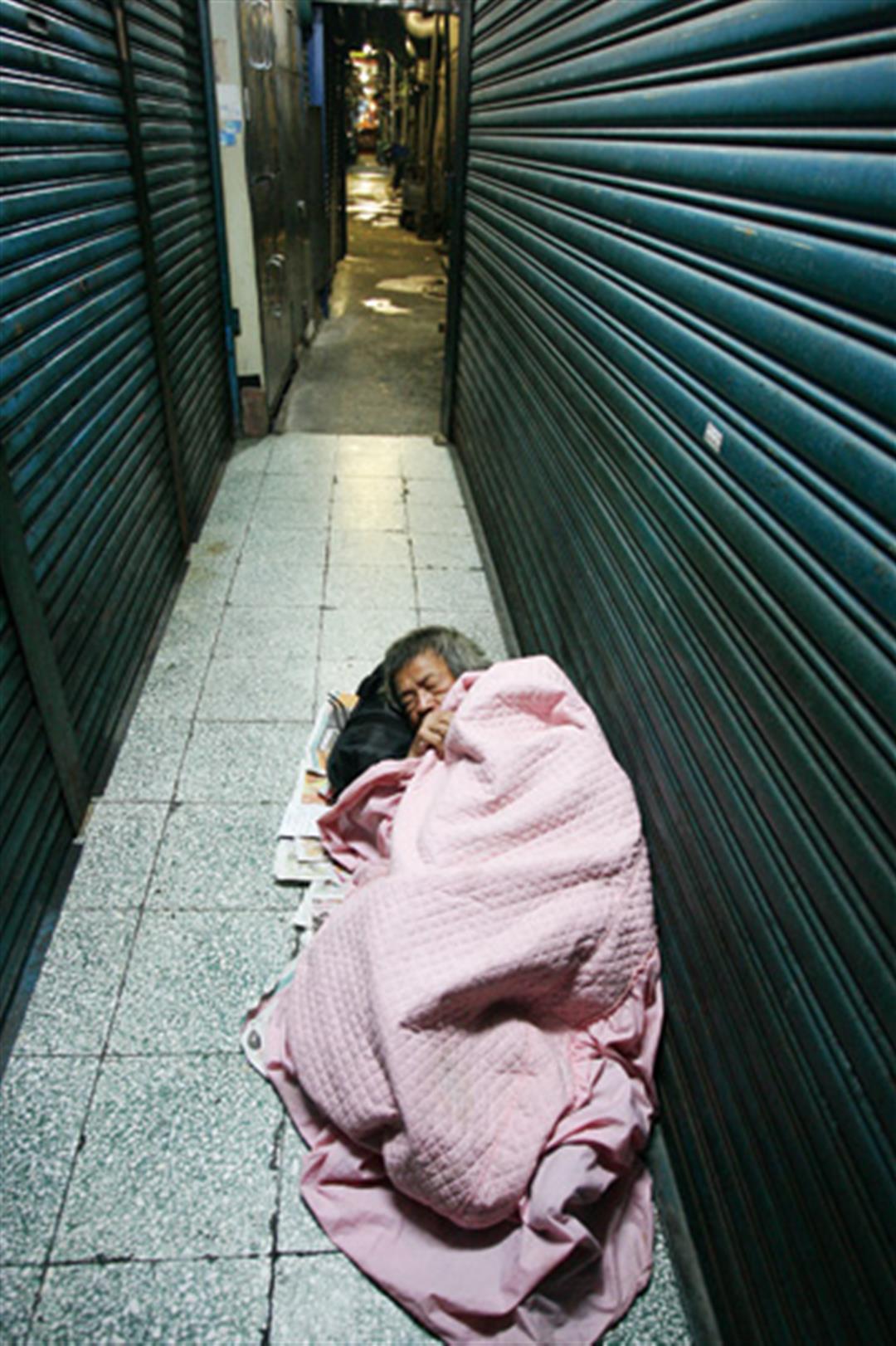
When it rains, it pours. Poverty, illness, and disasters are often linked, so the weak get only weaker. Mr. Hung, pictured here, suffers intestinal cancer and his family has basically dissolved. With the help of volunteer social workers from the Chinese Christian Relief Association, he is able to receive various forms of government assistance.
The poverty-disaster link
Looking at the problem from a different angle, one of the consequences of the ever-increasing stress of daily life is that there has been a sharp increase in the number of suicides. Statistics indicate that from 2001 to 2005 there were 16,779 suicides. But 4,282 of these came in 2005 alone, of which, according to statistics of the Department of Health, more than 700 cases involved economic problems. "As we understand the situation, only a very small number of suicides caused by economic problems occur in low-income households," explains Lin Wan-i. "Most of the cases involve the new poor. They have fallen down from a stable socioeconomic status and are psychologically unable to cope. When you add in the fact that they are excluded from the social welfare net, that's when they finally take the road of no return."
The continual increase in the number of suicides, plus a worsening of social problems like card debt and convenience-store robberies, has shocked the government into action. In May of 2006 Premier Su Tseng-chang asked Lin Wan-i, who has a strong reputation among social activist circles, straight out: Why are so many people killing themselves? What can be done about it? This was the background to the inclusion of an emergency family relief program in the Big Warmth program that the Executive Yuan announced in September.
From NGOs to government, helping the "new poor" has become a high-priority item for everyone. And not just in Taiwan. In fact, across the Pacific in the US, as early as 1997 the government launched the Temporary Assistance for Needy Families (TANF) program to address the steady increase in the number of poor people--at one point reaching as high as 13% of the total population.
TANF incorporated a number of tools, including direct subsidies and assistance in finding jobs. At one point, more than 2 million families received regular TANF subsidies. Meanwhile, the jobs aspect of the program greatly improved the employment situation for families (including single-parent families) facing economic difficulties, and millions of people formerly dependent on the welfare system greatly increased their economic independence.
Mediating conflicts
The M-shaped society, downward social mobility.... The sliding of middle-class people into the ranks of the new poor has been much discussed in the global media in the last two years, to an extent that has been rather alarming.
The term "new middle class" first appeared in Britain in the 1850s. "In contrast, Taiwan's middle class first appeared around the 1960s, more than 100 years later than in the West. As you can imagine, so-called middle-class consciousness and values are not as pronounced in Taiwan," says Tsai Hung-cheng, assitant professor of applied sociology at Nanhua University, adding: "But when the US and Europe began to move in the 1970s toward a knowledge-based economy which prompted a redivision of wealth, we were able to catch up to this competitive trend in a very short period of time, and accept a complete re-dealing of the cards among various social groups."
For the individual, the middle class represents pride and dignity, and the power to stabilize society and carry it forward in pursuit of a better tomorrow. For society as a whole, the middle class's affirmation of its own values is an irreplaceable asset.
"Therefore, to be concerned about the current plight of the middle class, you not only have to pay attention to the economic problems that they face, you also have to carefully manage the major shocks that could hit society if one day middle-class consciousness completely collapses," avers Tsai Hung-cheng.
Stabilizing force
"In fact, in the midterm elections that were just held in the US, many of the crucial issues were closely related to the concerns of the middle class," Lin Wan-i points out. The TANF program initiated under the Clinton administration successfully reduced the percentage of the American population defined as "poor" to below 10%, but now it has risen back up to 13%. This is very sobering for the middle class, because under conditions of incorrect policy direction, if they get just a bit careless they could slip into the ranks of the poor. This is why they opted for the Democratic Party, which tends to make policy more from the perspective of the poor.
"This is despite the fact that this means they will have to share more of the national budget and resources with the poor," explains Lin. This type of new attitude, which takes the perspective of society as a whole, and seeks not winner-take-all but mutual support and mutual benefit with everyone coexisting and succeeding together, is just what is sorely needed in Taiwan.
Today, with competition unabated and more "new poor" appearing all the time, the concept of mutual support is all the more to be cherished. It is precisely this aspect that shows the degree to which a society can really be considered a unified body in which all parts share a common fate. l