A World First--The Dual Network at Nankang Software Park
Vito Lee / photos Chuang Kung-ju / tr. by Anthony W. Sariti
August 2005


Correctly seeing the develop-ment potential of concentrat-ing high-tech talent in one place, the Ministry of Economic Affairs' Industrial Development Bureau selected Taipei's Nankang Software Park as a model incubator for dual-network applications services. The software park has made rapid strides forward in wireless applications thanks to its high wireless coverage rate and its excellent applications service. It not only leads the country in web access time and other standards, its three major online service blocks, "mobile office," "mobile monitoring," and "mobile life," are also ahead of domestic and foreign firms, becoming a focal point of the wireless applications market.
In fact, this world's first dual network applications park had many advantages to start with. Whether it be optical fiber connections or industry's use of virtual networks, there is a high degree of concentration here. And as for the human factor, the 12,000 software tech workers in the park are the most loyal supporters of high-tech products. A clear example is that dual network cellphones went on sale in Taiwan only last year, but everyone in the park has had one for some time. The software people who work there are not only the best testers of dual network capability, their experience can directly spur the development of related products and services.
However, the services that started up last December are still free of charge and experimental. For these to remain in operation in the future, there will have to be fees. We will see then whether the number of users will be able to support further growth.
Thursday afternoon in the waiting area of CKS International Airport commercial fliers take out their notebook computers to take advantage of a hole in their schedules and get on the web for e-mail, to find information or to kill time by playing a few games.
The CKS airport, which in 2001 set up WiFi ("wireless fidelity") Internet access, is one of Taiwan's oldest "hot spots." You don't have to find an Internet access line or plug in anywhere, and you don't have to worry about someone tripping over your power cord. These business people, accustomed to traveling all over the world, need only relax and, with an elegant flip of the wrist, open up their computers to surf the web to their heart's content.
Seeing from a distance
Among these international faces, Mr. Yu is not just on the web passing the time. Making use of an open spot in his schedule, he hunts up a quiet corner in a coffee shop, where he can link his hand-held computer up to a wireless Internet connection, allowing him to conduct an international meeting that spans Europe and Asia.
Mr. Yu and his colleague in Britain are using video phone, sound and instant messaging to make revisions to a sales contract. Together they both make notes on the contract and then save it on the company's server and their notebook computers. The discussion ended, they each continue their separate ways.
This kind of "mobile office" is also an important element in the network service at Nankang Software Park. The dual network allows an increasing number of park employees to be located far away, but seen from another angle, tied in by an Internet connection and an "electric chain" that know no bounds, you could also say they have never left the place at all.
An area that takes up less than one square kilometer, Nankang Park has close to 100 access points (AP) inside and outside the buildings. But dual network integration is not just accessing the Internet anytime, anywhere.
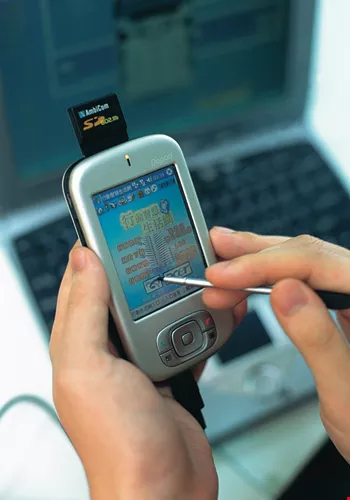
Another part of the plan is "mobile monitoring." Via a personal digital assistant (PDA) a guard is able view several dozen monitoring devices in the park at all times. He can go on patrol at the same time he monitors the area. It is not necessary for him to sit in a central monitoring room. This leads to a great increase in mobility and efficiency. The word is out: "Everyone knows that inside the park, even if there's no one around, you still can't get away with anything," jokes a Ms. Chien, editor of the Industrial Development Bureau's magazine Design.
Once the park grants authorization, you have immediate access to mobile office, mobile monitoring and mobile life. When dual network cellphones pass by the underground shopping complex of the park, immediately the screen is lit up with the advertisements and the daily specials of nearby stores. Via their dual network cellphones, employees can directly reserve tables in the cafeteria for lunch. Driving to and from work, employees can get the latest road conditions simply by using their dual network cell and PDA and on the basis of this select the fastest route. From work to entertainment, mobile service leaves no stone unturned.
Virtual keys
Nevertheless, in talking about the design concept for a "mobile Software Park," Li Ta-lung, sales manager of the Acer wireless technology group, which is a full participant in the dual network of the park, explains, "Outsiders think that 'the first' dual network park must mean 'the leading' park in the field of wireless technology. This is really not what we're after at all."
"The whole world is developing wireless service, but Nankang Software Park is the first to broaden this service into so many areas," says Li. "For this reason, the goal should be innovation in the utilization and integration of wireless technology."
With this kind of thinking, and with the dual network as the core, suppliers of related operating equipment are found all over, including those in the information and telecommunications businesses. Aside from Acer, which is responsible for the integration of the whole system, others have participated in this collective creation. These include Taiwan Microsoft, Taiwan Cellular Corporation (telecommunications), ZyXEL (manufacturers of modems and other optoelectronic and telecoms equipment), IAVista, Inc. (Internet security and recognition equipment), Mobile Mind Co. (mobile systems integration and software development), Systex Corporation (systems integration), and Chihhua Technology (maker of electronic digitalized signs), as well as foundations like the Industrial Technology Research Institute's Computer and Communications Research Laboratories and the Institute for Information Industry. Among the innovations these companies have produced, it is the SIM (subscriber identity module) card that most represents the quintessence of the interaction between information and telecommunications. The SIM card, which is used in mobile phones, is the basis upon which telecom companies collect fees. The card itself is a rather well-established identification mechanism, small in size and easy to integrate. Acer and Taiwan Cellular have chosen it as the identification key for the Nankang Park services. In the future, in addition to dual network cellphones, it will be possible to put this tiny chip directly into PDAs and notebook computers so that when park employees use the mobile services they will avoid the bother of having to log in.
Mobile war
With a safe identification mechanism, all that park employees need is a WiFi phone and they don't have to worry about missing an important call even if they are away from their office desk. WiFi phones can further integrate with mobile phones as well as office phones and, based on WiFi rates, people can save on phone charges and industries can cut down on operating expenses.
In addition, the spread of "virtual private networks" (VPNs) allows an increasing number of people to shuttle between venues and not worry about being far from the office.
Taipei IBM is an example. Except for assistants and upper management-level staff who must be physically present, the average employee can shuttle freely between the Nankang Software Park, the branch office in Hsinyi District and the main IBM offices. "With an integrated management mechanism, the personal secretary of the past has disappeared. The assistant who helps you may be a colleague you have never met, but the work still gets done as well as it ever was," says IBM's He Kun-chien with a broad smile.
Following the full development of encryption technology and the gradual elimination of security concerns, the number of companies that have opened up their own internal networks and have joined the mobile services of the Nan-kang Software Park has grown. Of the more than 120 companies in the park, close to one-sixth have now joined up. The Nankang Software Park might get further hooked up in the future with the government bearing the entire construction cost of VPNs for the whole park in the hope that all companies will enjoy information and resources on a common platform, allowing the entire park to "wage war" as one unit and raise its business efficiency.
As for the wireless network use rate, every month Nankang Software Park uses some 50,000 minutes, which is the highest for any demonstration application program in the country. And when moving from place to place presents no problems, this means a more efficient use of time. It is this consideration that drives industry applications. We can certainly expect that the Nankang Software Park will have a brilliant future.


