

"I've knocked off the most difficult peaks all in order to push my own limitations and overcome my own narrow perspective and cowardice," says Makalu Gau, who has spent his life climbing mountains.
On May 10, 1996, after a decade's preparation, Gau finally realized his dream of reaching the top of Mt. Everest. However, a few hours into what should have been the proudest time of his life, he was caught in a sudden snowstorm and left trapped overnight at an altitude of 8300 meters and a temperature of -60oC. Even the Sherpas, natives of the Himalayas, had given up on him, and yet he miraculously survived. Suffering severe frostbite, after his rescue Gau had to have his fingers, toes, nose, and part of his feet amputated.
After undergoing surgery, including reconstructive surgery, 15 times, Gau was discharged from the hospital to face his new reality. He began his new life having to relearn to wash his face and brush his teeth, and after he had learned to walk again, he eventually returned to the world of climbing, visiting places like Tibet and Xinjiang to continue to record climbs of China's famous 100 peaks. Since his recovery in 1998, Gau's madness for mountaineering has seen him tackle 25 more of those hundred, and he is predicting to have the remaining 55 done by 2010.
It was the worst disaster in Everest's history.
Thirty-three mountaineers, excitedly taking on the world's tallest mountain, were caught in a sudden snowstorm during their descent. Eight died, including three from New Zealand and the United States who were experienced climbers of Everest.
The Himalayas, with ten peaks over 8000 meters, are encased in snow and ice year-round, and are devoid of life. They are considered holy by the people of Tibet, with Everest the most so. To make the ascent, you start at 2700 m above sea level, then trek for a week to reach base camp at 5340 m. After this, you climb through another four camps before reaching the main peak, which sits at 8848 m. The whole journey covers some of the most treacherous terrain imaginable. Along the frozen river between base camp and Camp I, for example, there are over 20 crevasses and icefalls; between Camp III and Camp IV, the entire way is lined with sheer ice and rock cliffs. Camp III itself is built on an icy slope with not an inch of level ground.
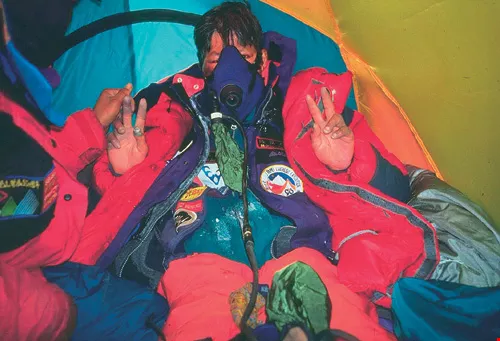
Gau spent a night trapped at 8300 m, part of what is known as the "death zone," waiting for rescue. This photo shows him after his rescue and return to Camp IV, his legs immovable and his hands, although not yet blackened, frozen solid and frostbitten. Later, as he was unable to get to a hospital promptly, his condition worsened further, resulting in the loss of his fingers.
Pushing man's limits
"That's not even the most challenging part," says Gau; the higher climbers get, the quicker they weaken, succumbing to a variety of altitude-related reactions including headaches, nausea, insomnia, and a lack of appetite. Even those fortunate enough to avoid such obvious symptoms of altitude sickness will suffer from delayed reactions and general malaise once they pass 6000 m due to the lack of oxygen; this also leads to impaired decision-making and memory, making the altitude as much a challenge as the terrain. The seriousness of these symptoms at heights over 8000 m, within 900 m of the summit of Everest, has led to these altitudes being known as the "death zone," and even the best Sherpas and climbers can have trouble making it through.
The first successful ascent of Mt. Everest was completed in 1953, and since then it has become the ultimate challenge for adventurers and climbers alike. Makalu Gau began his journey to knock off the world's most famous peaks in 1982, starting out in Tibet for his first attempt at climbing Everest in 1992, but he was forced back at 8000 m by a ferocious snowstorm. After that, he was determined that he would return one day.
In late 1993, Taiwan received unprecedented news from the Nepalese government: a Taiwanese team had received permission to climb Everest from Nepal in the spring of 1996. Gau quickly assembled the Republic of China Everest Team, and over two years of fundraising and training, including traveling to Mt. McKinley in Alaska for training. During this phase they lost their most experienced climber, Chiu Jui-lin, with another two team members suffering severe frostbite.
After returning from Mt. McKinley, with only half a year left before their departure for Everest, the team had suffered heavy casualties and were in financial trouble. Would they be able to carry on with their plan? "I was torn for a while, sure," remembers Gau. In the end, he wanted to make Chiu's dream come true, and considering how his team members had quit their jobs and gone through so much, there was no way they could give up.
Cheating death
After spending over a month leading his team from base camp to Camp III in order to give them time to adapt to the altitude, Gau decided on a two-team assault on the summit. If he and Chen Yu-nan, the two most likely to succeed, headed out first and succeeded, they could provide a morale boost to the two members of the second team. On May 9, Gau and Chen prepared to head for the 8000-meter-high Camp IV, but Chen slipped and fell outside their tent before they were set to depart. Although he seemed to be relatively uninjured, Chen decided it would be best if he stayed back for a while, and sent Gau and three Sherpas ahead. After reaching Camp IV, Gau learned that Chen had decided to head back to Camp II and had died on the descent. After some struggling, Gau decided it would be best to continue to the summit first and help with funeral arrangements afterwards.
No-one could have predicted that after making the summit, Gau himself would be facing down the Grim Reaper.
"I just lay there quietly, waiting for death," wrote Gau in his 1997 book Narrow Escape, describing that fateful night. Four hours back down from the summit, a snowstorm hit. It continued to grow in strength, soon obscuring the trail back to Camp IV. With the teams making a staggered descent, Gau was left separated from the others, and the storm left him without any way of making contact with the camp. In the darkness, two Sherpas--capable of getting about quicker on the mountain--struck out to find a way out, but did not return. Gau was left with no power in his headlamp, meaning that if he attempted to find the trail himself, he was very likely to lose his footing and fall. His best option was to find cover nearby, but he could not find any caves or rocks that could act as a windbreak.
Twenty hours after setting out, the zippers of Gau's clothes were frozen solid, his hands were numb from the cold, his communications equipment was unable to connect due to the extremely low temperature, and his lighter would not light because of the high winds. The snow from the storm was finding its way into every crevice. Afraid that if he fell asleep he would freeze to death, Gau first kept yelling to himself "Don't sleep! Don't sleep," then lay on his side to reduce the exposure of his face to the wind and snow. The slope of the mountain meant that on his side, he would steadily slide downhill, so Gau had to keep rolling to keep his balance and avoid sliding away.
His strength depleted and almost out of options, Gau began to wonder how his children would handle it if he died there like that, and to fear that he wouldn't be able to repay the support of Chin Hsiu Publishing for his unfinished "100 Peaks of China" project. He asked himself what ways he could end up dying there--one was through lack of oxygen, another by freezing to death. So he cleared the ice from his nostrils and began taking breaths as deep as he possibly could while slapping his hands against his thighs and stamping his feet into the ground. After doing this for half an hour, he began to feel some warmth returning, and so, at a slower pace, he continued like that for the night until he eventually fell asleep at dawn.
By the second day, the snow and wind had begun to ease up, and a team of Sherpas led by Tenzing Nuri mounted a rescue. Gau's legs were numb, and so the Sherpa tied a rope around Gau and pulled him along. Step by step along the rugged mountainside, they eventually made it back to Camp IV, after which several Sherpas continued to take Gau down, taking turns to carry him on their backs as they made their way through the dangerous terrain until they reached the icefalls near base camp, where a helicopter came to pick Gau up.
Later, Gau learned that the same incident had claimed the lives of some of the world's top climbers, including American team leader Scott Fischer, known as "Mr. Rescue," who had died near where Gau had been lying. Gau found it hard to understand how he had been able to escape from death's clutches.
"It might have been that I always tried to maintain a rookie-like attitude to climbing, being as conservative and cautious as possible. Before heading up to the summit, I put on an extra two layers of clothing, with the top layer especially cold resistant." Another reason, Gau thinks, is that prior to the Everest attempt, he had quit his job as a civil engineer and spent the previous two years living in Tibet at elevations around 4-5000 m in order to photograph China's famous 100 peaks. As a result, he had physically adjusted to high altitudes, to the point where it was as though he were half Sherpa, and was better able to handle the cold and lack of oxygen. And perhaps he simply had the Buddha's blessing on him.
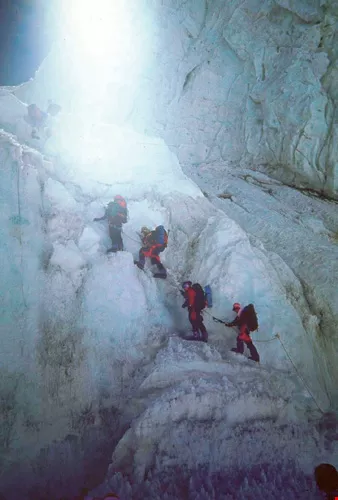
Climbing Everest requires climbers to start from base camp at 5340 meters above sea level, passing through four other camps before making their final assault. This photo shows the 1996 Taiwanese expedition team as they traveled between base camp and Camp II to help adjust to the high altitudes.
Cut to pieces
Since his rescue, Gau has gone through amputation, plastic surgery, and the trials of rehabilitation. This difficult process turned out to be just as hard as the climb.
First Gau's fingers had to be amputated, as they had been killed off by the frostbite. The wound left by the amputation was too large to stitch closed, so the doctors had to stitch his hands to his abdomen to encourage grafting of some of the flesh from there; once the skin had grown back over, they cut them apart again. During the 40 days his hands were stitched there, Gau was left unable to move his shoulders.
Meanwhile, Gau also underwent surgery to remove his nose, after which he had reconstructive surgery. Surgeons cut open his forehead, removed a small, triangular piece of flesh, which they then reshaped into a nose; the bridge of Gau's new nose was crafted from cartilage from his ear.
"Once the anesthetic wore off, my forehead hurt, my nose hurt, my hands hurt, and my throat had been scratched by the breathing tube. Everything was swollen and sore, and even breathing was difficult." After this major surgery was complete, Gau underwent three more minor operations to fix his nose, getting it into the condition it is today.
To stop the flesh from growing together and closing the nostrils, two special silicon tubes had to be inserted into Gau's nose and left there for three months after he left the hospital. On top of that, since some of the skin over his new nose came from his forehead, once the blood vessels were all connected again, his nose began to sprout hair. Following the surgeon's advice, Gau bought a pair of tweezers to pluck this new hair, which only stopped growing a couple of years after the surgery.
The biggest blow was the amputation of his toes. Since the front ends of both soles, along with parts of his heels, had died from frostbite, Gau would have to lose large portions of his feet, leaving him with reduced support when walking. Because of this, the doctors grafted pieces of flesh from each arm to each foot, creating new soles for him.
"Making the soles was nothing near as simple as doing my nose; when stitching the flesh to my feet, they had to connect the new and old blood vessels together one by one so that the graft would survive." Then, because the gap left in his arms was too big to stitch together, they had to take flesh from his legs and graft that in there. Finally, small portions of his heels also had to be amputated.
After returning from Everest and having lost his fingers and toes, Makalu Gau nevertheless persisted in pursuing his "100 Peaks of China" project.
Leading the disabled
"My feet hurt even more than my nose and hands put together!" exclaims Gau. The flow of blood through the newly stitched blood vessels was rough, and felt like a thousand needles stabbing through him, leaving him buckling in pain. "The pain was especially acute in the middle of the night when I was going to sleep. I cried out for the nurses to give me a painkiller shot, but they were afraid if they gave me too many I'd get addicted, so they refused."
Gradually the pain that racked his body subsided, leaving Gau to face the psychological challenges that lay ahead.
"When a social worker at Chang Gung told me I was now eligible to register as disabled, I really didn't want to even think about it," says Gau. But despite his discomfort with the idea, he realized that wallowing in his own pain couldn't bring so much as a finger back, and that he might as well face up to reality. He began to learn not to let his physical limitations push him down, and took to life with renewed vigor. "I'd already beaten back death once, on Everest, so why would I let him get the better of me now?"
It was not only his own superlative determination that drove Gau on; the support his friends, family, and girlfriend gave him while he was in hospital also moved him deeply, giving him the strength to carry on.
After returning home from the hospital, he began to take on the myriad difficulties he now faced in everyday life, from feeding and dressing himself, through reading books, and opening drawers, to going to the bathroom. Everything was a challenge, and sometimes he had to keep trying over and over until he was at his wits' end, leaving him dejected and depressed. Even simply learning to walk again, from staggering unsteadily to finally being able to walk in a straight line, took him the better part of a year.
After over a year of rehabilitation, he took a trip to Taiwan's Mt. Hohuan, where he found he was still able to handle high altitudes. Returning to the embrace of the mountains left Gau feeling overjoyed, and in 1998 he decided to try returning to Tibet. Traveling some of the way by vehicle and some on foot, he returned to Everest's base camp, 5340 m above sea level. On the way, the drop in air pressure caused his wounds to swell and begin to bleed, but once he got back down below 5000 m things began to improve again. The experience was a tremendous boost to his confidence, and reignited his hope of completing his "100 Peaks of China" project.
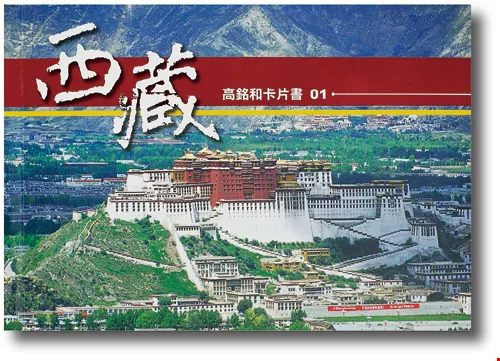
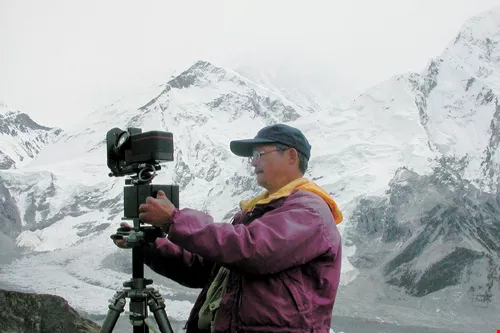
A life member of the Photographic Society of America, Makalu Gau has traveled to the heart of Tibet and taken a range of brilliant scenic shots of the mountains, people, and local culture. This book is a collection of some of his most spectacular shots.
Another mountain
The following year, Makalu Gau packed his luggage and, with the support of his friends and family, returned again to Tibet, where he stayed for eight months.
"It felt great, even though I was forced to move a fair bit slower," says Gau. What had been a day's trip was now a day and a half, and if it was a long hillside trek, he had to go at half his old pace to reduce the pressure on his feet. When heading downhill, having lost the gripping function of his toes, he was forced to either weave his way down by a zigzag path or head down backwards, both of which took a lot of effort.
Between then and 2005, Gau spent his time jetting between Taiwan and China, finishing off easier mountains like Sichuan's Mt. Emei in a week or two, and harder ones, like the Karakoram Ranges along the Xinjiang border, taking at least a month or two per trip.
Gau's other challenge in completing the 100 peaks project, aside from his physical issues, was the problem of fundraising. With his original backer, Chin Hsiu Publishing, out of business, he had to take to raising funds to continue his project through lectures and speeches. Results were good for a few years, but over the past two years things have got progressively worse; "Since 2006 it's looked increasingly like I might not be able to continue."
As well as raising funds and giving speeches, Gau also uses his tale of survival on Everest to motivate others. "I used resources from the community to get me up Everest that year; I should do what I can to pay them back." From schools to prisons, companies to dance halls, in Taiwan, Southeast Asia, and China he's given his speeches, and if he's invited, he's happy to travel even further.
After hearing Gau speak once, a middle-aged man by the name of Lu contacted him privately. Mr. Lu told him how he had come from a well-to-do family and had never wanted for anything, and how despite having married and had a child, he had never even had a real job. Meeting Gau had made him finally realize that he had wasted his life. After that, Mr. Lu set about trying to open his own business, and took upon himself the responsibility of caring for his elderly father.
Gau, who describes himself as "blood type M (for mountain)," has not only conquered the tallest mountain in the world, but also shown even greater courage and tenacity since his accident, living a life dedicated to overcoming limitations.
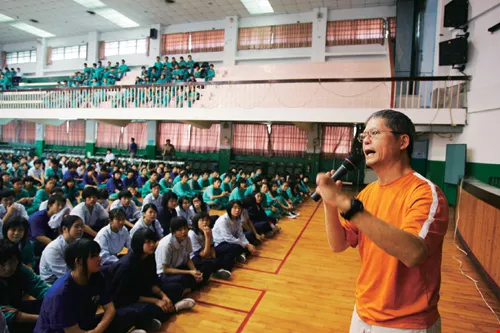
Gau is frequently invited as a speaker, using the tale of his Everest experience to inspire and move audiences. This photo shows him giving a talk at Taipei City's Longshan Junior High, drawing in the students with a combination of humor and brilliant slides.
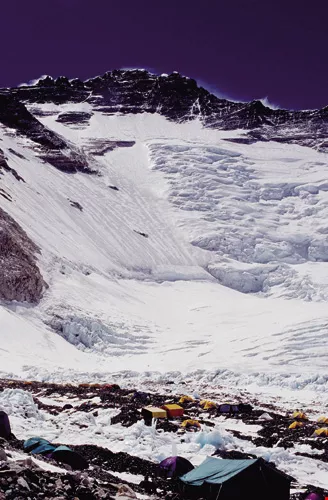
Situated at 6300 m, Everest's Camp II sits on a broad, flat piece of land, and it is here that the teams stock up on rations and equipment in preparation for the climb ahead. It was from Camp II that Gau and Chen Yu-nan set out to begin their assault on the peak.
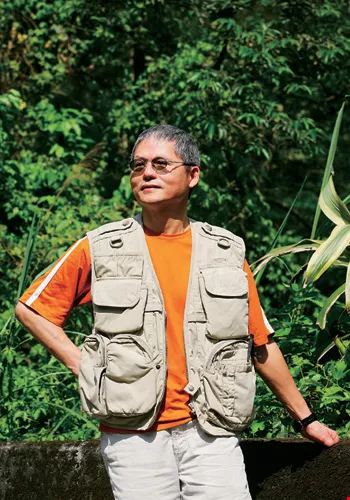
Makalu Gau, who jokingly refers to himself as having "blood type M (for mountain)," has had a lifelong passion for mountaineering, and despite the tragic price he had to pay for summiting Everest, he continues to face the future with positivity.


@List.jpg?w=522&h=410&mode=crop&format=webp&quality=80)


