A Growth Industry Spiritual Cultivation Groups Flourish in Taiwan
Tsai Wenting / photos Pu Hua-chih / tr. by Phil Newell
March 2002
All it takes is a weekend. Through a "spiritual cultivation" course, you will wash away all your worries, explore your inner self, cast away regrets and animosity, and dispel anxiety about the future. You will be energized, and gain immediate clarity and inner peace. Not only will you shed negative emotions, but you will find unprecedented harmony and success in your interpersonal relations and career.
It is easy to imagine how intriguing such claims can be to our contemporaries, who are so frequently poorly grounded emotionally and who rarely have a moment of tranquility.
And so we have A'nanda Ma'rga, Osho, Scientology, Avatar, Krishna-murti. . . . On the road in pursuit of spiritual growth, people in Taiwan not only enjoy local options such as "Seven Day Zen" courses, meditation, and qigong, but in recent years, there has been a proliferation of new spiritually-oriented groups. These combine core elements from ancient Eastern philosophy and religion with modern Western psychology and logic, and offer clear practices for self-cultivation. The recent case of Chu Mei-feng, in which both the victim and one of the figures implicated are members of one such group (Avatar), has inspired greater curiosity and greater concern among the general public about these opaque spiritual groups.
How many spiritual cultivation groups are there? Where do they come from? What do they teach? Is there really some path to health, happiness, success, inner peace, and total equanimity? How can you avoid getting scammed?
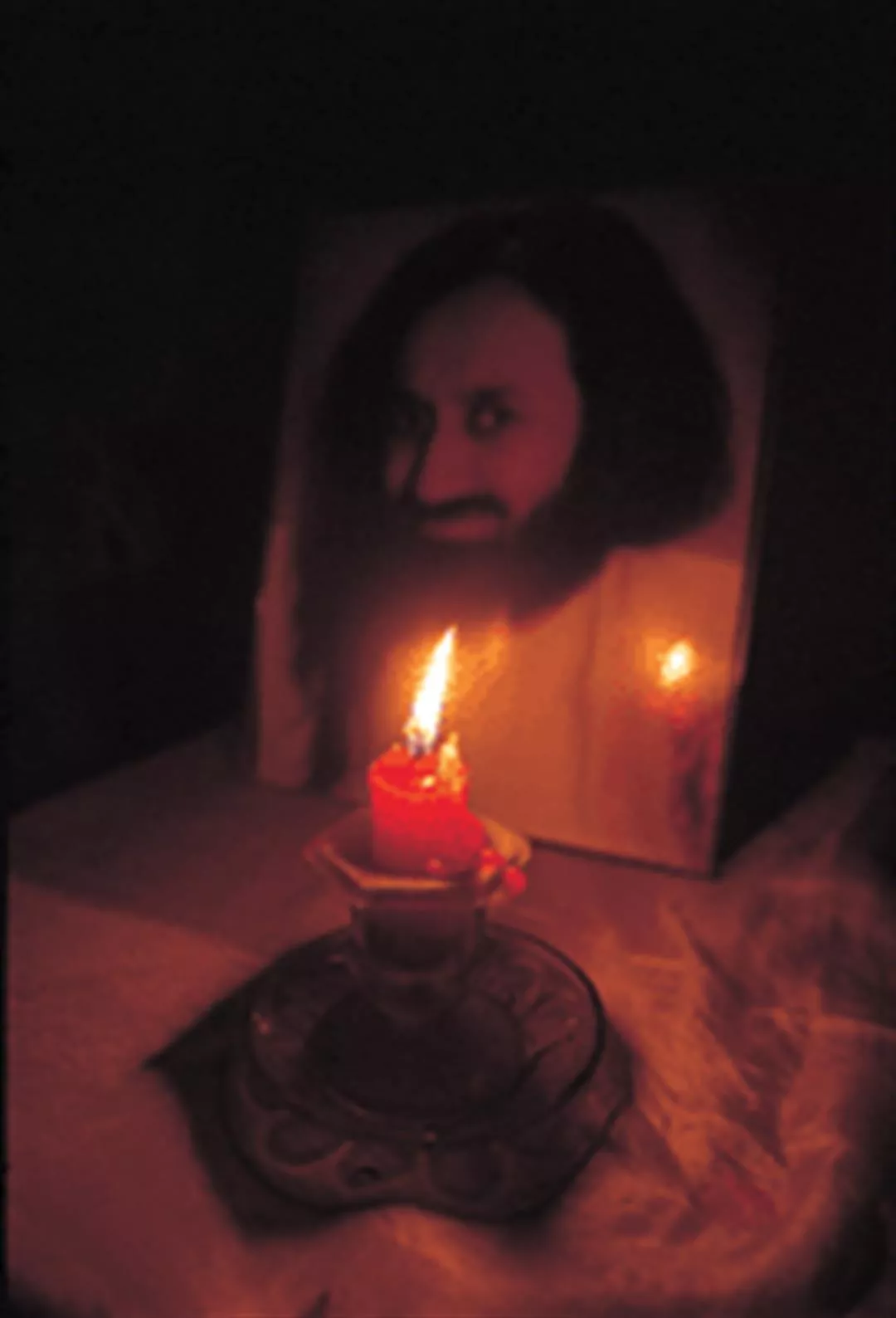
On a table, a gently flickering candle illuminates a photo of the Indian guru Sri Sri Ravi Shankar, clad in a white robe. Members of the Art of Living Foundation of Taipei City, posed in various postures with their hands raised chest- or waist-high, practice the "cleansing breathing method" (sudarshan kriya). It promises to enhance the vitality of their lungs, invigorate their cells, and expel accumulated toxins and negativity, bringing the melody of their lives into harmony.
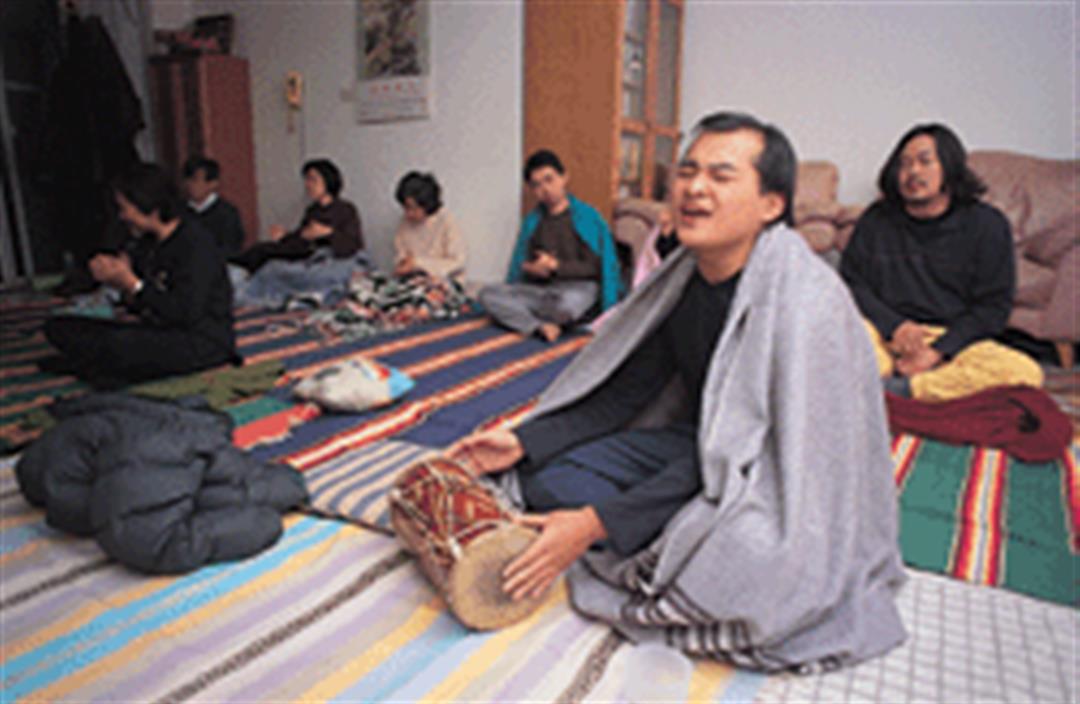
Afterwards, guided by their instructor Diana Sung, they slowly arise and proceed with chanting. Amidst the sound of gently tapped bells and drums, ancient sutra chants gather force, as the members of the group, ensconced in the gentle vibrations of harmonious music, enter a state of egolessness and leisurely relaxation.
"Before learning the cleansing breathing method, I felt very uncertain," says Wang Ya-hui, who was participating in her second breathing-method class.
Wang, a graduate in law from National Taipei University, had always wondered what it's all about. In her home were piled up a year's worth of old newspapers, which she had always kept around thinking that she should finish reading them, but never could. "I think at that time I was basically pretty close to insanity," says Wang, explaining with excitement in her voice how the course has turned her life around. When she attended her first two-day session, half-skeptical, she immediately felt a sense of peace and serenity she had never known before. While still at the class venue, she called her younger sister, with whom she had been at odds for a long time, and after returning home, spent the whole night giving that enormous pile of newspapers to an old trash scavenger.
Everywhere and always there are people anxiously seeking the path to enlightenment. Lin Kuo-yang (Sw. Dhyan Chan-dana) has translated 43 volumes of the works of Osho into Chinese. He recalls that when he was in his first year in high school, he suffered from a terrible bleeding ulcer. Knowing that his ailment was connected to his emotional state, he sought out answers from psychology and philosophy, and joined the Buddhist studies club. "I was eagerly searching everywhere, but none of those things could resolve the imbalance I felt inside."
Finally, in the United States, an economics professor of his introduced him to a book by Osho. "Osho simply talks about his own experience of enlightenment, which is completely different from the scholarly summaries and inferences of academics. His extraordinary wisdom is testimony to his genuine enlightenment." Thereafter Lin read more than 30 Osho books in a row, happily becoming a sincere follower and devoting himself to introducing the wisdom of Osho into Taiwan.

Many new gurus have appeared preaching a combination of ancient religion and modern psychology. The photo shows Sri Sri Ravi Shankar, who emphasizes breathing techniques.
A new age
"Last year at Chinese New Year, about 200 people from Taiwan went to Osho's ashram in India for spiritual cultivation," says Lin Kuo-yang. Eight years ago, when he translated his first book by Osho, it took three years to sell 1500 copies. Today, the works of Osho that he has translated sell about 13,000 copies per year, which gives you an indication of the spike in the spiritual movement in Taiwan.
If you were to take a tour of spiritual groups, you would discover that participants are mainly highly educated white-collar workers. Of course, spiritual seeking is not confined to intellectuals. It is common to find older people doing so with the help of their traditional belief systems, often including direct contacts with the occult world. It is just that traditional religions are burdened with features-dogmatism, sectarianism, and a certain social-class profile-which modern intellectuals find distasteful.
"Modern people are most easily swayed by things that are framed conceptually, so intuitive spiritual methods have to be packaged in rational terms to make them more acceptable. The new mode of 'spiritual cultivation' is something that satisfies the demands of modern urbanites," avers Lin Ku-fang, director of the graduate institute of arts at Fo Guang University.
Looking back, in the West, at least as early as the 1960s, people were discovering that modern society, structured by rationality, science, and capitalism, did not bring a sense of fulfillment, and they began to explore more spiritual avenues.
"Taiwan is showing a similar trend," says Liuh Shiuh-ya, executive director of the Shiuh-li Liuh Memorial Foundation, which has organized a large number of spiritual growth courses. In an age which demands efficiency and speed, less time is devoted to traditions such as the many rituals from birth to death, or mutual support in the extended family. As a result, modern people feel a sense of anomie, as if they belong nowhere, a sense of isolation and anxiety.
In the last couple of years in particular, all of society has been pushed toward a whirlpool of doubt about life. The current generation, which has made Taiwan's economic miracle an article of faith and has always believed that hard work would indubitably produce success, is now facing economic recession for the first time.

Students at the Art of Living Foundation chant sutras in time with the drumbeat, forgetting their worries as they resonate with the music.
Deep into inner space
Many of today's spiritual systems were developed in the West, drawing upon traditional belief systems and practices from India, Tibet, and Japan as well as from Native American and Latin American peoples; these systems are now being brought (or brought back) to the Orient.
One of the defining characteristics of modern spiritual belief systems is that they do not teach ethics such as obedience to parental authority, and they dispense with the many strictures and commandments of traditional religions. Another is that they take the anthropomorphized deities of the world of religion and convert them into symbols of a kind of power or force. They also bring together Eastern philosophy with Western psychology. Liuh Shiuh-ya points out, "The most important thing they provide is a first-hand spiritual experience." What modern people want is not to be told that they should love their fellow man, but to learn how to produce an inexhaustible supply of love to give; they want "an individual, internalized peak experience."
Artist Hou Chun-ming, who lives a spiritual life in rural Miaoli County, has participated in activities sponsored by various groups including the Shiuh-li Liuh Memorial Foundation and Osho organization. He's currently organizing his own "Mirror" sharing group. Hou states: "I'm not looking for some occult experience, or divine enlightenment that transcends time and space. What I want is a kind of sacred experience in which I can deeply connect with my inner self. I want to feel like there is a resonance, an intuitive link, with the entire universe, what the ancients described as 'harmony between man and nature.'" Hou, who was a spiritual medium in the Tsu Hui Temple in Sungshan, adds that he is very grateful for his temple experience. But the force he seeks comes from within himself, and not from deities in some outside realm.

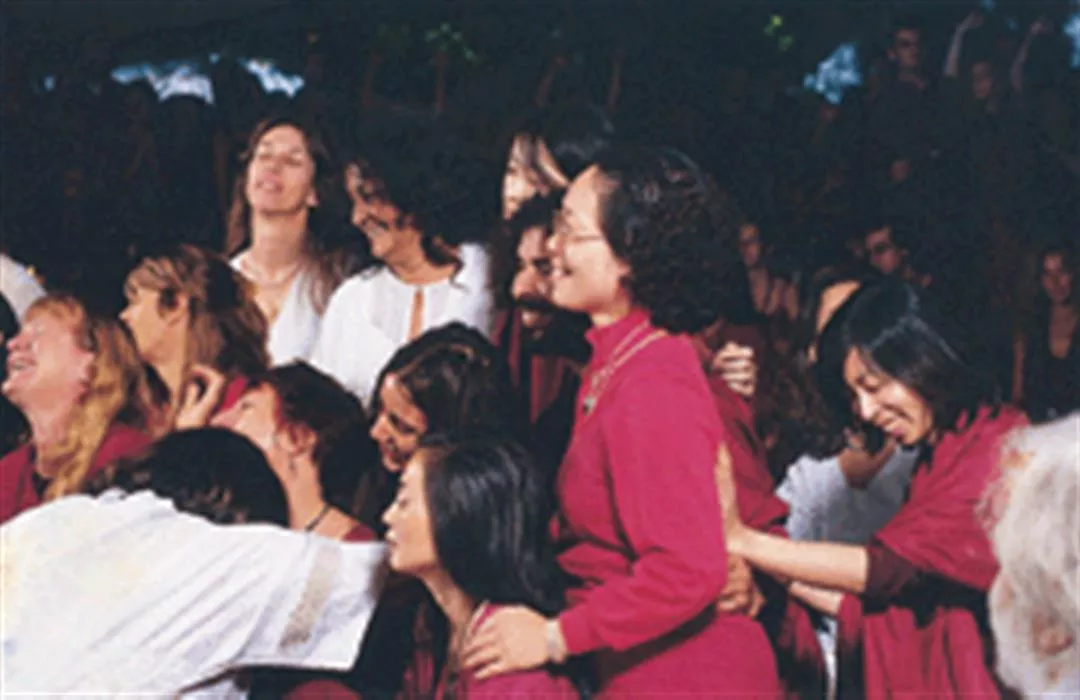
Students at the Osho Multiversity in the Osho Commune in Pune, India, touch one another to the strains of music, immersed in the resonance of their energy and potential. (courtesy of Wu Hsiu-ching)
To each his own
There are a variety of practices within modern spiritual cultivation groups, which promise convenient guidance to persons of differing needs and characters. Take for example dynamic meditation, part of the Osho system, which bring together ancient religious philosophies with discoveries from modern psychology; it is a prescription designed especially for modern man.
Chen Hui-chun, an editor in a publishing house, tried traditional meditation for a long time, but it was always the same: She would get restless and fidget about, while all kinds of thoughts would race through her head. However, introductory Osho dynamic meditation allowed this woman, who is every day buried up to her ears in words, to put her perturbations aside.
Dynamic meditation is divided into four stages. In the first stage, you spread your arms out like an eagle in flight, take big breaths to fill your body with energy, and shatter your everyday mask. Next comes screaming and yelling, with a flow of irrational gibberish, in order to release accumulated frustrations and negative moods. In the third stage, you lift your hands high above your head and hop around while simultaneously emitting a 'hu' sound from the lower abdomen, moving from a state of disorientation to one of sacred egolessness. When your body becomes tired, and your spirit is relaxed, then you can accept the final celebration, and dance to the music, freed from all cares and worries.
Tai Chih-ching, personnel director for a computer company, attended her first class in whirling meditation (based on ancient Islamic Sufi practice) at the invitation of a friend. When she heard that they were going to twirl in place for 15 minutes, Tai, who is anemic and who often feels dizzy, thought she had better leave the hall. But as she joined in a brief preliminary sacred dance, she opened her eyes and found herself, one hand raised in the air, the other held below, spinning like a child. She suddenly discovered that it was as if the spinning part were merely the exterior, while she herself was as calm as the eye of a storm. Later, she immersed herself in the quarter-hour whirling, and not only did not feel faint, but actually experienced greater clarity than usual.
Lin Ku-fang explains, "People of different orientations and abilities require different spiritual approaches." For example, those who are relatively fragile members of the modern world are most suited for traditional religion, which offers a clear object toward which people direct their faith and on whom they can call for assistance. Persons who are especially lackadaisical might find dynamic approaches like Taichi Daoyin (based on traditional taichi exercises) more fitting. Persons of straightforward character and intelligence, who seek the total awareness of sudden enlightenment, can follow Zen practice.
What about the approaches of today's spiritual cultivation groups tailored to contemporary people? Lin reminds us: "To realize that there has always been another realm to life is of course a good thing, and is an opportunity to find a pathway to spiritual enlightenment. But if you do it for a year, or five years, or ten years, and your real life has not changed, then it could very well be an illusion."

Table by Tsai Wen-ting/illustrations by Lee Su-ling
Golden means
Compared to traditional religions, today's spiritual cultivation movement most emphasizes the development of personal life force and improvement of interpersonal relations, so that the "me" can find happiness and fulfillment. It does not address remote questions of what came before or what is to come, the pursuit of eternal life or transcendence.
In general, Western scholars categorize these spiritual cultivation groups, clothed in a thin veneer of religion, as psychocults. In Taiwan, in order to minimize the hostility and mistrust many people feel toward new religions, many of these groups have established themselves under different facades: trading companies, health food companies, foundations, or psychological counseling services.
Take for example Avatar, recently the focus of a media clamor. Avatar instructors in Taiwan all say that it is a personal growth course, not a religion. The educational psychologist Harry Palmer, who created the Avatar course and has registered the Avatar name as a trademark, emphasizes in his writings that the goal of Avatar is not to acquire worshippers or followers, but is a system of accumulated wisdom that can be converted into money and success. Thus, the leaders in every area who receive a certification to teach the system must pay a copyright fee to the headquarters.
Can one purchase unsurpassed wisdom with money? This really marks a difference from the ideas of compassion and charity of most religions. For example, the three-stage Avatar leadership course costs roughly NT$75,000 for about ten days. A more advanced offering charges NT$260,000, and includes the stipulation that the course content cannot be revealed to outsiders. This degree of profit orientation is one reason many people have suspicions about the Avatar group.
Chuang Hui-chiu, director of planning at PsyGarden, says: "Spiritual cultivation groups that target the elite and have a large commercial and financial component give participants a sense of superior class consciousness, of being better than others, which distorts the basic charitable outlook." Knowledge that is helpful in life should be available to everyone.
Nonetheless, for participants who find these things useful, any amount of money is worth being able to transform how you think and feel in a short time. Wu Mei-ling, who is in Avatar global leadership position number 5946, argues: "I don't think it's expensive at all. I've taken management seminars which cost NT$50,000 to 60,000 for just a couple of days!"
Wu, who has just returned from Miami where she went through her second refresher course, is the general manager of an international consulting company. She feels that the Avatar course makes collective consciousness and trans-sensory contact simple; it teaches people how to verbalize concepts and create the reality that they desire. After a nine-day course in which she was emotionally wrenched to extremes of both laughter to tears, she felt like a new person.
In the "rediscovering life" class, when reading along with the leader, after only a paragraph or two Wu felt that the text completely fit her own situation. The frisson she felt was exactly like the moving sensation she had when she visited Putuo Mountain, a scenic location near Beijing with many monasteries. "It turns out that enlightenment is just so simple," says Wu, who adds that such a valuable experience is worth any amount of money.
"I've always believed I could be even better; even when I was a child I felt this way. I have attended countless management growth seminars. I used to be a very stubborn person, and my outgoing and happy attitude was mostly a put-on. I was incapable of going a whole day by myself, and I often felt pain or got rashes for no apparent reason," says Wu. Today, people who know her approvingly say how warm and upbeat she has become, and join her classes. Moreover, after taking the Avatar courses, Wu discovered that, once she could more effectively manage her emotions and construct her thinking more logically, her sales results have multiplied many times over.
"I attended many management courses before. I don't know if those count as spiritual cultivation, but they all strongly emphasized facing yourself, and especially that side of yourself you don't dare to face. A lot of people in my business have also attended these spiritual growth classes, hoping to break through their personal difficulties, have more harmonious personal relationships, and progress to a higher level at work," says Chen Tsu-yin. Chen recently entered the insurance business, and this year, despite her great terror about meeting people, won the annual best individual achievement prize given by her company's customer service department.
Liuh Shiuh-ya points out that many office workers have attended spiritual cultivation courses in hopes of being able to move faster and work harder in everyday life, or make more money. There's nothing wrong with that, but it is all part of the mundane world, and it would be difficult to really come to understand what it means to feel compassion and love for all things.
Pros? Or con men?
It has always been difficult to regulate and define religions and spiritual growth groups. The new "Psychology Practitioners Law," passed just last November, stipulates one must have at least a master's degree in a relevant field, as well as two years of practical experience, to go into professional practice. It also stipulates that therapists must respect professional ethics, such as prohibitions against discussing a patient's case with any third party or against getting romantically involved with a patient while the patient is still in treatment.
Despite such rules, it is very easy for a person to be accredited as a teacher or leader by such groups as Osho, Avatar, and The Art of Living, and Taiwan lacks any system for certifying legitimate groups. Anyone who wants to can establish their own center and recruit students. Given that none of the new religions or spiritual growth groups have traditional regulations or doctrines to fall back on, the results can be disturbing.
The recent case of former city councilor Chu Mei-feng, who was secretly filmed having sex, with the resulting VCD being sold publicly, is a case in point. One of those implicated, Kuo Yu-ling, who has an Avatar leadership certificate, allegedly took advantage of the trust put in her by her student (i.e. Chu) to install the hidden cameras, after which she copied and sold the video. Such appalling behavior cannot help raise grave doubts about the value of such spiritual training.
The Osho community emphasizes sexual freedom, with sex rooted in love, not necessarily in marriage. No wonder it has been called "a paradise for men." There have been several cases in Taiwan of directors of meditation centers putting too much emphasis on their personal charisma, of equating love with sex, and having affairs with their female acolytes.
Because spiritual growth courses are soul-baring experiences, people can in a very short time build very deep emotional attachments. "When deep emotional attachments go wrong, toward worldly love and hate, obsession and vengeance, naturally the actions taken will be more vicious," suggests Liuh Shiuh-ya. Overseas as well, spiritual cultivation groups appear and disappear all the time, with their fate often connected to scandals over sex and money.
"You have to remember that the teachers in the spiritual cultivation groups are also people, and though they may have started the search for enlightenment earlier than yourself, they also have their human weaknesses," points out Chuang Hui-chiu. Especially in spiritual cultivation groups that emphasize equality and no distinctions of status, teachers and followers closely interact, so it is even more likely that they will end up dragging each other into their secular concerns.
Getting in tune
Liuh Shiuh-ya, who has a PhD in integrated East-West psychology from the US, made a surprising discovery when she visited the Temple of Heaven in Beijing while in the mainland attending an academic conference: near the Temple of Heaven is a Temple of the Moon. "Just think of worshipping the moon in the dead of night. . . people have been pursuing that kind of spirituality since ancient times."
To modern people, divorced from sacred experience and cut off from traditional rituals, Liuh suggests that you can reconstruct your own personal altar, a corner where you can find peace and quiet, undisturbed, where you can listen to your own spirit and connect with the universe, a place where you belong and can always return on your journey through life.
Hou Chun-ming, who no longer participates in spiritual growth groups, rises each day at 5:00 or 6:00 a.m. First he does a half hour of "free writing," in which he writes down all his thoughts as they come to him, unedited, in order to bring out his inner self. After breakfast he drops his wife off at her teaching job, and then, equipped with self-awareness, drives up to his studio in the mountains of Sanyi. In the mountain forests he gets in tune with the natural sounds to harmonize the natural vibrations of his body, and then goes into his studio to begin creating.
"For me, creating has always been a spiritual exploration, coming face to face with your deepest desires and darkest side." Hou, whose work has been shown at the Venice International Biennial Exhibition of the Arts, was in the past always ready to attack and turn things on their heads.
Over the past two or three years, he has continued to make Osho mediation a part of his life. Every day he paints a mandala and sometimes isolates himself or fasts. These days his works are not so critical, angry, and chaotic. Like a cleansing ritual, the process of creating is like a budding desire, and his whole person enters a sacred state.
Life is itself a form of practice. Spend money, go to class, learn from a teacher, and if you afterwards really integrate the practices you have learned into your everyday life, the realm of joy, contentment, and awakening will certainly one day be yours.