

Taiwan has been called the Kingdomof Fruit. According to the Council of Agriculture, Taiwan produces NT$60 billion worth of fruit each year, of which watermelons account for over NT$3 billion.
Former Council of Agriculture minister Lee Ching-lung once sampled some watermelon while in Greece. The local farmer told him, "It comes from Taiwan!" That's when he found out: though Taiwan and Greece are half a globe apart, separated by a 15-hour flight, the watermelons that are all the rage in Europe are the handiwork of a Taiwanese seed company.
In fact, Taiwanese seeds crossed the oceans some three decades ago and were sold in more than 20 countries. In over 70 years of the All-America Selections trials, the world's largest horticultural competition, only eight watermelon varieties have won awards, and four of those were Gold Medal Awards plucked up by Taiwan's Known-You Seed Company.
Portraits Taiwan, a documentary jointly produced by the Government Information Office and the Discovery Channel and broadcast last year in 23 Asian countries, documents from an international perspective the success story of how Known-You founder Chen Wen-yu led Taiwan onto the world stage with a seed. The documentary not only showcases the essence of Taiwan's agricultural development; it also sketches out the persistent spirit and innovative vigor of the Taiwanese in improving the economy.
Taiwan's Green-Thumbed Water melon King
(Kuo Li-chuan/photos by Jimmy Lin/tr. by Chris Nelson)
Chen Wen-yu was born in 1925, when Taiwan was under Japanese rule, to a farming family in Tainan. His father raised sugarcane, and though his family was well off, Chen still had to help out in the fields after school. After graduating from Yungkang Public School in Tainan, he was admitted to the Hsinfeng College of Agriculture. In those early days, Taiwanese farmers were unable to afford better seeds, the quality of crops was hit-and-miss, and harvests were often affected by natural disasters. When Chen was a child, he often watched his parents stare at the fields sighing with exasperation, and he resolved to better the lives of farmers through crop breeding.
After graduation, Chen began working for the Fengshan Tropical Horticultural Experimental Station. In the beginning he concentrated on vegetable breeding, but after the war he began working with watermelons. In an era when there were only dirt roads in the countryside, his lanky frame could be seen everywhere, shuttling from place to place. He studied soil quality, moisture content, climate, and crops suitable for planting, researching in the fields by day, writing reports back at the lab by night. His thesis, Watermelons of the Hsiatanshui River, Pingtung, was published in Taiwan Farming and Forestry.
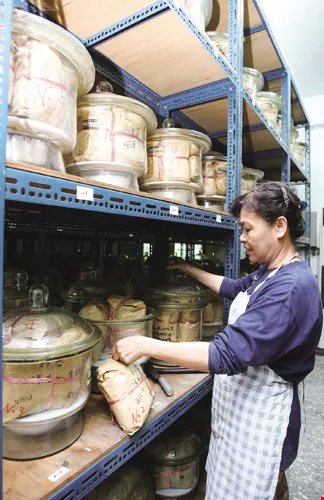
Known-You's seed bank in Kaotan, Kaohsiung County, boasts as many as 60,000 seed types gathered from around the world. The company has more seed types than any other company in Taiwan.
Seedless watermelons
In the 1950s, seeds of the American Sugar Baby watermelon cultivar were sold to Taiwan, and the farmers then sold the harvested watermelons to Hong Kong. Because Sugar Baby seeds are not disease resistant, the seedlings are prone to fusarium wilt if allowed to continue to the second generation: the watermelon vines will split open and crops will wither, causing great losses to unwary farmers.
By that time the Kihara Institute for Biological Research in Japan had developed a breeding technique for seedless watermelons, but it was not very reliable and not universally applicable. Chen set about conducting research, and after three years of effort, in 1962, successfully cloned Taiwan's first seedless watermelon: the Fengshan No. 1.
Cloning is a major global issue now, with cloned sheep and pigs eliciting ethical debates. But in fact cloning has been part of crop farming for ages. Chen employed cell culture techniques to replicate the watermelon's 22 pairs of chromosome into 44 pairs, then crossed the resulting plants with the original variety, modifying it into a generation that could not reproduce (i.e., a seedless watermelon).
At that time the Erhlun Farmers' Association of Yunlin County wanted to cultivate a specialty crop. From his own investigations of farmland Chen had found that the sandy land below the Hsiluo Bridge was quite well suited for planting this kind of delicate, cold-sensitive seedless watermelon, so at the behest of the farmers' association, he painstakingly drove from Fengshan in Kaohsiung County to Yunlin to teach the farmers how to grow them.
"Farmers work in the fields by day, so we could only hold the seminars in the evenings. I often had to stay overnight at the association, but there were so many mosquitoes that it was impossible to sleep," says Chen, recalling those days with a wry smile. Compounding Chen's lack of a good night's sleep was the fact that the sandy land below the Hsiluo Bridge was devoid of vegetation at that time. Chen and association director Wang Liang-hsiung, standing in the scorching sun drenched with sweat and teaching the farmers to plant watermelons, appeared to their colleagues to be two fools spouting pipe dreams.
Several months later, the once-barren fields were overflowing with green watermelon vines laden with fruit, and with the help of the supply bureau of the Joint Commission on Rural Reconstruction they sold this batch of seedless watermelons to Hong Kong. When the farmers found that watermelons were more profitable than rice, they grinned from ear to ear and dubbed Chen the "Watermelon King."
Because of his striking success in developing seedless watermelons, Chen was admitted that year to Chiba University in Japan for a year of study in vegetable breeding at the advanced age of 37. Chiba University's curriculum was designed to foster professionals in agricultural technology, and his mentor, Takeo Fujii, had abundant breeding experience and academic credentials. After class, Fujii would change into work clothes and bring his students out on field investigations, and Chen gained a great deal from Fujii's earnest and pragmatic teaching attitude.

Diana
In 1968, 43-year-old Chen left the Fengshan Tropical Horticultural Experimental Station, and founded the Known-You Seed Company with his friends. Before 1970, most of the world's seeds were purchased from the US and Japan, but Chen believed that Taiwan, with its fine climate and manpower quality, most certainly had a competitive edge for seed production.
As expected, after two short years in business, Known-You had built a name for itself internationally. Companies in many countries commissioned Known-You to produce seeds, not only bringing wealth to rural areas, but also creating a different kind of Taiwanese economic miracle. Even Japanese seed companies with business volumes many times that of Known-You were drawn into Taiwan and cooperated in the development of new varieties. The Hsiang-hua muskmelon currently on the market is the result of cooperation between Taiwan and Japan at that time.
Fast forward 40 years. Known-You, as before, shoulders the great responsibility of fruit and vegetable breeding in Taiwan, and Chen, just as in his youth, is busy rushing around in the fields all day long, without showing any of the fatigue of an 82-year-old man.
On a warm winter's morning, Known-You's provisional farm in Wantan Township, Pingtung County, is bustling with activity. This ten-hectare tract of farmland, leased from the Taiwan Sugar Corporation, has been planted with various crops. Under a makeshift canopy, several hundred watermelons, marked with variety numbers, are arranged in neat rows. It's selection time for Known-You's fall crop of newly bred varieties, and workers are shuttling back and forth taking care of their duties.
With the aid of an assistant, Chen takes a knife, cuts a hunk of flesh from a halved watermelon, and samples it. He immediately jots down notes, preparing to select watermelons for the next stage of breeding. Before a watermelon can be selected for breeding, it must pass muster on more than ten criteria including sugar content, mouthfeel, weight, hardness of rind, color and quality of flesh, seed count and seed size. Failure in any one criterion results in elimination.
In each of the spring, summer and fall growing seasons, around 200 varieties are selected. In the summer growing season, failure is often declared due to typhoons, but with the favorable weather of 2006, more than 500 varieties from the fall crop were chosen, requiring two full days to complete the selection. Chen remarked that he took a bite out of more than 1000 watermelons, often becoming so stuffed that he could barely stand.
Among the varying sizes, shapes and colors of the watermelon varieties in the selection grounds, one can, remarkably, see Brazilian and South African watermelons as well as central Asian cultivars from Tashkent and elsewhere in Uzbekistan and Almaty in Kazakhstan. The farm workers note that seed companies from around the globe regularly send locally produced seeds to Known-You for test planting in order to learn about their qualities; others are seeds brought back by company employees traveling overseas. As long as there are suitable climate and soil conditions, Chen will try growing and tasting them in the testing grounds.
The total workforce of Known-You is no greater than 300, including its headquarters and overseas branches. The watermelon team consists of 40 people, with an annual watermelon research expenditure of NT$100 million. "The way I see it, each watermelon is a work of art," says Chen. In Chen's hands, the development of a new variety requires at least six years, sometimes more than a decade, before the time is ripe.
Take the Diana variety, for example. This watermelon, with yellow rind and red flesh, not only breaks the stereotype of watermelons having green rinds; it also has a sugar content reaching 11°, thus imparting a satisfying intense sweetness the instant is enters the mouth. But the time Chen spent solely on stabilizing its yellow rind coloration was six years.
"The rind comes from wild South American varieties. The yellow gene is dominant, but its inheritance is unstable. Even if the parent generation is successful, the next generation will not necessarily have a yellow rind." On this account, Known-You sent people to Japan to learn the breeding process for red-skinned pumpkins.
After the rind color was stabilized, Chen spent another six years breeding the watermelon to develop a more appealing shape, redden the flesh and boost the sugar content because the wild South American varieties weren't sweet enough, were too seedy and had white flesh. Then on the eve of the unveiling of this new variety in 1997 came the sudden news of Princess Diana's death in an auto accident. To commemorate Diana's travels around the world to visit poor and sick children, Chen dubbed this yellow-skinned, red-fleshed, sweet and alluring watermelon "Diana" after her beautiful blonde hair.
This one-of-a-kind watermelon provoked Japan's biggest seed companies come to Taiwan and vie for exclusive buying rights. China, with the largest watermelon-growing acreage in the world, also jumped on the Diana bandwagon, and local melon farmers rushed to buy seeds. The price of Diana seeds skyrocketed to twice that of ordinary watermelons.
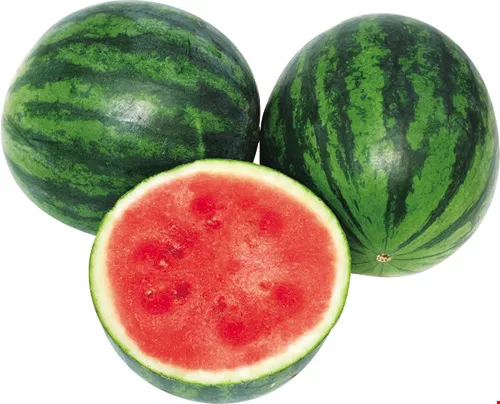
A new variety of low-calorie, red-fleshed seedless watermelon, Cute Lover, is set to become available this year, offering the people a new taste.
Watermelons made to order
Currently there are two main methods for developing new varieties. One is traditional breeding, a natural technique involving seed selection and cross-pollination, akin to eugenics. But it is slow and has unpredictable results. The other is genetic engineering, which came to the fore in the 1980s, a technology in which certain genes are inserted into plant DNA. For example, after introducing virus-resistance genes into corn, the next generation will be virus resistant. Genetic modification can quickly and effectively give crops special properties, but it also elicits major controversy regarding health and the environment.
Currently most seed companies in the world still cling to traditional breeding, because with the exception of several large conglomerates like Monsanto which create proprietary crops of soy, corn, cotton and potatoes through genetic engineering, the technology remains immature within other companies. Known-You combines traditional breeding with biotechnology to shorten the breeding process and reduce seed collecting costs.
In traditional breeding, cross-breeding of different varieties within the same species is used to modify successive generations, so the greater the gene pool and the more distinctive the characteristics of a variety are, then the easier it is to breed special varieties as one wishes. What makes Chen most proud is the fact that Known-You has a collection more than 60,000 varieties of seeds from all over the world, the largest such collection among Taiwan's companies. For more than 30 years, as long as he heard where to obtain rare fruits, Chen would be able to find someone to bring them to Taiwan, including requesting members of government agricultural teams be stationed all around Africa and Latin America collect seeds from their far-flung locations. When company employees go overseas, they first visit traditional fruit and vegetable markets, and if they see any kinds they've never seen before, they find a way to bring the seeds back to Taiwan.
On the shelves of Known-You's vast seed bank at its breeding grounds in Kaotan Village, Kaohsiung County, densely packed seeds fill clearly labeled glass jars. After drying, these seeds can be stored for several decades. As for watermelons, Known-You has a collection of over 1000 wild varieties; it can be regarded as the world's most complete watermelon seed bank. Seven years ago, the records were computerized, providing information relevant to flavor demands in different markets in different countries, for "made-to-order" watermelons.
According to Known-You's years of international experience and market surveys they conducted of local melon markets, Greeks prefer medium-sized (six to eight kilograms) watermelons with dark rinds, black seeds and bright red flesh; Americans prefer large (over 10 kg) ones with patterned rinds, big black seeds and pink flesh; and in Southeast Asia people demand light to off-white seeds. Chen laughs: "Southeast Asians don't like black watermelon seeds because they look dirty. People think it looks like a swarm of flies are stuck in the flesh!"
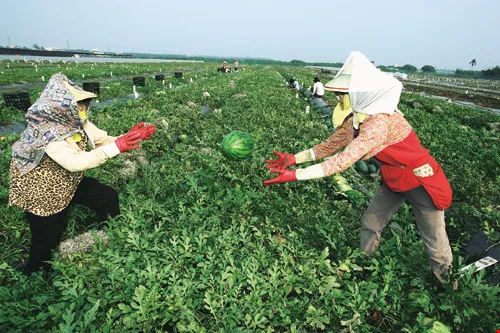
On a warm winter's morning at Known-You's provisional farm in Pingtung County, workers are busy preparxing for the selection of breeding varieties.
"Singles" melons
A few years ago there was a global tomato health craze, and the Santa tomatoes loved by the Taiwanese are a signature product of Known-You. But tomatoes need to be thoroughly cooked with oil before the lycopene in them can be absorbed by the human body, which can be a bit of a hassle. A paper recently issued in Japan indicates that watermelons are also rich in lycopene and carotene: the content of these nutrients in red-fleshed watermelons is three times that of tomatoes, and that the content in seedless watermelons is double that of red-fleshed watermelons; moreover, the nutrients can be absorbed into the body when eaten raw. So watermelons are more nutritious, more convenient and have fewer calories than tomatoes.
Over the past several years, the round, red-fleshed, seedless Queenlet watermelons with their dark-green rinds and Golden Crown watermelons with their yellow skins have become widely popular in European and American markets. An American seed company secured exclusive selling rights from Known-You for these varieties. The fruits weigh about two kilograms, small enough to be eaten by one or two people, earning them the nickname of "singles" or "lovers' melons."
So that Taiwanese can enjoy healthy, low-calorie, red-fleshed seedless watermelons, Known-You specially bred a similar melon--Cute Lover--choosing to grow them in Chiayi and Yunlin. They will become available this year. Chen released this superb variety for planting in these two agricultural counties not merely for factors like the soil quality and climate; another important reason was the vigorous promotion by the directors of the local farmers' associations.
Take, for example, the successful new variety of muskmelon, Ten-Me, that the company developed over 12 years. This is a hybrid of American honeydews, Japanese greenhouse-grown melons, Hami melons from Xinjiang and a primitive variety of Afghan muskmelon, with a rich perfume and a sweetness index as high as 14°. With great demand in the market, farmers have asked legislators to press him to sell them Ten-Me seeds, but Chen, who insists that "good varieties need to be planted by good people," is only willing to sell seeds to experienced, knowledgeable, conscientious and caring farmers.
For example, a decade or so ago, Known-You went to mainland China to set up a breeding ground. But the watermelon seeds were stolen by mainland melon farmers who sold them to the Philippines, Malaysia and Thailand. Afterwards, they were sold back to Taiwan at a low price, resulting in losses for Known-You and Taiwanese farmers.
Chen stresses that seeds are important, but so are farming methods. "There are two keys to agricultural competitiveness: one is to plant varieties that others do not have; the other is to grow them better than others!" Taiwan is the most developed place in the world for tropical agriculture, and if farmers improve their cultivation standards and grow Known-You's superior varieties, Taiwan's agriculture will have a competitive advantage even in the face of the impact from Taiwan's joining the WTO.
Chen notes, "Breeding doesn't just require good technology; it also requires an eye for the market." For instance, Known-You found through its market survey on flower color preference that, for the same kind of flowers, more than half of the people choose to buy pink flowers. On the basis of this survey, Chen decided to integrate the concepts of health and romance by breeding a beautiful pink-fleshed watermelon. In the future, this pink watermelon is bound to be a hit.
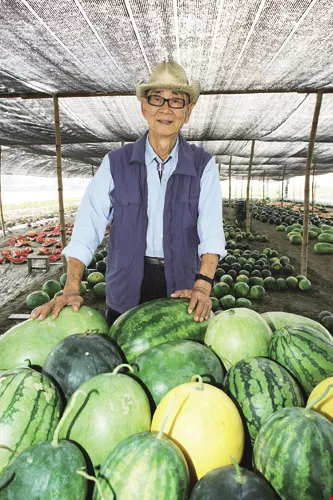
A born farmer, Chen led Taiwan onto the world stage with tiny seeds. His life reflects the history of Taiwan's agricultural development, sketching out the persistent spirit and innovative vigor of the Taiwanese in improving the economy.
Beautifying rural towns
Chen thinks highly of the market and in investing in consumer preference, but he is unwilling to regard seeds as a mere commodity.
"Every seed represents hope for the farmer, so we research and develop seeds so all farmers can make money, not just so our company can make money. This is a profound responsibility." Thus far, Known-You has founded branches in China, India, Singapore, Thailand, Burma and Vietnam, as well as Brassicaceae breeding grounds in Shanghai and Xi'an.
Chen has extended his passion for fruits and vegetables into a selfless caring for farmers. In 2001, he founded the Known-You Peasants' Hospital in Burma, providing free healthcare to impoverished farmers. After six years in operation, the hospital is accomplishing its mission, not only treating sick farmers but also helping many poverty-stricken households.
In his twenties Chen began touring rural villages all over Taiwan, providing resources for agricultural improvement, and even after many decades he still encounters familiar faces, evoking an emotional sigh from Chen. "Taiwan's farming villages are gradually aging: young people are unwilling to stay, and the villages are losing their vitality and futures," he says apprehensively. These villages need culture in order to thrive and retain young people, and in order to shed their grubby, backward image, the appearances of these places first need to be beautified.
Six years ago, Chen vigorously promoted a "Beautify Your Hometown" campaign in southern Taiwan. Each year, before fall, a season suitable for planting flowers like snapdragons, daisies, asters and marigolds, Known-You provides communities in Tainan, Kaohsiung and Pingtung with free seeds, and invites horticulturists to instruct the local people on how to grow them. Now over 180 communities participate in this project.
As for the future prospects of Taiwan's agriculture, Chen comments that though Taiwan's breeding technology leads the world, it still lacks well-known brands of produce. People associate New Zealand with kiwifruit; what about Taiwan? He believes that watermelons are the fruit best able to represent Taiwan on the international stage.
Gazing at an expansive watermelon field, Chen recalls the time he was involved in filming Portraits Taiwan for the Discovery Channel. Typhoon Haitang happened upon them, flooding the melon fields of the south, and the camera crew were unable to find a good shot. But he is happy because he discovered, by happenstance, several typhoon-resistant varieties of watermelon.
This is Chen: an elderly gentleman who has regarded fields as his laboratory for more than 60 years, maintaining an "anything's possible" optimism. His motto, "one seed, one responsibility, unlimited hope," fully reveals his passion for Taiwanese agriculture and his dynamic outlook on life.
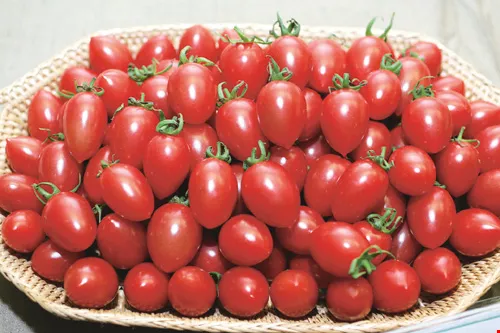
Tomatoes are rich in lycopene and other nutrients, but in the past, many children complained that they're too big and not sweet, and refused to eat them. To encourage children to eat tomatoes, Chen started breeding tomatoes. After six years he unveiled a variety that children love eating: the Santa.

After tasting, Chen immediately jots down notes. Varieties that do not meet the test criteria must be re-crossed with other strains until the desired standards are met.
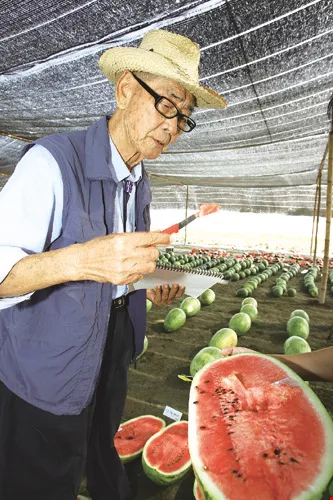
Taiwan's fruits are becoming more attractive and tasty thanks to the dedicated experimentation of breeding experts who cross varieties again and again. Here, Chen tastes some watermelon to gauge the texture of its flesh.
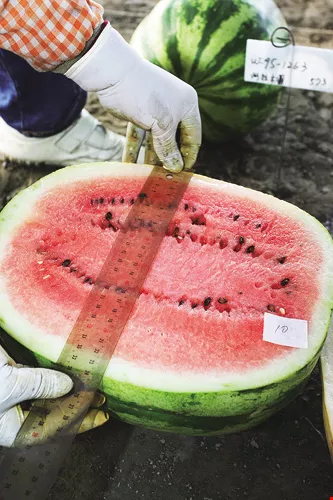
A worker measures the fruit's dimensions and rind thickness with a ruler.


@List.jpg?w=522&h=410&mode=crop&format=webp&quality=80)


