

Chien Chen is angry.
She first established her own style with her essay "Splattered Silk." With her latest collection Oh, What a Floating Island, published at the end of 2004, she expresses her anger that society has been on the wrong track over the past decade. In such essays as "Black Linen Clothes," she offers scathing and sarcastic social commentary. Like some wandering martial arts master of lore, her angry sense of righteous indignation seems to bring her technique to an even higher level, surprising and impressing people.
In 1999, when the Council for Cultural Affairs asked scholars to choose just 30 books as "classics of Taiwanese literature," Chien Chen was the youngest author on the list. Her selection not only confirmed the high literary merits of Daughter's Wine but also marked her as a writer to watch.
For readers, Chien Chen has to be mentioned in any discussion of the modern Taiwanese literary essay. That's because she gives voice to readers' own gentle longings, but even more importantly because she sets an inspiring example for young writers, by bringing incidents from daily life into her writing and by creating the possibility of a conversation between literature, current events and philosophy. From her youth to the present, she has frequently walked on dangerous ground, but has always somehow found the way, however winding, to her soul.
Chien Chen opened up new horizons for post-war women essayists in Taiwan, dealing with a broad range of subject matter not traditionally thought of as their domain. Chien's loose yet carefully constructed prose seems to be working on our behalf to save the Chinese language from its imminent demise.
Exactly what sort of literary life is hers? Investigating it is like exploring the literary passions that once burned inside ourselves.
"Readers may be wondering how Chien Chen turned into this angry woman shouting on street," says Chien Chen, laughing about her transformation.
The essay is perhaps the form of literature that offers the best glimpse of who a writer is as a person. From Chien Chen's words, we get fleeting glimpses of her background and zest for life, and also of her character that often casts a cold eye on the world around her. As one might expect, Chien asked to meet this reporter in front of her neighborhood McDonald's before settling in a quiet corner of a crowded coffee shop. As she speaks with her Ilan accent-right there in front of your eyes-it gives flesh and blood to her writing and a certain intimacy that's hard to put into words.
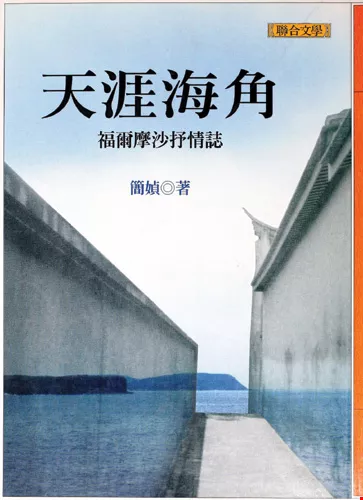
To the Ends of the Earth, 2002
Life is salty, not sweet
From living in isolation in Taipei County's Shenkeng, Chien has recently moved back into the city for her child's education. She lives at the edge of Taipei City in a quiet community not far from the city's hubbub. Now that she has the anxieties of motherhood, the kind of observations about the city that she made in Rouge Basin have expanded into the wide-ranging approach of Oh, What a Floating Island. When Chien Chen describes her new works, she speaks at length about wanting to treat social ills, about prejudice toward foreign wives, and about the politicization of everything. "Taiwan's parents have so many hidden anxieties. After all, there are 600 missiles pointed at you and your children at any given moment." Like every mother, Chien Chen brings up these matters with anger and a maternal tenacity.
Among the readers who became fans of hers during her student period, many are surprised to find that the somewhat anal literary girl has matured into a woman with broader concerns about the world. She takes the "floating islands" formed by the "grass carpet" of thick humus in ponds as a warning signal: "In the age of kebabs when the floating island is salty, the ink flowing from the pen's tip can't be licked up.... Take the floating island as a warning: If Taiwan sinks, it is people who are to blame."
When flipping through the 19 volumes of Chien's works, she appears by turn a classmate, a dear friend, an elder sister and a mother-a gentle, wise picture of womanhood at various ages.
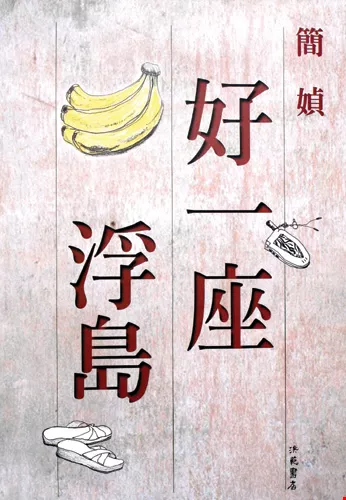
Oh, What a Floating Island, 2004
Books for self-exploration
Born in 1961, Chien Chen grew up in Tungshan Township, Ilan. Life among close farming families and paddy fields, barely polluted by materialism, shaped her work with its lack of concern for worldly success. For high school, she came to Taipei, where she experienced the alienation and diversity of the city. It had a big impact on her, and also pushed her to write. Shortly after starting, Chien Chen wrote a 20-year plan for what she wanted to write.
Apart from the college-age lyricism of Water Questions, Private Books, and Old Feelings Rekindled, and the naturalistic rustic reminiscences of Moonlight on the Bed, which form the mainstream of her work, there are also the urban observations of Rouge Basin, The Book of Sleepwalking, and Oh, What a Floating Island. These two styles complement and reflect each other, conveying the longing that modern people have for hometowns to which they cannot return.
"I selected these three main focuses for my writing to provide answers to myself. My writing reflects the basic tone of my life," says Chien, explaining that just as some people are born right or left handed, she from a young age put special emphasis on forms of literature and planning.
Each one of Chien Chen's books has been a search for answers to life issues that have happened to reflect the self-realization process of most Taiwanese women intellectuals born in the 1960s and 1970s. Growing up without experiencing war or the "white terror" period of political repression, they have experienced hardships connected to dramatic economic, social, and environmental changes. They have also been exposed to Western feminism, which was introduced into Taiwan during this period. These factors have pushed Taiwanese women to reflect upon the connection between themselves and the wider age.
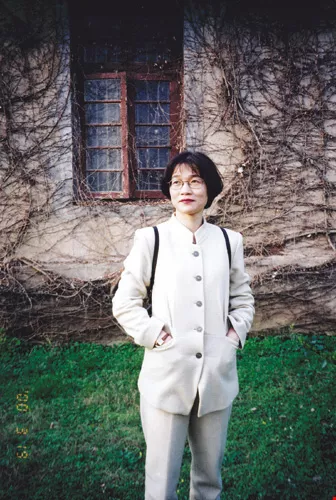
While traveling in mainland China 13 years ago, Chien Chen began to ponder the history of the Taiwanese. (courtesy of Chien Chen)
The tradition of women's essays
With a bachelor's degree in Chinese from National Taiwan University, Chien Chen's education laid a strong foundation for her as a literary stylist. Although she hasn't deconstructed language without reason, she has pushed the envelope of baihua (colloquial) literature. Reading her is like gazing upon exquisite art works in a museum. Furthermore, early on her "woman's whisper" narrative style was very accessible, so that readers could identify themselves with the two personas conversing in Chien Chen's writing. Her first book Water Questions employed this style to become a critical and commercial success.
Post-war literature in Taiwan took the sanwen essay genre that had always found particular favor with the Chinese and made it even more exuberant and lively. Originally coming to prominence because of the space limitations in newspapers' literary pages, the genre is characteristically full of beautiful phrases and moving anecdotes. Many of the masters of this genre were women writers from mainland China who moved to Taiwan as the mainland fell to the communists. They included Chi Chun, Lin Hai-yin, and Chang Hsiao-feng. Each staked out her own place within the genre.
Starting with their "private feelings," these women essayists offer direct and detailed observations about their own lives. Chien Chen's early work was very much in this vein. But rather than looking back toward the mainland with longing, she instead nostalgically described the "native soil" of her hometown in Taiwan, often inserting Taiwanese dialect without losing the beautiful rhythms of her prose. These works naturally found a place on the shelves among similar works by women writers.
"Sometimes, I would eat a warm bowl of rice porridge sitting in the threshold. From there my long-haired grandma appeared quite strange, particularly when she'd suck in her lips as she combed her hair. Her moving hand obscured her face, and with my own eyes I saw her gradually disappearing, becoming a grandma that I didn't recognize. The terror it struck in my heart caused me to shout out: 'Grandma!'"
She turned her head: "What?"
"Nothing," I said, guiltily covering up.
Moonlight on the Bed: A Silver Needle Falls is a successful blend of literary aesthetics and reminiscences about life in her hometown.
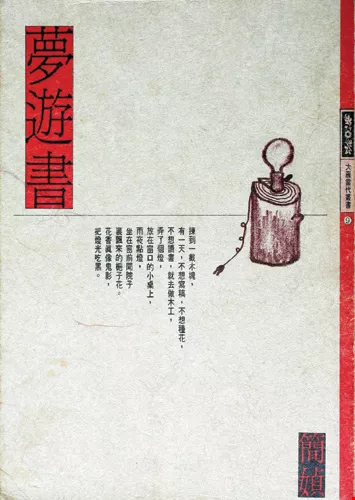
The Book of Sleepwalking, 1991
Sending off a woman warrior
"A Young Woman's Bedroom" falls into the realm of typical essays by women. Although it produces some special stylistic effects, it offers little exploration of broader issues.
With Water Questions and Moonlight Across a Bed, her themes completely changed. But the volumes that followed-Seven Seasons and Private Books-returned self-indulgently to plow over old ground. In Sleepwalking, she confesses: "On the one hand, I couldn't find a new voice, and the old literary devices I was familiar with didn't suit the new themes. On the other hand, I had no hope of raising my level of thinking, so I couldn't give myself reason to construct the content of a book that would both continue the legacy of my earlier writing and plant the seeds of something new."
In comparison to poetry or novels, personal essays are a more immediate form of literature. There is no way for the writer to hide her character. After her phase of expressing her inner sentiments and reminiscing about the fields of her hometown, Chien Chen could not help but reveal a certain sense of powerlessness when she turned to writing about city life with Rouge Basin. Her essays were short, with themes that weren't fully fleshed out. It made her fans wonder if she had run out of steam. She followed it up by discarding her original writing plan to write Daughter's Wine, which was about women's issues and brought her to another high point in style and content.
In her introduction, she writes, "'Daughter's wine' historically refers to alcohol; it's an old folk tradition: When you give birth to a girl, you brew a vat of rice wine, which you don't open until your daughter is getting married.... Drinking that vat of wine demonstrates that from that point on, she is removed from her father, mother, sisters and brothers and must fight for herself. From this angle, you can realize how Daughter's Wine has a bit of the flavor of 'sending off a heroic warrior across the Yi River on a cold winter's day.'"
Deemed "remarkable both for its experimental style and its creative success," Daughter's Wine was selected by the Cultural Affairs Council in 1999 as one of the 30 "Taiwan classics." From that point on, Chien Chen had heroically broken free from the narrow confines of being a "woman writer" in Taiwan.
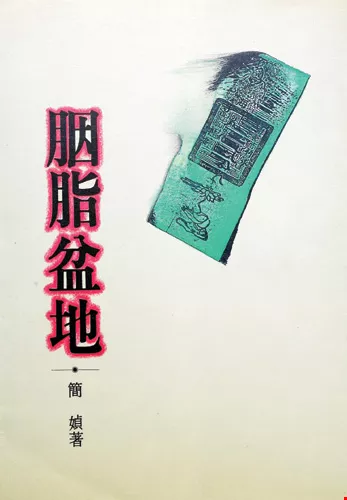
Rouge Basin, 1995
A quest for roots at the ends of the earth
While writing Daughter's Wine, Chien Chen married and had a child. Baby-The History of a Woman and Infant gave her readers a glimpse of the capacity of new mothers to go on and on about their children. Interestingly, young parents in Taiwan have adopted the book as a "Baby Bible," and it is often found on lists of baby-care books.
Baby combined "code language" and "documentary" to record in detail her experiences with her baby. The events are humorous and moving. As author Chang Jang once put it, Chien "goes into detail to an almost pathological degree," but with regard to the predicament of being caught between career and children, she "unfortunately is unable to craft an essay with a deeper level of analysis."
Chien Chen is already laying the plans for another work.
Chien admits that she is a kind of person who "accepts everything." Although she has never self-consciously embraced the "native soil" movement of Taiwanese literature initiated by Japanese-era author Wu Chuo-liu, she participated in a cultural exchange in mainland China 13 years ago that sparked her own interest about how blood and place of origin affect one's point of view.
"One old writer from the mainland said straight out that Taiwanese writing was 'marginal literature.' Chinese writing has its main tradition, and that is the mainland. This way of thinking about a greater China really provoked me," says Chien. From that standpoint, she wondered, what does all my work end up amounting to?
Another visit to the mainland-to Zhangzhou in Fujian Province-provided an even more direct stimulus to work out these issues. In that city she saw an 1895 tablet showing "Where Chien Ta-shih died." The tablet described how this opponent of Japanese rule in Taiwan had returned to his ancestral home in Fujian before being captured by Qing forces and killed.
"This marker had been neglected, and I myself had no knowledge of this forerunner who shared my surname. Who was Chien Ta-shih? Was he any relation of mine? How did the Chien clan come to Taiwan?" Chien says that eventually all these questions turned into one: "Where do the Taiwanese come from?"
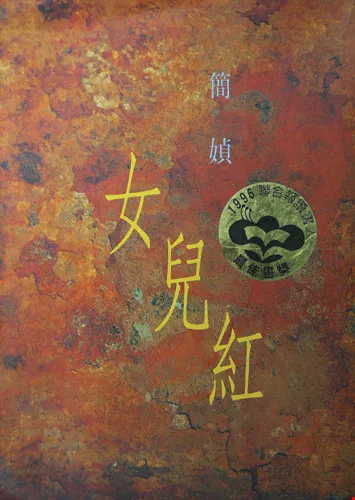
Daughter's Wine, 1996\
A record of the Taiwanese
Around the turn of the millennium, the Taiwanese literary scene experienced a wave of "family history" books. Chung Wen-yin, Chang Ta-chun and others produced good books, but To the Ends of the Earth-A Lyric History of Formosa is without a doubt the purest literary work of the bunch.
In To the Ends of the Earth, Chien uses the image of water to construct a history of Taiwan. "Wanderer" investigates her father's ancestry, whereas "Floating Clouds" tries to imagine what her mother's ancestors (who were plains Aborigines) must have experienced. "Morning Dew," on the other hand, looks back upon the resistance to Japanese rule after Taiwan was ceded to Japan at the end of the Sino-Japanese War. Whose sacrifices and whose survival would lead to the Taiwan we know today?
The most notable aspect of this book is that it is family history written from a woman's perspective. Although historical materials on the plains Aborigines are very limited, Chien Chen poignantly imagines the faces of sorrowful and determined maternal spirits. Even more creatively, she uses a flowing river to record the evolution of Taiwan's natural environment. And she weaves her childhood memories and youthful dreams into it, dedicating it to Formosa: "You are the place that I miss-for which I would go to the ends of the earth." She is attached to the land like to a lover.
After writing Daughter's Wine, Baby, and Ends of the Earth, Chien Chen returned to writing about her observations on urban life, a genre of essay that she had temporarily put aside. And it was as if she had returned to the womb to be reborn. Unlike most cultural criticism, Oh, What a Floating Island raises the writer's social and political opinions into the realm of literature. In particular, "A Record of Taiwan's Fruits and Vegetables" anthropomorphizes watermelons, bananas, guavas, tomatoes, onions and so forth to provide a reflection of Taiwan's twisted national identity and values. It is quite funny. "I Have Questions: A Journal of Complaints at Age 40" describes her middle-aged frustrations and panic about social realities. The method of directly describing chronic social disorders was perhaps not entirely embraced by her readers, but it showed that her writer's spirit was not old and brittle but rather still quite tough.
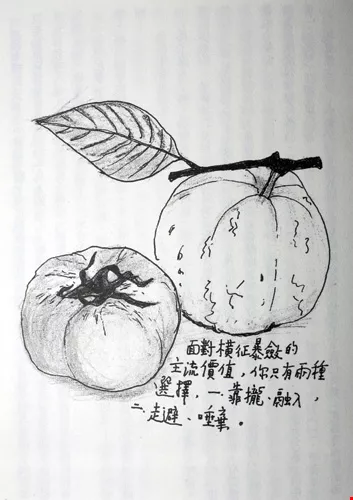
Chien Chen's illustrations, which she sometimes inserts into her essays, have their own unique style. (courtesy of Chien Chen, from Oh, What a Floating Island)
Breaking new ground
The themes that Chien Chen had staked out for herself 20 years ago were completed with Oh, What a Floating Island, and she is still formulating a new plan.
"It will be about themes of love," she says. In this digital age, youngsters find it very easy to find love, but what they call love is really just "magical fragments"-people feel that they've found something whole but it's just shattered pieces: easy to obtain, but easy to lose.
She is also concerned that the growth of the Internet is turning language into a high-speed communication tool, which doesn't value aesthetics or rhetoric and becomes monotonous as a result of being shackled to slang. But in this age of linguistic collapse and social transformation, Chien Chen is nonetheless optimistic about literary creation.
In a speech she made in 2000-"Promise Me an Essayist's Face"-she offered some sharp observations: modern-day Chinese essays were showing four main trends: First, there was a mixing of literary forms. Second, there was specialization. Third, there was sexual crossover and physical transformation between "me the narrator" and "me the author." (For example, when readers don't know who a writer is, they might think that a piece of writing is an essay. But once they do, they might think it is a fictional short story.) Fourth, they were more commercial.
These four trends taken together are certainly of great concern to creators and readers of Chinese essays. But having concerns isn't necessarily a bad thing, for it can allow one to test limits and stake out new ground. Or perhaps one day, we will need to cast aside slogans and old yardsticks, and directly discuss the actual thoughts.
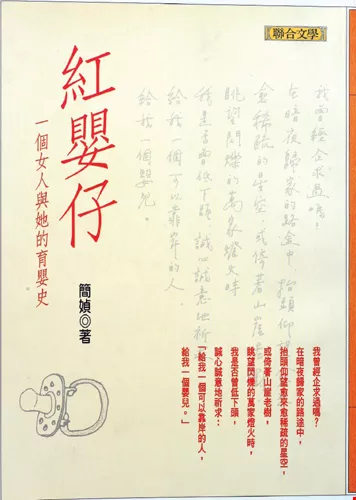
Baby-The History of a Woman and Infant, 1999
Secret challenges
Chien Chen used to work for a magazine and publishing house, but now she devotes herself entirely to writing and being a mother. In 1991, she created the Big Goose publishing house, which specialized in publishing literary works. Big Goose was fastidious about paper quality, binding and layout, but author Fu Yueh-an says that in the period before Eslite Bookstore and the Internet, Chien Chen was swimming against the tide. Eventually, she resigned herself to closing the business. Nowadays Big Goose books are staples of the used-book trade.
Chien Chen says that when she is creating she never considers commercial potential. Although she has a basic market, sales of her old books only bring her about NT$100-150,000 a year. From this, it's easy to see the financial hardships writers endure.
"With these kind of earnings, it's extremely tough to devote oneself to writing. And to give oneself over to the distractions of a day job presents great difficulties to maintaining creative output. It comes down to making a choice between the job market and writing." Even in adversity, she is quite content with her own choice. She says that she is very interested in knowing what she can accomplish in literature over the course of her life. She calls it "a secret challenge."
Just as her creative work often surprises with its beauty, Chien Chen, who previously believed that she would never marry or have children, eventually not only ended up having a family but ended up being very happy about it.
Although she gives the impression of being not concerned with worldly success, when it comes to her child she says that she is determined to encourage his competitiveness because ultimately people are responsible for their own lives. "Learning has always had unpleasant aspects, but it's a kind of discipline," she says. "It has to be trained."
She mentions that when her son meets difficulties and becomes teary eyed, he says, "I don't know why God made me." And Chien responds: "God made you because he thought you could overcome."
Her coffee finished and lunchtime nearing, Chien Chen rises to depart. She leaves with this comment: "Don't forget: when something happens, it's often the solution to an earlier problem."
Perhaps it is only this kind of tenacity that allows Chien Chen in the difficult literary environment of Taiwan to surpass her own heights. Or perhaps it is through her pen that we continue to realize the literary passions that we held as youths.
She is a literary dream that we have all had-or are still to have.

@List.jpg?w=522&h=410&mode=crop&format=webp&quality=80)


