Ang Lee's Prescription for Taiwanese Cinema
Teng Sue-feng / photos Yang Wen-ching / tr. by Geof Aberhart
June 2006


This March Ang Lee, director of the "gay cowboy" movie Brokeback Mountain, carried off the Oscar for Best Director at the 78th Academy Awards. In April, he returned to Taiwan for his mother's 80th birthday. As well as celebrating with family and visiting his alma mater, National Taiwan University of Arts, Lee took part in a Government Information Office/National Cultural Association conference entitled "A Rational and Sensible Look at Taiwan Cinema," where he offered his ideas on how to reinvigorate the local film industry.
The conference was hosted by Cite publishing group deputy chairman Hau Kuang-tsai, and guests included some of Ang Lee's fellow New York University graduates. It also featured a panel with Li Tao-ming, dean of the Graduate Institute of Filmmaking at Taipei National University of the Arts (TNUA), and documentarian Huang Ming-chuan, along with contributions from three generations of directors, including Li Hsing, Wang Toon, Ho Ping, Lin Cheng-sheng, and Lin Yu-hsien. The film-industry audience numbered over 300, with Premier Su Tseng-chang also listening attentively.
Ang Lee noted that Taiwan is not alone in confronting the threat posed by Hollywood films, but one reason the threat is so severe is that the operating model now used by Taiwan's entertainment industry is incapable of responding effectively to Hollywood's production and distribution methods. What is needed, Lee said, is for the industry to pool its resources in order to resist "globalization" and "Hollywoodization" of local cinema, much as South Korea and France have. National resources need to be invested in the industry, and a strong foundation gradually built up.
Having lived in America for so long, Lee admitted his understanding of Taiwan's film industry is no match for that of locals who have been part of it through thick and thin; that there were several issues on which no consensus would be reached that day; and that the results of their work may not be obvious until ten or 20 years from now. However, through collective brainstorming the industry will undoubtedly find a way forward, and it is vital these ideas are properly implemented. Lee hoped Premier Su would be the first in a long succession of politicians to promote these ideas, and that "whether or not Premier Su becomes President Su, he should follow through on these plans."
The bulk of Lee's suggestions revolved around "finding good stories to tell" and "nurturing the next generation of filmmakers."
"Mainstream movie audiences spend two hours sitting in the dark, enjoying the artistic use of space and time that is a film. The standard progression of any film is linear, and as such it can be considered a form of storytelling. It is in this area--narrative storytelling--that Taiwan's films are particularly weak," said Lee. When he was younger, Lee couldn't find anyone to help him convert his ideas into scripts, so he figured he may as well write them himself. The Wedding Banquet was a six-year process of continuous revision, until Hsu Li-kong, then general manager of Central Motion Picture Corporation, discovered it. Then, with American producer James Schamus' help in adjusting and tweaking the script, the movie was able to shine on the international stage.
"Our culture essentially lacks the 'Point A to Point B' style of storytelling," said Lee. "Martial arts fiction, and even classical literature, frequently leave issues unresolved, with characters appearing at the start and gone by the end with no explanation. Movies are not life; they only have two hours to tell their story in a traditional three-act structure, so they have to stick to a single theme, emotion, and feeling. We have to swallow our pride and learn such techniques from Hollywood."
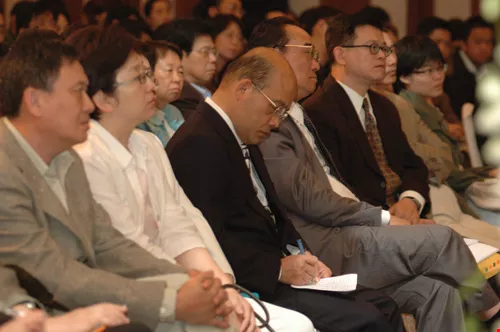
In front of Premier Su Tseng-chang, who was busily taking notes, Ang Lee emotionally spoke of his hopes for Taiwan cinema. He expressed his hope that Premier Su would be the first in a long line of politicians to get behind the industry, helping it return to its former glory.
An oldie, but a goodie
On the issue of subject matter, Lee reminded the audience that there is a plethora of entertainment media available today, so a movie has to draw people to the theater: it needs a selling point. But what are they selling?
Citing his return to Taiwan for the opening of Crouching Tiger, Hidden Dragon six years ago, Lee says the movie was being promoted as a "Hollywood blockbuster," which made him feel uneasy--who had he been toiling so hard for all that time? It was pretty clear the film was a Chinese one, but the marketers believed that calling it such would make it harder to pull crowds. Thinking long and hard about this, he realized that whether it was seeking foreign assistance or just reviving traditional stories, this is a phase the industry must go through; not realizing this was one of the industry's main problems.
"We try and be modern and speak English, but we'll never be better than Americans at it. We need to realize the tremendous value of our old ideas and beliefs, and we shouldn't discard the wisdom of our ancestors. With all these riches at home, why would we need to go begging for alms outside?" Lee explained that while he particularly wants to make Chinese films, Chinese stories take a lot of work to shape and develop, so he can only get one done every few years. English films, however, come to him ready-to-go in an almost never-ending stream, to the point where he could never do them all.
He emphasized that even though the Chinese market is booming, there are still many restrictions on doing business there, and many topics are off limits. Chinese and Taiwanese history are essentially virgin territory, waiting for someone to open them up. Taiwan's strength lies on the creative and intellectual side, as well as in its focus on quality. This differentiates it from the commercialized style of Hong Kong, where they "get to a certain point and then just goof around," not going into much depth. However, Lee is concerned this strength may not hold out much longer.
Desperate for talent
With regard to the limited resources the government can offer, Lee said that regardless how they are distributed, the government can't just "throw a pile of cash at the industry and hope everyone will shut up." The film industry in Taiwan today is becoming hollowed out and lacks creative young talent. As such, it needs to draw together all its strength and focus on developing new talent.
Li Tao-ming responded to Lee's comments by pointing out that TNUA established a Graduate Institute of Filmmaking three years ago, and has taken on ten students of writing and directing a year since. But they have had trouble finding top quality students. Taiwan's higher education system lacks facilities dedicated to nurturing filmmaking talent, whereas South Korea has several hundred such schools, along with Asia's best resourced and equipped film school. Taiwan has a lot of work ahead if it wants to catch up.
As well as writers, Ang Lee noted, producers have been a huge source of help. In his analysis, there are three kinds of producer. The first is the traditional "line producer"--if the director needs anything on set, it is up to the line producer to make sure it's there. The second is a "visionary producer," like Hsu Li-kong or Lee's friend James Schamus, who both took good care of Lee. "I supported them, they supported me. If I had an idea, they would show me how to develop it." Said Lee: "The director is like a racehorse, heading straight down the track for the line, while producers are jockeys, guiding him along the way."
The third kind is the commercial producer, like Crouching Tiger, Hidden Dragon's Hong Kong producer Bill Kong. Kong has excellent connections throughout the region, a talent for selling films, and a clear understanding of the market. He is the sort of person who knows exactly how to sell a film, which was proven by his understanding of how much of a box-office hit movies like Jet Li's 2006 film Fearless can be.
"Right now, what Taiwan needs most is skilled directors and producers of the second kind, who can make the most of good subject matter," stressed Lee. People shouldn't solely strive to become directors, and shouldn't feel dismayed if they don't succeed in becoming such; rather, they should turn their skills to helping others in their efforts. Filmmaking is a group effort, and people involved should be proud to play their part.
Passing the torch
Director Ho Ping asked Lee how he got along with Western cast and crew after so many years working in the US, and how someone with such a gentle demeanor handled the fiercely competitive world of Hollywood.
"A director needn't yell at people to get the job done. The crew are also passionate about film, and so speaking reasonably with them can help you put their passion to use," says Lee. The sets of American films are generally fairly sedate during shooting; the director realizes he can't match the specialist knowledge of the cameramen and art directors, and the crew don't try and tell the director he doesn't know what he's doing. The secret of their success lies in the director creating a vision for the film and explaining it clearly to the crew. Then, when they can see it too, the crew can put their specialist skills to use in realizing that vision.
To close, the event's host Hau Kuang-tsai quoted Swedish director Ingmar Bergman's words of praise for Italy's Frederico Fellini: Bergman liked Fellini's films, and liked Fellini as a person. Fellini had a constant stream of creativity, and a certain kind of self-awareness; he never went over the same material twice. He had a fire in his heart, one which continued to burn, but he never let that fire loose. We should wait and see, Bergman had said--one day, Fellini would refine that fire into its essence, and then we would see a film the likes of which we had never seen before.
Hau Kuang-tsai noted that, with the world having already enjoyed Crouching Tiger, Hidden Dragon, and Brokeback Mountain, we all eagerly await Ang Lee's next blockbuster, and also hope that Taiwan can follow suit.

@List.jpg?w=522&h=410&mode=crop&format=webp&quality=80)


