Sakinu, Sage Hunter of the Paiwan
Tsai Wen-ting / photos Wang Wei-chang / tr. by Scott Gregory
February 2006


With the book The Sage Hunter, an ordinary policeman of Aboriginal descent named Sakinu Ahronglong has become the winner of two major literary awards, and the first Aboriginal author to have his works included in junior high textbooks. In winter of last year, The Sage Hunter made it to the silver screen as a film featuring the author as himself. In addition to being a policeman, writer, and actor, he's also hard at work in his village as a "modern hunter," leading a youth group dedicated to preserving traditional culture.
Whatever the occasion, Sakinu always shows up with a group of youths in full tribal regalia--animal-skin caps on their heads, ceremonial knives at their sides, and wearing traditional clothes. He's a big man with a broad stride, and he attracts attention whether at an Aboriginal ceremony, at a wedding banquet, or on the crowded streets of Taipei. Seeing the confident 34-year-old, with his pride in his Paiwan heritage, it's hard to imagine that he came from a village that lacked a sense of identity and wore the traditional clothing of another tribe for its yearly harvest ceremony. It's also hard to imagine his difficult upbringing.
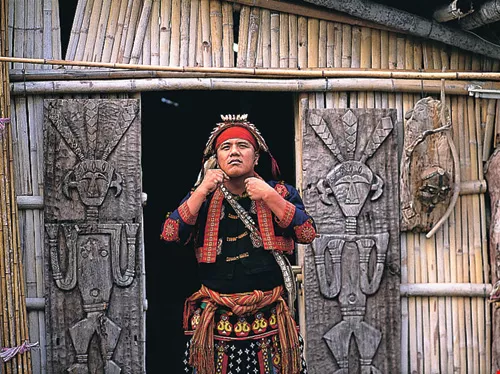
In addition to his roles as policeman, hunter, and writer, Sakinu is also an artist. The pieces to either side of him are his carvings.
Another village
Sitting on the beach in his maternal grandfather's village, young Sakinu Ahronglong had run away from home again. He had run almost 20 kilometers from home.
When Sakinu was eight years old, his father left for Saudi Arabia to work as a laborer. He had the spirit of a hunter, but was unable to adjust to a changing society in which the old prestige of the hunter was lost. He would drink, lose his temper and beat Sakinu and his two brothers. Their mother would often leave home. These are Sakinu's childhood memories. Afraid, he started to skip school and would run away from home. He shut out the world and rarely spoke.
That night he ran away, his grandfather didn't panic like most adults would. On the contrary, he found Sakinu on the beach as if they had some unspoken understanding. His grandfather calmly asked, "Dear Sakinu, are you my friend or my grandson?" Sakinu answered, "Of course, I'm your grandson." But his grandfather said, "No, you are my friend." His grandfather's tranquil demeanor made Sakinu feel a respect he'd never received before. Thinking back now, Sakinu deeply feels that his grandfather somehow healed the wounds he suffered in childhood. It's also because he had such a childhood that Sakinu cares so passionately for the children of his village.
As he was a strong cross-country runner, Sakinu was granted admission to Taitung High School, though it took him five years to graduate. When he passed the police academy entrance exam, he moved to Taipei by himself.
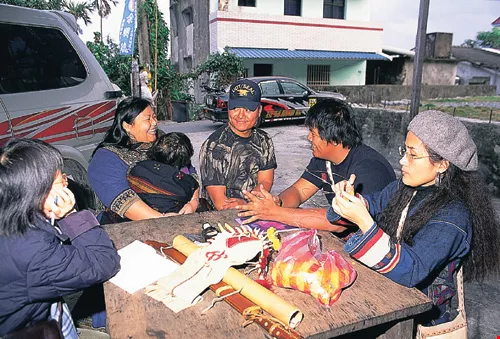
Youth group members create a garland for an Aboriginal wedding banquet in Pingtung.
"Who am I?"
Soon after graduating and donning the police uniform, Sakinu was stationed at a public square where protests were taking place. It was the tail end of the Aboriginal rights movement of 1996. He saw the Atayal with their headbands boldly taking to the frontlines. He saw the Amis holding hands and singing at the protest site. He saw the Tao with their eyes wide open, making faces to express their rage. When a group of protesters called him a "Chinese sellout," he couldn't help but ask himself, "Who am I?"
It was in such a state of identity crisis that Sakinu began to write, searching for traces of his ancestors and thus becoming acquainted with many Aboriginal cultural figures.
"The ones who had the most influence on me are my sworn brothers Sakuliu and Fachuku," he says. The former instilled in him a sense of pride in Paiwan culture and the Paiwan spirit of life, while the latter taught him many romantic and free ways of thinking.
Sakinu was born in Taitung County's Hsinhsianglan Village, where even men of his father's generation never wore traditional Paiwan clothing. During the harvest ceremony, they wore Amis outfits. They sang, danced, and ran races along with the Amis.
Hsinhsianglan is in Taitung's Taimali Township, where the population is about half Amis and half Paiwan. During the early years of the Japanese colonial period both the Amis and the Paiwan were forcibly moved by the Japanese to Hsinhsianglan, and their cultures began to mix with those of the Puyuma and the Rukai. Also, many Paiwan worked for Amis people, and as they found themselves in economic and cultural decline, more than 30 Paiwan households began to take part in Amis harvest festival activities such as the warriors' dance with umbrellas to symbolize spears, and singing Amis songs.
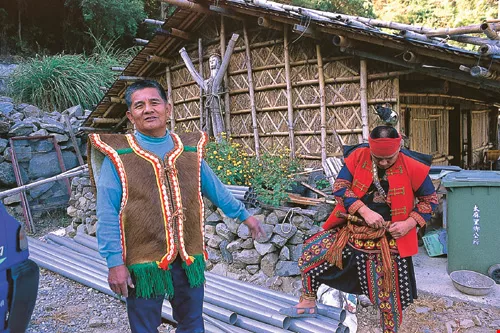
Sakinu discusses the yet-to-be-opened hunting school with his father, who built the straw hut behind them.
Sakinu's revolution
From 1993 to 2003, while working in the Shihpai area of Taipei City, every free weekend he'd take the night train to Kaohsiung, switch to a bus headed for Fangliao in Pingtung County, then take the little train to Taimali, from which he'd finally catch a bus to Hsinhsianglan Village. Sakinu and his ethnically Siraya wife A-chen agreed that for those ten years, they wouldn't buy a house or a car, nor would they have children--they'd give all they could to their village.
Every time as the train came out of the Central Tunnel, which joins Pingtung with Taitung, Sakinu felt like he was returning to another life. He wrote in his diary: "Taimali, almost to the village. It's a warm, breezy, happy feeling. I can smell the ocean my grandfather knew and see the sun standing on its surface. This is what it is to come home."
He returned home to enter the hunting grounds again with his father and learn to be a true hunter. He returned to visit each Paiwan village and learn the traditions, and to spend time with the lonely children there. Then he began his revolution.
In 1996, Sakinu and his cousin Pastor Tai ran into the harvest festival site dressed head to toe in traditional Paiwan clothing, creating an instant sensation.
The elder Amis were angry, feeling that this action was provocative and destructive to the "harmony" between the groups. After the festival, many of the Paiwan tribal elders began to recall remnants of their own Paiwan culture. Sakinu's appearance on the scene made them feel as if they'd seen their ancestors risen from the dead. It also caused the village's younger generation to begin calling for a separate Paiwan harvest festival.
The year after, Sakinu had all of the village children write letters to then-chairman of the cabinet-level Council of Indigenous Peoples, Hua Chia-chih, inviting him to attend. He accepted, and Sakinu earned new respect from the village elders. Traditional Paiwan ceremonies were to rise again through the passion of the youth.

Sakinu works as a forest ranger in Taimali, where he treads the same ground as his forefathers.
Big brother for the kids
After announcing his revolution, he began the even more important task of grounding it. With little free time, he could only use the time at home on the weekends to use funding from the National Culture and Arts Foundation to build a two-story community center with the village youth.
In the first-floor hall, smoke rises from time to time. It is meant to bring news of the village youth's doings to their ancestors, and to let the ancestors know visitors have arrived. On the walls hang hunting spears and pikes, hunting knives donated by the village elders, ancestral pottery, and doll-shaped clappers, once used for sending message. On the second floor, there is a small library with several thousand books.
"It's an important space for traditional society. All the boys practice there, and find a sense of belonging," says Sakinu. In this space, the kids can also talk out their problems with their "big brothers" in the village. "Behind a child's fear is a wounded soul. If the people of the village are all wounded and unhealthy, then the culture we create will also be unhealthy," he says. With the sharing and sheltering provided by the center, Sakinu has kept many lost children out of the school detention hall and the police station. As much of the population has left, there are only around 30 unmarried male students in the village. Of them, almost all have taken the "age group" placement tests staged by the youth center, and more than half are core members.
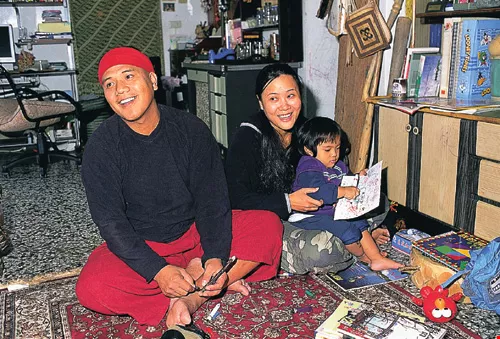
Sakinu at home with his wife A-chen and daughter Tai-yun.
John's redemption
"In the past, I didn't have self-confidence, and would just mess around and get in fights," says John, a youth group leader. The 21-year-old John is covered in tattoos. In his junior high days, he was a violent kid, roaming the streets with a sword. Sakinu attracted him to the youth center, and got him to try many things he'd never done before, such as giving public speeches and leading activities for village kids.
"It took ten years, but my brother finally got me to settle down," he says of Sakinu. John has remained in the village, working in recycling. Not only has he become a big brother to the village kids, but his girlfriend--an ethnic Chinese who's studying Japanese at National Chengchi University--has become a sort of popular big sister around the village as well.
The Paiwan youth group members go through various stages, just as a sprouting seed must go through various trials before its leaves and branches can grow and mature to the point at which they can provide shade. Every year after the harvest festival has finished, the village elementary and junior high students all take Sakinu's "bravery test." The younger kids gather at the home of the village chief to perform dances and jump through fire. Then a group of big brothers rush in and run off with one of the children. They take him to the foot of a mountain behind the village and make him climb a 200-meter tall slope alone, in the dark.
"Kids now are really afraid of the dark, because they've lacked the opportunity to encounter the darkness of night and nature," says Sakinu. After successfully climbing the mountain in the dark, the children come to their ancestral spring. Sakinu covers them in mud to symbolize their passing the test of nature. At this time, after the blazing campfire, the big brothers wear their formal traditional clothing and stand before the mountains, giving the children a view of their ancestors' likeness.
"What I want is to hold a ceremony that will raise goosebumps and move people inside, not one that is only for appearances. Through personal experience, the children not only get in touch with nature, but also hopefully form some collective memories. In the future, they'll feel a sense of belonging in nature," says Sakinu.
Sakinu asked the elders about ceremonies. He gathered ideas from myths and borrowed from the customs of other tribes, and put together what he thought was a kind of ceremony that would go straight to the heart. He also used ceremonies as a way to bridge the gap between the generations and to help them understand each other.
"Sometimes I am really thankful that so many of the details of our ceremonies had been lost, so I could do as I saw fit and had fewer limitations," he says. Even in the "tradition" spoken of by the elders and the old photographs from the Japanese colonial era, a strong Amis and Puyuma influence is evident.
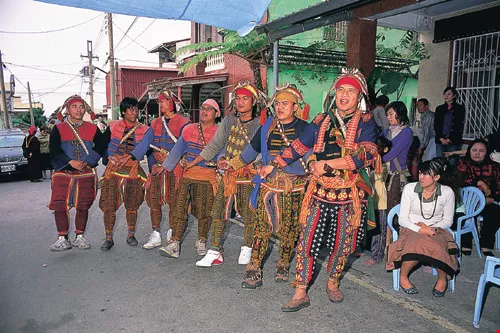
Sakinu and his youth group members don traditional Paiwan garb and sing in front of the homes of their sworn brothers, displaying their pride in their heritage.
Into nature
After ten years of commuting by night, Sakinu was finally granted a transfer to Taitung two years ago. Living together in their old village home, Sakinu and his wife had more opportunities to learn the culture of the hunter from his father. His father, who had been baptized in middle age, used Christianity and hunting as a means to heal the wounds in his relationship with his children.
"We are a hunting family. Only if we follow the rules of the hunter and respect life will the ancestors provide game for us. If you are disrespectful to nature, then animals won't come to your hunting grounds," he says. Sakinu and his father would catch the clever flying fox and watch the wild boars wrestling each other. He saw his father climb mountains in rain boots with only a garbage bag to protect himself from the wind and cold, and learned from him how to kneel in thanks before taking the life of an animal.
The father and son would spend the night lying in the back of a truck deep in the mountains. In the cold, Sakinu's father would naturally hold him and ask if he was cold. Under his father's guidance, Sakinu not only learned the hunter's respect for nature, but also healed the rift that had been between him and his father for so many years.
"In the hunting grounds, my father is a father of the Paiwan tribe who doesn't feel societal pressure and isn't influenced by outside religions," he says.
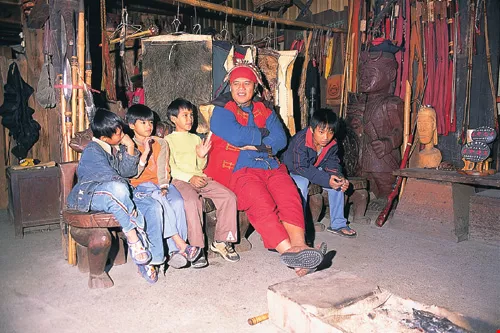
The youth center is popular with the younger members of the tribe. Their "big brother" Sakinu teaches them of Paiwan culture there.
Clash of beliefs
Sakinu is dedicated to restoring Paiwan culture and bringing self-confidence to his people, but the road home hasn't been completely smooth. The first obstacle he had to face was the clash between traditional and Christian beliefs.
For his wedding, Sakinu spent three years researching the old Paiwan marriage ceremony. He asked the chief to put feathers and other decorations on the newlyweds symbolizing their ranks and abilities, thereby helping to revive the old chiefdom system.
However, the chief summons the spirits of the ancestors to the wedding ceremony, and to Sakinu's Christian father, that was witchcraft and the chief a pagan. He even cursed Sakinu: "If it brings out evil spirits and your children are born with no arms or legs, don't say I didn't warn you!"
The next obstacle was changing modern parental values. Many parents would stop their children from joining the youth group, saying "What good is traditional culture? Will it help our kids get into university, or feed them?" Others couldn't bear to see their children go through the initiation ceremony. Thinking back on his efforts over the years, Sakinu can't help but shake his head and sigh, "In the village, it's really hard to get things done." But then he thinks, "If I give up like that, everything will be lost!" So he perseveres in the mission entrusted to him by the ancestors.
"He always just fearlessly pushes ahead like this. Most people believe something when they see it, but he'll believe it and then see it," says his wife A-chen, who constantly worries over him. She's tried to convince Sakinu to communicate more with village parents and elders when there are misunderstandings, but Sakinu feels that if he had to communicate and discuss everything, nothing would ever get done.
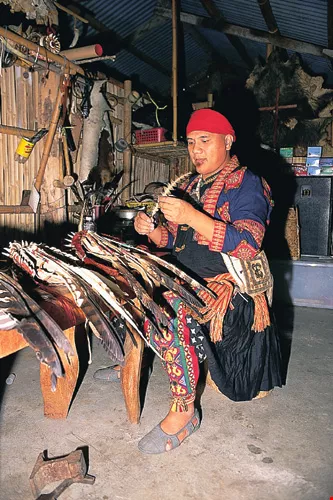
These headpieces, ceremonial knives, and traditional clothes are all the handiwork of Sakinu.
Ten years' journey
In addition to working in the village, Sakinu gave almost 20 lectures around Taiwan last winter, following the release of the film The Sage Hunter. The "Chinese sellout," the ignorant youth of the past, has become a font of Aboriginal and Chinese culture, setting up a "Village Alliance" in eastern Taiwan by which Aboriginal villages can assist one another and find a more powerful collective voice.
After that series of lectures, Sakinu, along with his wife and his one-year-old daughter Tai-yun, led a group of youth to Pingtung County's Laiyi Township where they donned Paiwan garb and attended a Paiwan wedding banquet. At nine the night before the banquet, guests gathered at the site and sang and danced hand in hand non-stop for more than two hours to give their blessings to the newlyweds. One was charged with offering dancers cups of strong rice wine. The atmosphere was festive and intoxicating. After the dancing, Sakinu and his brothers from the youth group came to the front, encircled the newlyweds, and sang an old Paiwan song a cappella. They then placed them on chairs and raised them into the air. The elders sitting to the side couldn't help but beam with pleasure as they watched members of the younger generation singing, dancing, and having fun. The father of the groom murmured, "Not bad at all! Those youth group kids really have some energy, eh?"
To Sakinu, it wasn't just a wedding banquet but also a display of cultural self-confidence. Through dress, performance, and ceremony, he was embodying Paiwan pride.
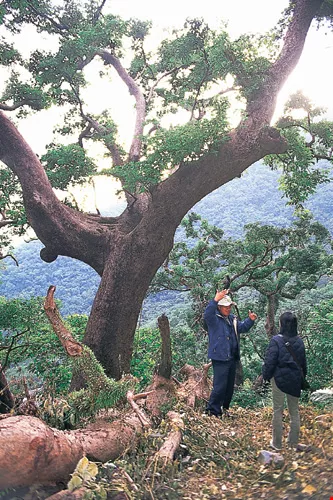
Sakinu explains his hunting school's vision by the spring of his ancestors.
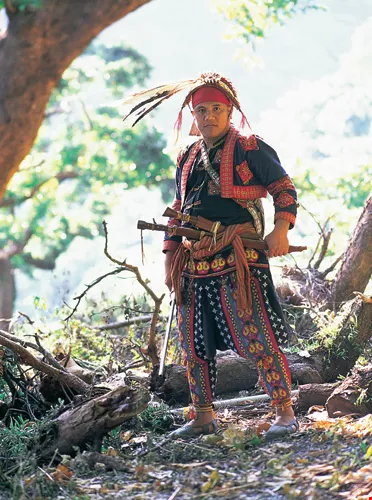
"As long as there are people, there is culture, and when there's culture, the spirit grows. People are the most important element." Sakinu, here in full tribal regalia, has worked tirelessly for more than a decade to improve the cultural life of his village, in the hope that his fellow tribespeople can become "modern hunters."


@List.jpg?w=522&h=410&mode=crop&format=webp&quality=80)


