

"Is life really worth all the bother, to the extent of making our soul a slave to the body?" This question, raised by "master humorist" Lin Yutang some 60 years ago, resonates deeply with 21st-century inhabitants of a highly capitalistic world. Even amidst the hubbub of daily life, Lin's voice rings clearly, yet subtly.
Two prominent names in Taiwan's publishing history-Lin Yutang and Yuanching Publishing-have recently reappeared on bookstore shelves. Among the classics that Yuanching is re-issuing, Lin's The Importance of Living particularly stands out.
After The Importance of Living-which Lin had written in English-was published in 1937, it remained at the top of the US bestseller list for a full year. From his vantage point on the frontlines of the encounter between East and West, Lin sought to propose his own ideas on how most expeditiously to move forward. Reading this work today, one discovers that Lin's critiques of American society actually get right to the heart of the ills of 21st-century Taiwan. The book is like an oracle from another era, pointing the way for an age in search of its own possibilities in the convergence of old and new.
During this year's Lantern Festival, an elementary school student called in to a Taiwanese radio show devoted to homespun riddles, offering up the following: "There are ten fish in a pond. If you stand by the pond and throw darts at the fish, how many will be left at the end?"
The radio host struggled in vain to answer the riddle. The child proudly answered, "Three. Because 'three fish dodge darts!'" (The answer, san zhi yu shan biao, is a pun on the name of a well-known cough medicine.) The host was full of praise for the young riddler.
One wonders how the master humorist Lin Yutang would view today's attempts at humor. One also wonders whether he would see the recent trend, via the tabloids, toward "consuming the private lives of the famous" as a satirical response to an ever-changing world.
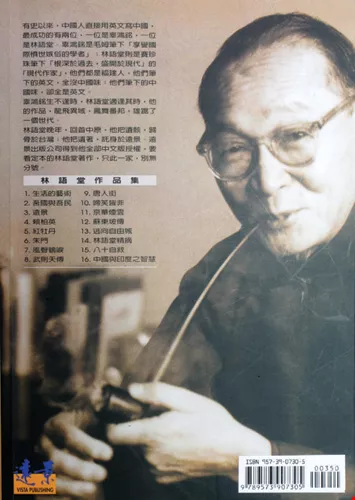
Title: The Importance of Living Author: Lin Yutang Publisher: Yuanching Publishing Reissued: December 2004 Price: NT$350
The dictator's smile
Lin Yutang's reputation as a humorist stems from two essays that came out in 1923, "Writings on Subtle Translations and the Advocacy of 'Humor'" and "Miscellanies on Humor," in which Lin opined that humor fell within a universal aesthetic. But since in traditional Chinese there was no precise phrase for "humor," Lin went ahead and pioneered the translation of this term into Chinese.
Lin recorded his observations on the different understandings of a life of humor in Eastern and Western cultures. His writing was amusing, but also witty and sharp.
"We are not indulging in idle fooling now, discussing the smiles of dictators; it is terribly serious when our rulers do not smile, because they have got all the guns."
Lin felt that humor had a "chemical effect" that could change the way we think and penetrate to the core of a culture. Moreover, humor could open up new possibilities given the advent of a rationalistic society. He wrote that there were three critical qualities that could lead to utopia: the simplification of thought, the relaxation of philosophy, and the experience of wonder. To Lin, all three of these things originated in humor.
Tongue in cheek, Lin proposed that all diplomats seeking to "serve" humanity should, in the first ten minutes of their meetings, watch a Mickey Mouse film. This way, any war could be averted.

Lin's study, sparely furnished and featuring desk and bookcases of wood, reveals the tastes of a man of letters.
A pseudo-scientific formula
The Importance of Living begins from the origins of human nature and discusses humans' "animal heritage," dignity, individuality, and so forth. Then it deals with figures from ancient times who truly knew how to live and criticizes capitalist societies for their essentially "anti-leisure" attitude. The book then charts a path through sections on "lying in bed," "sitting in chairs," "tea and friendship," religion, and good taste in knowledge, all of which are manifested in the subtlest aspects of daily life. Lin does all this to ascertain the kind of "art of living" that is most fitting and reasonable for humans to pursue.
Lin came up with some pseudo-scientific formulas to illustrate the importance and critical nature of humor:
Reality - Dreams = Animal Being
Reality + Dreams = A Heart-Ache (usually called Idealism)
Reality + Humor = Realism (also called Conservatism)
Reality - Humor = Fanaticism
Dreams + Humor = Fantasy
Reality + Dreams + Humor = Wisdom
Lin felt that the world was too serious, and needed an antidote in the form of a new philosophy of wisdom and happiness. He found in Chinese culture a kind of leisure and the enjoyment of life and nature that could truly be called a philosophy of happiness. His models included Zhuangzi, who lived up to the maxim "find thyself;" Mencius, who emphasized "wisdom, compassion and courage;" Laozi, who emphasized "cynicism, folly and camouflage;" and Tao Yuanming, who was a "lover of life." These figures lived by a philosophy of enjoying life, and also served as models of a life characterized by humor.
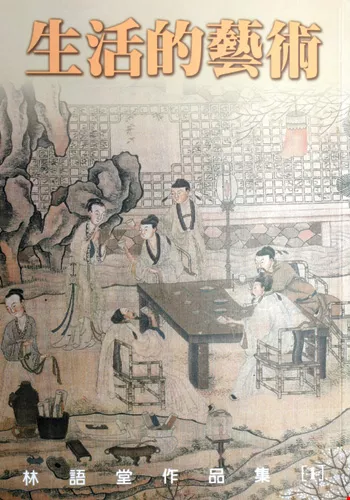
Title: The Importance of Living Author: Lin Yutang Publisher: Yuanching Publishing Reissued: December 2004 Price: NT$350
Three American "vices"
"Nothing matters to a man who says nothing matters." Lin felt that this was a distinctively and wonderfully Chinese attitude that provided a striking contrast with the American demand for efficiency.
Lin wrote of an engineering firm's ad that read, "Nearly Right Is Not Enough," prompting his cataloguing of what he considered the American's three vices: "efficiency, punctuality, and the desire for achievement and success." To Lin, Americans were so unhappy and so over-anxious because they had become consumed in their own perfectionism.
Lin had a "prophetic" vision of Manhattan a millennium hence. It would be a time "when the American 'go-getter' will become an Oriental loafer," a place where there would be no need to sign in at hospitals, no emergency rooms, and patients could discuss their life-philosophies with their doctors. The fire trucks would travel as slow as snails, and fire truck operators would jump off their vehicles to argue with the people in the crowd. In this ideal world, people could enjoy many leisurely afternoons.
Lying down, the best medicine
Lin knew that his utopia would never be realized in New York. He could have no way of knowing that 21st-century Taipei would be even worse than the America that he criticized.
With the arrival of the digital age, efficiency, punctuality and success have become widely held values in capitalistic societies. Letters, e-mails, and cell phone calls reach their destinations almost instantaneously, and newspapers, magazines, and 24-hour television news stations rush global conflicts and celebrity trash to a captive audience.
In The Importance of Living Lin humorously writes: "I find that those people who agree with me in believing in lying in bed as one of the greatest pleasures of life are the honest men, while those who do not believe in lying in bed are liars and actually lie a lot in the daytime, morally and physically."
Given Lin's logic, the growing number of insomniacs in Taiwan, for whom lying in bed is a torture, might just be the reason that society is filled with all kinds of nonsense and chicanery.
Reading The Importance of Living is like reading a diagnosis of society's most deep-rooted ills. If Lin were able to see what Taiwan has turned into today, he might say, "The riddle about the three fish dodging darts was okay. Also, it's not so bad to gossip about your friends once in a while. But if you could use humor to transform those kinds of skills into real loafing, as one does when lying in bed, then maybe people would be happier."
How would Lin address today's society? Through reading The Importance of Living, let us make use of the imagined words of Lin Yutang to speak forth our own deepest aspirations.

@List.jpg?w=522&h=410&mode=crop&format=webp&quality=80)


