With a Little Help from Your Friends--Chinese Seniors' Associations Are Booming in the US
Laura Li / photos Hsueh Chi-kuang / tr. by Jonathan Barnard
May 1998
One senior didn't start playing table tennis until well over 60. Another was far into her seventies before taking up dance. Participation in all manner of group activities is a salient characteristic of seniors from Taiwan who live in America.
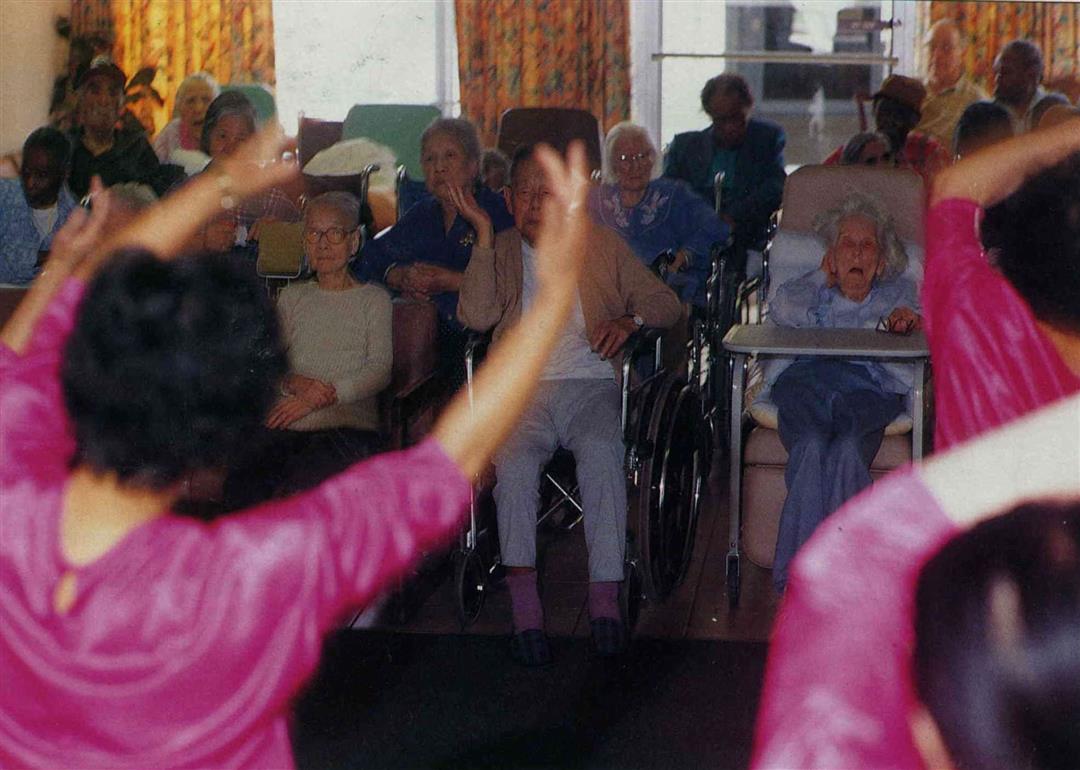
The Mariner Health nursing home in southwest Houston is usually a tranquil place, but at noon on this day its lobby is the site of great activity. Nurses are pushing in wheelchair after wheelchair whose elderly occupants look sleepy-even, perhaps, a bit out of it. But when 10 dancers from the Houston Formosan Evergreen Society start to tango, the music and motions seems to awaken distant memories in the audience. Some of the old folk clap to the beat, and others start humming. Upon seeing youthful old folk of about 70 dancing for an audience with an average age of about 80, onlookers can't help being moved.
When the program of three dances draws to a close, there is no applause, but a few of the elderly viewers raise their heads as if the end of the music has created a sense of loss. "Let's dance some more!" the dancers shout to each other. "Let's dance some more!"
"We accept all invitations to perform," notes Chen Po-wen, who has danced here many times before.

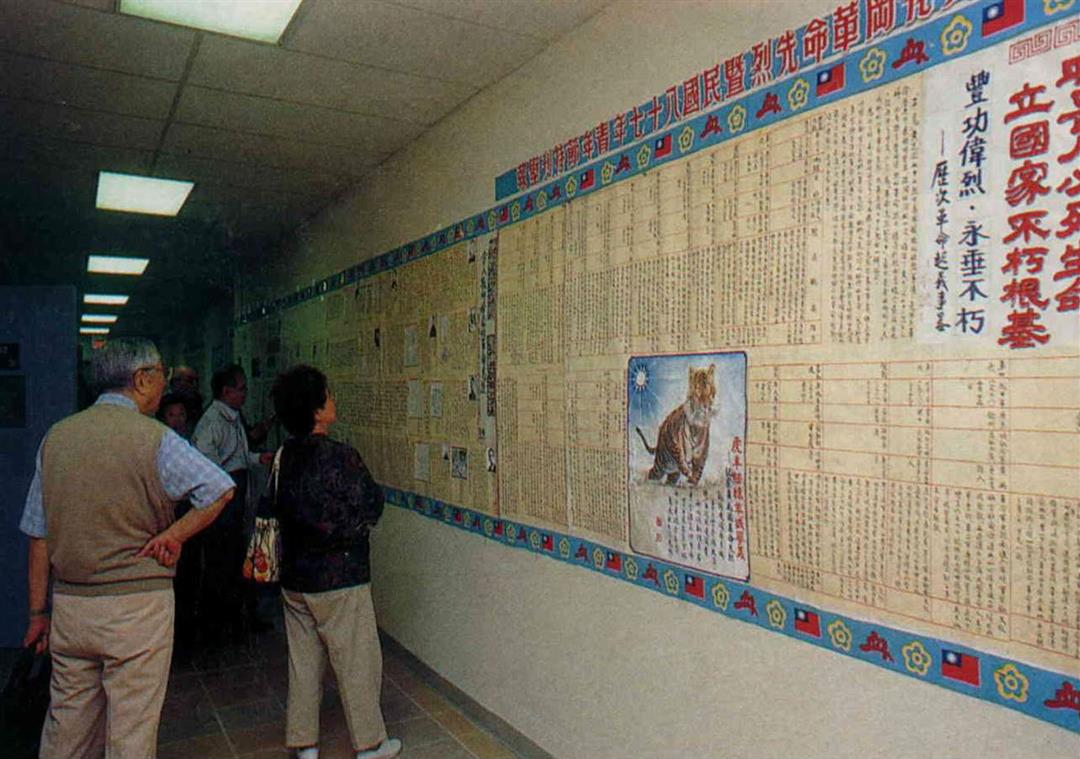
The huge poster commemorating the Huanghuagang martyrs, which stretches for tens of meters, was designed by Sun Chao-han in the hope of promoting understanding about Chinese culture and history. Everyone pitched in to finish it.
Dancing through the golden years
Meanwhile, in the auditorium of the Chinese Culture Center in Houston, various performance groups of the Chinese Seniors' Association of Houston are preparing for an upcoming ROC Youth Day celebration. First on stage is a choral group made up of 20 women, all 70 or older, who have shed their everyday attire for blue qipao gowns. With pigtails tied to their hair, they sing the "Great Sword Song," which was made famous in the War of Resistance Against Japan. When they utter those spirited lines, "Great sword lop off the Japanese ghosts' heads!" it is as if they have gone back in time and returned to the passionate days of their youth.
Participation in seniors' associations is common among elderly from Taiwan who have immigrated to the United States. These groups serve as the axis around which many an immigrant's life revolves.
Wang Pi-pai, one of the Houston Formosan Evergreen Society's founding members, can't help but smile when she recalls how the organization, now 300 members strong, came into being.
"Even though Houston is a big city, 20 years ago it was rare to see an Asian, and you wouldn't hear a word of Taiwanese, she recalls. "Day-to-day life left you feeling like you were trapped in a cage. Through chance meetings and word of mouth we were able to pull together a group of 10. Whenever we got together, we'd laugh and cause a ruckus. It was always very invigorating." Gradually the meetings grew more frequent, and eventually the group turned into a formal organization.
It turns out that the person who had the idea of forming the Houston Chinese Seniors' Association, which is now America's largest with over 4400 members, is a Cantonese who previously couldn't speak a word of Mandarin.
"Although I don't come from Taiwan, I could sense the loss and dejection experienced by those old folk from there," Terry Gee recalls in Cantonese-accented Mandarin that has become fluent after more than a decade of constant interaction with Mandarin speakers. "I felt I ought to help out and do a little something for them." He recalls that when he first chaired a group meeting, he spoke in English since there were some Americans in attendance. A few old codgers in the audience, who could make neither head nor tail of what he was saying, shouted, "Don't speak in the tongue of the foreign ghosts! Make some sense!" Realizing that the expression of these sentiments served as a form of emotional release, his response was to smile.

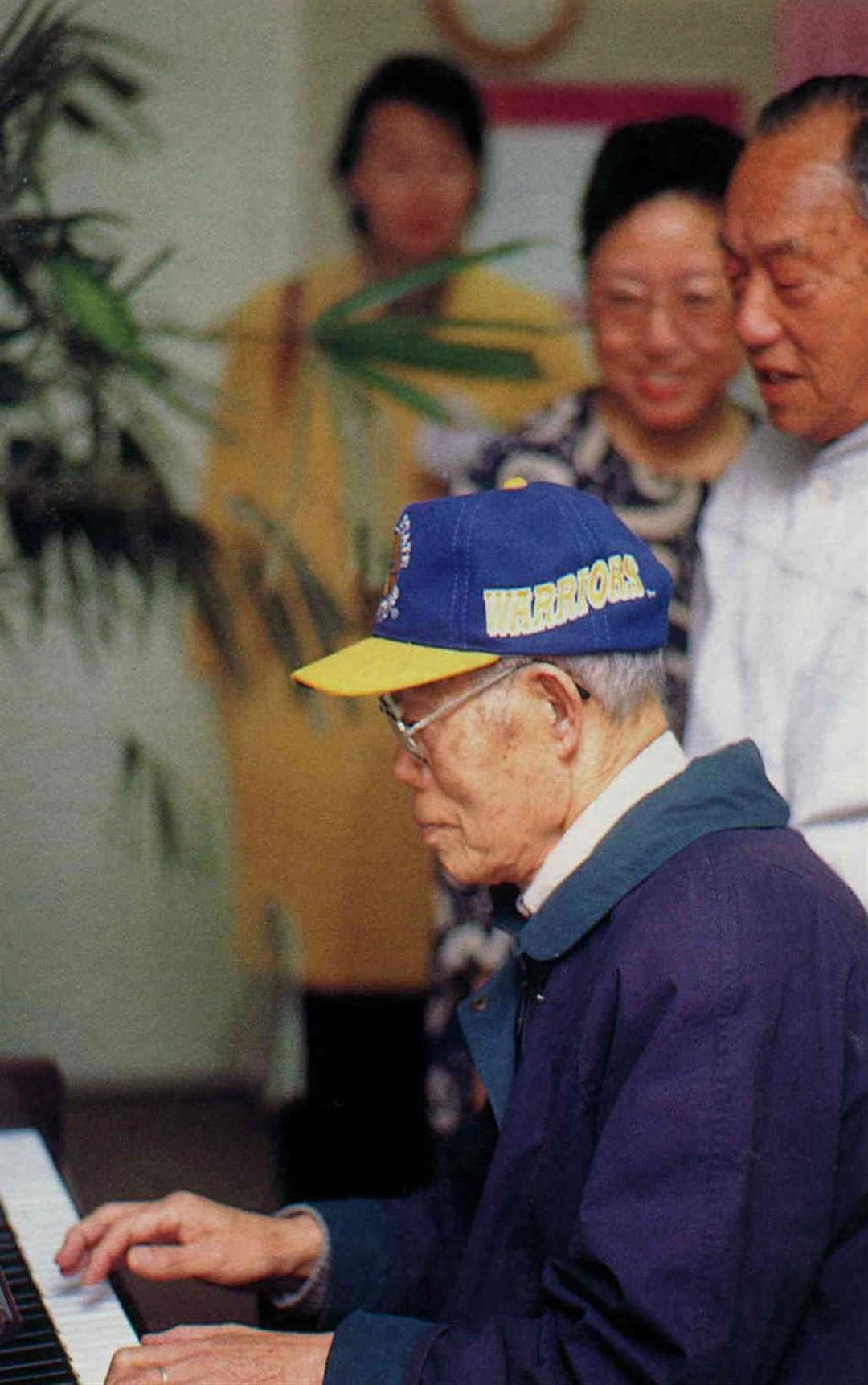
Nearly 80, this music teacher at a Chinese seniors' association in Milpitas, California had three major operations last year. Here he comes back to lead a class in song. His friends at the association look happy to see him.
A home for seniors' associations
The truth is that when elderly people move to the United States, they know that they've got to be independent and help themselves. But independence isn't something that can be achieved simply by wanting it. Those with good English will be able to get by, but others may be too embarrassed even to utter their own English names. How could they possibly be expected to become independent? These seniors' organizations provide something for these swimmers in stormy seas to hold onto. They have become places where old folk gather to study English, make friends, chat and pass much of their time. As the number of seniors from Taiwan who have immigrated to America has grown, these groups have been expanding their activities.
With so many ethnic Chinese in the Los Angeles area, it boasts more Chinese seniors' organizations than any other metropolitan area, more than 10 all told. Around San Francisco, most Chinese are Cantonese, but in the southern San Francisco Bay Area, jobs in Silicon Valley attract many Taiwanese who have studied in America. Old folk from Taiwan who immigrate to America live where their children live. There are six or seven Chinese seniors' associations there, most for Mandarin speakers.
For reasons of language, native Taiwanese have their own clubs, as do the nationalist mainlanders who came over to Taiwan after the war. For instance, the Chinese Seniors' Association of Houston commemorates the War of Resistance Against Japan by singing the "Great Sword Song," whereas the Taiwanese spoken at the Houston Formosan Evergreen Association is liberally peppered with Japanese, and its members take great pleasure in singing folk songs from the Land of the Rising Sun.
"In fact everyone gets along well. Although there's no way to change language habits, when people meet, they are always quite friendly," says Chen Po-wen, who fled Taiwan for the mainland after the February 28 Incident in 1948 and was long on the ROC's "black list." In recent years he has joined the groups of Chinese from Houston returning to Taiwan to celebrate National Day on October 10.
Of course, seniors' associations need more than just ideals-they need facilities and funding too. Because the elderly don't have large incomes, most of the membership dues fall in the US$10-15 range. This gets you a free meal once a year (on Chinese New Year), banquets every season, and a variety of activities and courses for which only small additional fees for materials are required. A membership is a real bargain.
One essential is a base for the organization. "If there was no Chinese Culture Center in Houston, then there wouldn't be a Chinese Seniors' Association of Houston either," avers co-chair Sun Chao-han. The Overseas Affairs Commission established the Chinese Culture Center on two acres of land, and it is the most expansive such center in the world. Apart from five classrooms, it also has separate rooms for badminton and ping-pong and a dance room of more than 3500 square feet. The mere sight of it fills new and prospective members with great expectations, making them eager to give the seniors' association activities a try.
In the southern Bay Area, where land is dear, the facilities at the Overseas Chinese Education Center are cramped, and most of the elderly groups try their luck elsewhere. On normal days the groups meet at municipal senior centers, apartment complexes for the elderly that house many seniors from Taiwan, or other places where they share space and resources with people of other ethnic groups.

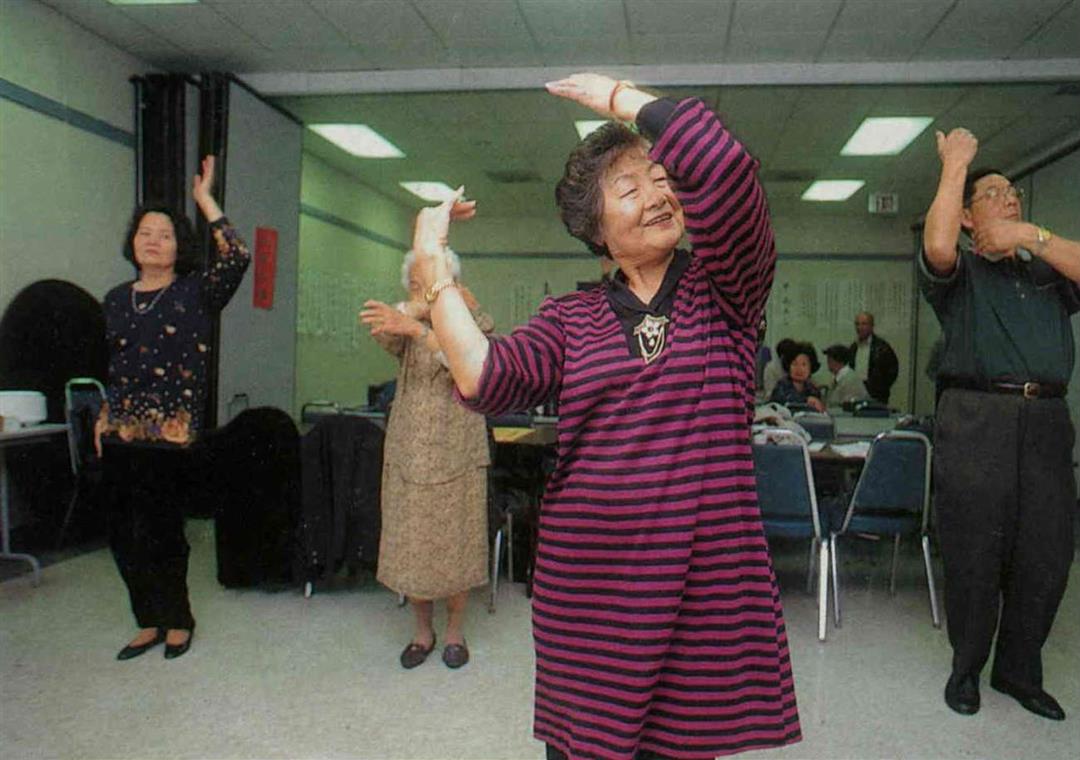
During recess from English class at the South San Francisco Bay Chinese Seniors' Association, seniors get some exercise by dancing.
Looking for happiness oneself!
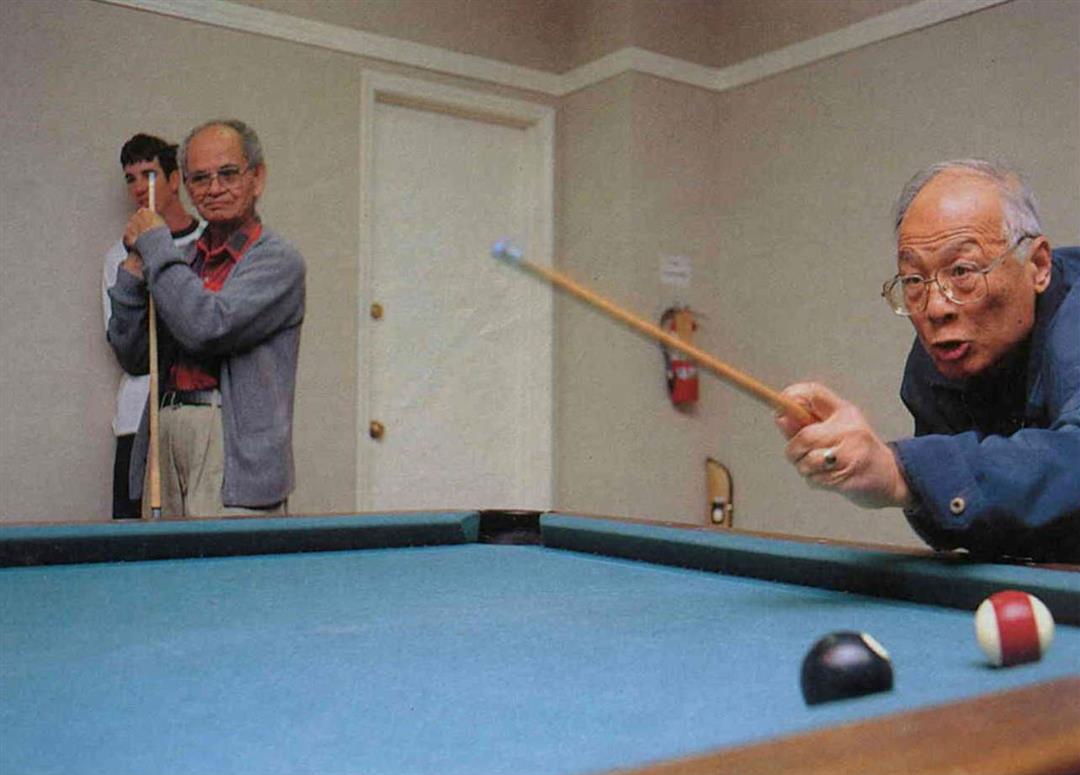
In the South Bay city of Milpitas most of those using the city's senior center are of East Asian ancestry. This is where the Milpitas Chinese Seniors' Association puts on many of its activities. Apart from the incessant games of ping-pong, pool, and checkers, there are also two tables set up for mahjong. Classes are available for those interested in choral singing, martial arts, dancing, Chinese painting, and arts and crafts. Here singing and the music of stringed instruments are intermingled with the clack of billiard balls, the clatter of mahjong tiles, and old folks' laughing and bickering. In terms of noise, a grade-school classroom has nothing on it.
"Don't laugh at us for being old and childish," remarks Lu Kuang-hua, vice-chairman of the Houston Formosan Evergreen Association. "Everyone finds happiness their own way!" He notes that Americans are scared of growing old, and always want to prove that they are still full of vitality. Well, when in Rome. . . . Here talking about being old is against the rules: "Every year, you're a year younger!"
But being old and childish-or old and childlike-doesn't usually come easily. Lu's good friend Li Chin-ju says that when people are first invited they always feel that they are too old to learn how to sing or dance. But Lu, Li says, gives them these words of encouragement: "If you can walk, you can dance. If you can talk, you can sing." Now Li's house has become a karaoke center for her friends.
A Mr. Wang worries about his mother, a widow who never puts down her load, never opens up her heart, and would rather stay cooped up and depressed at home than go out and be seen in public. Chang Tzu-ping, co-chairman of the Chinese Seniors' Association of Houston, has strong opinions about this. He says that old people ought to get out of the house and participate in activities. Otherwise, when left at home to brood, even people in good health get sick. Chang's wife Han Yu-chen is a women who can't be held back. She helps her husband handle association matters, selling tickets to banquets so as to fill the association's coffers. Often they get together with small groups of friends. Their lives are so full that sometimes they get home late only to discover that they haven't any clean clothes. Then they have to drum up the energy to do their laundry deep into the night. "We're busier than when we were working!" Han Yu-chen, who is nearing 70, says that "by being occupied with nothing in particular" she is too busy to notice that old age is coming.

His aim is true! These seniors' associations are places where elders can happily pass their twilight years.
The warmth of friends
These seniors' jokes belie the deeper meaning that these associations hold for them. The members stimulate each other, truly care about each other, and at times help to keep the passion for living alive.
Three years ago Wang Pi-pai's husband had a stroke. Doctors said he might not have long to live, but Wang wasn't willing to let go. Knowing how much her husband enjoys the Houston Formosan Evergreen Association, she puts him into his wheelchair and drives him to each of its meetings, making nothing of the trouble. After three years, Mr. Wang has not recovered all his mental faculties, but at least he can sit off peacefully to the side and quietly observe his friends as they chat and take part in activities. Sometimes, his eyes light up when he sees an old friend.
Chu Chen Ai-lun, who lives in the Sharpstown Seniors' Apartments, loved to sing as a youth. But because her husband died young, she bore tremendous financial burdens and had no time to pursue her interests. "I never would have expected that I would be singing songs when I was 70 and tone deaf, getting another taste of the dreams of my youth."
Because Chu can drive, a bunch of old girls who also live in the Sharpstown apartments rely on her to drive them to the Chinese Culture Center to sing. "Sometimes I'm not feeling well physically, but I don't want to disappoint them, and so I go to the center, sit there uncomfortably and sigh." Chu says that when she listens to the singing her vitality comes back to her. She can't help but want to join in, and her spirits rise.
Her high blood pressure keeps her up at night, which in turn leaves her tired during the day. Sometimes she wants to take a nap. With all her friends, her phone is constantly ringing off the hook. Her friends tell her to just go ahead and disconnect the phone while she takes her nap. But she's not willing to do this: "All my life I've been beset with poverty and illness. My many friends are the only thing I have to be grateful for. No matter how tired I am, I don't want to miss even one of their calls!" By this point she is getting teary-eyed.

On the days of association meetings, members get up bright and early andhead out to spruce the place up.
Fated to meet
Apart from having outgoing personalities, those who participate in these organizations must possess some wisdom in dealing with others. Among the old folk from Taiwan who have immigrated to America are a disproportionate number of soldiers, public servants and teachers, as well as many doctors and high-level executives. They are a talented group. All old people are all set in their ways to some degree. Many are unwilling to concede defeat, and others go on about their past glories or brag incessantly about the success of their children and grandchildren in America. Then there are those who scold others for talking too much or wanting always to be the center of attention.
"If this sort of behavior bothers you, you're not going to have any fun and you won't last a day. But in that case how will you ever make friends?" asks Sun Chao-han, co-chair of the Houston association, and leader in spirit to all 4000 members.
Lu Ju-jung, chairman of the Milpitas Chinese Seniors' Association, says that since he has been chairman, he has made only one demand of its 500-some members: "No matter how much power you used to wield and no matter how rich your family, when you come here you have to obey just one rule: 'Respect each other!'" Everyone who goes there wants to pass their days in peace, and so they shouldn't be concerned about trivial things.
For instance, in Taiwan people may be very particular about who they play mahjong with, but here they play with whoever sits at the table. As soon as they've got four people they'll start playing. "The farthest corners of the world are right here in our neighborhood," Lu Kuang-hua explains. "We were fated to meet the people in our lives." The mantra of many in the group is, "Don't bring up the past; don't bring up the past."
Past privilege does not bring popularity here. Rather, gratitude is bestowed on those who make a practical contribution to serving the group as a whole-for instance by teaching English or naturalization-prep classes, in which they go over the proper phrases one word at a time. The multi-talented Sun Chao-han painted two huge posters for the organization: one commemorating the Huanghuakang martyrs who died during the 1911 revolution, and another commemorating the Marco Polo Bridge incident that triggered the War of Resistance Against Japan. Yet to make a contribution no special skills are required: the volunteers who make nutritious lunches are also among the people these groups value most.
"What's most remarkable about these seniors' groups, is that their teachers and workers are all volunteers, and they don't get a cent in compensation," says Mr. Chang of the Milpitas association. In Taiwan, he also served as director of a Taipei County group for the elderly, but there the teachers were all paid, and teaching was viewed as a job. It's quite different in the States, where the teachers and other volunteers act in the spirit of giving. As a result, there is a particularly strong sense of cohesion.
Wendy Wu, who teaches dance at the Milpitas association and has led dance groups from there to perform in many different places, explains that teaching old people to dance requires great patience. A two-minute dance may require several days of indefatigable instruction. She has so devoted herself to teaching old folk to dance that she has begun to neglect her travel agency. But when she sees these seniors perform a folk dance, the joy that it brings to their faces is so moving that she finds it more precious than gold.
Solidarity
Sun Chao-han of the Houston association says, "Our group not only puts on activities for our members' enjoyment, we also hope to use Chinese culture as a weapon that we can wield to enter mainstream American society!" For instance, in America it has become fashionable to take a Chinese name, and so every year members of the association go to various fairs and charity activities all over Houston where they set up a stand for writing out Chinese names for people. At other times, they might put on an exhibit about Chinese poetry or give performances of song and dance.
But these seniors don't merely want to make a "show" of Chinese culture for the foreigners, even more they want Americans of Chinese descent to have a sense of connection to their roots. The association is now pushing to have its posters about the Marco Polo Bridge Incident and the Huahuanggang Martyrs kept on permanent display at the Overseas Chinese Educational Center. "If even one child in ten develops an interest in understanding such history, then Chinese culture won't die here!" says the association's Chang Yun-wen, speaking from the heart.
The nutritious lunches are another main attraction of these seniors' associations. They're cheap and may be a senior's only meal that day that isn't eaten alone. As a result, a lot of people always show up for them. Because the Milpitas association is located in the city's seniors' center, its members are offered a good, nutritious lunch with two dishes, soup, fruit and milk, all for US$1.50. And because the Houston Chinese Seniors' Association is well attended and enjoys a good reputation, the city government specially prepares 60 meals for them, which are delivered to the Chinese Culture Center every morning at 10:00 a.m. sharp. Each meal costs only 50 cents.
Besides providing education, fun and food, these seniors' associations also allow old folk from Taiwan a chance to experience the power of ethnic solidarity.
The Silicon Valley cities of Milpitas and Cupertino both have ethnic-Chinese mayors. Lu Ju-jung says, "We can't provide any campaign help, but in English class I write the names of the overseas Chinese up on the blackboard in big letters, so that the students will take them home and tell their families about them. Electoral victories are built one vote at a time." There are large numbers of other Asians in the area, he notes, but rarely does one see the solidarity that is on display at the Taiwan seniors' association.
Another example of how these groups obtain strength through numbers is the naturalization services provided by the Houston association.
Heaven's wish: Respect thy elders
"In the past, when the elderly wanted to apply for citizenship, they would go for a consultation with a lawyer, fill out forms, and after passing the exam go to the Immigration and Naturalization Service to have their fingerprints taken and to be sworn in," says Terry Gee. "It was a costly and difficult process." Then the rapidly growing Houston Chinese Seniors' Association earned the trust of the INS, which took the unprecedented step of authorizing it to open its own naturalization services counter. This has meant more than simply easier access to forms: Whenever it is time for a citizenship exam, six to eight INS workers come to administer it right there in the center. Taking the test in a familiar environment and surrounded by familiar faces, the old people are put at ease and as many as 80%-90% of them pass. They are then notified when to come in and recite the Oath of Allegiance. In the past figuring out where to go for the oath caused all sorts of difficulties, and in this respect too, the new arrangement has proven far superior.
The association will acquire another unique feature when the Rainbow Apartment Complex it is building with US$400 million of city money opens. Close to a Tzu Chi Foundation center and the Houston Branch of the Metropolitan Bank and Trust, it has an attractive location for seniors from Taiwan. According to law, anyone can apply to live there, but, as Terry Gee notes, "Few Americans of other ethnic groups will be moved to apply by seeing advertisements written in Chinese!" But how the old Chinese are going to share it among themselves is sure to cause big problems.
While these seniors' groups are a boon for elderly Chinese, transportation problems limit the number that can regularly attend. Although the Houston association has more than 4000 members, only a few hundred show up for its seasonal banquets. For the many elderly who have difficulties moving about, the pleasures imparted by these groups' activities can not be experienced first hand. This problem, common to all these seniors' associations, is where they most need a helping hand.