Through the tunnels and over the creeks
Passing Yutengping, you come to a famous series of five tunnels. It's a curious experience moving back and forth between the dark and light.
Huang Chuo-chuan, who works for the agricultural college in Kuanhsi and has researched the development of northern Taiwan's interior mountains, says that when he was little and rode steam trains, all the tunnels on this stretch of track made a big impression on him: "Before entering the first tunnel there'd be a toot of the horn, and everyone would close all the windows and not open them again until we were through the last tunnel." Upon coming out of the tunnels, the train windows would be temporarily covered in steam and coal soot.
Back then, these tunnels were given impressive-sounding names by the Japanese governor-general or other officials. The characters have grown indistinct with the passage of time or even been covered over with cement, but train enthusiasts can still recite them. They include, "Giant Spirit Conquered," "Clear Through in One Huff," "Big Peace Tunnel," and "Moving Without Obstacles." The names seem to bring the tunnels to life, speaking to all that work that went into them and the hardships they surmounted-as well as the happiness and pride that must have followed their completion.
Back then building tunnels was no small task, and this section of track was a major bottleneck for the main line. Work began on the main line in 1899, but it wasn't until this difficult section was completed in 1908 that trains could run its entire length.
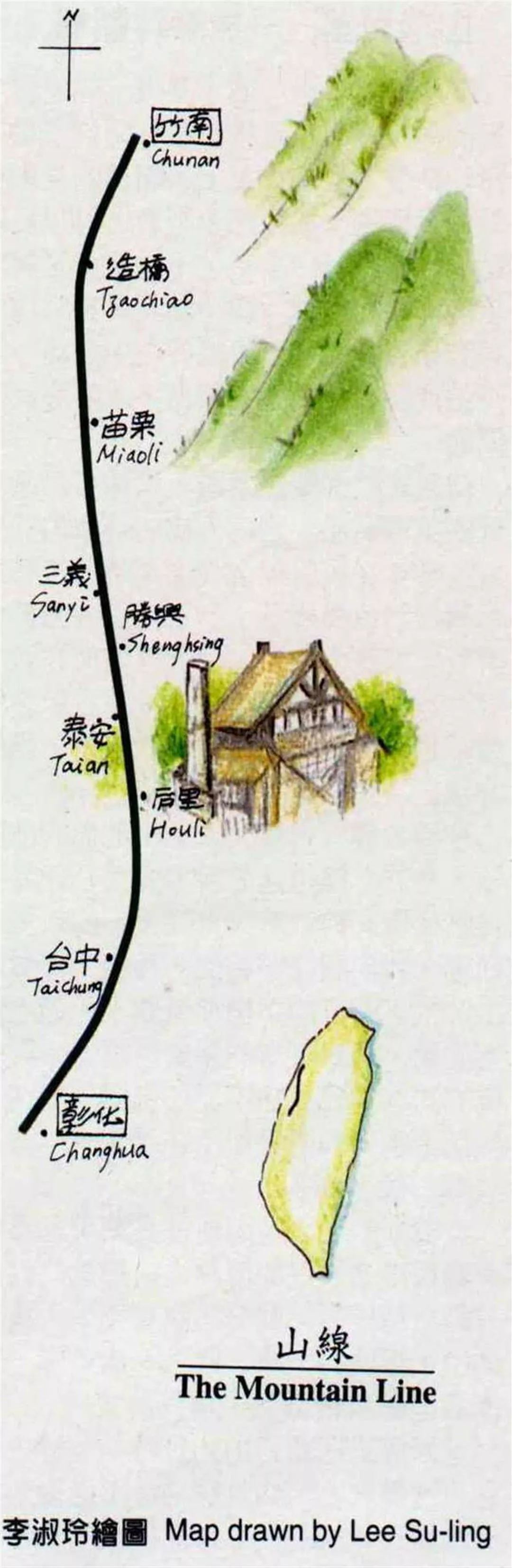
Nonetheless, because there are steep inclines and sharp turns on the mountain track, it is not advantageous for long-distance transport, so a coastal line was added in 1919. At Chunan in Miaoli County the main line splits, with one route running through the mountains and the other along the coast. They don't merge again until Changhua. But because the mountain line goes through Taichung, central Taiwan's largest city, 80 percent of the trains take this route, and the coastal line has taken on the feel of a laid-back branch line.
After the aftershocks
After passing through four tunnels, the train crosses the Liyutan Bridge. Under the bridge is the Liyutan Reservoir, which was only completed a few years ago. The building of the reservoir meant the end of the lake in which that legendary monster carp resided. The surface of the reservoir reflects the green of the surrounding hills, making one feel momentarily enveloped by greenness-before everything turns black again as you enter yet another tunnel.
Out of that tunnel, the train keeps its rapid pace and crosses the Anhsi truss bridge with its wide spans and magnificently interlocked beams. Looking to your right you can see a high concrete railway bridge extending across the river. This is the just completed double-rail bridge, ready for use.
Cross the Ta-an River, and you enter Taichung County. Next to the rails at the Tai-an Station is a monument in the shape of a giant artillery shell. It tells another sad story: "To commemorate the reconstruction of the Taichung line after an earthquake."
The text that follows documents the 1935 Kuantao Mountain earthquake, the damage to the railways, and the repairs. It is said that under the monument are the bones of personnel who lost their lives on the job.
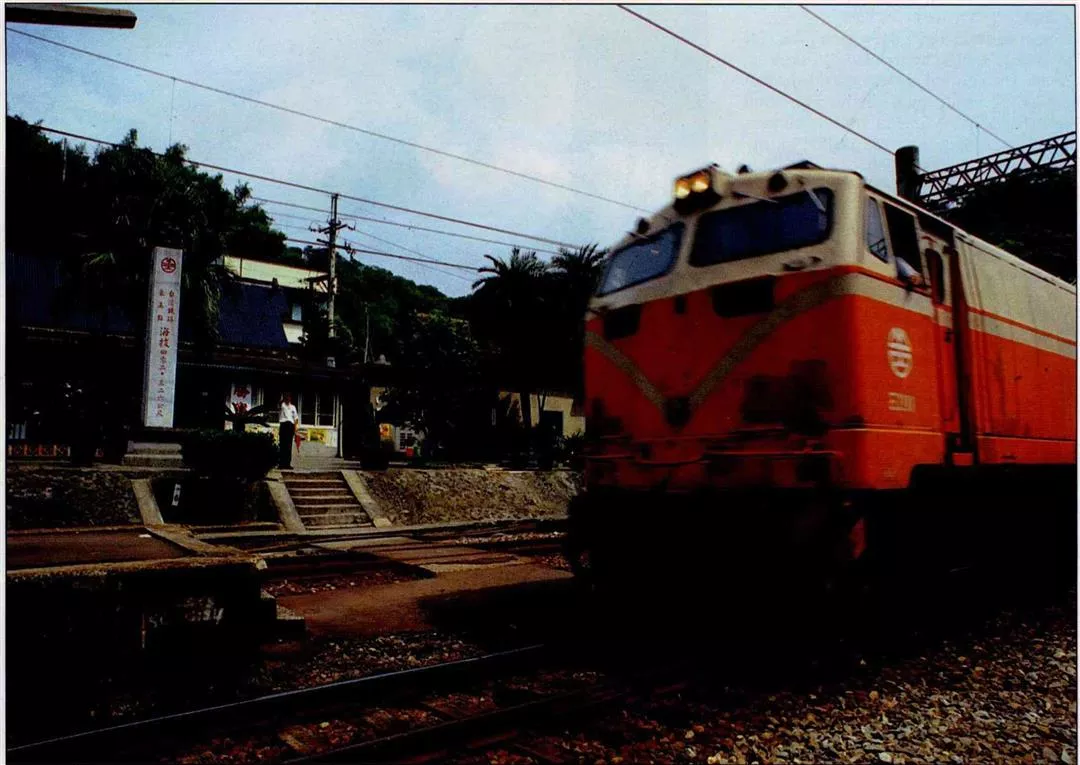
The original wooden structure at the Taian Station collapsed in the earthquake, and the reconstructed pillars in front of the door add a lot of character. What's most remarkable is that the station house is lower than the tracks. When you disembark from a train, you must first pass through an underpass to leave through the main gate. Leaving the building you see a road out front, with a few stores open on either side of the station, and some local kids out riding their bicycles. It seems as if time has stood still here.
Turning into a mountain hermit
But what will befall the entire old mountain line? The straightened, double tracks are sure to make travel safer and speedier. In general, as the old replaces the new, what is sought are things that go higher, faster, and farther. Will the no-longer-needed old tracks and stations enjoy a easy-going old age, or will they promptly be tossed into the dustbin of history?
The standpoint of the Taiwan Railway Administration is that once the new tracks are completed, the old line will be ripped up and the old stations torn down. But the Miaoli and Taichung county governments are reluctant to let stretches of track in their counties disappear, and in 1994 Miaoli went so far as to hire a consultancy to assess the possibility of establishing a "tourist railway" and a railway museum in Shenghsing. The provincial government is also assessing the feasibility of developing tourism for the old mountain line from Sanyi to Houli.
The public too is concerned with the fate of the old mountain line. "It would be an awful shame to see a line that was in service for more than 90 years be torn up," say many here, visitors and locals alike. For the past two years many people have gone to the Shenghsing station to pay their last respects.
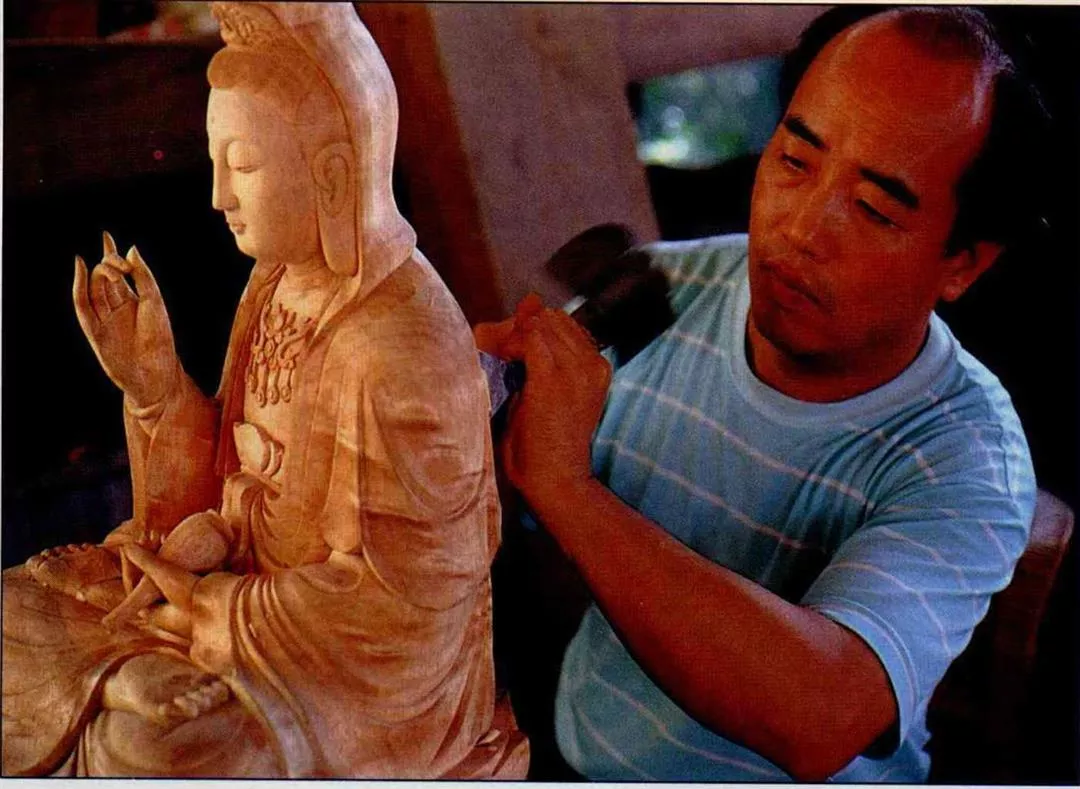
Yet there was an old station on the mountain line, the wooden-frame Sanyi station, which despite being nearly 90 years old, was torn down and rebuilt for the sake of expansion. The first thing you see upon entering this town renowned for its wood carving is this new concrete structure, which fails miserably at conveying the local character. The reconstruction dismayed many members of the cultural community. Is the same fate in store for the Shenghsing Station?
At the end of June this year, the Shenghsing community established the Mountain Line Preservation Promotion Committee. Its chairman is an outsider, Tsai Chung-ho, who is an instructor in architecture at Lianho Vocational College. Although he's not a local, since he took on planning for the Miaoli Station two years ago, the mountain line has been close to his heart.
Tsai says that the most important work of this ad hoc committee is "keeping a high profile and continuing to making a lot of noise in the hope that the government will protect the railway's cultural monuments." Such activities include holding a Yuteng-ping Bridge photography contest as well as guided tours of the Shenghsing Station with the Taichung Housewives Society. Now the Taiwan Railway Administration has decided to preserve the section from Sanyi to Shenghsing and decided as well to repair the Shenghsing Station.
A New Spring for an Old Station
The second time we visited the Sheng-hsing Station, the acrid smell of new paint was wafting through the air, as the carpenters were just preparing to paint the walls. Station Master Luo Chin-huang says that from the perspective of station master, he has the responsibility to keep the station attractive, neat and in a state of good repair. "For the rest, I just do what my superiors tell me." Nevertheless, he decided to paint it chestnut brown, like a small wooden house.
Head carpenter Chuang Ping-fa by chance heard about the hard work that the Mountain Line Preservation Committee was doing, and volunteered his services to repair the Shenghsing Station as a way to give something back to his home town. Then the Taiwan Railway Administration decided to repair the old station, and he became foreman of the repair crew.
Chuang says that on close inspection he discovered that the damage is far greater than it appears. They have already replaced three rotten pillars. "It's harder to repair an old structure than it is to build a new one," he says shaking his head. It is particularly difficult because they are doing their best to repair things in keeping with the original intentions. Because it is impossible to find many old materials, often they can only do their best to stem further deterioration.
A hot potato
The Shenghsing Station is lucky to survive, but the next big question is: if the whole single-track mountain line is to be preserved, then who is going to take over running it? The Taiwan Railway Administration plans to turn these seventy hectares over to local governments to decide if they should be developed or turned into green zones. But the exchange comes with a price tag of NT$150 million. Even if county governments want the line, are they financially capable of managing it? Or should it be rented out to private concerns to manage? Should it be turned into a tourism railway or are there other possibilities?
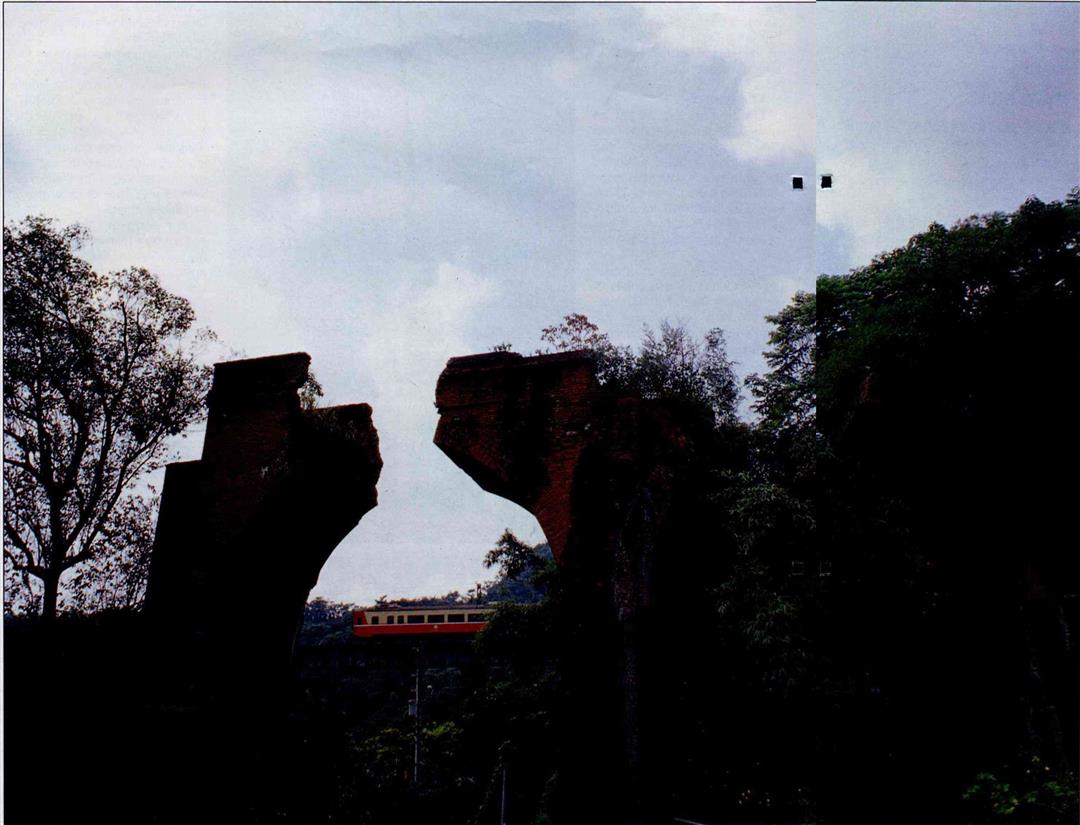
Chen Tsung-hsiung, who is responsible for carrying out an assessment of the tourism potential for the mountain line for the Taiwan Provincial Tourism Bureau, says that there is little chance that the whole line will be preserved, because the operating and maintenance costs will be too high. "What's more possible is that a few scenic spots, such as the Liyutan Bridge or the Yutengping Broken Bridge, will be developed as tourist attractions."
Tsai Chung-ho, the executive director of the Mountain Line Preservation Committee, opposes the orientation of the current tourism plans. "Most of the proposals run along the line of theme parks, where the natural environment is not preserved and major construction is undertaken, but the value of the Mountain Line is impossible to put a price on," he says. It is an historical asset that is part of the collective memories of the people who live in Taiwan, and also provides living instruction about the history of railroads here, and could also be a concrete way for the government to show their concern for Taiwan's native culture. "It has more meaning from the perspective of cultural preservation and education."
Hoping to see it again unscarred
"The Committee's first task is to influence policy," Tsai Chung-ho says. Once this stage is completed, if still no one is willing to take over responsibility for the line, they might consider reorganizing themselves into a maintenance organization, and get volunteers from foundations, communities and schools.
The Chichi Line, which has been a hot topic of late, serves as an example. At one point the Taiwan Railway Administration was thinking about taking the line out of service because it was losing money. Then locals made loud calls to protect it, and now it is looked after by the local government and has become a priceless tourism resource.
Lai Te-hsiang feels that dynamic preservation has more value than static exhibitions. "If you could still see trains running, with guides on board explaining rail history, how much fun that would be!" he says with great expectations.
That ideal will probably take a long time to realize. As the train slowly pulled out of Shenghsing Station, I made a wish that the next time I come to visit, the mountain line won't have come to any harm.


@List.jpg?w=522&h=410&mode=crop&format=webp&quality=80)

@List.jpg?w=522&h=410&mode=crop&format=webp&quality=80)