You Must Be Joking!
Live Comedy Gets a Foothold
Kobe Chen / photos Chin Hung-hao / tr. by Phil Newell
April 2013


“.come” (aka “dacon.come”) and “Comedy Girls” are two troupes composed of former students of Social Chang. Their shows are a hot ticket these days.(courtesy of the Comedy Club)
Many cities have a landmark locale for the “culture of humor.”
New York has the Comic Strip Live, where Hollywood superstar Eddie Murphy, among many others, got his start. In Osaka, Japan, the Namba Grand Kagetsu Theater is the home base for the Yoshimoto New Comedy group, from which emerged the humor duet London Boots, who serve as hosts for the popular TV program “London Hearts,” the prototype that many Taiwanese variety shows try to imitate. In Tianjin, mainland China, you will find the Mingliu Teahouse, which has hosted many performances by the “crosstalk” comedian Guo Degang, one of the mainland’s “national treasure” level comedic performers.
Taipei now has its very own bastion of buffoonery, the Comedy Club. Each week it offers entirely new comedy shows, and over its six years in existence has nurtured over 10 performance troupes, generating the wave known as “the new Taiwanese humor” and giving a start to many talented people who have gone on to blossom beyond the venue.
A: My love life is a mess.
B: Have you tried going to a fortune teller?
A: Yeah. I went to one ask about my love life, and I couldn’t believe it—he just said to me, “You trying to give me a hard time?!”
B: What kind of fortune teller did you go to?
A: A face reader. Have you ever heard of a fortune teller saying something like that?
B: It’s your fault for asking him that kind of question.
A: Why shouldn’t I?
B: Well just look at the face you brought with you to talk about romance!
A: Hey, I can only go with the face that I have!
B: Then don’t be surprised if your romantic future doesn’t “look good.” Just “face facts”!
A: Ouch! Another slap in the face!
The whole place explodes in laughter.
This was the scene at a performance of the new-wave humor troupe Yubon Theater. The two comedians, who are part of the group, are known as the Houdao Brothers, and their specialty is Japanese style manzai, comic dialogues akin to Chinese “crosstalk” or the old Abbott and Costello routines in US cinema. Starting in 2011, they have been doing a series of shows on the theme of “dumb to start with, and very, very confused.” Using wulitou humor (a Cantonese style of jokes in which a person rambles on nonsensically, but somehow there is truth or wisdom in what they say), non sequiturs, fast rhythmic patter, and cutting remarks, they poke fun at the hypocrisy in how people treat each other.
The Comedy Club, founded in 2007, has been up and running for six years now. The layout and décor leave virtually zero space between stage and audience, so there is a great deal of interactivity, making it a great place for stressed-out office workers to let off steam. However, because the club only seats 70, even with seven performances per week it’s often difficult to get a ticket.
Even that, nonetheless, is part of the charm.
.jpg?w=1080&mode=crop&format=webp&quality=80)
“.come” (aka “dacon.come”) and “Comedy Girls” are two troupes composed of former students of Social Chang. Their shows are a hot ticket these days.(courtesy of the Comedy Club)
The one and only
The birth of the club can be traced back to the fevered imagination of its manager, “Social” Chang.
Born in 1971, Chang was a first-generation member of Taiwan’s “little theater movement” of the 1980s. A graduate of the Department of Electrical Engineering at prestigious National Chiao Tung University, he was in university in the late 1980s, when martial law was lifted and countless previously silenced voices began to have their say. It was in this environment that a plethora of “little theaters” sprang up. Chang abandoned his profession-by-training and, with Chen Meimao and others, founded Taiwan Walker Theater, adopting an “anti-establishment” avant-garde position. He quickly became one of the most prominent writer-directors in the whole movement.
In 2003 Chang moved over to television as a scriptwriter, and worked on any number of prime-time serials. However, though he was making good money, he found the layers of review and approval in the TV industry suffocating, and finally decided to get back into live theater. But this time he vowed he would come up with a performance art model that would be commercially viable while still keeping that experimental edge.
He chose as his target market Taipei office workers, who are always looking for novelty and escape. He opened his club in a basement in the Shida Commercial District, a high-income, high-education area close to the nation’s top universities. He took on the tasks of writing, directing, training, and business operations single-handedly.
After six years of sowing, not only he has reaped the fame of being at the center of “the new Taiwanese humor” and developed a core audience, but even more importantly has been nurturing a number of comedic performance companies.
Xiao Xia (“Shrimp”), a TV program host who last year shot to fame with his imitations of celebrities Fei Yu-ching and Jay Chou, and Rifat Karlova, a Turkish stand-up comic living in Taiwan whose travel program Ex Taiwan won a Golden Bell Award, both performed in the Comedy Club, honing their skills and getting experience in front of the footlights.

StandUpParty is said to be the top stand-up comedy act in the Chinese-speaking world. This year they will appear at the venerable Red House Theater, taking their act to a new level.(courtesy of the Comedy Club)
More complicated than it looks
After years of experimenting, the Comedy Club now incorporates a variety of well-established performance formats, including US-style stand-up, improv skits, and Japanese-style manzai.
“What we offer here is something you could only find in Taiwan, a blend of East and West, traditional and modern.” Chang says that comic styles reflect their cultural contexts, so likewise the jesting at the Comedy Club reflects the diversity of influences on contemporary Taiwanese culture, bringing together comic styles from other countries with down-home Taiwanese tomfoolery, to create something uniquely our own.
Take for example Taiwan’s first interactive improvisation comedy troupe, Guts Improv Theater. They have no scripts, but depend entirely on their exchanges with the audience to decide the content and ending of each performance. It takes acute sensitivity and quick wits to keep up with the endless twists and turns proposed by the audience.
The NG Improv Club, on the other hand—whose name in Chinese is a homonym for “acute myocardial infarction”—has a unique style which, while based in improvisational performance and likewise emphasizing interaction with the audience, starts with basic scripts and storylines. The actors then develop the skits freestyle depending on the mood at the venue, which gives the audience more of a sense of satisfaction at getting their laughs from a coherent story while still requiring the actors to stretch their improv muscles.
“Ding! Change!” is one of NG Improv’s most popular pieces. The “star” is a bell of the kind that is often seen at speech contests. Audience members can ring the bell at any time, and when it sounds, the actors have to switch the subject, continuing to do so until the audience is satisfied. As the dialogue changes, the plot often becomes incoherent and bizarre—a father turns into his own son, a gift of flowers turns into a bomb…. And the temptation for the audience to keep hitting that bell gets more and more irresistible, until everyone is belly-up with laughter.
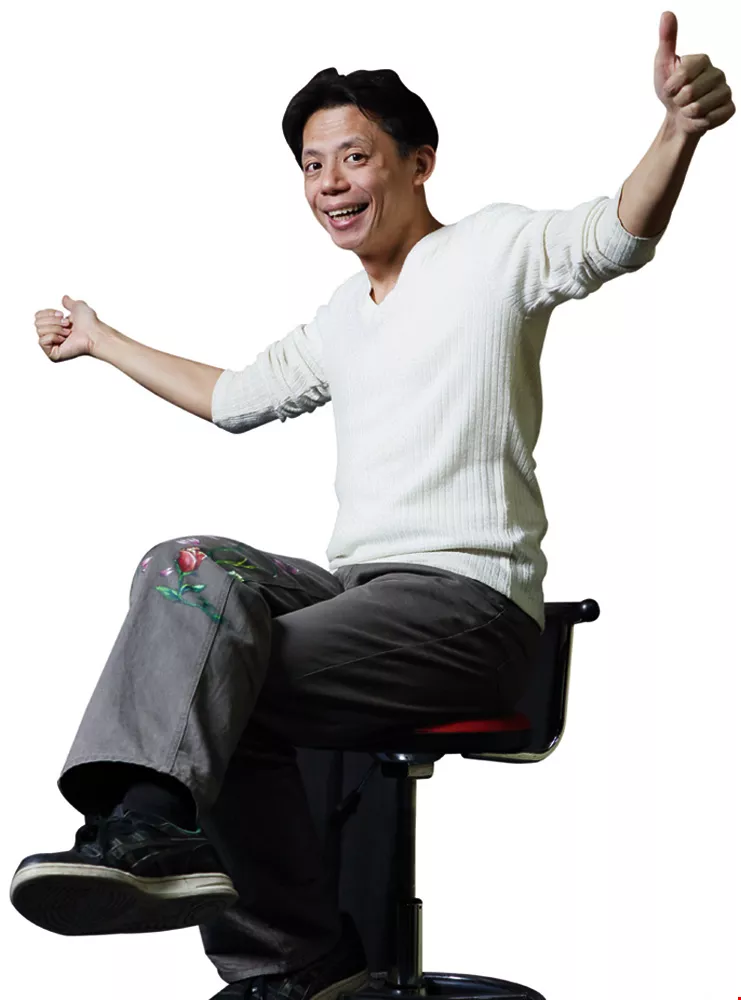
Comedy Club founder Social Chang wants to have it all: avant-garde comedy with commercial viability. He has injected innovation and creativity into Taiwan’s humor scene.
Takin’ it to the public
A ticket for the Comedy Club costs about NT$350–450. The club’s growing popularity means that at present the owner is able to keep the books balanced.
After moving to its new location near the Taipei City Hall MRT Station, the club now has a brightly lit restaurant on the ground floor, diversifying its sources of income. The stage remains in the basement, to maintain an ambience of intimacy and infectiousness.
The success of the endeavor has, however, spawned a new problem: Too many performers! “In addition to being the founder of the club, I teach up-and-coming comedians. My training class has completed four sessions so far, with more than 30 students. Meanwhile the dozen or so comedy troupes have nearly 60 actors,” says Social Chang. A single venue is no longer adequate to contain the overflowing abundance of talented young people coming along.
Therefore, in addition to in-house shows, Chang has also worked to create a comedic “spillover effect.” Thanks to a commission from the New Taipei City Government, every weekend there are regular shows in the historic Shengping Theater in the always-crowded tourist town of Jiufen.
Chang has furthermore decided that 2013 will be the year of “going amongst the masses.” With a troupe of students from his training class as his cadre, he will hold admission-paying performances at Taipei Red House Theater and Nanhai Theater (at least three are planned so far). Each show is expected to draw an audience of 300, and Chang hopes this will spread the enthusiasm for live levity, create wider name recognition, broaden the market, and generate revenues that are by no means laughable.
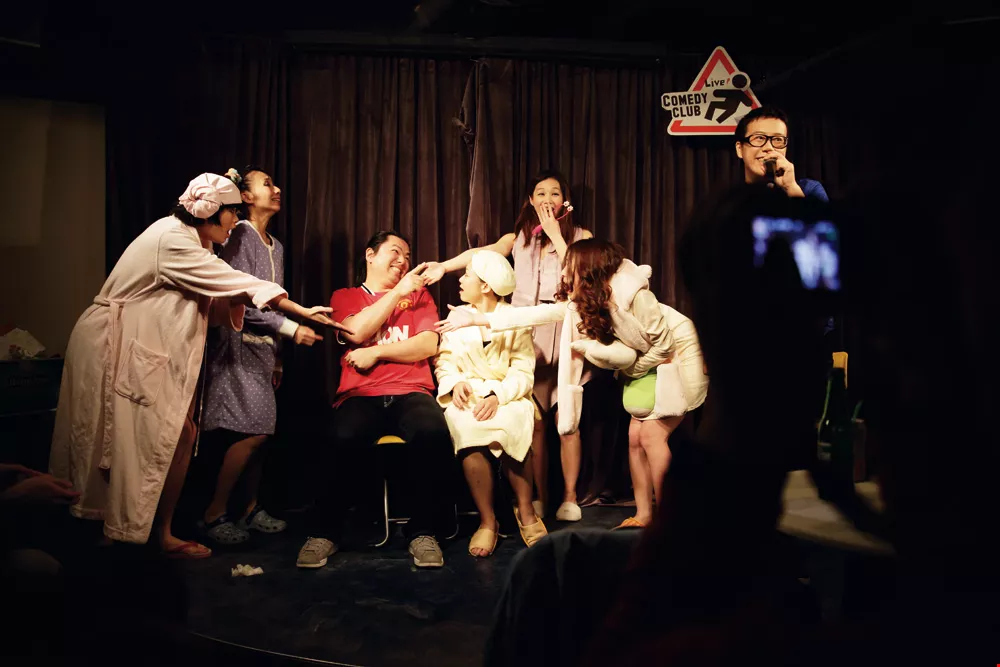
If you go to see a show at the Comedy Club, you’d better be prepared to get dragged on stage at any moment. The guy in red in this picture hasn’t been caught out—he seems to fit right in!
It’s especially interesting to see how comedy can transcend barriers of nationality and language, and the Comedy Club has attracted customers from Japan, Korea, Hong Kong, Singapore, and other countries. “Although they inevitably don’t get a lot of the jokes, there’s still a kind of infectiousness to a live comedy performance, and they still watch and laugh,” says Social Chang.
There is an old expression in the theater: “Performers are all crazy, but then again anyone who would pay to watch them must be a fool!” Following this logic, what kind of person would found a performance venue? Chang chuckles at his own folly: “A certifiable lunatic!” Maybe so. But just remember that to make a full-time comedy club a working proposition, Chang and his actors have to take their calling very seriously indeed!
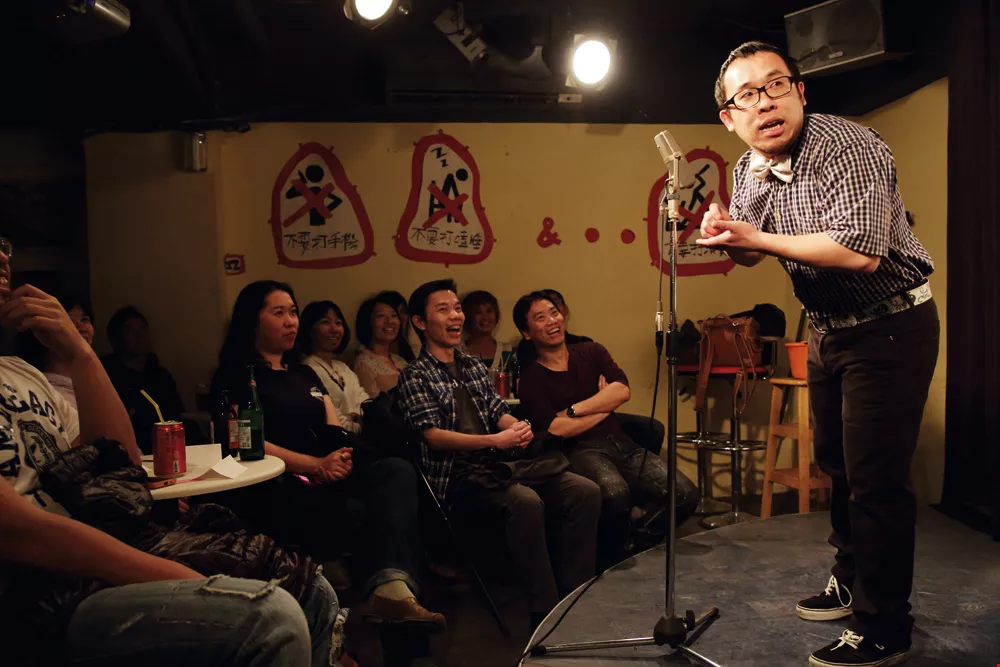
With zero buffer space between audience and stage, the setting is intimate and the mood infectious.

@List.jpg?w=522&h=410&mode=crop&format=webp&quality=80)

@List.jpg?w=522&h=410&mode=crop&format=webp&quality=80)


