Arhats' feet:
Is the problem solved once one has found the right ancient characters? Clearly not, for using them is a real headache. At the very least you won't find them on any computer. This is why some people have suggested that Taiwanese words for which it is hard to find characters should be spelt out in a phonetic-based script, used in combination with Chinese characters. Because most of the phonetic systems used are based on the Roman alphabet, they have been jokingly dubbed "Arhat's feet" [a pun on luohanchiao ("bachelor") meaning the feet of an Arhat (Buddhist monk ready to pass into Nirvana), or a combination of luo (romanization), han (Chinese characters), and chiao (annotation)]. Such "luohanchiao" would appear to solve the problem of obscure characters, but writing texts in this way destroys the visual regularity of Chinese characters, producing a mish-mash of Chinese and Western script which has aroused many people's opposition. Some people have proposed changing over completely to a phonetic script, to ease computerization and internationalization, while others have simply gone ahead and created their own "Taiwanese script" ; but because all these methods would break the link to the language's cultural roots, their proponents remain in the minority.
Taiwanese has an existing writing system available, but the languages of the 350,000 people of Taiwan's aboriginal tribes were originally unwritten, so that the task of writing mother-tongue teaching materials is even more problematic, and it too is dogged by a lack of uniform standards.
The French missionary Father Gerard Cuerq, who has lived with the Ami people since coming to Taiwan 28 years ago, has studied the Ami language in great depth, and is engaged in compiling a romanized dictionary of Ami. The work has been carried on by successive missionaries over the last 30 years, and has now reached the letter " S." Father Cuerq says that to record the aboriginal people's languages, it is not enough just to hold a few meetings: you have to understand their language through their culture and way of life: "You really have to go and live with them. " He believes this is an essential requirement, but seemingly it is something most scholars are not able to do.
A common standard?
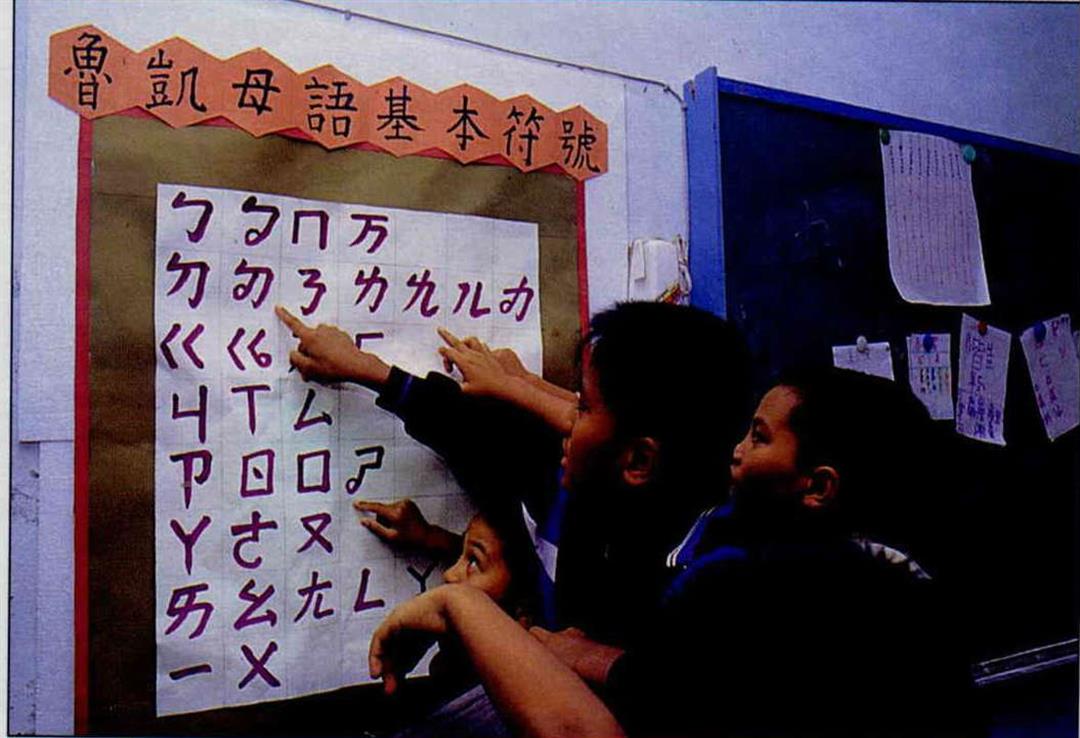
Missionaries have used romanized scripts to record the languages of the aboriginal peoples, but because this is at odds with the mainstream China's writing traditions, in early years the government was not very much in favor of it. Furthermore, the fifteen languages of the nine tribes are not mutually comprehensible, and it is inefficient for each tribe to use a different grammar, so some people have attempted to unify them according to a common standard. For instance, based on the fruits of his many decades of research into the languages of the aboriginal people, Li Jen-kuei, vice-director of Academia Sinica's Institute of History and Philology, has devised a system of "phonographic symbols" for the aboriginal languages, based on the International Phonetic Alphabet and romanized scripts. But although this has been enthusiastically received by some people, there are others who do not approve.
Liu Hsueh-hsiang from Tawu in Taitung County belongs to the Ami people. As a church worker she is in frequent contact with members of her tribe, and is rare in also speaking the Ami language fluently. In her view the various tribes' languages are not alike, and there is really no call for forcing a common standard on them. Besides, the majority of aboriginal people are already accustomed to using a romanized script, and to start using something else would only create extra problems.
On the other hand Pao Mei-fang of the Paiwan tribe, teaching director at Chingshan Elementary School in Santi Rural Township, Pingtung County, believes that the nine tribes really do need a common writing system with which to communicate with each other, enabling each of them to break out of their own narrow circle. Chang Chih-cheng of the Bunun tribe, who also teaches at Chingshan Elementary School, and over recent years has devoted himself to collecting Bunun culture, is also strongly in favor of a common writing system for the aboriginal peoples.
Embrace life, or return to tradition?
Pronunciation and the writing system are merely questions of expression; when one touches on cultural content, there are yet more problems with the way mother-tongue instruction is currently practiced around Taiwan.
Luo Chao-chin, the Hakka linguist whose "Give Us Back Our Language" movement sparked off a wave of searching for linguistic roots among all the peoples in Taiwan, says bluntly: "I'm not satisfied with any of the Hakka teaching materials currently in use."
He says that most mother-tongue textbooks today emphasize the language of everyday life. Although this makes for livelier lessons and reduces the academic pressure on pupils, it takes no account of the nature and content of culture.
"Everyday language should be learnt within the family; school learning should start with Chinese-character texts." He says that in the past when children started school they would read You Hsueh Ch'iung Lin ("Children's Treasurehouse of Knowledge"), the Three Character Classic and Pai Chia Hsing ("The Hundred Family Names"), and there was no problem reading them in Taiwanese or in Hakka. But now instead of these texts, the spoken language of everyday life is being taught, so it is not surprising that one constantly comes up against words for which there are no written characters.
There are still more problems with the teaching materials for the aboriginal languages.
Pao Mei-fang points out that in the Paiwan language textbook for Pingtung County, there is a lesson about a traditional Paiwan fairy tale in which a child is mistreated by its stepmother. But in contemporary Paiwan society there are many families where husband and wife have split up, and therefore many children have stepmothers, making this kind of over-pessimistic story, which damages the "image" of stepmothers, unsuitable for teaching to young children. "So I refuse to teach that lesson," says Pao Mei-fang.
Moreover, with only one to two hours a week allocated to mother-tongue instruction, and no exams to take, many teachers are apt to commandeer the lessons for "extra coaching" in English or maths as the need arises. And though pupils can learn a few words of their mother tongue at school, if their parents don't speak the language with them at home, then the result will probably be little different from current English teaching in Taiwan, where most people still find themselves tongue-tied.
Regulation is important:
For lack of an authoritative body to bring the different strands together, at present mother-tongue instruction seems to be pulling in many different directions at once, causing some to believe that things will only improve if the government steps in to "take charge."
For Wang Fu-chang, who has been observing and studying ethnic issues for many years, the problem with language policy in the past was excessive political intervention, but in the current period, if the political authorities do not intervene appropriately to save them, then some languages may be faced with extinction.
Author Huang Chun-ming also believes that there is no body other than the government which would be able to unify and standardize the writing systems.
Looking at the problems in mother-tongue instruction, it would appear that only the government has the power to solve them. But what is the government's attitude towards such expectations? Tseng Yi-shih of the Ministry of Education's educational research committee, says that the government's position is very clear: it is to "promote the National Language and respect mother tongues." On the principle that any country need a common language of communication, the work of promoting the National Language will definitely continue; but although local vernaculars will no longer be suppressed, neither can the government inflexibly enforce a methodology. "If the government uses one system rather than another, then once again there will be people who will be unwilling to accept it," he says, pointing up the difficulty that faces the government.
Everyone lent a hand:
There are many tales to tell about the revival of mother tongues. For instance, when Wulai Junior High School first wanted to compile teaching materials, having no previous examples to follow, it turned out that simply to rely on the teachers' enthusiasm was not enough. The materials were only completed with the kind assistance of linguists such as Li Jen-kuei and Huang Mei-chin. The school also lacked sufficient funds to pay for printing the textbooks, and so it was only after the owner of the printing works generously gave the school credit that all the children could receive handsome books to use.
Regrettably, although some have high hopes for current mother-tongue instruction, others believe it is over-politicized.
Pao Mei-fang says that some people are constantly putting on exhibitions which exaggerate their achievements, and some schools are even appropriating Mandarin teaching time for mother-tongue lessons, which is "really putting the cart before the horse," she says with emotion.
But while some are overenthusiastic, others are consciously or unconsciously playing down mother-tongue instruction, fearing that teaching dialect "goes against national policy. " A few years ago when policies were still unclear, some schools already took the lead in providing mother-tongue schooling, but they did it furtively, not daring to publicize it.
Just what is my mother tongue?
Although mother-tongue instruction is spreading like wildfire throughout Taiwan, many aspects of it are still obscure. For instance, just what is a "mother tongue"? Its definition often gives rise to disagreement. Mainlanders take the view that since coming to Taiwan, they too have lost their mother tongue, so why is nobody trying to revive the mother tongues of people from Xinjiang or Shanxi?
Linguists believe that if questions such as what is a person's mother tongue, and which languages should be taught, are approached from an emotional standpoint, then there are really no answers. In Luo Chao-chin's view, because Taiwanese, Hakka and the aboriginal languages have several hundred years of history in Taiwan, then every effort should be made to preserve them and the associated cultures. But the native tongues of people from mainland provinces are not so common in Taiwan, and so their preservation is much harder to achieve, and will have to rely mainly on the individual efforts of families.
How closely a language is linked to a specific geographical area directly affects the success of efforts to preserve it. Taking Hakka as an example, there are some 45 million Hakka people around the world, but because their villages are often isolated and scattered, their language tends to be lost fairly quickly. Luo Chao-chin says: "A few years ago I went to Meixian Prefecture in Guangdong Province, which is usually regarded as having a high concentration of Hakka people. But nowadays there are many young people who cannot speak much Hakka."
Language as an expression of local sentiment:
But if we look at the Shanghai dialect, although there are only 12 to 13 million Shanghainese, they are concentrated in Shanghai, one of China's major economic centers. With both economic power and this geographical advantage in its favor, the Shanghainese dialect is very strong, and it seems that anyone going to Shanghai really needs to learn a few phrases.
Language is very regional in nature, so whether and how to promote mother tongues has to be decided area by area. Where dialects are just "a little poorly" they can be nursed back to health, but those in an advanced state of decline are probably beyond hope. Huang Chun-ming says that places like Taipei are "lost territory" as far as dialects are concerned, with many people there speaking only Mandarin; but in other areas families can surely keep Taiwanese and Hakka fully alive.
In fact all the different techniques and methods for studying mother tongues are of secondary importance: what counts most is motivation. "To study a language, emotional involvement is essential. " Recounting his experience as a mainlander studying Taiwanese, Legislator Cheng Chien-jen says that only someone with feelings for this place will be able to successfully learn its language.
Of course, enthusiasm can spur people to enormous efforts, but there is no guarantee that their hard work will be rewarded. We have all woken up to the necessity and urgency of keeping alive the linguistic and cultural heritage of Taiwan's various ethnic groups. But with everyone doing their own thing and often pulling in different directions as at present, will these efforts succeed? Clearly we need to think carefully about the path to follow.
[Picture Caption]
p.75
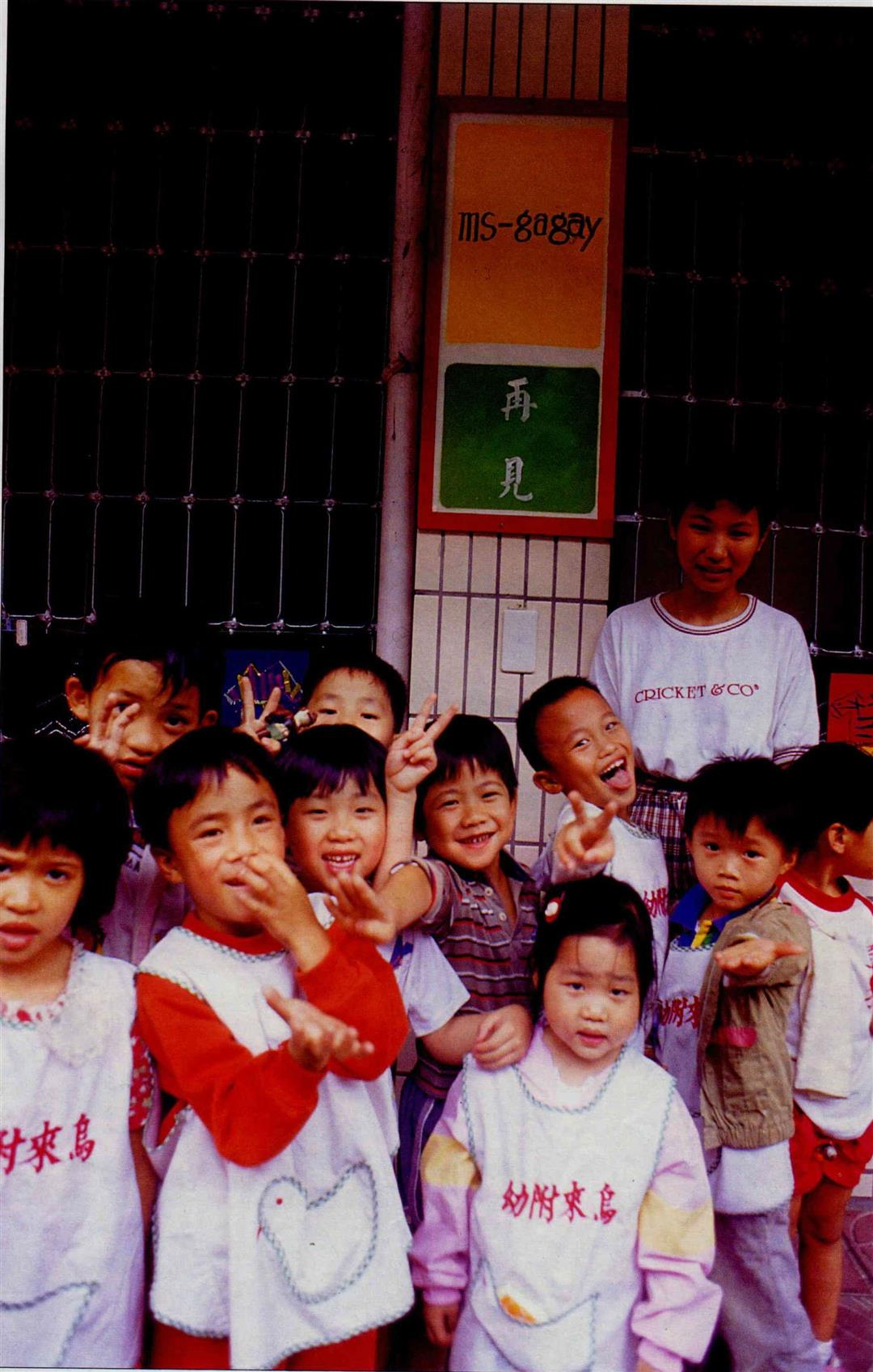
Many schools are now providing mother-tongue instruction. (photo by Lin Kuo-huang)
p.76
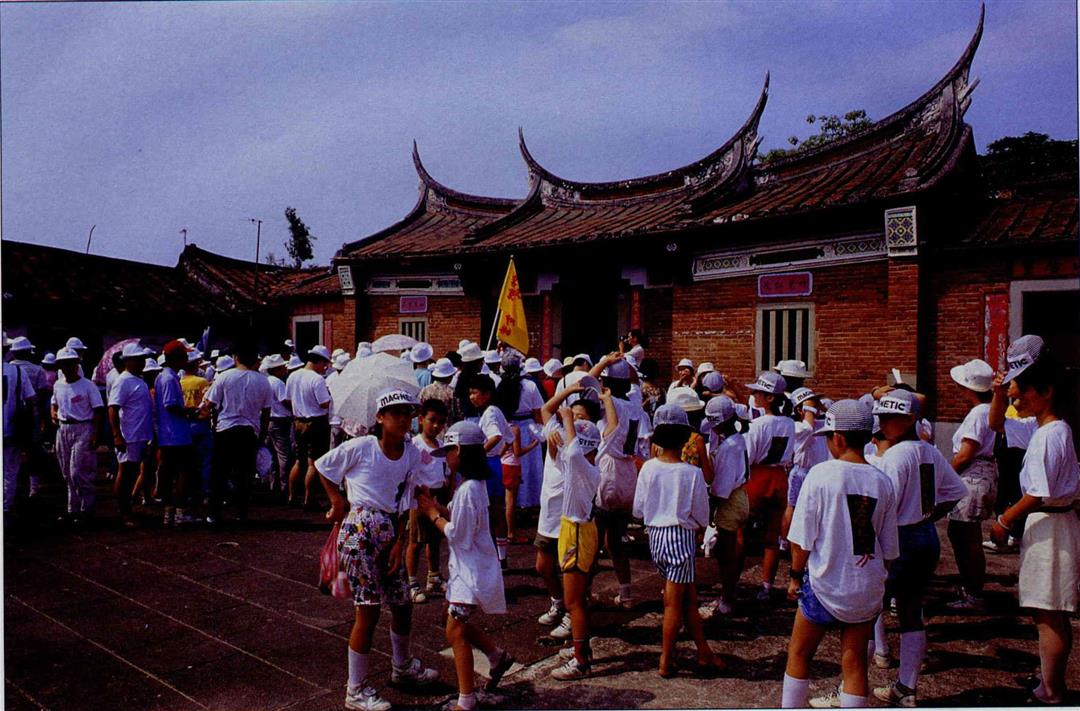
To awaken ethnic consciousness one must first value language. All kinds of ethnic summer camps have been popular in recent years. Here students at a Hakka summer camp visit a Hakka cultural site.
p.77
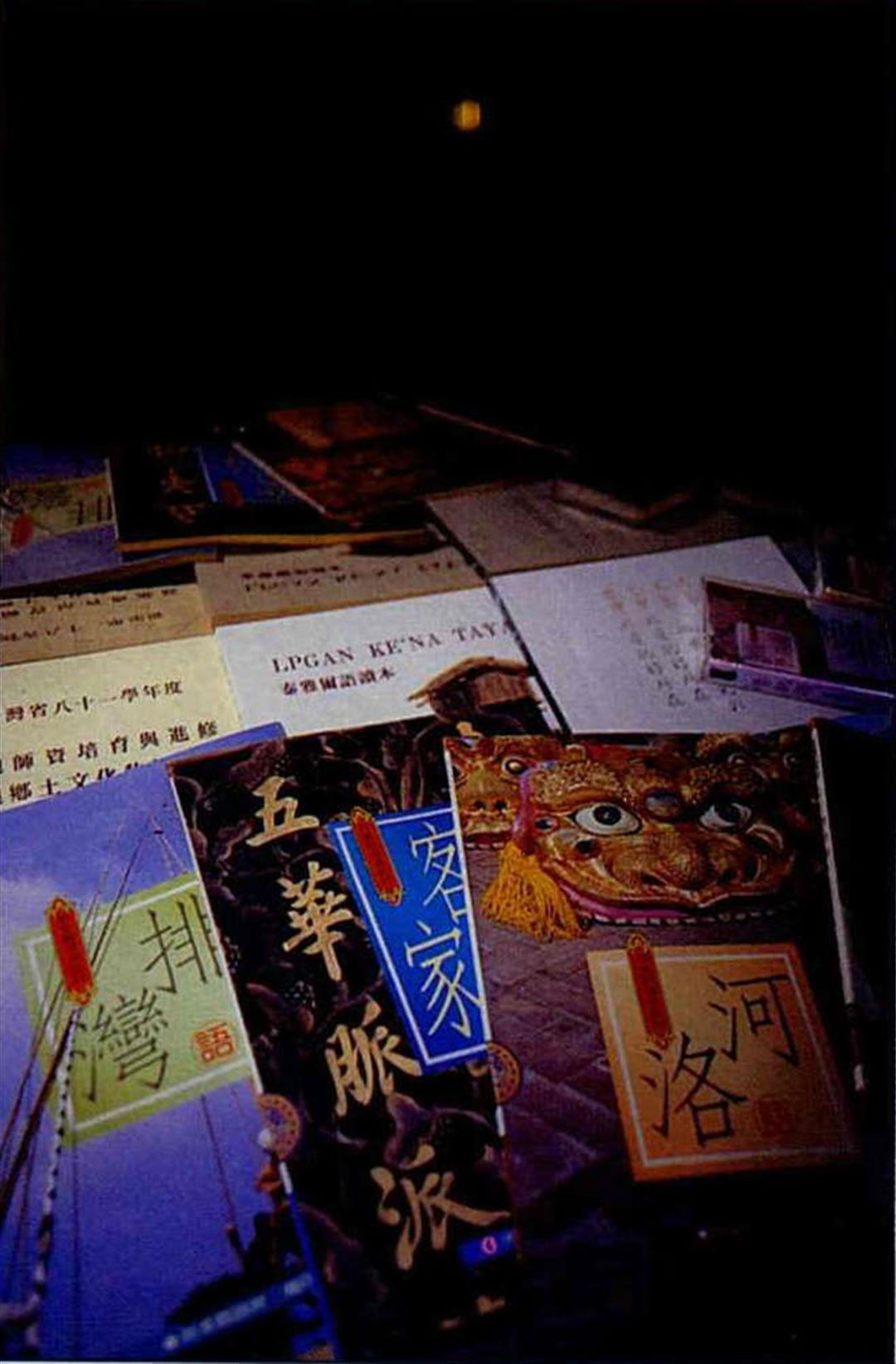
Dialect textbooks abound, but although they show the importance people attach to the local vernaculars, no one has yet developed a "universally applicable" way of teaching them. (photo by Cheng Yuan-ching)
p.77
The languages of the aboriginal peoples have some special sounds which need extra symbols to write them. The easiest way is to use the National Phonetic Characters which everyone is familiar with, and add a few modified ones to express the special sounds.
p.78
Mandarin is our common language of communication, but we still feel closer to our own local dialects. At a night market, tapes of songs in Taiwanese dialect sell like hot cakes.(photo by Liu Wei-chun)
p.79
At election time candidates often use dialect to try to win local people's support and sympathy. (Sinorama file photo)
p.79
Taiwanese Opera or Ketzai Hsi was one of the most popular forms of entertainment in early Taiwanese society. Its spirit only shines through when performed in Taiwanese dialect. (photo by Pu Hua-chih)
p.80
It would be wrong to think that broadcasting is only in Mandarin, Taiwanese and Hakka. To meet the needs of the aboriginal peoples, programs in their native languages are gradually making their appearance.
p.82
Scholars stress that the environment for learning local languages should be the home. School instruction is only a remedial measure. (Sinorama file photo)




@List.jpg?w=522&h=410&mode=crop&format=webp&quality=80)
@List.jpg?w=522&h=410&mode=crop&format=webp&quality=80)



@List.jpg?w=522&h=410&mode=crop&format=webp&quality=80)