How Much Farther Have We Got to Go?
Chen Shu-mei / photos Chien Yung-pin / tr. by Gerald Hatherly
December 1986


It doesn't look so difficult; winning an Olympic gold medal. The national record for skeet shooting is just three points short of the Olympic record, and in women's archery the 60 meter target record a mere 11 points. But then if you examine the record books for swimming and discover the Republic of China's women's 4×200 meters freestyle relay is a lengthy 1:12 behind the mighty East German squad's world mark, or note that the island's men's high jump record holder is 14 centimeters below the existing Olympic record high jump, it becomes more evident. The Seoul Olympic Games are less than two years away--how can the gap between international and domestic athletic performances be closed?
The first and most basic element is the athlete. "You need to spread a lot of seeds," says one local observer of athletics, "in order to pick out the best." Such an idea--to develop a pyramid structure of recruiting top athletes, a large base to pick out the best--is an ideal, but with 12 sports earmarked by the national Olympic Committee for development, this is a rather big problem. Zinovy Kinolik, a noted gymnastics coach of Soviet descent hired by the island's gymnastics association to develop a team program, summed the situation when he said, "Gymnasts must be trained from youth; the competitors in the Republic of China are too old." Where do you look for these youthful champions?
The Republic of China is not a communist country that goes out and simply selects promising young children and then begins to train them. Nor is it like Western Europe or North America where athletes are developed through a strong network of sports clubs and athletic organizations. The only remaining route is to go into the school system and nurture athletes through a program of physical education classes. Unfortunately a physical education program is not a definite guarantee of producing successful athletes. "Most students are too busy with their studies," observes Chien Yao-hui, head of the Physical Education Research Department at the National Taiwan Normal University, "to pursue athletics." Another important deterrent to participation in athletics is that Chinese society traditionally looks down on sports and athletes. They (athletes) do not receive the same respect and admiration that they do in other countries.
"I used to often feel that people merely looked at me like I was some animal with a developed body and simple mind," says Ch'en Hung-ya, a graduate of the faculty of management studies at Fu Jen University and the Republic of China's record holder in the javelin. Not only is there often dissent from parents, but many teachers are not encouraging, and the athletes themselves often say that they would not encourage their children to get involved in sports.
Next to the athlete, the coach is the most important ingredient to sports success. During the Asian Games, held this year in Seoul, South Korea, there was a popular joke circulating around the city--it was common to see Oriental faces competing in the events but when they were presenting the medals, the face behind the gold medal winner was almost always either black or white. Most of the coaches were from foreign countries. This isn't to say, as a Chinese idiom kids that, "the Western moon is rounder," but rather that in order to produce a good athlete you need a good coach. So it was no surprise then that the coach of the mainland Chinese swimming team was a Czech, or that the coach of the South Korean gymnastics team was from Japan.
The Republic of China is no stranger to foreign coaching either. About three years ago some sporting bodies like swimming, track and field, and taekwando invited foreign coaches to come to Taiwan. In most cases these visits were just short-term. There are, however two coaches who committed themselves to longer stays. They are archery coach. Hardus Warb of the United States, and the gymnastics coach, Zinovy Kinolik.
An integral part of the Republic of China's Olympic Archery Association's gold medal plan, Warb was hired for the substantial salary of U.S. $3,000 per month. Upon arriving in Taiwan he boldly stated that, "Within one year I can develop a team that will be Asian champions." His plans, however, did not meet with immediate success as he encountered strong opposition in the form of a boycott by local coaches. The undaunted Warb started from scratch by traveling throughout the island, going from school to school in order to draw together a pool of 20 promising young athletes. After developing their basic fundamentals Warb's three-year contract ended and he returned to the United States.
While the foreign coaching experts did not achieve immediate results, there is still hope for future success. Many people look at South Korea as a successful example of a country that invested time and money into developing athletics.
The government of the Republic of China has become involved in helping nurture a program of developing athletics. One program that has met with mixed results is one that allows the top three finishers in national-level competitions a place in the physical education faculties of the country's leading post-secondary institutions. The problem that has resulted from this program is that many athletes have recorded poorer performances after entering the school system.
In 1981, Sun Yun-hsuan, Minister of the Administrative Yuan, announced that National Games athletes who broke national records would be awarded a bursary of US$1,250 to help with their training. There has been a question of this influencing athletes in sports like weight lifting, where the lifter has three separate lifts, so an athlete could conceivably win three bursaries. There are those people who suggest that the awards be made for larger competitions (such as South Korea has introduced) thus setting a target of an international competition.
The Republic of China has what it takes, but still remains a bit short. Will this little difference be the determining factor in future victory?
[Picture Caption]
When will there be another major athletic success like the bronze medal won by the Republic of China's baseball team at the 1984 Los Angeles Olympics? (From Sinorama's information file).
How Close Are We to Olympic Standards?(Events with Objective Measurements)
*Source: ROC Athletics Association
*Note: Because each of the six categories of competition above includes many events, Sinorama requested the ROC Athletics Association together with Hsu Antung, Lin Kuei-chang and Shih Te-yang to select the events in which ROC athletes are strongest.
Compilation data: 11/25/86
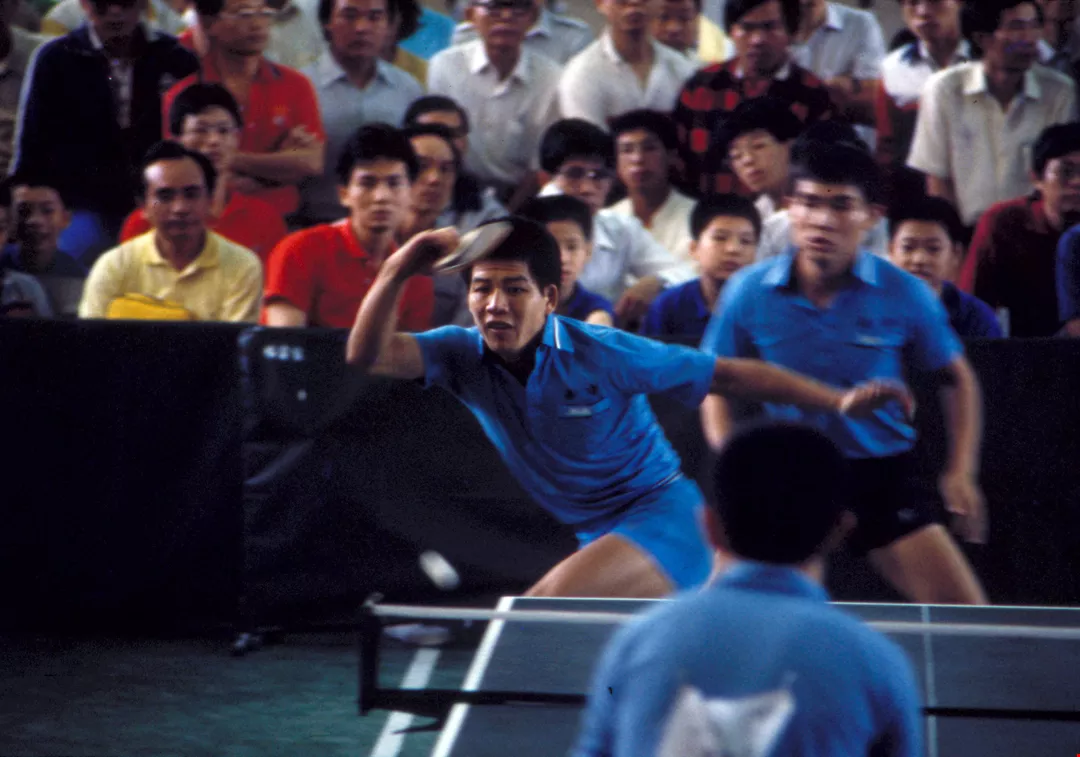
The heroes of table tennis--Wu Wen-chia and Huang Hui-ts'an. What place will they capture at the 1988 Olympics? (photo by Chien Yung-pin).
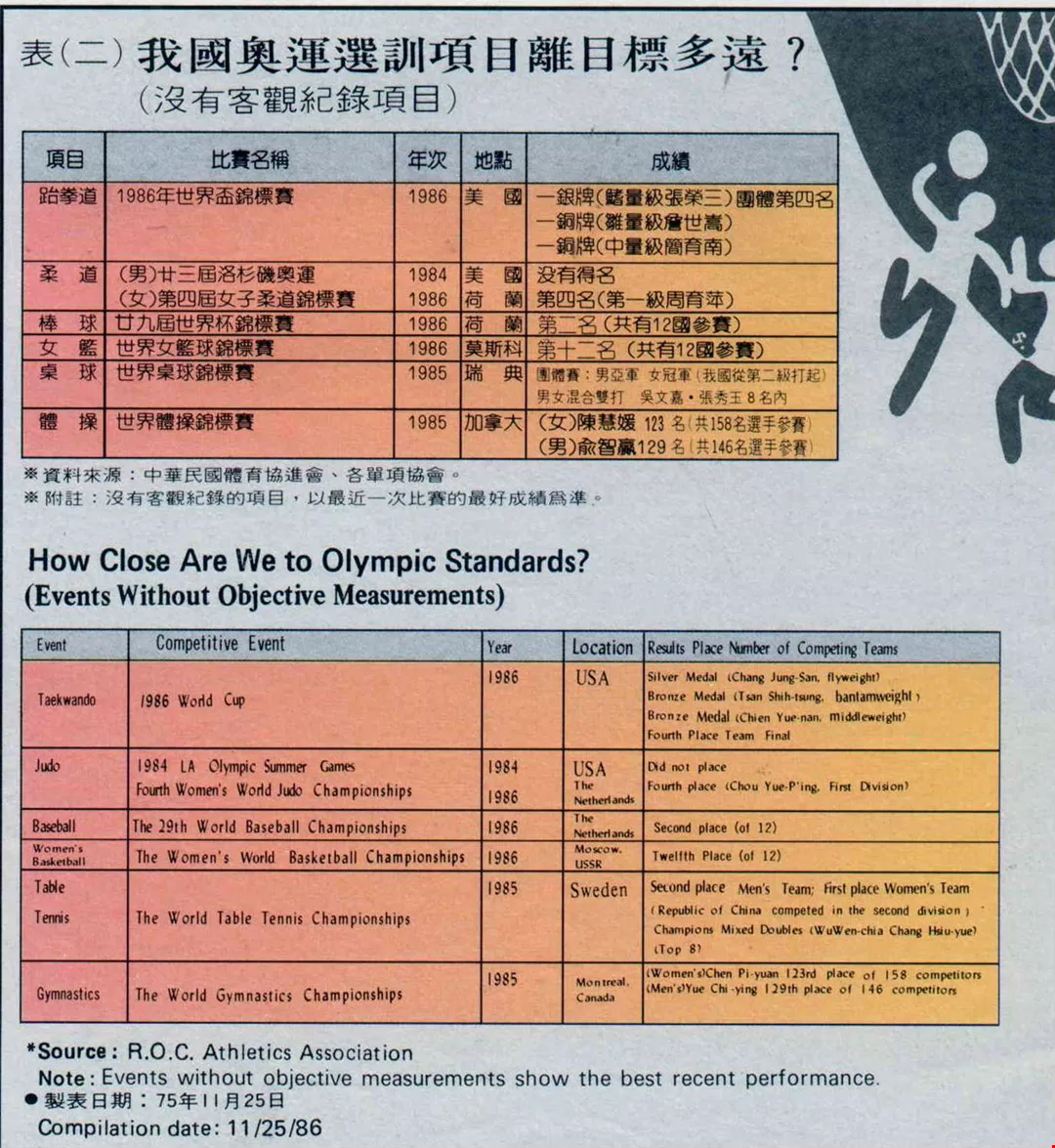
How Close Are We to Olympic Standards?
(Events Without Objective Measurements)
*Source: ROC Athletics Association
Note: Events without objective measurements show the best recent performance.
Compilation date: 11/25/86
Shooting is one of the sports with the most hope of yielding an Olympic medal for the Republic of China. Pictured is veteran champion, Tsai Pai-sheng. (Photo by Chang Liang-kang).
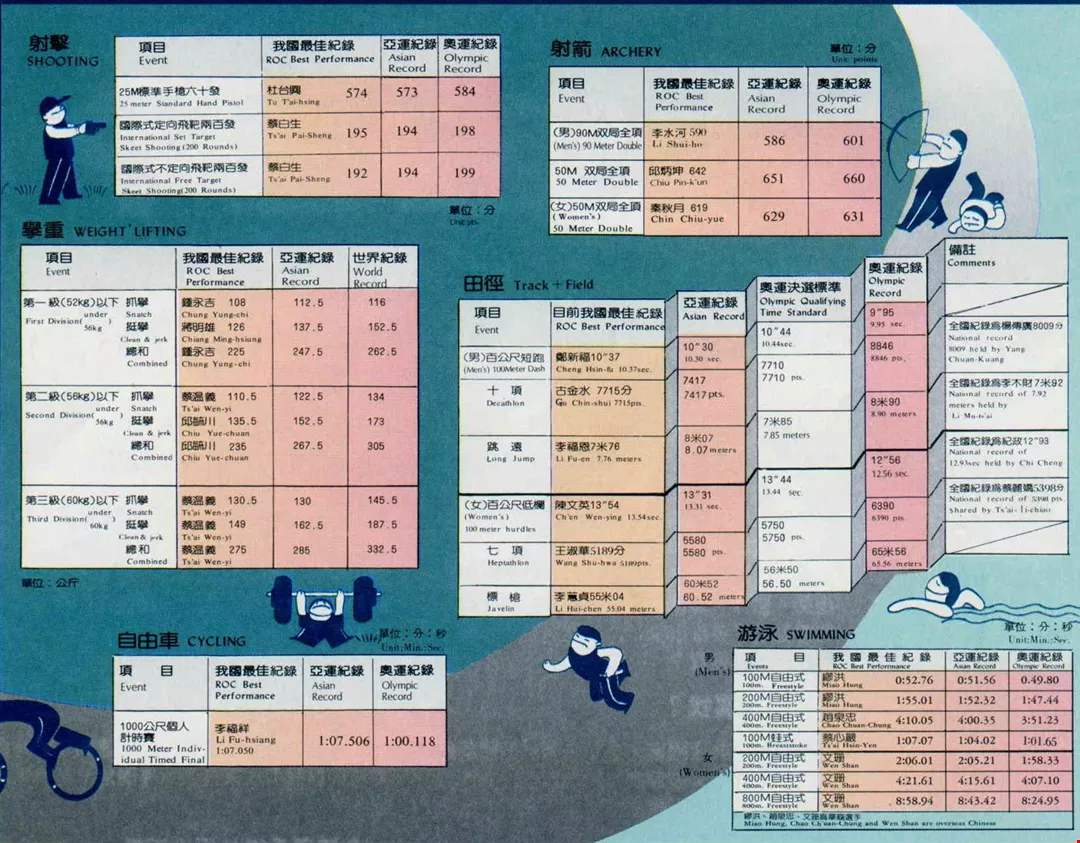
How Close Are We to Olympic Standards?(Events with Objective Measurements) *Source: ROC Athletics Association.
*Source: ROC Athletics Association *Note: Because each of the six categories of competition above includes many events, Sinorama requested the ROC Athletics Association together with Hsu Antung, Lin Kuei-chang and Shih Te-yang to select the events in which ROC athletes are strongest.
桌球雙雄——吳文嘉、黃慧傑,八八年奧運可打進第幾名?(簡永彬攝)
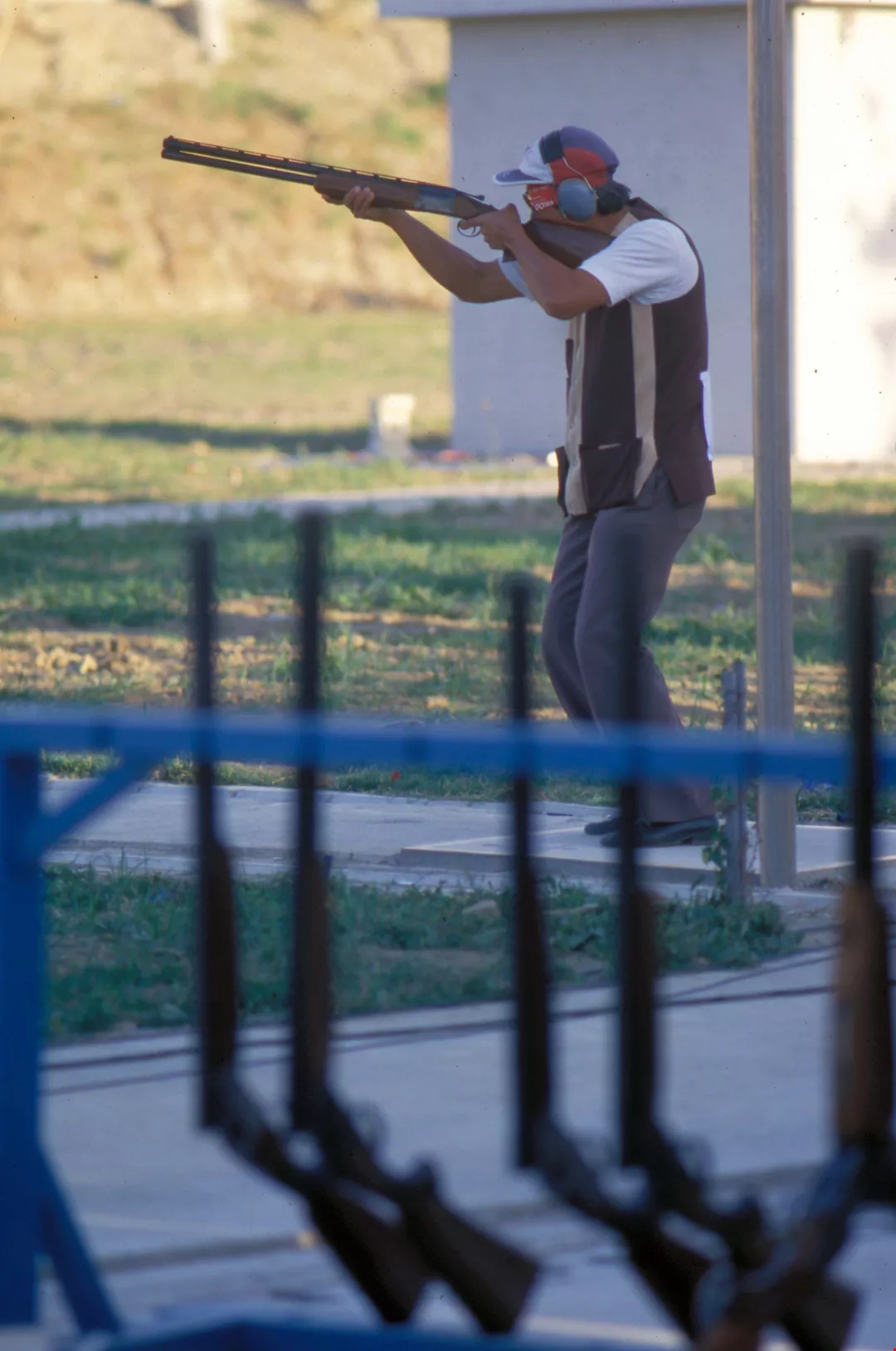
Shooting is one of the sports with the most hope of yielding an Olympic medal for the Republic of China. Pictured is veteran champion, Tsai Pai-sheng. (Photo by Chang Liang-kang).

@List.jpg?w=522&h=410&mode=crop&format=webp&quality=80)

@List.jpg?w=522&h=410&mode=crop&format=webp&quality=80)


