Standing Tall--Sim Mow-yu, Chinese Education Pioneer
Coral Lee / photos Chuang Kung-ju / tr. by Geof Aberhart
June 2005


To Malaysian Chinese, Sim Mow-yu is the personification of the long, winding path their community has walked. He has always encouraged his compatriots to be upstanding Malaysian citizens, and has been a pioneer defending Chinese education in the country, a "Confucian activist."
Despite being 93 years old this year, Sim is as lively as ever. When discussing Chinese education in his highly articulate manner, he demonstrates an intense passion for the subject. His passion and scholarly warmth have proven a source of great encouragement to those who have followed in his footsteps.
Over the decades, Sim has played a role in virtually all aspects of Malaysian life, including politics, education, and culture. In the 1940s, he led resistance against Japanese forces, and was arrested and exiled for his efforts. The 1950s saw Sim come into the forefront of national politics, until his expulsion from the association he helped build in the 1960s as a result of his tireless struggle for recognition of the Chinese language. He went on to stir the Chinese community to action in the 1970s, and was arrested under the Sedition Act. His fight to preserve Chinese education continued through the 1980s, and even saw him spend over a year in jail at age 76. Throughout the years, Sim has continued to make stunning achievements in working toward his goals.
Surprisingly, in the midst of all these heroic deeds, Sim has also shown himself to have a touch of the "gardener" in him, personally establishing the nation's longest-standing private Chinese school, Seng Cheong Night School, which has proven to be fertile ground for Chinese educational development. The masses of figures pedaling their bikes to and from class in the mornings and evenings stand as testament to Sim's indomitable spirit.
"My father gave me my name, Mow-yu, which roughly translates to 'honoring Guan Yu.' With Guan Yu being such a major deity, a name like that obviously made me feel that I had quite a lot to live up to. I have dedicated my life to fighting and working for the community partly in an effort to live up to the hopes my parents had for me." So said Sim to guests at a birthday banquet held in his honor by the United Chinese School Teachers Association of Malaysia.
Stepping into Sim's living room, the first thing one sees is a carving depicting the "peach garden pledge" from Romance of the Three Kingdoms, bearing the phrase "Loyal through a thousand years." This illustrates much of what has made Sim's path different to those of many others. On the wall hang pictures of Sim's two greatest influences-Sun Yat-sen and his father Sim Ang-bei. Between the two hangs a couplet reading "In line with the teachings of the Confucian sages, the government should follow the ways of the emperors Yao and Shun." This has been Sim's mantra throughout his decades working to further Chinese education.
Sim Mow-yu was born in the southern Malaysian city of Melaka, in a family dedicated to academia-his grandfather had been a scholar in the Qing Dynasty court in China, and his father was one of Sun Yat-sen's earlier followers, serving as head of the Melaka branch of Sun's Revolutionary Alliance, and later as a member of the overseas Chinese committee of the Kuomintang. Aside from his dedication to his home country, Sim Ang-bei's other major passion was education, and in the 1920s he established Malaya Common School, Peifeng School and Peide Girls' School. He was untiring in his efforts to spread education. "Coming from a family where politics and education were so intertwined could be considered the foundation of Sim Mow-yu's path in life," says Ho Khai-leong, senior lecturer in the Faculty of Law at National University of Singapore.
It is in the simple, yet very Chinese setting of that living room that I meet Sim Mow-yu, a man who has been witness to virtually every major milestone passed by Malaysia's Chinese community in the past century. And it is in that room that he tells me of many of the unforgettable events in the struggle for Chinese education, set against a complex historical backdrop.
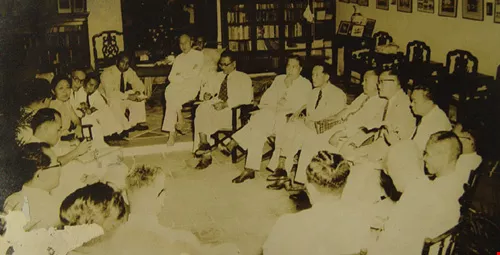
In 1955, talks were held between the leaders of the Malay and Chinese communities. The Chinese community leaders, bearing in mind the good of the whole nation, made some concessions on the status of the Chinese language. This gives some indication of how complex and intricate the issues of education and ethnic politics in Malaysia could be. (courtesy of the United Chinese School Committees Association of Malaysia)
Political prodigy
To fully tell the tale of the upheavals in the Malaysian Chinese Association in 1966 and Sim's expulsion from that association, we must go back to the start of the MCA Youth Corps in the 1950s and the organization's fight for Chinese to be recognized as an official language of Malaya, as the nation was known at the time.
While Malaya was still under the control of the British, businessman Tun (Sir) Tan Cheng Lock founded an organization designed to represent Malaya's Chinese population, the Malayan Chinese Association. Drawn to their goals, Sim joined the MCA in 1949, in their earliest days. In the two elections either side of Malaysia's declaration of independence, Sim was active in the drive for votes as a leader of the MCA's youth division.
In 1956 Sim was appointed a justice of the peace by the British colonial government. During the push for independence, Sim again set to work with the MCA, working alongside Malays and Indians in an effort to establish their own nation. In 1957 he traveled to America on an Eisenhower Scholarship, which was provided to leaders of Malayan youth to give them exposure to the American environment. That same year, Malaya declared independence, and Sim was made a Johan Mangku Negara (Defender of the Realm).
Despite all these achievements, Sim had still not forgotten what drew him to politics and the MCA in the first place-being able to use political means to further the development of Chinese education.
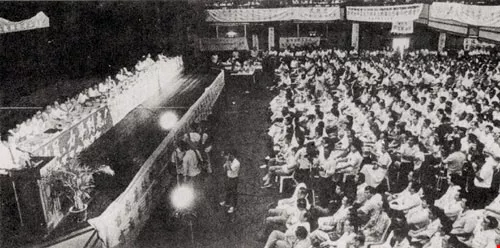
In 1971, the Malaysian Chinese Association initiated a "National Chinese Alliance" conference, as the community was desperate to try and save itself from the problems it faced culturally and politically. (courtesy of the United Chinese School Teachers Association of Malaysia)
Language movement
In 1951, Malaya's colonial government issued the Barnes Report, which recommended that English and Malay be the colony's two primary languages. At that time Sim was principal of the Melaka Common Elementary School, and he met with Lim Lian-geok, leader of the Kuala Lumpur Chinese Teachers' Association, to discuss how to unite Malaya's Chinese teachers and bring their power to bear on the political authorities. This meeting was the birth of the United Chinese Teachers Association, or Jiao Zong.
Sim closely watched the rise of Malay nationalism after independence, and the role of education policy in increasing emphasis on the Malay sector of society.
"A people's language is part of their spirit, and each ethnic group's self-worth is tied to protecting their mother tongue and heritage. There are a number of developed nations around the world which have elevated multiple languages to the position of official languages in an effort to satisfy the needs of their various ethnic groups," says Sim. Only 1% of Switzerland's population speak Romansch, yet it is recognized as an official language there. Chinese made up the largest single group in Malaysian society at that time, outnumbering even Malays, and Chinese had been used in the area continuously for over 500 years.
While Chinese educators fought fiercely for official recognition of their language, after Malaysia gained its independence, long-time resident Chinese families began to settle down and integrate rather than continue to identify themselves as citizens of the Republic of China. "Those Chinese considered themselves part of the Federation of Malaysia, and Malaysia doesn't permit citizens to hold dual citizenship," explains Hou Kok-chung, chair of the Institute of Chinese Studies at the University of Malaya and a researcher of issues of Chinese identity. The Chinese community at the time had no problem identifying with the country-rather, their problem was with the matter of adjusting their own culture to fit with a multicultural society.
Malaysian politics has always been driven by ethnic issues, including those of culture, and this has long been a heavy burden on the Chinese community, even leading to disputes within the community.
The original primary goal of the MCA was to have Chinese recognized as an official language, and prior to independence, leaders in the Chinese education field such as Lim Lian-geok laid aside their issues to work with the MCA in their election strategy. However, after independence localization began to speed up, and with a change in the leadership of the MCA, concessions started to be made, and the Malaysian government put the squeeze on Chinese schools through policy after policy.
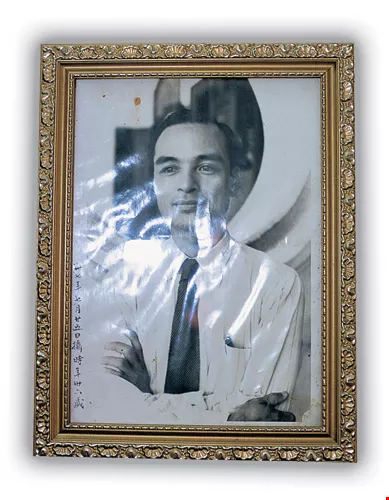
In his younger days, Sim played a role in the fight against Japan and in Malaysia's push for independence, and in the 1950s took a leading role in the political scene.
Give and take
To the MCA, being the second largest member of the Alliance (Malaysia's ruling coalition, made up of the United Malay National Organization or UMNO, which was the largest Malay party, along with the MCA and the Malaysian Indian Congress), national stability and ethnic harmony were prime concerns, in addition to protecting their own culture. The new leader of the MCA, Tun Tan Cheng Lock's son Tan Siew Sin, said that in a multicultural society, no single ethnic group can just do as they please-rather, there needs to be give and take. He believed the aggressiveness of Lim Lian-geok would lead to failure, because he failed to take into account Malaysian society and culture.
"'Give and take' is one of the defining characteristics of Malaysian ethnic politics," says Hou Kok-chung. The Dong Jiao Zong (made up of the United Chinese School Committees Association of Malaysia and the Jiao Zong), the representative organization of Chinese educators in Malaysia, made it clear it recognized the need for concessions, but where was the bottom line?
"There were constant rumblings about closing Chinese schools issuing from the upper echelons of the UMNO," recalls Sim. Sim was already disappointed at the ruling alliance's betrayal of their pre-independence promises to protect Chinese rights, as well as the MCA's constant concessions in their fight for recognition of the Chinese language. Year by year he watched as Malay grew closer to becoming the nation's sole official language, finally deciding that he "had to step forward and make a stand for my people."
In 1965 he and the Jiao Zong stirred up resistance amongst the Chinese community to the dominance of Malay, but Tan considered this a breach of MCA discipline and Alliance rules, and Sim was expelled from the association. Sim Mow-yu had served the MCA for 17 years and made quite a name for himself during that time.
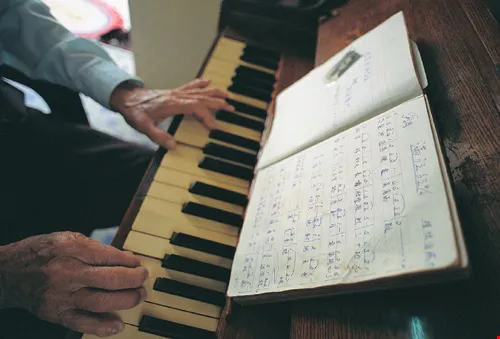
At age 93, Sim Mow-yu continues to play music and sing heartily, his words and music brimming with a cultural air that can move Chinese, both Malaysian and otherwise.
Expulsion
The decision to expel Sim from the MCA caused a furore in the Malaysia Chinese community. Emergency meetings of the MCA Youth Corps were held across the nation, and a number of association members canceled their memberships. "If the MCA had been able to latch onto that high level of public feeling and turn it on the government, they'd have certainly at least been able to improve the standing of the Chinese language, even if they couldn't completely turn it around," recalls Sim with obvious regret.
After his expulsion, Sim dropped out of the political scene, and instead dedicated himself fully to working with the Jiao Zong, continuing his fight for rights for the Chinese language through peaceful petitioning. In the late 1960s, calls for an independent Chinese university started to grow in response to the restrictions placed on Chinese students wanting to study abroad, and Sim started to focus on this new fight.
Malaysia held its third post-independence election in 1969, and thanks to the Jiao Zong's stance, the MCA's opposition to an independent Chinese university and the Chinese language movement as a whole lost it a great deal of support from the community. This resulted in the biggest loss in votes since the association's formation and a massive drop in morale, to the point where it seemed like the association almost couldn't function coherently.
In order to rebuild that morale, the MCA planned in 1971 to initiate a "National Chinese Alliance" movement. At the joint request of several community leaders, Sim eventually accepted the invitation of Tan Siew Sin to chair their conference.
During his speech, Sim set forth seven counter-proposals to a statement issued by the UMNO. The proposal included the following points: that all ethnic groups should hold equal status in the eyes of government, that language restrictions were a hindrance to national unity between ethnic groups, that all people should have equal educational opportunities, and that the government should not treat the poor of each ethnic group differently. This speech received thunderous applause, electrifying the conference.
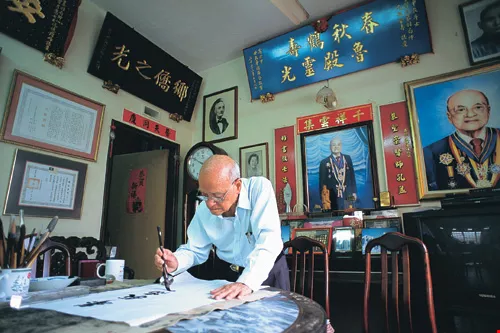
Sim Mow-yu's calligraphy has its own distinct style, which students from around Melaka have modeled their own work on. The concentration and immersion of self that Sim demonstrates through his calligraphy seems to give a window onto the persistence and fortitude that have characterized his life's work. ju/tr. by Geof Aberhart)
A "savior" incarcerated
According to Ho Khai-leong, the Malaysian Chinese community at that time was in dire straits economically, culturally, and politically, and deeply concerned about the need to preserve their heritage. This was particularly so after the May 13th Incident of 1969, when concerns started to peak and people began looking for a "savior" to appear. When Sim Mow-yu decided to step forward, hopes began to soar throughout the community, with some even chanting "Long live Sim Mow-yu!"
As expected, Sim's popularity with the people gave rise to serious apprehension in the government, leading to his being arrested along with another prominent Chinese leader, Gu Hsing-kuang, under the Sedition Act. Their case ran for two years, during which time they had to frequently be heard in court. Eventually the Malaysian authorities, fearing a reversal in public opinion, dropped the case.
In Sim's 28-year leadership of the Jiao Zong and their fight for Chinese education, the organization faced a number of obstacles. In their continuing attempt to unify the education systems of the country, in the 1960s the Malaysian government worked to reform the Chinese high school system. In the 1970s they blocked the creation of an independent Chinese university, and in the 1980s instituted a series of measures that led to a deterioration in the situation for Chinese elementary schools.
In 1987, the Ministry of Education began gradually assigning non-Chinese-speaking Malaysian Chinese to positions as principals and deputy principals of Chinese elementary schools. Feelings grew amongst the Chinese community that such schools were in grave danger, and Sim appealed to the community to pull together. Soon after, over 3000 Chinese educators from around the country gathered at a temple in Singapore for a protest, demanding that the Malaysian government listen to the will of the people and remove the non-Chinese-speaking principals and teachers. They also called for all Chinese elementary schools to go on strike.
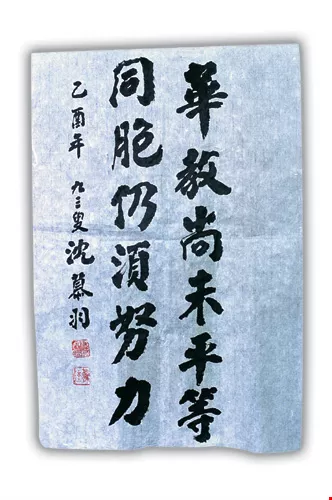
Sim Mow-yu's calligraphy has its own distinct style, which students from around Melaka have modeled their own work on. The concentration and immersion of self that Sim demonstrates through his calligraphy seems to give a window onto the persistence and fortitude that have characterized his life's work. ju/tr. by Geof Aberhart)
Jailed a third time
However, minority extremist groups seized on this opportunity, holding their own protests. The government, being placed under great pressure, passed the Internal Security Act and launched "Operation Lalang," arresting over 100 promoters of Chinese education, including Sim.
The 76-year-old Sim, along with three other leaders of the Chinese education movement, was placed in solitary confinement for 60 days, locked in a tiny room barely big enough for a single person, with a lamp shining down on him 24 hours a day. The room had no bed and only a single water pipe which provided both drinking water and toilet amenities. Every day he would be blindfolded, handcuffed, and led to court. He revealed to old comrades that during that time he even contemplated suicide, but when the thoughts came he would sing old songs from the anti-Japanese resistance, "The River Ran Red," or other morale-boosting songs to encourage himself on. But in the end, he managed to survive the long, hard days in solitary.
Sim's sacrifices for Chinese education over his 28 years as head of the Jiao Zong are widely known. Although he may not have been totally successful in reaching his ultimate goal, thanks to the struggle he and many other Chinese educators put up, Chinese education has made great strides in Malaysia, with a system now third only to those in China and Taiwan. And as times have become more liberal, tensions have eased between the Chinese community and the Malaysian authorities, and the country is starting to realize the dream of being truly multicultural.
Fertile ground
Although the few schools he has set up in Melaka are hardly the shining light of Sim's efforts in Chinese education in relative terms, they have proven to be a fertile development ground, as befits a "Confucian activist" such as Sim.
Flipping through the Seng Cheong Night School memorial album and seeing photos of Sim with class after class of graduates from his youth to his old age is like traveling through time. Sim writes that in 1933 he worked as a teacher after the founding of the Seng Cheong Night School, and from World War II he took on administrative duties, watching class after class spread their wings and fly-after 60 years in education, even his students' students have retired, so Sim has become a virtual great-grandfather of teachers.
Seng Cheong Night School has worked to promote the language and culture of the Chinese community. They primarily offer night classes to young dropouts and those in the Malaysian Chinese community who received English-medium education-the school could be considered one of the pioneers of adult education in the country. But over the decades the school has faced its share of ups and downs. In the late 1970s, when Chinese education was in great turmoil, Sim said that as long as there was a student to be taught, the school would continue its work-they would find a way to pull through. Now Seng Cheong Night School is the most famous private institution in Melaka, and possibly all Malaysia. Through the years they've even counted a number of Malays and Indians amongst those studying Chinese with them.
The pine in the snow
Sim retired from the night school at the age of 91. He continues to read a number of newspapers, write in his diary, and practice calligraphy every day, as he always has. He has kept a diary continuously for over 40 years, and in recent years the Chinese community has actively worked to raise funds and have his diaries published, calling them a peerless resource for studying the people, history, and ideas of Malaysia's Chinese population.
Every weekend, Sim teaches an advanced calligraphy class at the local Confucian hall. When asked how he keeps so healthy, he laughs and says that the breath control involved in calligraphy is the best form of exercise. Despite his lifelong dedication to the public good and his defiant stand against the powers that be, Sim hasn't neglected his own children's education, with two of his nine children gaining professional training and dedicating themselves to educational and cultural work in the Chinese community in Malaysia.
In Malaysia's History and People, Chu Hung-yuan, a research fellow at Academia Sinica's Institute of Modern History, writes about Sim's staunch lifelong dedication and contributions to the preservation of Chinese culture and traditions, which have now, in his twilight years, been recognized and rewarded by Taiwan and China. Even the Malaysian government, which continues to promote policies of assimilation, has had to acknowledge the contributions to the nation Sim has made. In 2000, at the suggestion of Prime Minister Mahatir bin Mohamad, the governor of Melaka conferred upon Sim the title of Datuk.
"Don't learn from the willows in the wind, learn from the pine in the snow." "A man willing to suffer hardships and losses for the sake of virtue is no fool." Reading comments like these, written in Seng Cheong Night School's memorial book in Sim's vivid calligraphy, one can easily find oneself drawn in completely. Sim's kind words and constant supportiveness may seem at odds with modern values, but they are exactly what make him such a valuable and unique part of our times.


@List.jpg?w=522&h=410&mode=crop&format=webp&quality=80)


