The people who do funerals, reading from the sutras and ritually correct in every way, often lead one to assume that the funeral societies that arrange everything must be part of a venerable profession passed down through the ages. In fact, in Taiwan it is a "newly rising industry" which has been around less than half a century. And it goes by a rather inapropos name: "extreme joy."
Prior to retrocession in 1945, No one in Taiwan worked for "funerary societies." Funerals were run by the family, usually with the head of the family directing the procession, while other family members and close friends would help out with the arrangements.

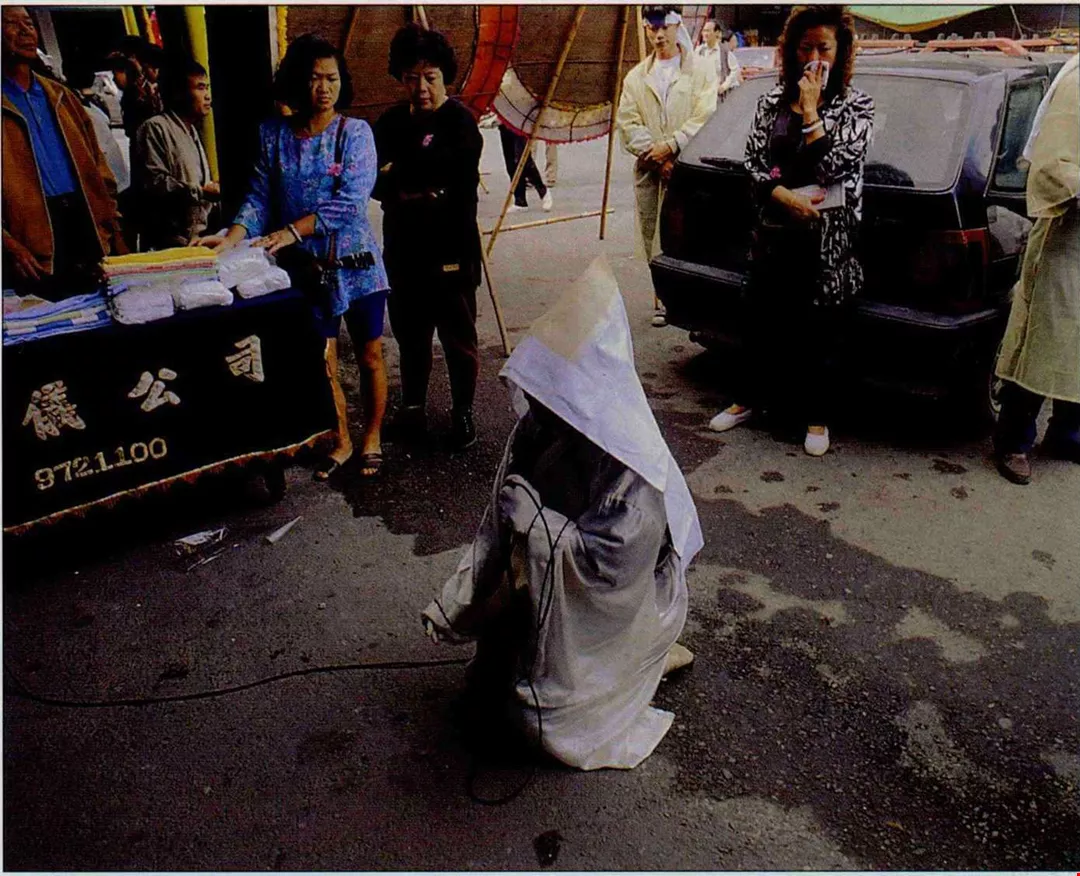
Funeral homes handle all matters large and small; they can even find a "filial daughter" to help the family fully express its filial obligations.
Death finds a salesman:
Before that time, the Japanese who ruled Taiwan set up a "funeral hall" in what is now Linsen Park, providing it to the citizens for memorials and funerals. After the ceremony, the deceased would be immediately sent to the crematorium on what is now the corner of Hsinsheng North Road Section 2 and Changchun Road.
After retrocession, You Mi-chien became mayor of Taipei in 1948. He had in his early years travelled and worked in the mainland and become very interested in the funerary societies, found in Shanghai and other large cities, that would arrange funerals for people. He felt that this service could also be brought to Taiwan. After becoming mayor, he made a special trip to Shanghai and, through an introduction by the Shanghai Funeral Society Association, hoped to find someone willing to come to Taiwan to pioneer the profession here.
At first, it wasn't easy to find people to work for him. Few people living in Shanghai's fast-paced world were willing to go to a strange, remote land. Finally You Mi-chien found Chien Tsung-fan, who operated the "Ascend to Heaven Funeral Hall," only then opening the book on the funerary profession in Taiwan.
Boss Chien was part of a secret society and was quite intelligent. He saw that Taiwan might be an excellent market, so he brought along masters of all of a funeral's "affiliated industries," including monks, Taoist priests, carpenters and wood carvers, painters, and makers of incense and of symbolic gold and silver paper money. He gave each of them a substantial payment to insure financial security for their families, and then--more than 100 strong--they imposingly crossed the sea to Taiwan to open a new world.
Chien finds a niche:
After Boss Chien came to Taiwan, Mayor You turned over the former Japanese funeral hall to him. The name was changed to the "Shanghai Extreme Joy Funeral Hall." It formally opened on October 16, 1949.
At that time Extreme Joy had a monopoly, but because local customs were different, very few Taiwanese knocked at his door, and some were even quite unhappy about the idea of someone doing "dead man's business." The large sign that Extreme Joy had set up on Nanking East Road was often put up in the morning only to be torn down by nightfall. Unable to cope with the interference, Extreme Joy had no choice but to take it down for good.
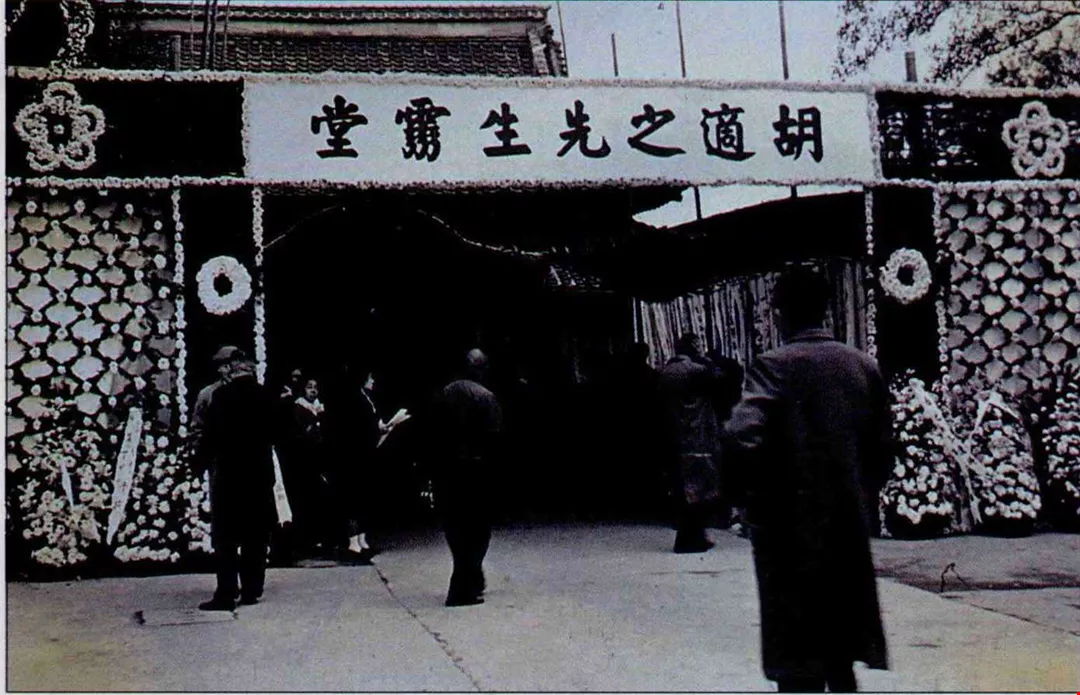
Extreme Joy may not have been popular among Taiwanese, but it did manage most of the funerals for important people who had come from the mainland. Mr. Hu Shih-chih died in 1962, and his funeral was handled by Extreme Joy. Taipei natives who are now middle aged certainly have memories of the splendid affairs when the highly regarded scholar was buried, and the roads were closed off for the procession from the funeral home all the way to Nankang. The esteem in which Extreme Joy was held at its peak is reflected in the words of a former employee: "The late president [Chiang Kai-shek] would come several times a month."
Still, what comes around goes around. Extreme Joy's success attracted attention, and it moved step by step toward its own demise.

The Extreme Joy Funeral Hall had its days of glory, and many well-known figures had their final rites here. The photo is from the funeral of Mr. Hu Shih. (photo courtesy of the Hu Shih Memorial Hall at the Academia Sinica)

Going to Extremes:
It is said that around the early 1960s, a certain leading figure in the government and party passed away, and his funeral, as was customary, was turned over to Extreme Joy. Concerned about the arrangements, the late president inquired as to the cost of the coffin, and the person he asked responded (deliberately or not, who knows?) by stating the expense of the entire funeral. Upon hearing the answer, the late president was appalled and felt that Extreme Joy was making windfall profits; this was an important reason why Extreme Joy was forced later to close its doors.
In his "Two Supplementary Essays on the People's Livelihood and Recreation," President Chiang Kai-shek stated, in order to insure that the people's funeral arrangements would go without worry, that every locality should have a publicly funded funeral hall. This discussion later became the starting point for the construction of funeral halls in the Taiwan area, and also meant that Extreme Joy would no longer be able to monopolize the market. In 1952, Taipei City provisionally set up a simple funeral hall. Then in 1968, the Taipei Municipal Funeral Hall was constructed. The national elder Yu You-jen was the first whose funeral made use of that hall.
After the establishment of the public funeral homes, funerary societies large and small, copying the style of Extreme Joy, popped up like mushrooms after a spring rain. Traditional local operators in this line also followed the herd and held funerals in that fashion. Extreme Joy faced intense competition, and Boss Chien steadily shifted his capital into other areas. In 1971, after the city government tore down the hall in the name of clearing away illegal construction, Extreme Joy passed away into history.
Struggle for business:
The Extreme Joy Funeral Hall came to its end in the early 1970s, which was just when Taiwan was entering its economic take-off. People were busy making money, and had less and less time to take care of family funerals on their own. As a result a large number of funerary societies appeared, becoming an essential new "service industry" of the time.
According to estimates of the Office of Funerals of the Taipei City Government, in Taipei City alone there are more than 200 funerary societies, counting the illegal as well as registered ones. To beat the competition, operators have countless strange tactics and unusual approaches, some being better than others.
For some companies, in order to win business, they have invested a great deal of capital, and, on the basis of the logic that "lamb's wool grows on the body of the lamb," they routinely get the money back from the family of the deceased.
"The more 'flower vehicles' [trucks with strippers, a common part of funerals], dramatic troupes, and other participants there are in the procession, naturally the more the funerary society earns," points out one operator who has been managing funerals for over 40 years. Orthodox and honest operators are pained at such spectacles but find it hard to end the absurdities.
With the "Business of Extreme Joy" having developed to its current level, were Mayor You to be able to see from the grave, he would certainly be shaking his head!
[Picture Caption]
p.24
The funerary societies have all the funeral accoutrements you could imagine. Even if they are only used once, one must still select the best.
p.25
Funeral homes handle all matters large and small; they can even find a "filial daughter" to help the family fully express its filial obligations.
p.26
The Extreme Joy Funeral Hall had its days of glory, and many well-known figures had their final rites here. The photo is from the funeral of Mr. Hu Shih. (photo courtesy of the Hu Shih Memorial Hall at the Academia Sinica)