"Mountain, Water, & Lantern of the Heart"--The Taiwan Pavilion
Lin Hsin-ching / tr. by Scott Gregory
May 2010


The World Expo, held once every five years, is sometimes known as "the Olympics of architecture." That's because, among the festivities, architecture is one of the most powerful forms of visual expression. The buildings take on the important mission of conveying each nation's values to visitors.
Facing the largest ever World Expo in Shanghai, nations are biting the bullet and spending large sums of money to build their pavilions even in the aftermath of the 2008 global financial crisis. Not only do they hope to sell their nations' image during the exposition, they also hope to pave their way to the China market.
For Taiwan, taking part in the expo has the added meaning of being a return to the international stage. This time, the Taiwan Pavilion takes as its theme the sky lantern, combining a depiction of everyday life, traditional culture, touching warmth, and wishes for world peace.
Taiwan's pavilion will be small and its capacity for visitors will be limited, so its chief architect C.Y. Lee specially proposed the concept of "architectural media," in which architecture serves as a dazzling multimedia stage. Even visitors who can't enter will be able to see it from afar and enjoy the light show on the glass walls of the "lantern," leaving a good impression of Taiwan in their hearts.
At this year's expo in Shanghai, Zones A, B, and C in the Pudong area are the main focus of attention. There will be 73 pavilions of various countries and international organizations.
Among the major contenders for visitors' attention will be: Saudi Arabia's RMB1 billion (NT$4.8 billion) "Silk Road Treasure Boat" (also known as the "Moon Boat"); the UK Pavilion, "Seed Cathedral," which breaks the stereotypes of British conservatism and reserve and is themed around a dandelion made of 60,000 seven-and-a-half-meter-long acrylic fiber-optic rods; and the Spanish "basket" constructed from 8,524 hand-woven wicker panels in a skirt-like streamline shape that looks especially graceful in the sunlight.
As for Asian nations, Japan's "Purple Silkworm Island," which combines cartoon-like style with advanced eco-friendly construction, is not to be missed. There is also Korea's pavilion, which emphasizes traditional culture and the beauty of the Korean script. Of course there is also the one the whole world will be looking to, China's, which is inspired by dougong interlocking brackets as seen in traditional Chinese architecture. This "Crown of the East" overlooks the entire site.
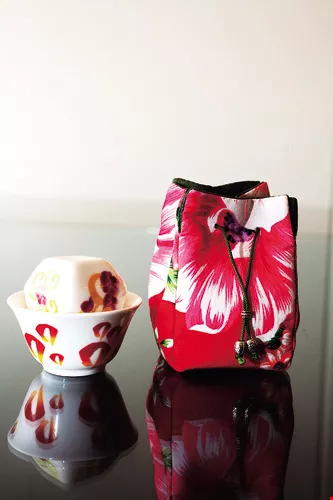
Souvenirs from the Taiwan Pavilion-a sky-lantern teacup and a bag made of Hakka floral-pattern fabric.
Due to special restrictions from the Chinese authorities, Taiwan's pavilion contrasts with most of the others, which rely on governmental funding and cover 6-7,000 square meters. Taiwan's only covers 658 square meters on a 1,400 square meter exhibition space. It's only slightly bigger than those of Hong Kong and Macao, which have around 1,000 square meters of floor space each. But it's located right next to China's, the largest in the park, and Taiwan only signed on in July of last year. With limited time and funding, how could the Taiwan Pavilion make a splash? That was the thorniest problem for its planners.
According to Wang Chih-kang, chairman of the Taiwan External Trade Development Council (TAITRA), the limited size of the pavilion means that only an estimated 700,000 visitors will be accommodated over the six months of the expo. That equals only one out of every hundred expo attendees will be able to visit it.
But on the other hand, Taiwan's pavilion has a good spot at the entrance to Zone A beside the Expo Axis. That means that all expo attendees will have to pass by it.
"Because of this, we decided early on that Taiwan's pavilion would have to be 'small but bright,' and that the exterior would have to be as attractive as the interior," Wang says. "Even if visitors can't make it inside, they'll be wowed by the sight of it."
C.Y. Lee, who 40 years ago took part in the planning of the Republic of China Pavilion for the World Expo in Osaka, Japan, proposed the theme "Mountain, Water, & Lantern of the Heart" for the Taiwan Pavilion. This was chosen by TAITRA as the most apt theme.
Comparing his two experiences with the expo, Lee says that the first, with its team led by famed architect I.M. Pei and modernist, geometrical "hanging garden" theme, broke away from the classical, "palatial" styles of past Chinese pavilions and was quite well received.
"But pavilions of the past were for the most part 'boxes' to show off the country's treasures," Lee says. "The focus was mostly on the outward appearance and the construction method, and there wasn't much call for considering how the exterior of the building and the content of the exhibition went together."
However, having seen 40 years of convergence of architecture and conceptualizations of leisure, the World Expo is now like a large-scale theme park. Most countries' pavilions make great use of multimedia elements and 3D or even 4D theaters in the hopes of giving visitors the most interesting and memorable experience possible within the limited time available. For this reason, architects designing such a project have to consider whether the "outer wrapping" and the "inner meaning" go together.
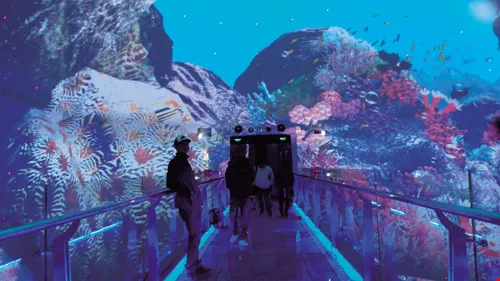
Images from the 720-degree, 4D immersive theater make you feel like you are really in the middle of the scene.
In order to meet these requirements, as soon as bidding opened for the project, C.Y. Lee and renowned adman Jerry Fan teamed with Taiwan's most prominent 3D theater designers YAOX Edutainment to develop the "Mountain, Water, & Lantern of the Heart" concept.
With the team's bubbling creativity, the Taiwan Pavilion design tightly integrated architectural design and multimedia performance. The final product presents viewers with two major themed elements: an L-shaped building with a mountain theme featuring outlines of the ridges of Yushan, Alishan, and Yangmingshan; and a "glass sky lantern" that not only represents local culture but also functions as a multimedia display. The following are three key features:
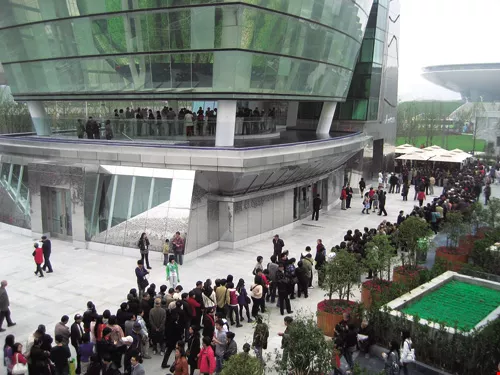
The expo held a "trial opening" on April 20 for 200,000 visitors. The Taiwan Pavilion was a big hit, with people lining up for three hours to get in.
The sky lantern, which looks like a crystal encompassing a pearl, changes unexpectedly in appearance with time and viewing angle. Its wonder can be seen in layers:
Layer one, the outer layer, is the sky lantern screen. It is made of 854 pieces of glass of various sizes that are covered with a "smart film" developed by Chyun Hang Technology Development. The total surface area of the film is around 15,000 square feet. By changing the electrical current running through it, it can be set to various modes such as transparent, fogged, and semi-transparent.
The second layer, the "sky lantern globe," weighs 1.3 million tons. Its surface is covered with 1 million LED lights provided by Opto Tech Corporation that act as a giant video screen to show all sorts of images. This is a "window on Taiwan" for visitors.
The creators also placed 18 projectors between the glass screen and the LED globe. The projected images interact with those on the globe's screen and go along with the changing opacity of the outer wall's smart film. The images come together dynamically and bring the Taiwan Pavilion to life.
The images on the surface of the globe and the glass screen were designed for TAITRA by YAOX Edutainment, Fanghe Advertising, and the National Palace Museum. Their three themes are "breathing buildings," "Taiwan's riot of color," and "treasures of China," and they include the cityscape of Taipei, butterfly orchids, bicycles, computer chips, Yeliu's "queen's head" rock formation, a street with shops full of traditional Lunar New Year goods, streams of traffic, Tzu Chi volunteers, excited baseball spectators, and National Palace Museum holdings such as a seventeenth-century world map and the famed Song-Dynasty painting Along the River During the Qingming Festival. One by one, these appear, and from time to time 3D butterflies even fly out from the LED screen to rest on the outer glass wall or the train from Alishan makes its way around.
"The Taiwan Pavilion's programming not only changes from instant to instant, it's even better at night than during the day," says Wu Ju, the Taiwan Pavilion programming producer and YAOX general manager. "It's sure to stop passersby in their tracks!"
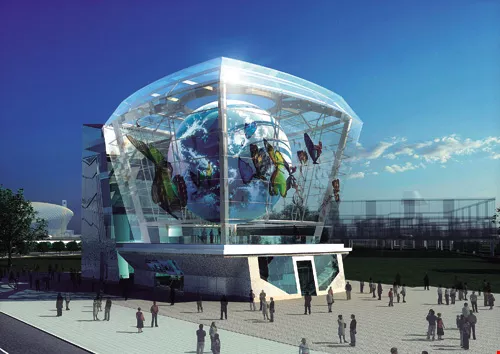
One of the highlights of the Taiwan Pavilion, which is based on the shape of a sky lantern, will be the interactions between images shown on its outer wall and on the surface of its LED globe. Three-dimensional butterflies will even appear to fly out from inside.
The dazzlingly lit globe in the center, which is 12 meters in diameter, has a surprise inside as well.
Ticket-buyers take an elevator up four floors to enter the globe to see a presentation on an 8k digital-video, 720-degree dome screen in 4D (1k is 1024 x 1024 pixels, 8k is 8192 x 8192 pixels; "4D" is 3D with added sensory elements).
According to Wu, the worldwide success of the 3D film Avatar has led many pavilions, including Germany's pavilion and the SAIC-GM "Drive to 2030" pavilion, to imitate it and use 360-degree dome theaters as selling points. However, only Taiwan's has a completely immersive theater, and moreover the resolution of the video is higher-more than six times those shown at the Expo in Aichi, Japan, five years ago.
"The special thing about the spherical screen is that images can be projected onto it horizontally and vertically for a total of 720 degrees," says Wu. She adds, confidently, "When viewers stand on the bridge that crosses through the theater, the 12 projectors and eight-channel sound system provide them an auditory and visual experience from all directions-it's something that most people have surely never experienced before!"
The immersive film that is shown was directed by the famed Taiwanese documentarian Lai Fong-chi. He took "the natural city" as his theme for the four-minute-long film, which shows beautiful cityscapes and expresses the hopes of the Taiwanese people to live in harmony with nature.
The film begins from the vantage point of outer space, looking at the Earth. The camera moves to East Asia, then to Taiwan. It zooms in on the sea of clouds around the peak of Yushan as the sun rises and sets, then it cuts to the untouched forest of Alishan, with native animals like sambar, Formosan clouded leopards, and Swinhoe's pheasant darting through it. Then, moving to lower elevations, it shows delicate orchids, flitting butterflies near a stream, and a pool of blooming lotuses in the summer sun.
The marine environment is another part of Taiwan's natural beauty that can't be left out, so the film takes viewers to the bottom of the ocean to watch tropical fish play and witness the magical moment when the coral spawn. Then the camera returns from nature to city life, and viewers take a seat on the MRT for a tour of Taipei. They can also bathe in a beautiful sunset at Kaohsiung Port. Finally, they fly upward with the sky lanterns.
Lai says that the most special part of the immersive theater is that the picture has no "frame" around it. That makes the audience feel a part of it, floating within the scene. The feeling of the ambience is powerful.
The other special characteristic of the film is that it is in "4D." That's 3D with added sensory elements. "When the film shows the forest or orchids," Lai says, "there is the scent of cedar or orchid. When the audience sees dolphins jumping in the water, they actually feel the ocean spray, too. It's really fun!"
3. Sky lanterns and cups of teaAfter the audience has been wowed by the Taiwan Pavilion's multimedia show, it can experience the quintessential Taiwanese activity of lighting a sky lantern.
Of course, due to safety considerations, the "sky lantern lighting ceremony" is replicated by computer animation, but the pavilion's designers have kept a fine eye to detail so as to give an authentic experience.
First, the sky lantern platform has two concentric pools, with water from the Pacific Ocean in the outer ring and from Sun Moon Lake in the inner ring. In the center of the pool is a piece of the type of rose stone found on Yushan. Visitors lighting lanterns feel as if they were really among the natural wonders of Taiwan.
The pavilion takes 40 visitors at a time, and at the 40 lighting stations with touch panels they can choose from 12 blessings for their lanterns. The blessings, which were selected by online poll, include messages such as "Prosperity to the nation and peace to the people," "To a bustling economy," and "Travel the world." When they press the button, the lantern is projected onto the LED globe and flies upward. It's a satisfying virtual experience.
After the sky lantern lighting ceremony, visitors come to the end of their experience at the Taiwan Pavilion. Their last stop is a city square, which is formed out of a large tree woven from bamboo by craftspeople from Nantou. As visitors come together to "cool off" under the tree, they are served tea from Alishan by 16 "friendly ambassadors" chosen from 2,137 applicants. Once they've finished their tea, they can take the sky-lantern-shaped cups home with them as souvenirs-a souvenir of Taiwanese hospitality.
"In just 20 minutes in the Taiwan Pavilion, visitors can get a good impression of Taiwanese technology, culture, and friendly attitude," says Wang with a smile.
"Taiwan is big because of its heart" is this year's touching slogan. It captures a sense of the nation and the pavilion. Despite limited time and space, Taiwan's team pulled it off, and the "Mountain, Water, & Lantern of the Heart" will be a burst of radiant light on the expo stage!


