Fabricating a New Future:Taiwanese Textile Investment in ASEAN
Coral Lee / photos Jimmy Lin / tr. by Phil Newell
July 2009


It's not news that much of Taiwan's textile industry has relocated to mainland China and Southeast Asia. But in the past it was mainly a case of ready-made garment manufacturers (who imported materials and just did processing) or makers of cloth on a large scale, whereas the most recent wave of investment in ASEAN countries has involved Taiwan's strongest firms bringing over knitted-fabrics manufacturing with high technical barriers to entry. And now people are beginning to worry about the most upstream contributors, chemical fiber makers-will they make up the next wave of emigrating companies?
From another angle, some scholars estimate that ASEAN+3 will put in jeopardy 12,000 employees out of the 200,000-job textile sector in Taiwan. (This is an argument in favor of Taiwan and mainland China signing an economic cooperation framework agreement, since Taiwan's domestic textile industry will be the greatest beneficiary, creating less pressure to relocate to ASEAN.)
When all is said and done, what will be the gains and losses to Taiwan's textile sector-one of the nation's main earners of foreign currency-from ASEAN's economic integration? As Taiwanese firms aggressively stake out territory in ASEAN, what can Taiwan do to make the best of the current situation?
It is late May in steaming Ho Chi Minh City, and that means frequent intense afternoon thunderstorms. The energy unleashed in these slashing downpours has something in common with the pace of Vietnam's economic development in recent years: both are breathtaking. Dong Nai Province, located about an hour's drive northeast of Ho Chi Minh City, is well known for its dense concentration of Taiwanese firms. And in next door Ba Ria Vung Tau Province is the My Xuan A2 Industrial Park, only recently developed but now sharing a similar status. Six years ago Yangming Marine Transport decided to develop My Xuan Harbor, drawing numerous Taiwanese firms, and in May of 2009 Taiwan's number-one knitted fabrics powerhouse, Eclat Textiles, opened its newest factory here.
Eclat is the main supplier to well-known sportswear labels like Adidas and Nike. It specializes in the development and manufacture of materials with specific properties (e.g. anti-bacterial, sweat-transporting) or functions (e.g. cycling attire). In recent years, in response to demands from brand names for comprehensive outsourcing, Eclat has gone in for vertical integration, incorporating more downstream firms, in order to provide a "one-stop shopping" service to clients that will include everything from making the fabric to designing the product to processing the ready-to-wear outfits. In its global strategic deployment, ready-to-wear garment manufacturing is located in Cambodia, Vietnam, and Lesotho (in Africa), but the core knitting and dyeing-and-finishing plants (four in all) have always remained in Taiwan.
In 2007, Eclat altered its investment strategy. The change, it turns out, was in response to the new challenges posed by ASEAN integration, creating an opportunity for Eclat to grow stronger and upgrade.
"All of our knitting machines have their own 'private room,'" says Henry Chen, operations manager at Eclat Fabrics Ltd. (Vietnam), as he takes reporters on a tour of the US$40 million plant that does everything from knitting to dyeing and finishing. In the six-meter high space, machines from famous makers in Germany and Japan are set in rooms separated by transparent barriers. On the left- and right-hand walls of each room are each hung 48 spools of yarn, while spools of elastic yarn are hung in a circle around the machine itself-whose shape calls to mind a flying saucer-which is located in the center of the room. Strands from the three locations (the two walls and the circle of elastic yarn spools) are continually woven into a long sheet of "gray fabric" (undyed cloth is generally called "gray").
Henry Chen explains that in order to preserve the flatness and elasticity of the material, each "private room" must be maintained at a humidity of 65% and a temperature of 25°C. The rooms are separated to prevent contamination from one machine to the next (for example having a colored yarn machine contaminate a gray fabric machine).
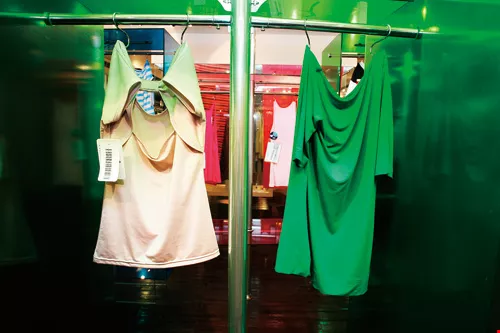
In the face of intense competition in the world textile industry, Taiwanese firms need to upgrade all links in the production chain and come up with a new generation of textiles in order for major manufacturers to be able to stay in Taiwan and grow sustainably. The photo shows the sample room of the Eclat headquarters in Taipei.
A dyeing craft
The process in the dyeing-and-finishing plant is far more complicated. Dyeing is divided into two main types: yarn dyeing and cloth dyeing. For the former, spools of yarn are first loosened by a special machine to allow the dye to spread evenly. Then several spools are slipped onto a stainless steel frame (30 or 40 spools to a frame) and are plunged into an enormous vat. In a procedure controlled from a computer, dye is added and the temperature is set; after the dyeing itself the process is completed by hydro-extraction and drying.
Don't get the idea that dumping color on stuff is some kind of primitive industry! In fact dyeing-and-finishing is an essential link in the textile-making chain, and there is a great deal of craftsmanship and skill involved. "Take two vats with the same water temperature and dyes, and two different people will produce two different results!" says Cheng Kai-fang, deputy director of the Department of Industrial Information and Services at the Taiwan Textile Research Institute. Because the process cannot easily be standardized, each batch of material will come out differently (in terms of qualities like luster, evenness of color, and texture) depending upon the controls imposed on the nature and quality of the material, the tensile strength of the yarn, and other conditions. The experience and know-how of dyeing masters in Taiwan has long been one of the critical factors allowing Taiwan's textile industry to remain so competitive.
A dyeing facility on the scale and specifications of Eclat's is a definite standout in a country like Vietnam, where textile technology is still rather backward.
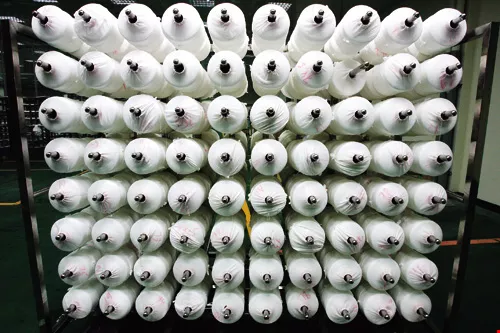
In recent years Taiwanese textile firms have been moving investments in mid- and upstream operations to ASEAN countries. Firms are simply responding to commercial incentives, but the question arises as to whether their choices will damage Taiwan's textile industry as a whole. The photo, taken at Eclat (Vietnam)'s plant, shows loosened yarn ready for dyeing.
Grabbing for the ASEAN market
C.H. Hung, CEO of Eclat Textiles, says that aside from the well-known consideration of lower labor costs (workers' wages in the Vietnam dyeing plant are one-fifth those of employees in factories back in Taiwan), there are two main reasons why he brought core operations to Vietnam: nearness to the market, and ASEAN integration.
"Our textiles are marketed to Cambodia, Thailand, Singapore, Indonesia, and mainland China. With the trend in recent years toward shorter and tighter delivery schedules, Vietnam naturally has several advantages-it is close to our customers, we can use inexpensive overland transport, and there are no customs duties between ASEAN member states." He adds that because knitted fabrics produced by ASEAN countries are of uneven quality, Eclat has gotten quite a few new orders in recent years. Since there is not enough production capacity in Taiwan to meet these new orders, it has been necessary to add new production locations, even for core operations.
"Right now the scale of Eclat's Vietnam factory is already equivalent to the total of all four Taiwan plants. In the current [first] phase, production capacity is 600,000 kilograms, about the same as in Taiwan. When the second-phase lines get underway, production capacity will increase to twice that of the parent factories in Taiwan." Moreover, Formosa Plastics Corporation set up a chemical fiber plant in Vietnam way back in 2000, so there is no shortage of upstream materials, which is like (as a Chinese saying has it) "putting wings on a tiger"!
Eclat expanded to build new production facilities overseas rather than "relocating" equipment or production capacity out of Taiwan, and moreover its corporate headquarters remain in Taiwan. But from a Taiwanese perspective, you can't miss the fact that by conservative estimates, over the past five years, in response to the ASEAN+N situation, listed or OTC-traded chemical fiber and textile companies have invested in ASEAN countries. How can Taiwan's own export competitiveness remain unaffected when major firms are moving cutting-edge operations abroad?
According to statistics from the Taiwan Textile Federation and Taiwan Weaving Industry Association, fabrics have long been the main component of Taiwan's textile exports, accounting for 60% of textile sales abroad over the last five years. In 2008, of total textile exports of US$10.9 billion (out of a production value of NT$446.8 billion), fibers accounted for 10%, yarn for 20%, and fabrics for nearly 60% (ready-made clothing and miscellaneous items accounted for the remaining one-tenth).
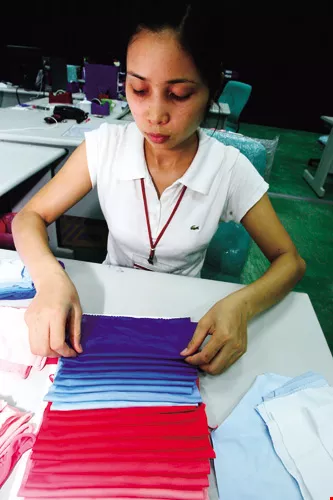
In response to the different water quality in Vietnam, Eclat has had to construct from scratch a new dyeing database-an enormous undertaking. The photo shows a worker handling some sample cloth that makes up part of the database.
Vertical integration
Within the fabrics category, materials with high technical barriers-knitted cloth and special-use fabrics-account for over 60% of the total export value. These mainly go to supply high-grade cloth to ready-to-wear clothing makers in Asia.
"The competitiveness of Taiwanese cloth comes from its vertical integration with the mid- and upstream sectors," says Chiu Sheng-fu, director of the Department of Industrial Information and Services at the Taiwan Textile Research Institute. "From polyester chips, spinning, and yarn formation to the making of cloth itself, Taiwan firms do very fast, high-quality work, creating extremely high added value." In contrast to mainland China, Taiwan has a very solid foundation in the petrochemical industry, which has been making chemical fibers of high quality in large quantities, providing a powerful impetus driving development of the industry as a whole.
Of the four major chemical fibers, Taiwan's real strength is in nylon fiber, which has a high unit cost. Taiwan is three to five years ahead of the mainland in the technology for long-fiber spinning and textured yarn. As for short fibers, on the other hand, as a result of rapid growth in the mainland, most Taiwanese firms have already moved production overseas.
The ingrained practice of Taiwanese companies of working together to create collective competitive advantage is precisely the reason why Eclat has been getting a continuous flow of orders for knitted fabrics from ASEAN countries. It is also the reason why Taiwan has been able to maintain high exports of textiles for so many years, keeping always a step ahead of mainland China, which is in hot pursuit.
But how long can Taiwan maintain its advantages of up-, mid-, and downstream unity and responsiveness to the market? Will the textile industry agglomeration that is evolving in Vietnam be able to catch up to Taiwan?
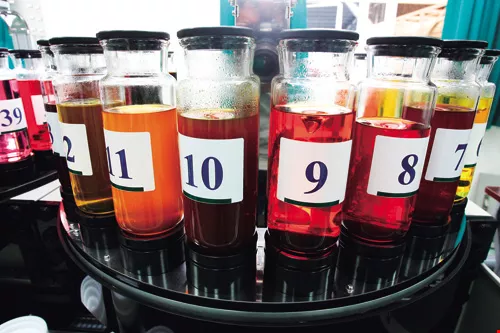
Dyeing and finishing involves a great deal of craftsmanship and skill, and has long been a key factor allowing Taiwanese textile firms to keep a step ahead of the competition. The photo shows automated dye-dripping machines in the "samples room" at Eclat (Vietnam).
Critical mass
As long ago as 2001, the Vietnamese government set out a program to raise the competitiveness of the country's textile industry, with a goal of sharply increasing self-sufficiency in raw materials by 2010. The government created incentives for foreign firms to directly invest in mid- and upstream operations like fibers, fabric making, dyeing and finishing. So long as the investment is in new equipment or new technology, investors will receive special benefits, with the hope being that Vietnam can reach self-sufficiency of 75% in major raw materials like chemical fibers and cotton by 2010 (the current level is 25%).
Although it will be difficult to achieve such a high self-sufficiency target in such a short time, it cannot be denied that many mid- and upstream enterprises from around the world have found Vietnam attractive for investment. Such firms include Pamatex Berhad of Malaysia, Daewon of Korea, and Taiwan's own Formosa Plastics.
Let's look at the case of Formosa Industries Corp., part of the Formosa Plastics Group. For their new factory-a capital commitment of NT$10 billion-they chose the Nhon Trach Industrial Park in Dong Nai Province. The project includes a power station and textile plant, with a complete series of operations (long fibers, short fibers, spinning, yarn formation, knitting, dyeing and finishing) on the textile side.
Moreover, changes in the global trade environment have also caused major firms to turn their eyes to ASEAN.
In 2005, under the leadership of the World Trade Organization, the 30-year-old "curse" of the textile trade-the quota system-was dissolved. With the loss of their protective umbrella, ready-to-wear clothing manufacturers around the word entered into a no-holds-barred war of all against all. Vietnam, following its entry into the WTO in 2007, was therefore even more attractive to investors.
Makalot Industrial Co., one of Taiwan's blue-chip listed textile firms, used to have nine or 10 centers of production scattered around the world. With the demise of the quota system four years ago, there was no longer any need to scrounge around for quota shares, and the company has already closed its factories in Central America. Now it is it concentrating its energies on five Asian locations.
Makalot spokesperson Wang Tay-chang says, looking at the two most important inputs of this industry-raw materials and manpower-Asia is still the region with the most to offer. And when you see that everybody who is anybody in Taiwan's textile sector is in Vietnam by now, there should soon be a "critical mass" effect, and it is by no means impossible that Vietnam will become, after mainland China, the second most important overseas bastion for Taiwan's textile firms.
One giant production base
"ASEAN integration means companies can wander freely through the region. Each of the 10 member states has its own advantages, creating one enormous production center!" enthuses Kang Shu-teh, senior manager at Tuntex Textile (Thailand), which invested in Thailand in the early 1990s and now has the third-largest cloth making operation in the country. The key considerations in corporate investment decisions, he reminds us, are access to raw materials, markets, and human resources, and each country in ASEAN has its own assets. If you enter any one of these states, it is like getting a regional travel pass-you can utilize the resources for which each given country has a competitive advantage and thereby make the most competitive product possible.
Kang, who came to live in Thailand in his teens when his father moved here and who speaks Thai fluently, offers Tuntex's ASEAN deployments as a case in point. The material in the men's suit pants they produce is 100% long-fiber cloth, and therefore the factory has been set up in Thailand, where textile technology is more advanced. Ready-to-wear clothing operations, on the other hand, are situated in Indonesia and Vietnam, where labor is abundant. They have also recruited managerial personnel from Malaysia to help manage in Indonesia, since both countries share an Islamic heritage. But because no country in ASEAN has the right conditions to produce long-fiber yarn, the most basic input, production remains at the parent plant in Taiwan.
Leaving Taiwan to help Taiwan
In sum, a number of shifts in the economic environment-incentives offered by national governments, the dissolution of economic barriers among ASEAN members, the demise of the quota system, and so on-have created the conditions for enterprises from around the world to flock to ASEAN. Yet the Taiwan firms that have long been giving it their all abroad have never forgotten their original vision: the goal of relocation of branches of the firm is to make the roots back in Taiwan even more stable and enduring.
Take Eclat for instance. They set up a cloth factory in Vietnam in order to diversify and raise the competitiveness of the corporation as a whole. They took knitted fabric production, which has low profit margins and low barriers to entry, out of Taiwan and moved it to Vietnam, while leaving the kinds of textiles that have high unit prices, small and diverse production runs, and short delivery times in Taiwan. For the company's core cloth-making business as a whole, this is a kind of horizontal integration, allowing more flexible allocation of resources.
The success story of Tainan Spinning Co., a historic 50-year-old firm that came to invest in Vietnam 12 years ago, provides even stronger evidence of how the "children working overseas" support the "parent" back home.
At that time the firm found that it was unable to compete with mainland China's high-volume low-cost yarn formation, so they moved all the equipment in an entire yarn plant to Vietnam, while the parent firm kept the upstream chemical fiber plant as well as other yarn production facilities in Taiwan.
To everyone's amazement, this yarn formation facility, whose components could only have been sold for scrap in Taiwan, was completely revitalized in its new home. As all the elements fell into place one after another, production capacity increased by a factor of 10 over as many years. Now it is Vietnam's largest yarn plant, with capacity of 520,000 spools, accounting for one-fifth of the whole nation's production. Moreover, recently, in addition to investing in cloth and dyeing operations, the firm has branched out into construction and other sectors.
Spinning out profits
In the main office, located in the Bien Hoa Industrial Zone in Dong Nai Province, Tainan Spinning (Vietnam) assistant general manager Lo Yao-tang, with the rapid rhythms and to-the-point manner of speaking so typical of Taiwanese businesspeople, analyzes how the Vietnam plant has become so dominant. Yarn formation, he explains, requires large capital inputs (a 100,000-spool plant needs an investment of US$80 million), and costs for raw materials are also high. They have their own methods for keeping cash flow going, and they take advantage of the production advantages offered by Vietnam. What gilds the lily, moreover, is that "our customers are precisely ASEAN+3!" At present, whether selling with any of the 10 ASEAN member states, or from ASEAN to mainland China, Japan, or Korea, so long as there is a certificate of origin, such sales are entirely exempt from tariffs. "If we were selling out of Taiwan, we would have to pay tariffs of 4-8%, which is just like taking all your profit and handing it over in taxes!"
Besides its own achievements in ASEAN, Tainan Spinning (Vietnam) also serves as "fireman," absorbing excess demand for short fibers that the headquarters in Taiwan can't handle. They also carry on a parallel division of labor with the parent firm: Taiwan does the high-tech long-fiber spinning, while Vietnam is the site for the more time-consuming, labor-intensive short fibers.
"We increase the profits of the whole company by NT$300-400 million annually, which is 50% more than the core enterprise back in Taiwan," says Lo with satisfaction.
It is early Saturday morning, and by 7:00 the hardworking Vietnamese employees have already started their day. Inside the Tainan Spinning (Vietnam) factory, machines are whirring away and cotton is dancing through the air. Workers wearing protective masks, working with the dexterity that comes of experience and skill, process the cotton and feed the tireless machines. Outside the factory, in the middle of a flower-dotted lawn, there is a tall, snow-white Chinese-style ceremonial arch, looking unusually striking in the dusty industrial park.
Some say that the outstanding performance being turned in by Taiwanese firms in Southeast Asia is the weapon by which Taiwan will avoid marginalization from regional economic integration. As ASEAN takes off, the story will certainly get more complex and exciting in the future!

@List.jpg?w=522&h=410&mode=crop&format=webp&quality=80)


