Neways 2021
Reviving a Community Through Social Enterprise
Eric Lin / photos Jimmy Lin / tr. by Phil Newell
October 2013


Xiaolin Village, which was destroyed during Typhoon Morakot in 2009, has now been through four years of reconstruction.
After building permanent homes in their new village locations, the survivors came up with the brand name “Sunlight Xiaolin,” under which they produce plum-preserve pastries, handmade soap, and other products. This year, they broadened their ambitions and formed a social enterprise called Neways 2021, planning to link together all the peripheral areas around Provincial Highways 20 and 21 into a “Plum Economic District.”
This social enterprise—combining community reconstruction, sustainable development, cooperative production and sales, and tourism—plans to plow all profits back into basic agricultural infrastructure. They mean to define this area as “home” through rebuilding and love for the land.
Starting out from downtown Kaohsiung City, after passing Qishan and turning on to Provincial Highway 21, our field of vision is filled by emerald mountain scenery.
Our vehicle first passes the Tzu Chi Great Love Village, built to resettle disaster victims from Typhoon Morakot, and then Yonglin Shanlin Organic Farm, started with money provided by business tycoon Terry Gou. After that we enter the Sunlight Xiaolin Community. If you were to continue straight on, the route would intersect with Provincial Highway 20 at Jiaxian. If you were to turn onto 20 and go further into the mountains, you would reach Masuhuaz Aboriginal Community. If you followed 21 you would reach the Aboriginal villages of Wulipu and Namasia.
The mountain area into which these two highways extend is famous throughout Taiwan for its qingmei (green ume plums) and taro. Before Typhoon Morakot, many tourists came to this area for the special local products, but those halcyon days have never returned.

Plum-preserve pastries (left) are Sunlight Xiaolin’s marquee product. Around traditional Chinese holidays, the bakery operates round the clock, but even then it cannot keep up with demand. Other products include plum jam and plum paste (right).
Xiaolin Village was completely buried in a landslide during Typhoon Morakot, and the surviving residents are now living in three communities: Sunlight Xiaolin, Wulipu, and Xiaolin Xiao’ai. Of these, because Sunlight Xiaolin has been reconstructed along the same pattern as the original Xiaolin Village, it has become a kind of “indicator” for rural community development in Taiwan. It is quite common to see buses carrying student and community groups up here to observe and learn.
The sunlight is very bright up here, infusing the tranquility with an ambience of vitality and energy. The community’s two-story duplexes have been built along a gentle slope, so drainage is excellent. There is a small yard covered with healthy green grass in front of every home, while beside the doors are tile mosaics of family crests of a bear, a boar, and other animals of Taiwan.
When we arrive, nursery-school children have just finished eating and are getting ready for nap time, but the production workshop not far away continues to operate without interruption.
The workshop, still located in a temporary structure, is divided into five work areas for baking, hand-making soap, processing farm products, making lunches, and handicraft guided tours. Because the time around Moon Festival (which fell on September 19 this year) is the peak season for sales of plum-preserve pastries, all of the manpower gets concentrated in the baking areas in order to keep up with incoming orders. With equipment limited, the 28 employees have no choice but to divide into three shifts and keep production going 24 hours a day, even then barely reaching their goal of producing 6000 boxes in two weeks. Customers who have not ordered in advance are just plumb out of luck.
Plum-preserve pastries are the signature product of Sunlight Xiaolin. Dough is rolled in plum jam made from qingmei, and takes on a light brown color. The filling, meanwhile, is made from a mixture of plum flesh and white bean paste. Biting into one of these unpretentious little cakes is a flavor revelation: don’t be surprised if you hear yourself oohing and ahhing out loud.
“The first time you eat one, you’ll literally shriek with delight,” proudly declares a woman working in the baking area. “This is a special flavor that we have developed over time with much trial and error.” The rich plum fragrance makes the taste extremely smooth, but also surprisingly refreshing, and it is not unusual to see people wolf down several pastries without even realizing what they are doing.
Production capacity here is limited, and everyone is looking forward to the day when the community’s proper factory opens and they can expand production volume.
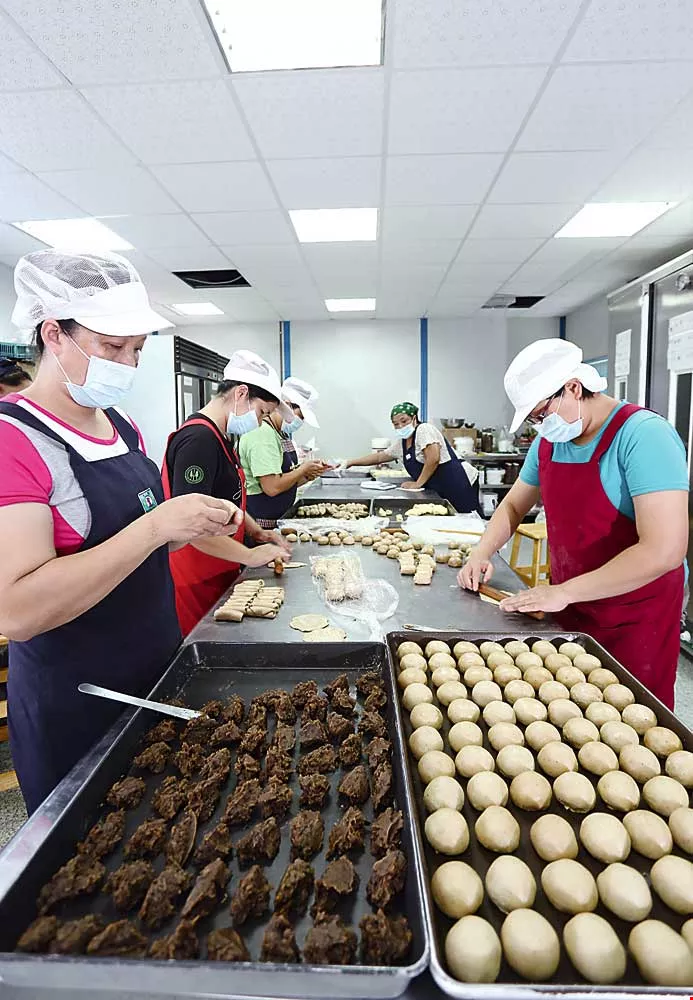
Plum-preserve pastries (left) are Sunlight Xiaolin’s marquee product. Around traditional Chinese holidays, the bakery operates round the clock, but even then it cannot keep up with demand. Other products include plum jam and plum paste (right).
In fact, the establishment of the workshop was somewhat accidental. Early in 2010, as the first Lunar New Year following the disaster approached, everyone was still living in temporary prefab housing, and the arrival of this traditional family holiday made people more depressed and forlorn than ever. At that time Tsai Song-yu, the head of the Xiaolin Village Self-Help Association, got the notion to find something to keep everyone busy that might also bring in some income. So he called on all his fellow village residents to package and sell the sole surviving batch of plum preserve. The task had an unexpectedly strong healing effect, even drawing elderly women out of their prefab shelters to work together sticking on labels, chat, and even smile.
This batch of 10,000 units sold out as soon as it hit the market, creating name recognition for the “Xiaolin Plums” brand. Suddenly there were jobs for elderly people and young people who wanted to return home, and an officially recognized “production and marketing group” was quickly set up. They also got funding through the community empowerment and employment program of the Council of Labor Affairs, and could begin to expand the scale of their operations.
In 2012, Tsai was introduced to Thomas Chien, chairman of Allion Test Labs (which tests information industry products), and discovered that Chien had bought some Xiaolin plums a decade earlier and, using a combination of traditional Japanese and Italian methods, had preserved them to make plum paste, which he then stored (in order to age it) in the Nanxi District of Tainan City. Wishing to help Sunlight Xiaolin get back on its feet, he generously contributed NT$6 million in capital so that Tsai could create Neways 2021, and also became the exclusive agent for plum paste at cost, resolving the difficulties faced by the local qingmei industry in transporting and selling their product.
Tsai Song-yu, who was born in 1976, graduated from the Department of Law at Chinese Culture University, and for a while ran a company in Taipei City providing online legal consultations. The biggest dry goods store in Xiaolin had been founded by his father and inherited by his elder brother, but their homes and the store were buried under the landslide.
At the traditional one-week memorial ceremony, when he saw the hopeless expressions in people’s eyes, Tsai was suddenly struck by an inspiration—he picked up a megaphone and loudly declared: “We must be strong! We must rebuild Xiaolin Village!” All of the residents, at least for a moment, received a jolt of energy. This marked a turning point in Tsai’s life, as he was nominated to become head of the Self-Help Association, then became the director of the Xiaolin Village Development Association, and now is executive director of Neways 2021. This young person who lived away from home for 20 years had returned to become an entrepreneur leading the way for all of his fellow villagers.

The smiles of children are a source of energy for the revitalization of the Sunlight Xiaolin Community.
“Typhoon Morakot was Nature sending us a warning, that any industry we have up here must be environmentally friendly in order to be sustainable,” says Tsai. The idea behind Neways 2021 is to promote natural farming methods, growing qingmei without pesticides or chemical fertilizers. They hope to ride the tide of “healthy eating” to revitalize local industry, and create incentives for young people to return home to work.
Tsai plans to divide the industrial chain into two parts: one up in the mountains and one down in the plain. Up in the mountains, the first goal is to raise the price of qingmei in order to improve the economic circumstances of growers. Next, four processing plants will be built, one each in Namasia, Masuhuaz, Wulipu, and Mizuhu, so they can process the plums locally and extend the shelf life of their product, in order to avoid the risk of having roads cut off by another natural disaster, leaving them unable to transport their fruits down to the plain.
In the plain, they plan to set up farm co-ops which will buy semi-processed plums (pickled in salt) and turn them into “candied plums.” After aging, the plums will be made into jam, pastries, and other products. The upstream and downstream parts of the production chain will be genuinely linked, creating a unified local economic district that handles both production and sales, and that creates profits and jobs.
At the press conference in early August formally announcing the creation of the social enterprise Neways 2021, representatives of several participating communities signed contracts committing them to a target of NT$16 million in profits within two years, which will be the fund to invest in the first phase of construction of production and sales facilities.

Tsai Song-yu, chairman of the Xiaolin Village Self-Help Association, has founded a social enterprise known as Neways 2021. Built around the core product of plum paste, it aims to create a “Plum Economic District” with integrated production and sales.
These days there is a real sense of unity in the air in Sunlight Xiaolin. One especially noteworthy sign is the formation of a troupe specializing in the dances of lowland Aboriginal peoples, which holds practice sessions every Monday and Thursday night. A wide spectrum of people, from a 12-year-old girl to a 60-year-old grandpa, attend.
The group is called the “Taivoan Dance Company” because the people of Xiaolin are one branch of a subtribe of the Siraya indigenous people known as the Taivoan subtribe.
Over the past few centuries, because the Taivoan have been heavily assimilated into Han Chinese society, their culture has virtually disappeared. Only a few basic words remain of their language, and a few decorative patterns are all that is known about their pre-Han attire. Fortunately a few of the elders still remember some dances, and this has become the entrée for a cultural revival. Young people who in days gone by had not the slightest interest in Taivoan traditions now show extraordinary enthusiasm. The dance company has found healing through music and movement, serving as a fountain of renewed purpose.
It is a paradox that it was the very destruction of the Taivoan community in Xiaolin Village that has been the spark for efforts to revive a culture that was nearly lost. On October 19th, survivors from the old Xiaolin Village will host a traditional festival in Wulipu, with over 1000 people expected to attend. This will make it the single largest tribal ritual in nearly a century.
Wang Minliang, who was born in 1980, lost over ten family members in the Typhoon Morakot disaster. Formerly employed in Taipei City by a pharmacy chain store, he applied for a transfer to Kaohsiung to look after his younger sister there. Oddly enough, the closer he got to home the more he missed it, and finally he quit his job to join the operations team for the Sunlight Xiaolin brand.
Wang says that having lost so much, they treasure what remains even more. If their local industry takes off and there are more jobs to be had, young people who migrated out before Morakot may very well return home and settle and have a good place to raise their children. “We can already envision our new homeland!”


@List.jpg?w=522&h=410&mode=crop&format=webp&quality=80)


