

A 30-minute drive from the Southern Taiwan Sci- ence Park brings us to the STSP's second base: Lujhu Science Park in Kaohsiung County. Lujhu is still in the midst of construction, and does not boast the impressive structures of the STSP. But we are surprised to see that the site is laid out with flat green spaces as tidy as a golf course, criss-crossed by access roads. Not far from the entrance we suddenly come upon a one-story office building. Inside are gathered many visiting representatives of industrial companies, listening to presentations in the reception area, beside a model of the park, and in offices.
"We have only five permanent staff here to handle all the back-office and front-office work," says STSP Administration team leader Lin Wei-cheng, who is responsible for the Lujhu Park. Lin says that the STSP Administration has earned a reputation for service, efficiency and a cooperative attitude, which firms appreciate very highly. To attract friends old and new to locate in Lujhu, Lin and his team are intent on providing even better and quicker service.
Development at Lujhu began five years later than at the STSP, so that it seems to have missed the peak of Taiwan's high-tech industries' prosperity. But Kaohsiung County Government has redoubled its efforts to develop Lujhu as a knowledge-intensive industrial park, in the hope that once it begins operating, firms in the surrounding area can work with the high-tech companies located there, to jointly boost the prosperity of southern Taiwan's new economy.
"In the space of six years, the STSP has created 20,000 job opportunities. This is a staggering achievement. We hope the Lujhu Park will also set new records for creating employment," says STSP Administration director-general Tai Chein.
To make this goal a reality, Kaohsiung County commissioner Yang Chiu-hsing and the STSP Administration director-general together visited various telecommunications industry firms such as Chunghwa Telecom and Taiwan Cellular Corporation to invite them to head south and set up in the Lujhu Park, to make it into a new manufacturing and research hub for Taiwan's telecoms industry. Much in the way of resources has also been into leisure and tourism development, in the attempt to create a new vision of prosperity for southern Taiwan.
"Siting the National Telecommunications Technology Center in the Lujhu Park will boost the development of telecoms firms that locate there," says Lin Wei-cheng. He explains that the new center, in which the government plans to invest NT$2.5 billion over four years, will be Taiwan's first independent state-approved testing and certification body for telecommunications equipment. The emphasis will be on providing a one-stop service to meet the certification requirements of countries worldwide, so that firms that until now have only been able to submit their products to Chunghwa Telecom or send them overseas for certification will be able to enjoy quicker and more convenient service.
As "patriarch" of the Lujhu Park, Tai Chein is bullish about its prospects: "As well as Lujhu's suitability for development as a telecoms industry center, precision engineering also has a long history in the area. We hope to leverage the presence of organizations such as National Cheng Kung University's Aerospace Science and Technology Research Center, the Kangshan Airbase, and Japan Asia Airways' aircraft maintenance center in Tainan, to develop Lujhu as an aerospace technology center. Together with the STSP's Tainan Park and the Tainan Technology Industrial Park we will form an industrial golden triangle for southern Taiwan, which will lead the area's high-tech industries into a new era."
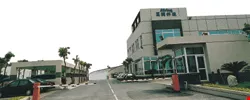
Having completed construction and commenced mass production at its new facility in just eight months, All Ring Tech is not only establishing a new milestone in its company development, but also opening a new chapter in the development of the Lujhu Science Park.
Lujhu Pioneer-All Ring Tech
All over the Lujhu Park, building work is under way to accommodate the firms that are moving in. But one building is obviously already finished, with staff hurrying in and out and goods stacked ready for shipping. This is the home of All Ring Tech, which was the first company to set up in the Lujhu Park, and is now in full-scale production.
"Work started on the plant in July 2003, and it was finished in February 2004. We completed commissioning in March, and began volume production right away," says Lee Chiende, a general manager at All Ring Tech. He explains that the company was set up nine years ago in Yenchao, Kaohsiung County, and initially specialized in producing automatic equipment for the manufacture of passive electronic components such as resistors. Its annual turnover started at NT$400 million and has grown continuously. In 2004, operating revenues are set to reach NT$1.15 billion.
"With business growing all the time, we had to expand our factory and take on new personnel and equipment. This happened when the STSP was beginning to recruit manufacturers for the Lujhu Park, and we quickly completed the application procedures and smoothly set up here," says Lee. As a listed company, All Ring Tech believes that setting up at Lujhu has done more than solve its factory expansion problem. The stringent government review that it had to pass should also increase confidence among investors and international partners, and is thus very helpful in boosting the company's image.
A Kaohsiung company since its inception, All Ring Tech is an excellent example of the "high-tech transformation of local traditional industries." Four years ago it branched out into the semiconductor industry by taking up IC packaging, and this year moved into optoelectronics, making equipment for LCD-TFT production. It has also developed a range of binoculars incorporating digital cameras, and three years ago it ranked second in CommonWealth magazine's listing of Taiwan's 100 fastest-growing SMEs.
"We have over 50 R&D staff and a first-rate marketing team, who develop new technologies and products in line with market trends. But we contract out assembly processes to downstream companies. This has been the secret of our transformation and upgrading," says Lee. He states that the move to the Lujhu Park has many advantages. At the current ground rent of NT$3 per ping (3.3 square meters), All Ring Tech pays only NT$6000 per month for its 2000-ping factory. After starting operations it has to pay 0.2% of its operating turnover in management fees, but the availability of resources such as subsidies for innovative R&D, training programs, and various collaborative programs with academia, make this a completely different experience to that of setting up its factory in Yenchao nine years ago. Seeing building work starting on the empty plots surrounding All Ring Tech's plant, Lee looks forward to the arrival of more firms, so that together they can build a new future. (tr. by Robert Taylor)


@List.jpg?w=522&h=410&mode=crop&format=webp&quality=80)


