Making Money off the Dead: Rosy Prospects for Taiwan's Funeral Industry
Tsai Wen-ting / photos Pu Hua-chih / tr. by Julius Tsai
August 2001


In tough economic times, some industries are taking flight overseas while others are laying off personnel. There is, however, an industry that is able to "make money off the dead," Taiwan's funeral and burial services industry. Some even predict that it will be the last industry left to be firmly rooted in Taiwan.
In a series of reforms, the Taipei City Bureau of Social Affairs has instituted a ban on wreaths and floral archways at the tightly packed No. 2 Municipal Funeral Parlor. Because this decision blocks one of the income sources of the funerary industry, unsavory elements within the industry have sent death threats naming three officials most responsible for these reforms and expressing a desire to see their "corpses lying out on the streets."
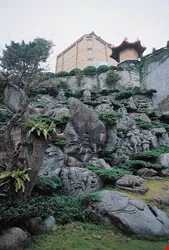
As part of the reforms, there is a growing trend for cemeteries and columbarium grounds to be landscaped like parks. Private-sector operators have been quickest off the mark in this regard. The picture shows Chinpaosan Cemetery, planning for which started over ten years ago. The cemetery is evocative of the Buddhist grottoes at Dunhuang in Western China.
Death: a NT$100 billion industry
What kind of profits would provoke such a frenzied response? According to standard industry figures, a large wreath generally runs between NT$600 and NT$1,200; a better funeral parlor will generally need ten such wreaths. In addition, floral archways that are set up outside the funeral parlor run between NT$15,000 and $50,000 each. Taking the case of the No. 2 Municipal Funeral Parlor, which holds upwards of 1,200 funerals a year, the funeral industry stands to lose nearly NT$100 million in that period.
But to only calculate the costs of the wreaths and floral archways is to miss the forest for the trees. According to statistics from the Ministry of the Interior (MOI), Taiwan's death rate in recent years has been about 0.6%, which means that the number of people dying each year is between 120,000 and 140,000. The cost of the average funeral is about NT$367,600. This amounts to typical yearly sales of NT$50 billion. Also to be added are the costs of acquiring a plot in a public cemetery, the costs of placing one's bones in a columbarium or carrying out a re-burial, not to mention the "incense and oil" fees at the columbarium or temple where one's remains are kept. According to Yang Kuo-chu, a specialist at MOI's Civil Affairs Department who is currently responsible for analyzing the new funeral laws, "Yearly sales figures in the funeral and burial market are definitely in excess of the statistics given. This is not to mention the fact that Taiwan is an aging society where the numbers of the dying will increase, not decrease."
Indeed, according to figures from the Manpower Planning Department of the Council for Economic Planning and Development, in 35 years time the number of the dying will have risen from the current 130,000 per year to 270,000 a year, more than doubling. This is also to say that over-the-counter sales in the funeral market will surpass the NT$100 billion mark, representing tantalizing potential.
About ten years ago, Global Company's Peihai Pagoda Gardens was built with 380,000 places in its columbaria. Within a few short years, Global not only reaped back its initial capital, but made enough to then found Global Life Insurance and the Peihai Funeral and Burial Management Company. LungYen Construction Company invested NT$800 million to build what it called the largest columbarium in Asia, and was able to pay off all of its debt within two years. There is currently more columbarium space than there is demand, and current capacity is not projected to be exhausted for the next 20 years. But Taipei City has halted burials in its public cemeteries, and plans to transfer burials elsewhere. For those who prefer burial to cremation, future supplies of legal gravesites are in extremely short supply. This has prompted Pacific Group investors to set up Rose Garden, a landscaped cemetery set on land acquired in the Chinshan and Yangmingshan area.
Construction companies that have typically built houses for the living have crossed over into the construction industry for the dead. Experiencing great profit, many have continued to expand, moving from burial to funeral services, establishing their own companies in these areas.
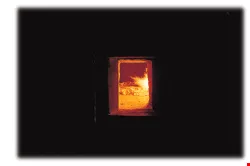
Great heroes, ravishing beauties, no matter who. . . everyone dies eventually. Funeral reform is bringing external changes in the way the business is conducted, but it also means thinking more carefully about how we live our lives.
Charging for everything
The funeral and burial management is a unique service industry, subject to different forces of supply and demand than that of other products. As Professor Tao Tsai-pu, who teaches life-death studies at Nanhua University, explains, the funeral industry is one that cannot but grow, one in which demand will only increase. Moreover, the industry is unaffected even in harsh economic times, given the Chinese culture of reverence for the dead. Thirty-three-year-old Chen Chuan-yuan, who has been in the funeral and burial industry for seven years, puts it more bluntly: "In this industry, you can charge for everything."
Given the impressive scale of the Taiwanese market, foreign companies have also arrived, hoping for a piece of the pie. In 1994, SCI, the number one funeral and burial management company in the world with over 2500 offices worldwide, began to send representatives to Taiwan. SCI wished to discuss the development of a dedicated funerary and burial zone with Taiwan Sugar Corporation; it was also interested in cooperating in the contracting out of service and managerial operations for the City of Taipei's funeral homes. Although unsuccessful, SCI has persisted in its efforts. After entering the Asian market in the last two or three years, they have held talks with industry heavyweights to discuss mergers through the pooling of capital. However, because Taiwanese funerary enterprises are not in great need of capital, SCI has remained on the sidelines.
Wu Cheng-chun, general manager of the PR division of the LungYen Group, thinks that if large-scale corporations were to enter the marketplace, they would be able to offer abundant capital and top management concepts. However, "the funeral and burial business is an extremely localized one, so unless foreign companies emphasize local employment, the threshold for entry is high."
Large corporations offering industrialized services present a serious threat to traditional family-operated burial and funeral service providers. This is reflected not only in the introduction of new funeral and burial products, but also in the fact that employees of these large corporations often start up companies of their own after familiarizing themselves with industry processes. Competition is heating up, and traditional operators feel that business in urban areas is getting harder and harder. "Whether in pricing or in quantity, we've seen our business slashed in half," says Kao Chi-chang, who has been in the business for three decades. Many younger operators, who have reluctantly inherited their family businesses, now only receive two or three cases a year.
Last year, Taipei City undertook an inspection of funeral and burial service providers. Only 30-some businesses out of the 228 registered participated. Most participants were large companies whose comprehensive bundling of service packages has become the industry mainstream. Small-scale, traditional operations may be forced to form alliances among themselves to avoid being rendered obsolete in this market.
High-tech funerals
The large pie that the funeral and burial services industry represents is actually made up of quite a number of recipes and flavors. Businesses thrive by developing new products and creating new consumer needs in this fiercely competitive market
"The funeral and burial services industry is the most humane of all the service industries," comments Wu Cheng-chun. "Whoever offers the best service wins." According to his analysis, the industry still has markets to tap in terms of local convenience and segmentation. While in the past, columbaria tended to be concentrated up north, they have begun appearing in the central and southern regions as well. Businesses aimed at adherents of different religious traditions also stand out from the rest of the pack.
In the past, a family's funeral expenses have typically fallen into three categories: expenses for funeral procession and associated rituals; for the coffin and gravesite; and for the funeral banquet. However, landscaped columbaria and public funeral homes for the most part do not permit funeral troupes. Furthermore, the MOI has recently proposed draft guidelines for funeral regulations that propose collecting fees from those who set up funeral marquees in the streets. They also propose that funeral processions be registered with the local police three days before they are to take place.
In the future, grand funeral processions stretching two or three kilometers should become less common. In addition, the industry is hoping that new markets will open up, such as funeral home developments in local communities or the restriction of funerals to the premises of funeral homes as in Hong Kong, or holding the funeral banquet and ceremony in large hotels as in Japan.
According to a recent newspaper survey of young people's attitudes towards funerals and burials, over 30% hoped for more individualized funeral services and more environmentally friendly and high-tech practices such as burial at sea or under a tree. Businesses have also begun promoting such innovations as using coffins made from recycled materials, portable incinerators to provide "house calls," and web-based funeral services and prayers for the deceased. The funeral and burial market certainly show room for profit as well as for change.


