Saving Money, While Saving the Earth--Green Hotels Launched in Taiwan
Coral Lee / photos Hsueh Chi-kuang / tr. by Christopher J. Findler
July 2008


"Look after the planet!" "Environmentalism is happening!" Well-known leisure hotels in Tanshui and Hualien recently began employing environmentalist marketing activities. In contrast to most other hotels in Taiwan that highlight luxurious decor and various types of novel services, a small number have begun to stress simplicity and minimalism. Their ads state that they don't provide things like toothbrushes, soap, combs, razors, or slippers, and guests are asked to bring their own. For longer stays, hotels don't change sheets and towels daily. The good news is guests get a break on room prices.
With ecotourism becoming increasingly common in Taiwan, it only makes sense that environmentally friendly, waste-reducing hotels will gradually become ubiquitous. But for now, the fact that environmentalism is being adopted by Taiwan's hotel industry is still "hot news." In contrast to countries in Europe and North America where it has been the order of the day for years and where environmental rating mechanisms are mature, Taiwan still has a long way to go before tourism becomes a "non-smokestack industry."
For the 2008 National Environmental Hotel Competition, organized by the Environmental Protection Administration earlier this year, people were asked to vote for the hotels that they felt were most environmentally friendly based on five categories, including the level of recycling, green purchasing, not providing disposable bathroom articles, not changing bedding daily for guests on extended stays, and not using plastic items. More than 100 hotels were recommended by the public. Of these, nine five-star tourist hotels and ten general hotels were selected by over 40,000 visitors to the site. Although the idea was good, the contest could have been designed rather better. Environmentalists criticized it, saying it was riddled with defects like hard-to-understand webpages, no mechanism to keep visitors from voting more than once, and the fact that water and electricity consumption was not averaged to hotel size. Despite its flaws, however, it is encouraging to see that the activity placed the idea of environmentalism in hotels center stage.

To encourage their guests to use the most eco-friendly means available for touring the countryside, a number of hotels and guesthouses offer bicycle rental services.
"Might as well use it"
What exactly is an environmental hotel? According to the Green Hotels Association, "Green Hotels are environmentally-friendly properties whose managers are eager to institute programs that save water, save energy and reduce solid waste-while saving money-to help protect our one and only earth." So what are the standards used in Taiwan? Taiwan's Environmental Protection Administration recently took it upon itself to create an environmental label for hotels which it plans to introduce in July.
Browsing through the environmental measures adopted by hotels selected during this round of voting, we see that a number of them change and wash sheets and towels less frequently, and have installed water-saving devices in bathrooms. With the low price of water in Taiwan, not much importance is attached to conserving it, so measures used in Europe and North America to save large amounts of water, such as not changing sheets and towels daily, are simply viewed as "poor service" in Taiwan.
Taiwanese travelers remain firm adherents to the idea that "if it's there, you might as well use it." A 2001 Ministry of Economic Affairs survey of water use in 54 hotels in Taiwan revealed that an average of 904 liters of water was used per guest per day, a true disgrace. It's really not all that difficult to promote methods like these and the economic benefits would be remarkable. The five-star Grand Formosa Regent Taipei Hotel offers the option of not having sheets changed daily and 40% of guests elect not to do so, saving NT$300,000 a month.
In addition to cutting back on sheet and towel changing, some resolute hoteliers have taken the further step of reusing water. The five-star Far Eastern Plaza Hotel pipes water drained daily from the hotel's swimming pool back into its central cooling system's cooling stack. Miaoli's West Lake Resortopia waters its greenery with its wastewater.
Disposable products are the nemesis of the environment. Using only a little bit of toothpaste or soap before tossing the rest into a rubbish bin and the mountains of single-use toothbrushes, combs, razors, and slippers are not only wasteful, they have to be transported long distances to be incinerated. These disposable "services" might be a convenience for guests, but their use totally disregards all economic and ecological ramifications. Although change is not easy, some hotels are taking first steps.
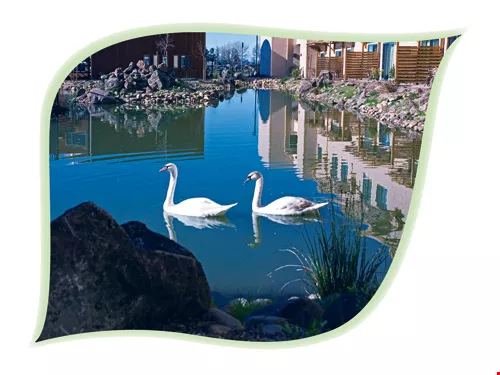
Disposable items
"The people of Taiwan don't generally like to bring sopping wet toiletries with them when they travel. Hotels are concerned that if they don't provide these articles, they will be less competitive, which is why they have been slow off the mark," notes Lee Chih-han, director of the Taipei County Hotel Trade Association and general manager of the Fisher Hotel in Tanshui. He goes on to say that only 3% of Taipei County hotels agreed with the idea of not supplying disposable toiletries when he advanced it a few years back, while 97% either didn't like it or adopted a wait-and-see attitude. In recent years, guests who know when they book a room that Lee runs an environmental hotel bring their own toiletries, but guests who are unaware of the hotel's green leanings in advance complain a great deal during their stays.
Going on her own experience, WildFun EcoEnterprise general manager Bird Lai, who is dedicated to promoting ecotourism, points out that travelers are not as hard to educate as people in the business might think. What's more, being green doesn't mean simply not providing soap and shampoo. She explains that installing refillable applicators on bathroom walls is much more environmentally friendly and economical. As long as hotel management is willing to try out new ideas, consumers generally have no problem accepting them.
The Leofoo Travel Group was the first in Taiwan's hotel industry to announce in January of this year that none of the hotels in its consortium will supply disposable toiletries. To avoid inconvenience, it will provide environmental toiletry packs, the contents of which can be used for extended periods of time, to any guests that ask for one. The percentage of guests requesting the packs at the Westin Taipei since the policy's implementation four months ago has declined from 30% to 10%, illustrating that as long as environmental policies are made clear up front, guests are more than willing to comply.
In addition to working to change the living habits of consumers, award-winning hotels have all put into operation various green policies, such as recycling, green procurement, and energy conservation, to some degree or other.
Since hotels deal with huge quantities of various packaged beverages, paper, and kitchen waste, recycling is a basic must. Some of the practices of more committed hotels include using reclaimed goods and materials. The Lees Hotel in Kaohsiung, for example, converts waste oils from the kitchen into soap or compost by adding sawdust. It also puts the unused portions of toilet paper and soap from guest rooms and restaurants into bathrooms used by the hotel staff. Taichung's Landis Hotel uses old sheets and towels as cleaning rags.
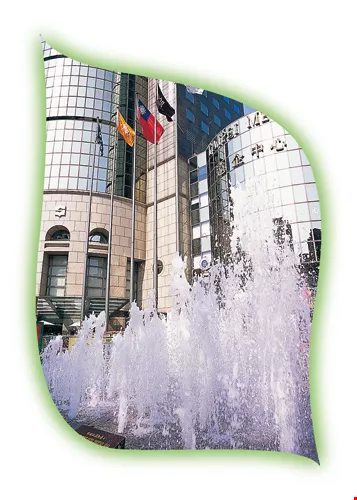
Although Taiwan hasn't experienced a water resource crisis as yet, committed hotels have already implemented a number of water conservation measures. In the photo, the fountain at Taipei's Far Eastern Plaza Hotel uses an automatic sensor to determine wind speed. If the wind is too strong, the fountain is automatically shut off to reduce water loss through evaporation. The 15 tons of water drained from the hotel swimming pool daily is pumped back into the cooling stack of the hotel's central cooling system.
Room for improvement
Bird Lai relates that energy conservation measures, not among the five categories in the recent competition, are not only crucial to environmentalism, they are the biggest money saver. It's one area, however, in which hoteliers still have plenty of room for improvement. Because things like lighting systems, air conditioning, and hot water systems expend tremendous amounts of electricity, natural gas, and diesel fuel, the sky is the limit as far as energy conservation is concerned. What's more, there are all kinds of ways to conserve.
Green hotels in other countries start with the building itself by improving such things as natural lighting and natural airflow and by installing solar panels. A top-rated hotel in Austria even has its rooms underground where the constant temperature keeps the rooms warm in winter and cool in summer. The hotel also utilizes white walls and large amounts of glass in its design to compensate for the lack of natural lighting. But the methods used in award-winning hotels in Taiwan still go little further than replacing traditional tungsten filament or halogen bulbs with energy-saving light bulbs and tubes.
The Naruwan Hotel in Taitung, the Lees Hotel in Kaohsiung, and the Fisher Hotel in Tanshui have gone a bit further in regard to energy conservation. The Lees has replaced traditional boilers with a heat recovery system that uses a converter to heat water for its guest rooms using heat radiated from air conditioner compressors. The 30-room Fisher uses a heat pump system to heat water with heat drawn from the air-conditioning system, which also reduces the load on the AC system. Lee Chih-han relates that the initial investment in the heat pump system exceeded NT$1 million, but they save NT$70-80,000 in fuel costs every month. When expected electricity and fuel price hikes take effect, the economic benefits of energy conservation will really kick in.
How can hotels save energy with traditionally electricity-guzzling air conditioning systems? A number of hotels have begun using variable frequency appliances or controlling the AC in guests' rooms via master switches. The ice-storage air-conditioning system used by Taipei's Far Eastern Plaza Hotel and the three-in-one chilled-water air-conditioning system in Kaohsiung's Lees Hotel were part of the hotels' initial construction plans, so they do an especially good job of conserving energy.
The Far Eastern Plaza's air-conditioning system uses lower-priced nighttime off-peak electricity to produce 1,500 tons of ice which is held in an ice storage tank that takes up an entire floor of the building. Chilled air is then pumped into rooms during the day. No air conditioner compressors are needed, saving some NT$2.5 million in electricity bills a year.
Regarded by many as a top energy-saving hotel, the Far Eastern Plaza is the only hotel in the industry to have gained ISO14001 Environmental Management System certification. It was also presented with the Outstanding Energy Conservation Business Award by the Ministry of Economic Affairs' Bureau of Energy in 1999. The Far Eastern Plaza has clear goals and concrete policies for achieving them. It has even established a new position-environmental management system manager-to oversee the environmental and energy conservation affairs in all departments. Energy saving measures have been applied everywhere, from guest rooms, restaurants, and VIP services to the engineering, security, and finance departments.
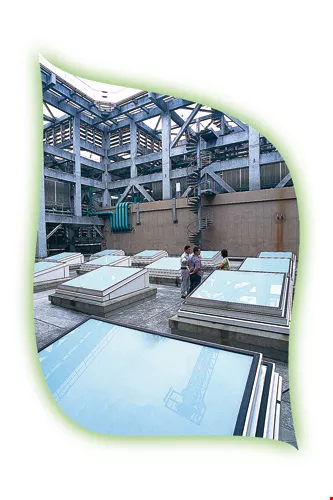
Hotels' lighting, air-conditioning, and hot water systems expend tremendous amounts of power and are the areas with the most room for improvement in the area of energy conservation. Many hotels have responded by installing energy-saving light bulbs. The photo above shows skylights installed atop Hsinchu's Ambassador Hotel. They practically do away with the need for artificial lighting in the hotel's atrium, which is more than ten stories tall.
Ensuring quality
Gino Hu, assistant director of engineering at the Far Eastern Plaza, explains that their Hong Kong headquarters sets annual energy conservation goals. Last year it was 6%; this year it was hiked to 12%. They start with big systems, like AC units with variable-frequency drives, insulation for hot and cold water piping, installing energy-saving light bulbs in hallways and rooms, and many details, like dimming lights when setting tables in the restaurants, installing variable-frequency kitchen ventilation fans, infrared sensors in linen and supply rooms on each floor to turn lights on and off when employees go in and out, and training employees to shut off unused lights. The general manager leads by example. The hotel makes sure that policies are carried out thoroughly at every level.
Looking back at Taiwan, we see that although the environmental movement taking place in Taiwan's hotel industry was a little bit late in starting, faced with the high price of oil and the increasingly severe issue of global warming, Taiwan's hotels are improving their environmental record by leaps and bounds. And with the new environmental label about to be unveiled and Taiwan being opened to Chinese tourists, they couldn't be doing it at a better time.
Hotel operators in Taiwan have been working hard to get ready and give their hotels facelifts in preparation for the expected influx of PRC tourists. While experts in various fields are discussing how to use Taiwan's attractions and culture to draw tourists from across the Taiwan Strait, hotel operators should think about making Taiwan's hotel industry a showcase to show the world the concern her people have for the environment and the corporate social responsibility of her businesses, rather than spending huge amounts of money on making hotels more luxurious, thereby exacting a tremendous toll both economically and environmentally. This would do wonders for the image of her tourist industry. Looking at global trends, we see that attention to detail and environmental responsibility are the keys to keeping Taiwan's tourism industry from degrading into a "disposable" commodity.
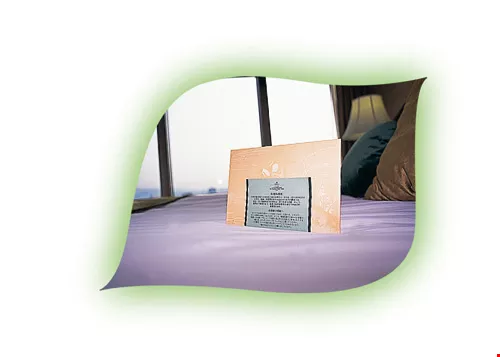
Hotels in Taiwan have become more environmentally conscious in recent years. Many place cards in rooms encouraging guests to conserve water by not changing linen and towels daily. Some hotels no longer provide disposable toiletries.
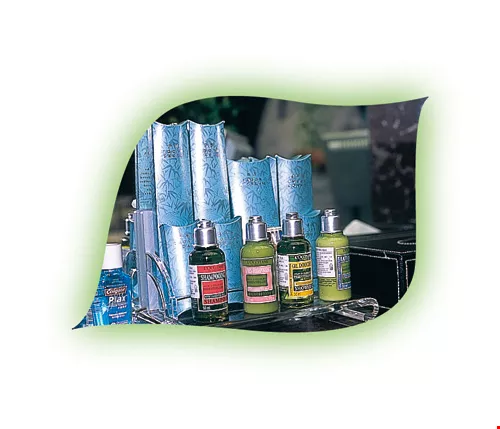
Hotels in Taiwan have become more environmentally conscious in recent years. Many place cards in rooms encouraging guests to conserve water by not changing linen and towels daily. Some hotels no longer provide disposable toiletries.
Hotels' lighting, air-conditioning, and hot water systems expend tremendous amounts of power and are the areas with the most room for improvement in the area of energy conservation. Many hotels have responded by installing energy-saving light bulbs. The photo above shows skylights installed atop Hsinchu's Ambassador Hotel. They practically do away with the need for artificial lighting in the hotel's atrium, which is more than ten stories tall.

@List.jpg?w=522&h=410&mode=crop&format=webp&quality=80)


