Evenings With the Stars --The Modern Value of Ancient Astronomy
Elaine Chen / tr. by Robert Taylor
June 1996


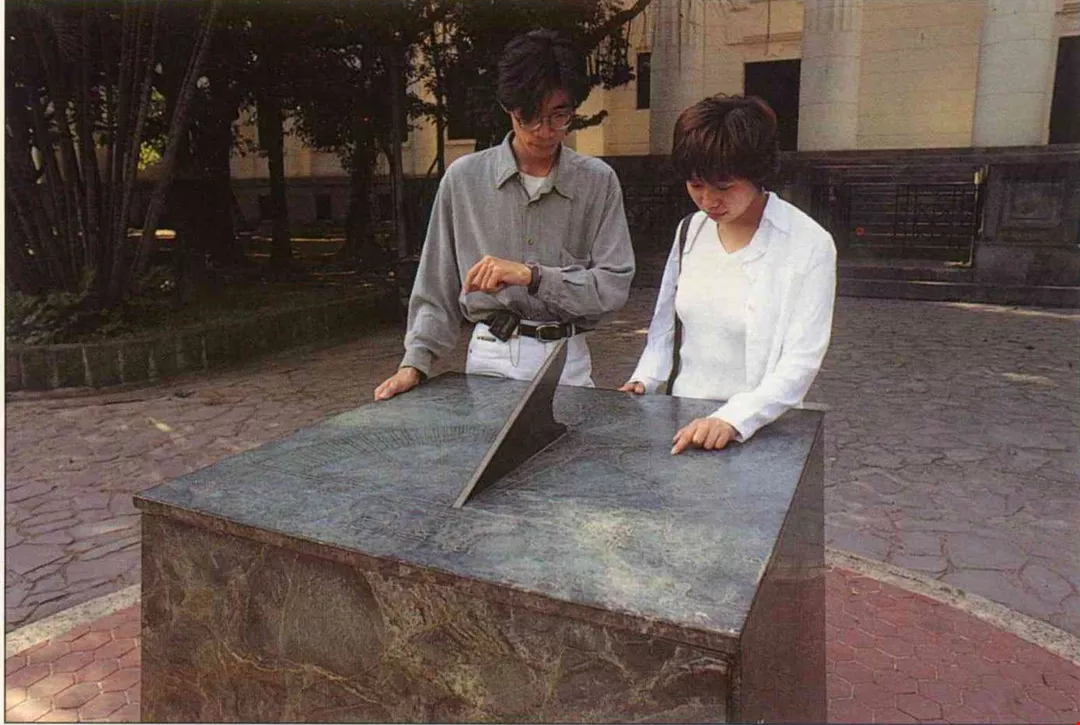
The sundial is an ancient instrument for measuring time. The shadow of the pointer falling on the radial scale marks the hours. (photo by Hsueh Chi-kuang)
What did the Song dynasty rulers want with a water-powered astronomical clock tower?
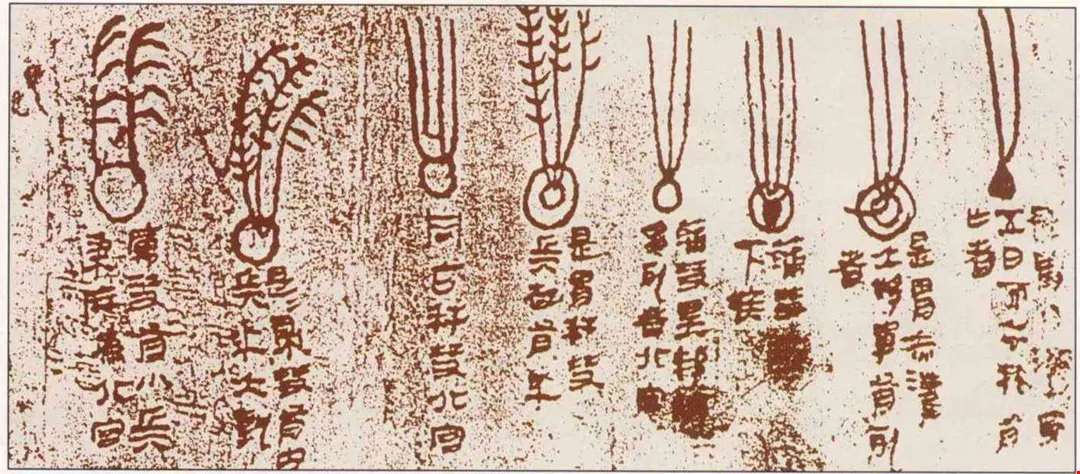
Court astronomers in ancient China were very anxious to observe any unusual celestial phenomena, for they might reveal the "will of heaven." The earliest formal records of H alley's Comet were made by the Chinese. Shown here are depictions of comets from the silk book Tianwen Qixiang Za Zhan ("Miscellaneous Interpretations of Astronomical and Meteorological Phenomena") fro m the Han tombs at Mawangdui in Hunan Province, mainland China. (from a PRC publication on Mawangdui)
Ancient Chinese knowledge of astronomy seems to touch on our modern lives only at traditional festivals, three times a year. But did you know that Halley's Comet, which arouses such excitement among the people of this Earth every time it returns, was first recorded in detail by the Chinese, and observed consistently over more than 2000 years?
Opening up the history books of past ages, the obligatory biographical notes on each emperor are followed by "astronomical annals." Over the 500 hundred years of the Spring and Autumn (770-476 BC) and Warring States (475-221 BC) periods, political power changed hands many times. Astrologers, working for many different masters, had great influence, and directed the attention of monarchs and nobles to the observation of the heavens.
The Chinese believed that celestial phenomena affected and were affected by political events on earth--that heaven intervened in human affairs, and human affairs also influenced heaven. Hence monarchs did not dare disregard the "will of heaven." As well as issuing commands appropriate to the time and season of the year, when informed of any disaster they would examine their own past actions to find the cause.
Over the last 2000 years and more, though dynasties came and went, with research funding and equipment provided by kings and emperors, the Chinese accumulated an enormous and unbroken collection of observational records which form the world's most complete set of astronomical data.
Methods of calculating calendars were known in China as early as the Xia (c. 21st-17th C. BC) and Shang (c. 17th-11th C. BC) dynasties, and today's Chinese lunar calendar is also known as the Xia calendar. The length of the year as calculated in the Xia was 365.25 days, which is very close to the 365.2425 days of the Gregorian calendar we use today. In the time from the Western Han dynasty (206 BC-25 AD) to the Five Dynasties period (907-960 AD), the 24 Solar Terms, the lunar cycle and the placement of the intercalary months in the lunar calendar became well determined, and this was of tremendous assistance to agriculture in ancient China.
Good workmanship takes good tools
Calendrical calculations require precise and accurate mathematical data, and this requires the help of instruments. 2100 years ago, Luo Xiahong of the Western Han invented an armillary sphere for Emperor Wu (reigned 140-85 BC), and this instrument was gradually improved over the ages.
How did the armillary sphere get its Chinese name of huntianyi ("celestial sphere instrument")? In ancient times the Chinese had three conceptions of the universe, called the "celestial dome" theory, the "celestial sphere" theory, and the "infinite space" theory.
The infinite space theory proposed that everything outside the earth is gas, and the reason the sky appears blue is because it stretches so far into the distance. The celestial dome theory had it that the heavens are round and the earth square, and the heavens hang above the earth and cover it like a wok cover. Meanwhile the main idea behind the celestial sphere theory was that the heavens are a hollow sphere with the sun, moon and stars all attached to its inside, and that the earth is enclosed inside the heavens like the yolk inside an eggshell. This is an example of a geocentric cosmology, which places the earth at the center of the universe.
To prove the truth of the celestial sphere theory, the Eastern Han dynasty astronomer Zhang Heng (78-139 AD) designed a water-driven celestial globe. Water dripping from a clepsydra (a vessel with a small hole from which water drips at a constant rate) drove a train of gears to move a globe, representing the sphere of heaven, through one revolution per day, in time with the movement of the heavens.
In the reign of the Tang emperor Xuanzong (ruled 712-755), Buddhist Master Yixing (673-727), another outstanding astronomer, improved on Zhang Heng's instrument by making a bronze armillary sphere which revolved through one degree a day and one full revolution per year, and also had two wooden mannikins which beat a drum and a bell to mark the time of day.
Building on their inventions, Su Song of the Northern Song dynasty designed an even better water-driven astronomical clock tower with an armillary sphere and celestial globe, which used an escapement to control the movement of the gears, enabling the whole device to keep time accurately and to turn in synchrony with the stars.
The escapement is the mechanism at the heart of modern mechanical clocks. The water-driven clock tower can be described as the direct ancestor of astronomical clocks throughout the world. But sadly, just as with gunpowder, paper and printing, China was not able to maintain this lead.
Using ancient wisdom to modern ends
Why did astronomy in China not continue to develop in later times?
In the view of mainland Chinese scholars Chen Jiujin and Yang Yi, apart from societal reasons such as economics and government policy, there were also factors inherent in astronomy itself. In the Song (960-1279) and Yuan (1206-1368) dynasties, astronomical instruments reached the limits of what could be achieved with naked-eye observation. Their accuracy could not be increased without the use of optical lenses, but the art of making telescopes was born in Europe. Secondly, the ancient Chinese were skilled in algebraic calculations, but resolving the positions of celestial bodies requires geometrical concepts, and geometry was one of the weakest areas of traditional Chinese mathematics.
In the 16th century, the Polish scientist Coper-nicus proposed the theory that the sun was at the center of the solar system. This laid the foundations of the modern science of astronomy, and from then on Western astro-nomy made rapid progress. In the late Ming dynasty, know-ledge of Western astronomy was transmitted to China by the Jesuits. At this point the Chinese, who had believed for thousands of years that the heavens were a sphere which enclosed the earth at its center, completely rejected the past and accepted the theories of Western astronomers.
Nonetheless, the astronomical research of ancient China has proven to be of tremendous value for modern astronomy.
The Spring and Autumn Annals (a history attributed to Confucius, based on the annals of the state of Lu and covering the period 722-481 BC) records that "in the 14th year of the reign of Lord Wen of Lu (613 BC), in autumn in the 7th lunar month, a bright comet appeared in the Big Dipper." This is the world's earliest confirmed record of Halley's Comet.
Halley's Comet returns every 76 years, and from the 7th year (300 BC) of the reign of the first Qin Emperor to the 2nd year (1910) of the reign of the last emperor of China, the Qing emperor Xuantong, every appearance was recorded in detail. In modern times Western astronomers have used this continuous record of observational data to work out the orbit of Halley's Comet, and to reach many other important conclusions.
The Song dynasty historical annals Song Hui Yao record a stellar explosion in 1054 AD, and this has been identified by Western astronomers as the supernova that developed into the Crab Nebula, which is still expanding in the constellation Taurus. To predict the fortunes of monarchs and dynasties, the ancient Chinese also kept the most complete records anywhere in the world of cosmological phenomena such as sunspots, meteor showers and meteorites. These are seen as priceless research data by modern astronomers.
To keep the will of heaven secret, the imperial astronomers of ancient China were forbidden to leave the capital. Although treated leniently if they committed crimes, even in old age they could never retire or return to their native places. They can surely never have guessed that the lonely months and years they spent staring through sighting tubes to record whatever changes they saw in the vastness of the heavens would make such a great contribution to the astronomy of later ages.
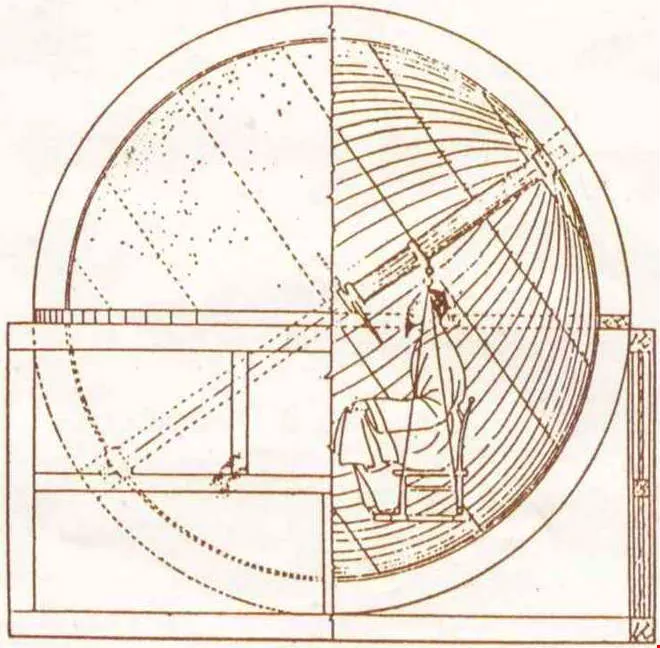
In ancient China, many people's conception of the universe was that the heavens formed a sphere which enclosed the earth at its center. Su Song of the Song dynasty also constructed a hollow celestial globe, pierced with holes to represent the fixed stars. Court astronomers could sit inside the revolving globe on a suspended seat to see the daylight shining in through the holes, giving an effect very much like a modern planetarium.

@List.jpg?w=522&h=410&mode=crop&format=webp&quality=80)


