

How is it that the grandmotherly wisdom of "cherishing all living things" has suddenly become a trendy environmental protection position?(photo by Pu Hua-chih)
The starting point of environmentalism is protection of nature, and it is an idea that must be put into practice in daily life. Yet it seems that it has become a synonym for "plain and simple." Are environment loving "greens" only those who eat natural foods? Or who wear hand-made clothes? Who do amateur gardening? Who do their own handicrafts? Who love riding bicycles? Or could they just be the old grannies who cherish and protect every living thing?
When the Earth Summit opened in Brazil last year, conservation groups raised the slogan of "global thinking, grass-roots action." This signified that environmental problems should be handled from the larger perspective, and weighed in terms of the whole earth; but on the other hand action should begin in the community where one lives, so that one should not mouth fine-sounding slogans while overlooking what needs to be done next door.
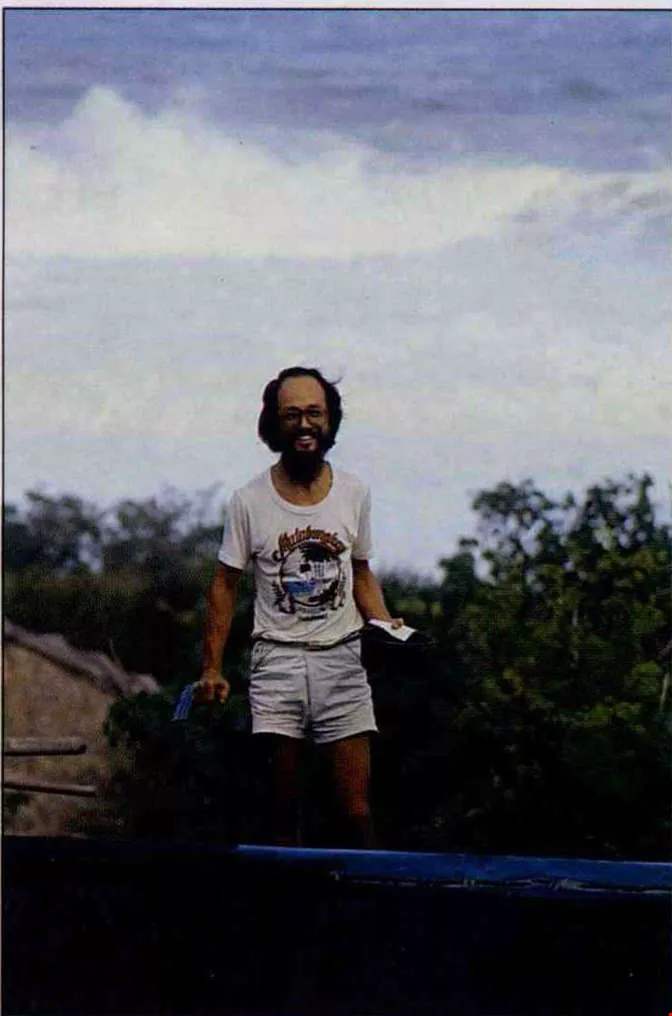
Ou Chi-fu of Hualien has the waters and fields as his neighbors, and is one of the leading" environmental protection" personalities in Taiwan. (photo by Vincent Chang)
Reject excessive consumption:
Now that Taiwan has achieved prosperity, most consumers are willing to cough up a little extra and use their purchasing power to support environment-friendly products. But there are those who doubt that environmental protection can be bought.
"Green consumption cannot completely resolve the problem of environmental protection. The most positive method for the environment, and the one most friendly to the earth, is to reject excessive consumption," says Lin Chun-yi, a professor at Tung-hai University and a leading environmentalist. We should encourage restraint in nonessential consumption. Only after that, under conditions where we are willing to reduce consumption but cannot but use something, should come choosing environmentally friendly products.
"Using green goods is only one part of green thinking. Even more important is lowering demand for material goods, and treasuring the things you already have," explains Chang Kuo-lung, a professor of physics at National Taiwan University, of the origins of the green tide. He argues that in the two hundred years since the industrial revolution, the large-scale use of non-recyclable materials by mankind has allowed modern people to enjoy the same standard of living as an ancient emperor attended by 200 servants.
But the earth's resources are limited, while man's desires seem boundless. The systematic balance between them has been thrown out of kilter, so that the sounds of protest are arising from the wounded earth.

Environmental protection doesn't necessarily mean giving up city life. If office workers would carry reusable lunch containers, using one less styrofoam box each day, that would be ideal.
The edge of civilization:
Every time the 500-plus environmental mothers of the Home-makers' Union and Foundation have an activity or go on a trip, they remind members to take along a notebook, pen, towel, teacup, bowl and chopsticks, a bottle of water, and a bag for purchases in order to avoid creating unnecessary garbage. Lin Chun-yi wears his white shirts for a long time, and never buys designer brands. At noon along Nanyang Street, when the cafeterias are jammed with people, you can occasionally see a few people who have brought their own steel lunchboxes for take-out food, to use one less styrofoam package.
Ou Chi-fu, who lives in Yanliao Village in Hualien, always thinks whenever using even a drop of water, what's the most efficient way to use it? Is the tap turned on too much? Water used to wash the vegetables can be saved to rinse out the toilet or spray the flowers.
"Is it necessary to be that parsimonious?" many people can't help but wonder. His response is, "Whether to conserve or not is a matter of attitude, not a matter of whether you have the money or can afford it."
You could say all of these people are "greens." Although there are differences in degree, they share the spirit of respect for green philosophy.
"In the past simplicity and caring for living things was seen as a kind of virtue. Today it is seen as backward. You could say this is a product of a capitalist society. But the price will be paid for by future generations who will rely on the earth for survival," says Chang Kuo-lung. He does not believe that a simple, conservationist lifestyle is necessarily uninteresting or dry; on the contrary it is full of the fun of creativity. "Our family hasn't bought dish-washing soap in twenty years." All the dishes or anything that needs cleaning can be washed in hand soap, because the basic ingredient in soap is plant or animal fat, and even if it's phosphate-free dishwashing liquid, it still includes perfumes and artificial coloring. Long-term contact is harmful to people's health. The Chang family's electric fan has also been in use for many years, and it is periodically oiled and maintained, and small parts are replaced; he is confident it still has ten or more good years in it.
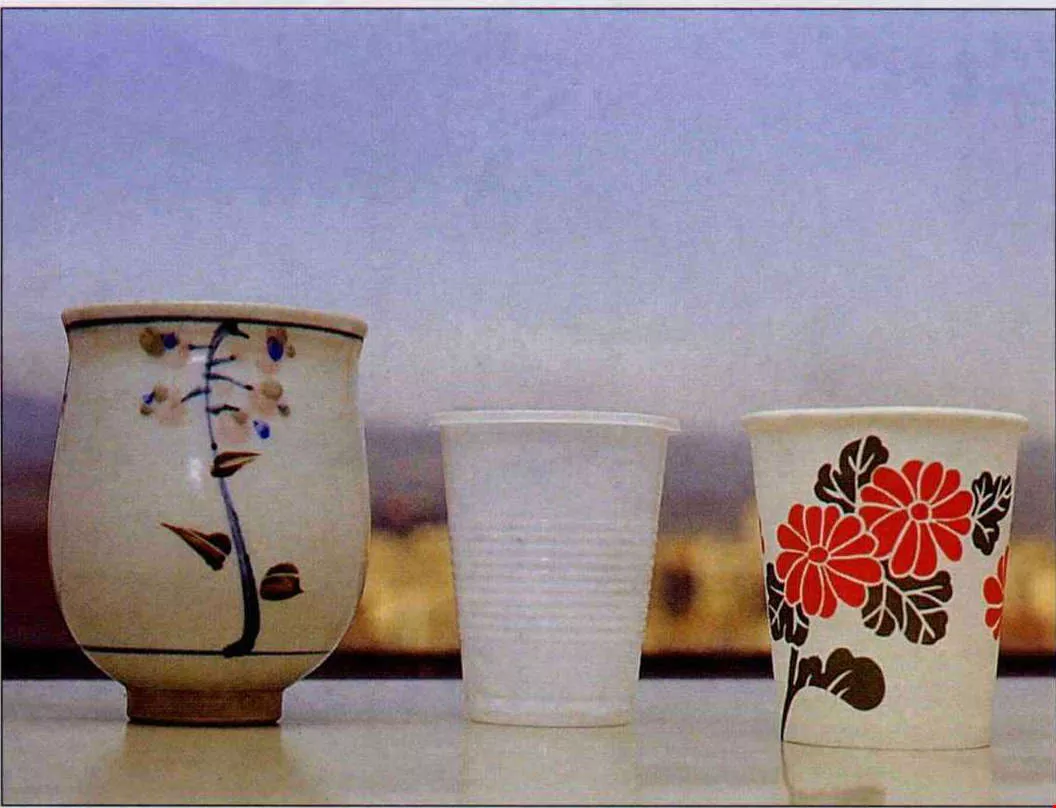
From porcelain cups to plastic cups to paper cups to asking everyone in the office to reduce garbage by having a personal porcelain cup, we've come full circle.
In search of other values:
There is also someone like this in Hongkong, though in the eyes of most Hongkongers his lifestyle may be a bit "extreme."
Chow Chao-hsiang, who teaches at the Chinese University of Hongkong and who is seen as the "green godfather" of the island colony, has his own green philosophy: Don't live in the city, don't take elevators, don't go into supermarkets, don't drive a car, don't smoke or drink, don't use MSG or dish soap or plastic bags, don't eat processed food, don't watch TV, don't attend extravagant Chinese weddings, gradually give up meat, don't use paper towels, don't install air conditioning or window screens . . . .
After Chow's lifestyle was reported in the Hongkong media, it instigated a great deal of attention and dissension. Some said he is a "naturalist," or a "modern Tao Yuan-ming" [a Tsin dynasty poet who wrote of a natural paradise]. Others said he wanted to "drag mankind back to a primitive era," and was nothing but "100% opposed to urban culture."
In his book Alternative Life Values, Chow explains his own "off the beaten track values": "If we all agree that we need to reduce the wastage of resources, then there are hundred and thousands of ways to concretely put this into practice. If everyone could cut back 20, 30, or 40%, that would bring peace of mind and would be ideal."
Giving up a little convenience:
"Dispose of after use" is the main reason behind the overindulgent use of resources and energy, and behind the creation of massive amounts of garbage. In his book Chow points out that the level of material life and the quality of life are two quite different matters. He states, "We always criticize industrialists for putting profit ahead of anything else, and for being unwilling to absorb the costs of pollution without regard for the lives of the great mass of people. But we are very forgiving of the real criminals-- ourselves. The destruction of the planet is not the result of one person or a group of people being neglectful or not taking responsibility for their actions, but is the very philosophy of life and style of life that we embrace at present." The problem is, under a commercial system which pursues consumer profits, is it possible not to consume?
"Don't assume that it can't be done at this stage. Many values in the past changed just because of the passage of time!" Thus, even if green consumption is a secondary method, Lin Chun-yi still sees it as the hope of the future. He feels that green consumption won't be just a passing fad, but will exist along with environmental consciousness.
Chang Kuo-lung approves of green products as one way consumers can put green thinking into action. But going a step further to internalization of environmental thinking and behavior is not just being picky about what kind of bottle your soy sauce is packaged in. The spirit of environmental protection can in fact penetrate all facets of life.
Ever since entering the ranks of the environmental mamas, Homemakers' Union and Foundation Secretary-General Lin Yuh-pei feels that her own desire for material goods has declined. When she shops for clothes, she will first think once through all the clothes in her closet and ask herself if she really needs a new outfit, or whether she is just blindly following fashion.
Who says you can't change the world!
Looking back over the conservation movement in Taiwan, some private environmental groups feel that the impact of bringing together action in daily life with environmental ideals is far greater than talking about profound environmental theories. Only the application in daily life of ideals can allow even more people to participate, so that everyone will realize that environmental protection isn't so difficult. One need only make a few adjustments in one's basic living habits to be able to change the environment.
The basic view of green consumption is the admonition: "Don't avoid doing something just because the gain seems small; don't go ahead and do something just because the harm seems marginal." Realized in daily life, "it amounts to a series of choices. Before you consume, think twice, and don't just always be pursuing convenience and comfort," concludes Lin Yuh-pei. For example, when you buy something, tell the shop owner that you only need one plastic bag, and not to give you any extras.
From bringing your own shopping bag to remembering to turn off the engine if you're just sitting on the motorbike chatting to buying a smaller car, care just a little bit more each day than the day before, consume a little bit less, and do a little something more of benefit to the environment.
[Picture Caption]
p.94
How is it that the grandmotherly wisdom of "cherishing all living things" has suddenly become a trendy environmental protection position?(photo by Pu Hua-chih)
p.95
Ou Chi-fu of Hualien has the waters and fields as his neighbors, and is one of the leading" environmental protection" personalities in Taiwan. (photo by Vincent Chang)
p.96
Environmental protection doesn't necessarily mean giving up city life. If office workers would carry reusable lunch containers, using one less styrofoam box each day, that would be ideal.
p.97
From porcelain cups to plastic cups to paper cups to asking everyone in the office to reduce garbage by having a personal porcelain cup, we've come full circle.


@List.jpg?w=522&h=410&mode=crop&format=webp&quality=80)


