

In the mid-1980s when the Chinese character entry systems Cangjie and Dayi were the talk of the domestic computer industry, Hsu Wen-hsing, who had just returned from doctoral studies in Japan, held a contrarian's view about this technology. Hsu believed that systems capable of deciphering handwritten Chinese characters would end up being the most important input systems. The Mengtian Chinese character recognition system that is now on the market very much fits Hsu's earlier vision, and Hsu has come to be regarded as the father of optical character recognition technology in Taiwan.
At a time when the share prices for Taiwanese tech stocks have collapsed and profits are low, this farsighted and innovative maverick of an entrepreneur sees the dawn of a bright new technological era. Perhaps his revolutionary ideas offer some hope for the future of Taiwan high-tech.
At last year's ceremony for the Gold National Awards for Excellence, which are the highest honors given for industrial research in Taiwan, Hsu Wen-hsing, Startek Engineering's CEO, suggested to President Chen Shui-bian that "MIT" (made in Taiwan) be changed to "CIT" (created in Taiwan).
How does Hsu, who is described by his students at National Tsing Hua University as an "academic and industrial trendsetter," plan to substitute "creativity" for "manufacturing" in Taiwan, which has long focused on OEM production? How does he plan on turning knowledge into capital?
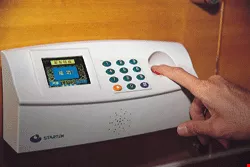
Lost your employee ID Card? Forgotten your password? You can put an end to these hassles just by extending your finger. In Taiwan there are already several office buildings using Startek's door security and personnel attendance tracking systems.
Conquering the world with patents
Hsu, who is now 50, was in the same class at Taipei's Chien-kuo High School as Taipei mayor Ma Ying-jeou. After studying electrical engineering at National Cheng Kung University, he earned a doctorate at Japan's Keio University, where he wrote his dissertation on optical character recognition systems. This was his first step down the path toward the systems he would later develop at Startek.
And quite a successful first step it was. Shortly after his dissertation was published, a Japanese company bought a patent that Hsu had obtained based on his research and built a character recognition device with a price tag of 40 million yen. The product became a gold mine for the company, and the experience provided the initial motivation for Hsu to focus on "turning knowledge into profit."
As one of the field's pioneers, Hsu has six international patents for optical recognition inventions, which are a source of much pride for him. Startek has used these technology patents to acquire stock in companies in Japan, the United States and elsewhere. These foreign companies invest time and money on marketing and licensing the technology, and then they share the royalties equally with Startek. Very few Taiwanese companies are able to make money abroad in this fashion. Acquiring these knowledge dollars without having to put up any money of your own is a perfect instance of profit in the "knowledge-based economy."
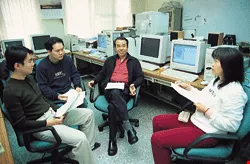
Year after year, Hsu's doctoral students win awards for their dissertations. Hsu isn't shy about offering them lessons from his own entrepreneurial experience.
Driving safely
Why did Hsu pick an unpopular field like optical recognition as the focus of his development efforts? "The true information age should be starting now in 2001," says Hsu, who takes a long-range view of the information industry. "Up to now, we've simply been laying the groundwork." People can't use roads until they are built, explains Hsu by way of analogy. With computer technology coming into maturity and broadband Internet access gradually becoming widespread, the information, materials and capital are all ready to roll. Now the most pressing need is safety.
"With trucks and compacts using the same road, dangers are found everywhere," Hsu says, sticking to his metaphor. "If drivers are clueless and constantly breaking the rules, then no one will survive on a highway like this for very long." In the 12 years that Startek has been in business, Hsu has insisted that it continue to pursue OCR research because he believes that researchers must be farsighted, accurately assessing people's needs a decade or two down the road. But when you get in early as a pioneer, you then have to wait for the market to mature.
Although Startek sells OCR systems, it is even more concerned with the development of related software. The company has no production lines, outsourcing all of the assembling. Instead of building machines, the 50 employees of the company cloister themselves in their relatively small office space, spending their days staring at computer screens, and writing all manner of complex codes.
Hsu points out that industrial development has now come to full flower, with productivity greatly rising. For the first time in history, people need not worry about material want. But the surfeit of consumer goods is raising one environmental warning sign after another. Mankind is now moving to treasure resources and overcome material desires. Yet out of step with international trends, Taiwan is still focused on the manufacture of hardware.
With people spending half their days on line in front of their computers-gaining knowledge, buying stuff, playing games, and chatting with friends-the industries related to the Internet are by necessity the stars of the day. Internet stocks have collapsed for two reasons: (1) as an inevitable consequence of people swarming to invest and (2) as a result of half-baked Internet business models. There are many users, but there are few buyers. In other words, collapsing share prices are a temporary setback for the Internet industry, and will not change the general trend toward growing Internet use.
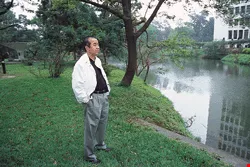
Hsu, an academic who spent years in Japan as a graduate student, has a traditional Taiwanese gentleman's elegance. Here he appears by a lake on the campus of National Tsing Hua University.
Foiling evildoers with fingerprints
"During economic downturns, the issue of security receives greater attention." Currently, Startek is working with James Shaw and Sherman Tuan, overseas Chinese entrepreneurs in Silicon Valley, to develop a method of verifying identities electronically. By using either handwriting analysis or fingerprint matching, you could eliminate concerns about credit card fraud. The market for fingerprint recognition has taken off over the last two years, and now amounts to US$1 billion a year, a figure that amply displays the potential for this industry.
After Startek won a Gold National Award of Excellence last year, it then won an annual award for excellence in information technology applications for a circuit board which boasts no fewer than five world-first innovations despite being the size of a business card. It can distinguish between 5,000 different configurations of fingerprints. A person's identity can be verified within a second. Moreover, it is extremely accurate, and its price is only a bit over NT$10,000. It can be used to check identities at hotels and in place of time card machines in offices. It can also be used for safe deposit boxes or for computer network security.
This fingerprint verification module hasn't been around for even six months yet, but in Taiwan and Japan there are already 200,000 people using it for security purposes every day. And Startek has received several thousand orders from Japan for an even newer fingerprint security module it has developed for PCs. Its prospects look good.
For a company like Startek, a frequent winner of national awards, innovation and foresight aren't problems. But being so far ahead of the curve has its frustrations. Because markets for many of its products have not developed to maturity, it frequently finds that there is a lack of technology to work in conjunction with its products. As a result, some of its development efforts go for naught.
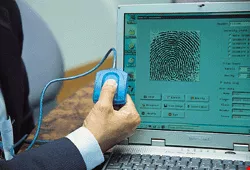
Security devices will play an important role in the future of information technology and telecommunications. Fingerprint recognition systems have been designed for PCs, notebook computers and mobile phones. In the future, national identity cards, drivers' licenses and banking cards may also be equipped with fingerprint verification software to stymie thieves.
The loneliness of the pioneer
To combat the problem of thieves withdrawing other people's money with stolen ATM cards, as early as six years ago Startek worked with IBM of South Africa to create the first ATM machine that reads fingerprints. It was used at 24 branches of Standard Bank there. Unfortunately, computer operating systems change quickly. Now those fingerprint readers, which only work with IBM OS2, are no longer in use.
"Technological innovation is often out of step with market demands," points out Hsu. Fingerprint recognition requires image processing. The calculations are very time consuming. It wasn't until Intel started producing Pentium II processors that the commercialization of fingerprint recognition technology became feasible.
Last year, to great fanfare, the US Bureau of Standards announced two regulations relating to international standards for fingerprint technology. When the regulations were announced, 90% of major international producers, including NEC and Fujitsu, discovered that their previous efforts in the field had been wasted. Startek, however, had correctly guessed that recognition standards would be based on key points for each print. Startek is now one of only three firms anywhere in the world that can provide the proper fingerprint recognition software, and its products are technically the most advanced.
Returning to the lab
Although he is Startek's CEO, Hsu was once deputy director of the Opto-Electronics and Systems Laboratories at the Industrial Technology Research Institute, and he is still a member of the Institute of Information Science at the Academia Sinica and professor of electrical engineering at Tsing Hua University. By nature he is a true academic. Instead of putting the focus on grabbing the opportunities right in front of your eyes, the "Created in Taiwan" campaign that he takes every opportunity to advocate emphasizes making long-term profit by pioneering new technology.
Observing how the integrated circuit industry in Taiwan has lost its luster and industrial development its focus, Hsu finds it hard to conceal his concern. He points out that while there's nothing wrong per se with OEM manufacturing, it does distort how the precious resource of research manpower is used. In particular, over the last decade the graduates of the various university information institutes have all gone to work for top manufacturers as engineers. None are willing to toil in research labs to create products of their own.
Moreover, there isn't an adequate concept of intellectual property rights within Taiwan industry. Most Taiwanese product developers believe that changing something by 1% is enough. They don't realize that in the United States and Europe the concept has long been that "if it's just a little bit alike, it's a knock-off." The result is that engineers here are constantly stealing ideas, and their managers are blind to it. Deep-rooted ways of thinking can't change just like that. It is too much to expect Taiwan to develop a "knowledge-based economy" overnight.
Hsu's personality and character are reflected in his style of teaching. Various dissertations for which he has acted as an advisor have won national awards. What is the key for a famous teacher to attract high quality students? The answer is a broad perspective and objectivity.
In a cleanroom
As an advisor on dissertations, Hsu requests that the students first spend three months examining the past 30 years of research history in the field, asking themselves such questions as the following: Who were the important forerunners in this field? Who have carried on in their traditions? What are the various schools? What are their differences? Only when you can draw a chart that clearly traces the history of research in this field can you know for sure that you won't accidentally be duplicating the research of your forerunners.
"When you do any kind of research you must have a broad understanding of the field, and objectivity," says Hsu. For the following three months, Hsu demands that his students study all of the dissertations in the field, so as to absorb and digest the information. Afterwards, the students have finally reached the final stage that requires them to cloister themselves in the "cleanroom of the mind"
In the "cleanroom" you discard all of what you have read by others and start thinking for yourself. At this point Hsu will occasionally ask his students questions to stimulate their thoughts.
Long involved with imaging research and also an expert ballroom dancer, Hsu is worried about the creative abilities of Taiwanese. He says that the information age is an age of expression. The method of expression can be the one-dimensional expression of writing and music, the two-dimensional expression of painting, or the three-dimensional expression of sculpture. By adding the fourth dimension of time, you get the expressions of theater or cinema. But Taiwanese students can copy and memorize, but they can't express originality and don't understand how to use things creatively. This is an Achilles' heel for industrial competition in the information age.
"It's not as if Taiwan lacks chances for success, but our generation is going to have a tough time of it," Hsu says. "We can only hope that loosening the binds of education will allow the next generation to become more creative, so that it can take its products that are 'created in Taiwan' onto the world stage!" As a pioneer of creating high technology in Taiwan, Hsu's experience is worth studying and reflecting upon.


