Manufactured in the Mainland, Made by Taiwan
Laura Li / photos Diago Chiu / tr. by Phil Newell
July 1994


Ever since the new variable of the "cross strait economy" entered the picture, scholars, officials, and businessmen in Taiwan have busied themselves with endless optimistic and pessimistic scenarios. The government has been getting more and more nervous, even as the private sector has become more and more fired up. As the pace and the scale at which Taiwan factories relocate to the mainland increase, will Taiwanese businessmen be building up their own competitors in the PRC? Will it be a case of "teaching the acolyte how to outsmart the master"? It's something quite a few people have been worrying about.
As you enter a Taiwanese shoe manufacturing plant in a suburban county of Shanghai, the factory is silent as the 1,000 or so workers bury their heads in concentration over their cutting. Taiwanese managers who periodically make the rounds watch and offer advice, while the employees look respectful and eager to learn more. Who knows how many of the workers in this factory will not themselves become skilled supervisors and future bosses, competing with the Taiwanese companies?
For Taiwan companies, which have struggled to catch up to the Japanese and taken on and beaten Korean and Hong Kong competitors in the international marketplace, this does not present a new challenge. The problem this time is that the main competitor--mainland China--is not like those others.
First, mainland and Taiwan firms share a common language and a common cultural background. The PRC is an enormous economic unit with the potential for explosive growth. Like a "black hole," it could absorb and exhaust Taiwanese capital and technology. Further, the political standoff between the two sides has yet to be resolved. Commercial competition may have a complex impact on all this, and should not be seen as a simple economic problem. It's hard for anyone to look at all this with equanimity.
The market economy has just taken hold in the PRC. Are they really ready to take on Taiwan and its 30 years of experience and success? Have economic relations between the two sides gone, as some have feared, from a "positive-sum complementarity" where both sides benefit to being a "zero-sum competition" where one side can gain only at the expense of the other?
Chung Chin, an assistant researcher at the Chung Hua Institution for Economic Research, is currently working on An Analysis of Trends in Industrial Competition Between the Two Sides of the Taiwan Strait, a study commissioned by the ROC's Council for Economic Planning and Development. Addressing the above question, she points out that between any two economic entities which have interactions there will be both complementarity and competition. In fact, even before Taiwan allowed visits to the mainland and permitted interactions across the Taiwan Strait, the products of the two sides were already competing head-to-head in third-country markets (i.e. markets other than Taiwan or the PRC).
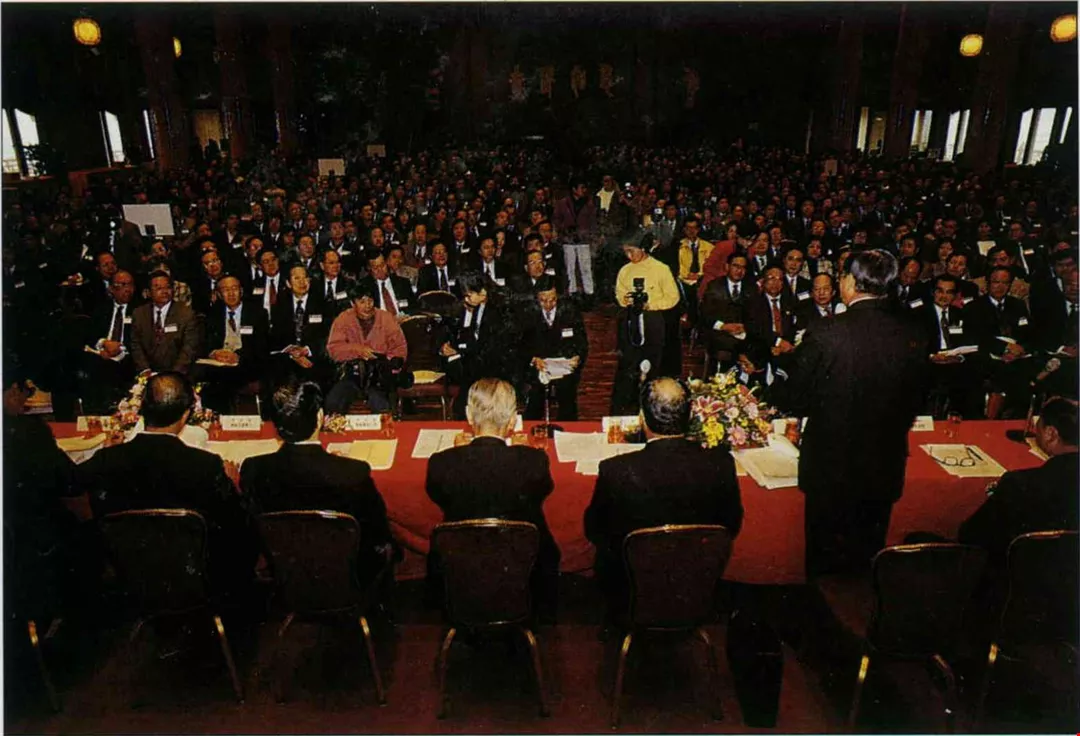
In February the Chinese National Federation of Industries held a "New Year's Friendship Meeting for Taiwan Businessmen Investing in Mainland China." The event attracted nearly 1,000 entrepreneurs, and many relevant government officials also attended.
Taiwan does the work, mainland gets the credit?
Because the mainland domestic market has been opened to outsiders for only three years, and Taiwan has yet to open its market to imports from the PRC, the main areas of commercial competition remain these third-country markets, especially the United States, Japan, and Europe.
Looking at the results in these markets, there has definitely been a trend for Taiwan's fortunes to wane and those of the mainland to wax. For example, in 1991 export value from Taiwan to the US was 1.2 times that from the PRC, but was only 0.96 as large in 1992, when the mainland surpassed Taiwan for the first time. The mainland has long been ahead in the Japanese market, and the gap has been growing. In 1992 the PRC exported 1.8 times as much in value to Japan as Taiwan did.
In the past Taiwan was known as a leading producer of shoes, umbrellas, textiles, ready-to-wear clothes, toys, lamps, and handicraft gifts. But the mainland has already taken over in these areas. In the last two years, after the ROC government relaxed restrictions on the types and amount of investment that Taiwan firms could make in the mainland, mid-level technology industries like electronics and computers-which now account for the largest proportion of exports from Taiwan have moved to the mainland. Many large companies which list on the Taiwan stock market have done likewise. This is a warning signal for Taiwan, whose economy has always depended heavily on exports.
Yet figures on paper are far from telling the whole story. How much of the mainland's exports are actually from Taiwanese firms which have relocated there? Everybody has a different opinion on this riddle.
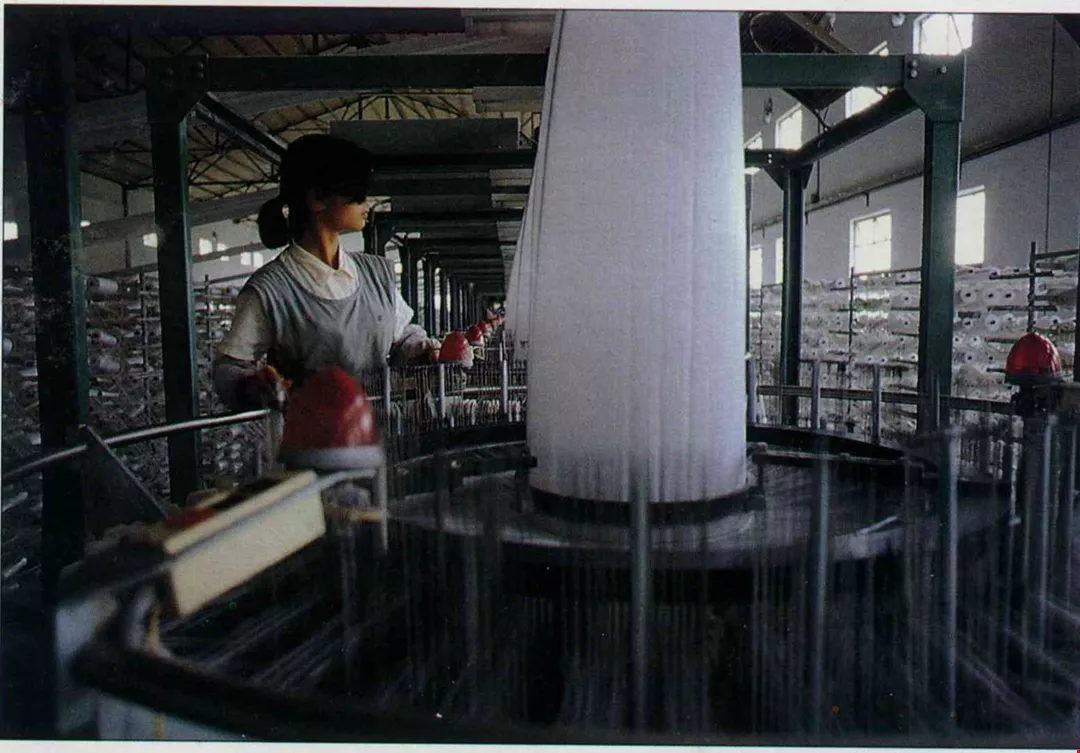
When Taiwan firms invest in the mainland, they build factories and bring over capital and technology. Inevitably they will have an instructional and demonstration effect. The photo shows a Taiwan plastic bag factory in Xiamen. (photo by Pu Hua-chih)
Value of production going up
Chung Chin has calculated the "export transfer effect" based on figures announced by the PRC for total Taiwanese investment in the mainland in 1991. She discovered that Taiwanese capital has made a startling contribution to mainland exports. She estimates that Taiwanese companies accounted for US$5.3 billion in exports from the PRC in 1991, or 11% of the PRC's total manufacturing exports. Of these, Taiwanese firms accounted for 43% of all mainland exports in rubber and plastics, 42% in transportation equipment (mainly bicycles), 37% in electronics and electrical goods, 24% of miscellaneous manufactured goods (shoes, toys, handbags, and so on) . . . .
Chung Chin explains that she used data for 1991 because it made calculations relatively simple. In 1991 the PRC was strongly encouraging foreign firms to go all out to export goods and earn foreign exchange, and Taiwan firms were given little access to the domestic market. Therefore using total Taiwanese investment in the economic formula to calculate the contribution made to mainland Chinese exports would give a close approximation to the actual figure. However, after Deng Xiaoping's "southern tour" in 1992, the mainland opened up its domestic market and its service industries; Taiwanese enterprises consequently diversified and broadened their areas of operation, so that making a similar calculation based on investment data for 1992 would be much more difficult.
Turning to look at figures from Xiamen, 6O% of the total value of production in the Xiamen Special Economic Zone can be ascribed to firms established by "external investors" (foreign, Taiwanese, and Hong Kong capital). Of this 60%, Taiwan businesses take up 40%, which means that Taiwan capital generates a full quarter of the value of production of industry in Xiamen.
"This figure is probably an underestimate," points out Kong Changcai, who is concurrently deputy director of the Xiamen City Taiwan Affairs Office and vice-chairman of the Association of Taiwan Invested Enterprises. This is because, first, Taiwanese firms have long been accustomed to "going in high, coming out low, " and reporting losses on their manufacturing books. In the second place, many Taiwan firms have taken advantage of the tax-exempt period which is part of the "two exemptions and three reductions," and during this period Taiwan firms are less than precise about reporting tax data. Thirdly, many Taiwanese firms register under Hong Kong fronts, so their investments are calculated as coming from the Crown Colony rather than from Taiwan. If you calculate in these caveats, then the contribution of Taiwan capital to Xiamen's total value of production would be even higher.
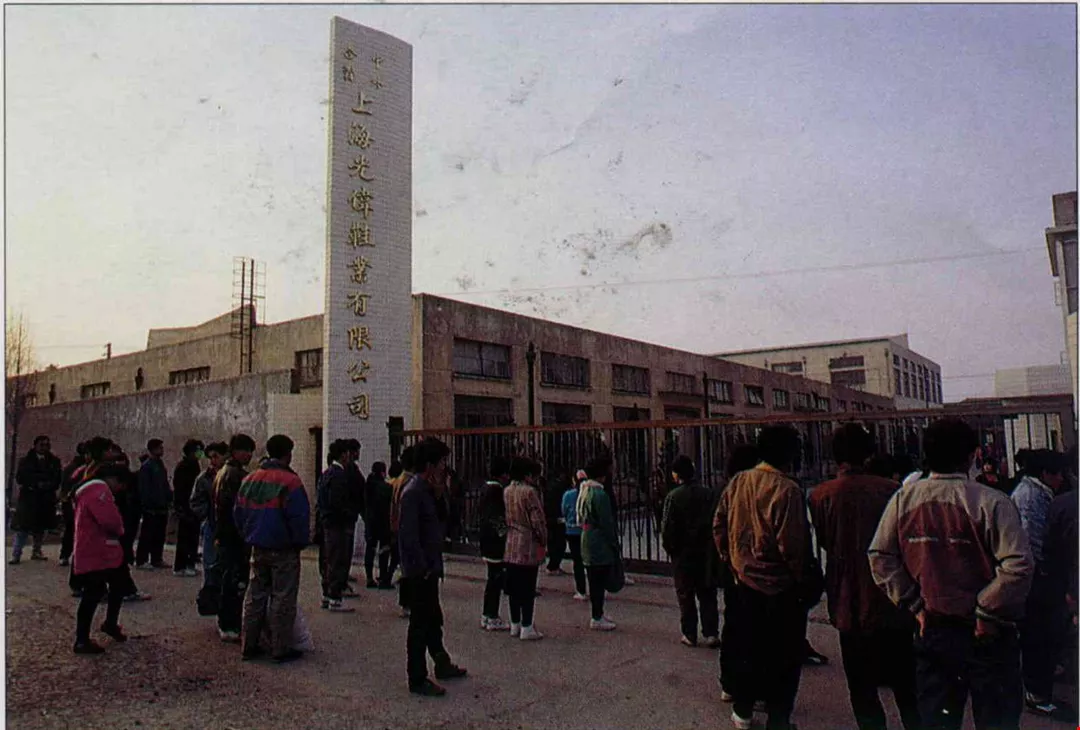
There is often a line of people looking for work outside of Taiwanese factories, or waiting for relatives inside who have just picked up their pay to pass it out. The shoe factory in the picture is a joint venture between Taiwan's Victoria Success and Fengxian County near Shanghai.
The acolyte outshining the master?
Although it is hard to nail figures down to the exact dollar, supporting evidence for the above conclusion that a lot of mainland exports come from Taiwanese firms comes from estimates by those in business. For example, David Jiang, operations section chief in the Taiwan Footwear Manufacturers Association, reckons that two out of every three pairs of shoes exported from the PRC are made by Taiwanese companies. It's true that the label says "Made in China," and not "Made in Taiwan, " but Taiwan entrepreneurs are still reaping the profits.
"As long as the United States continues Most favored Nation status and offers GSP privileges to China, it will be no problem to maintain these levels of success," he says, brimming with confidence.
In other words, argues Chung Chin, if you forget about the actual location of production, and simply calculate on the basis of "production value under the control of Taiwan firms, " there has even been a small increase over the past. "In sum, then, Taiwanese firms are growing in both production scale and value of production. " Even if the proportion of total mainland production accounted for by Taiwan companies will drop over time as the PRC's entire economy grows, the fact will remain that Taiwan companies will not have lost any real strength compared to the past.
Nevertheless, growth in individual industries and growth in Taiwan industry are two different things. What's more, these small and medium enterprises which have gone to mainland China were the driving force in the Taiwan economic miracle. Relocating to the mainland to seek a new lease on life, inevitably they will become "localized" after a long period there. And in the process of "localization," they will unavoidably transmit all types of technology and know-how. In the end, what kinds of "acolytes" will Taiwan businesses be training? After striking out on their own, will these acolytes return to defeat their former masters? Will they bring harm to Taiwan itself?
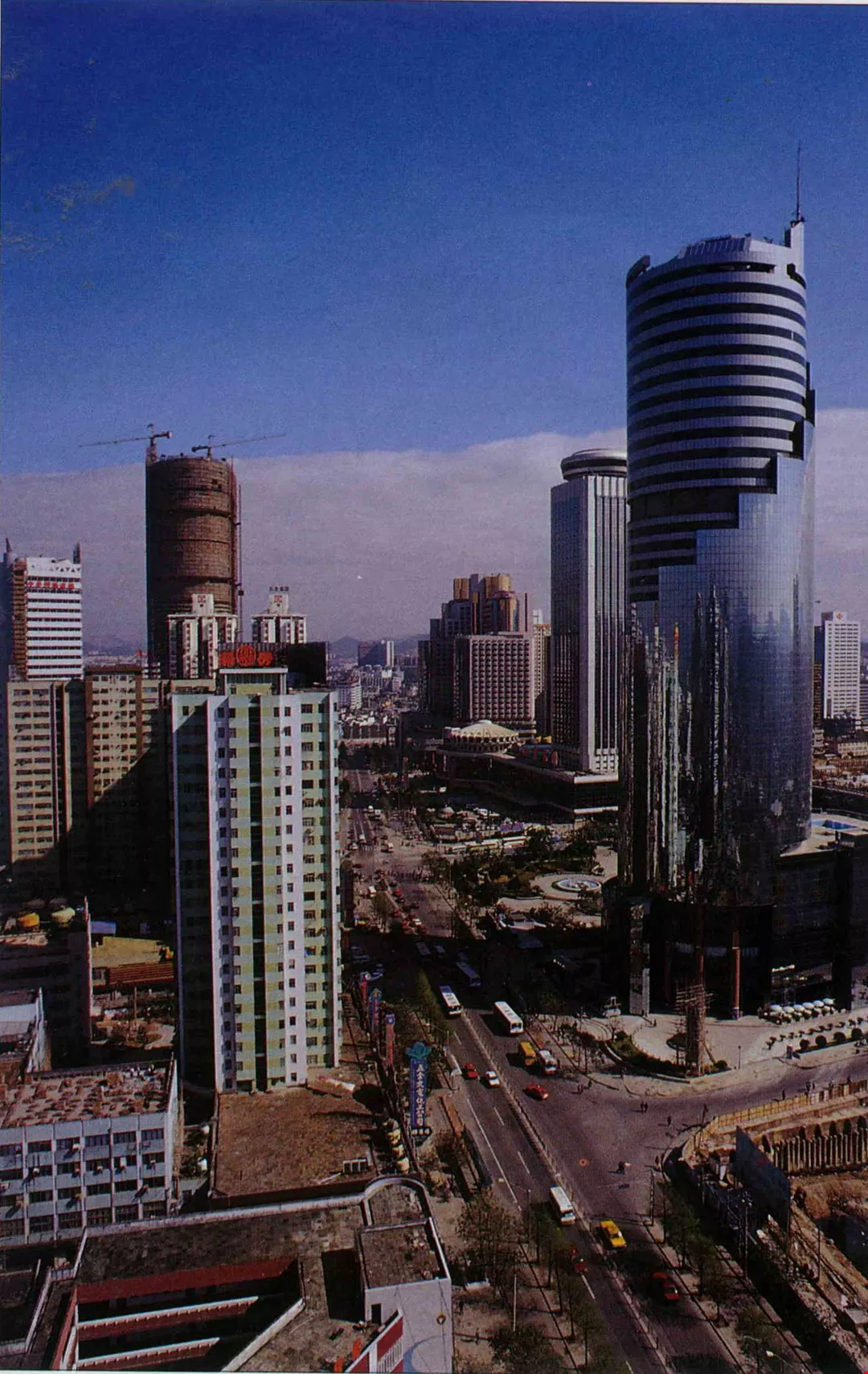
Long streets lined with skyscrapers--it's hard to imagine that only 15 years ago Shenzhen was a sleepy fishing village.
Mainland technology is not that backward
Fortunately, it seems the master has still not lost his touch. Or rather, let's say that the acolyte has a number of innate and acquired disabilities which hamper learning, so that the superiority of Taiwan firms is not yet being challenged.
Looking in turn at the three major forms of enterprises in the mainland today, state-run enterprises still labor under a heavy burden of weak incentives created by the "iron rice bowl"; private enterprises are still in their infancy; and township collective enterprises, which stand between these first two types in terms of scale, are mainly rural, and still lack the capital, information, and trained personnel to pose a direct challenge to Taiwan firms.
So how good are mainland Chinese products when all is said and done? In fact, many Taiwanese tourists travelling in the PRC are surprised by the low prices and nice styling of the handbags, shoes, and clothing being sold on the streets of Guangzhou and Shanghai. But it's too early to begin crying wolf. Often when you look more closely you see that the stitching on the clothing is badly done, or that the clasps on the handbags don't hold together. These types of flaws ruin otherwise appealing products.
"In fact, the technology level is not too bad in many of the traditional industries in mainland China," says Hsu Ming-sheng, a director of Taiwan's Chunghsing Textiles and concurrently general manager of the Shanghai Three Rifles Company. For example, there is a venerable Textile University in Shanghai, from which many of Chunghsing's mainland staff have graduated. Also, Shanghai and Putian (in Fujian) have been famous for their shoe production for half a century, and the strict system of masters and apprentices has been maintained to a certain extent.
Victoria Success Investment Limited, a Taiwan company which mainly manufactures shoes, now has 12,000 employees on the mainland. For its two cooperative factories in Shanghai it deliberately selected suburban medium-sized township cooperative enterprises. General manager Lu Teng-feng explains: "We would never place orders with the huge state-run factories in Shanghai City. They have too good a foundation, and they would learn and copy from us in an instant. " Victoria Success general manager Keeper H.M. Chen is even more wary, and constantly keeps an eye on what the big state run factories are up to. "They are progressing very quickly, so I feel threatened, " he relates.
If the subject is limited to manufacturing technology, then Taiwan companies have no huge advantage. Fortunately technology is just one element in commercial competition. Mainland manufacturers still offer too few styles, and use outdated materials. They are not like Taiwan firms, which can afford to bring in superior, more durable materials from abroad. Most importantly, they have weaker quality control and do not deliver promptly; these are their real weak points.
Aside from technical production and business factors, the real Achilles' heel of state-run and collective enterprises in the PRC is that they "lack entrepreneurial spirit."
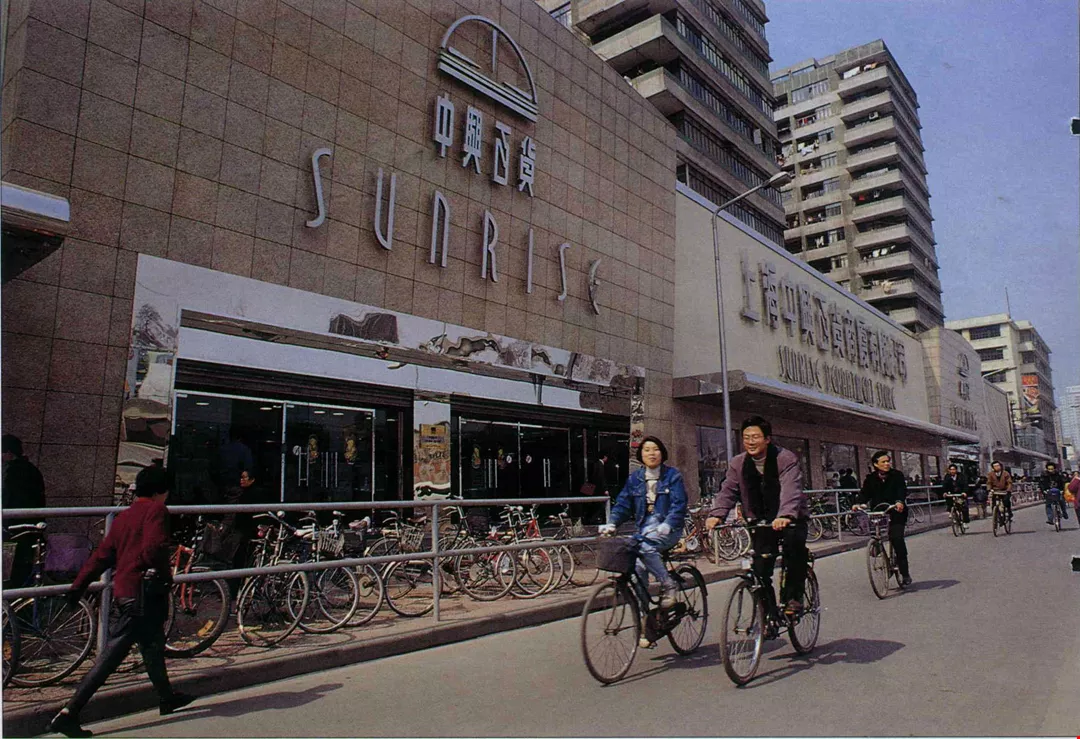
Taiwan's Sunrise Department Store has set up a branch in the Xuhui district of Shanghai, and is trying to break into the retail network.
The battle is won behind the lines
Taking shoes, for example, given that two out of three pairs of exported shoes are made by Taiwanese firms, the other is made by a state-run shoe factory. But as David Jiang observes: "Almost all the state-run shoe factories operate at a loss. Orders are under one government bureaucracy, while production is under a separate department, and exports are under yet another. In fact, no one cares whether the enterprise as a whole is using capital efficiently."
A certain General Manager Wu from a large Taiwan computer concern who went to the PRC to invest last year after receiving government approval shares this view. He notes that after 4O years of being in a centrally planned economy, the mainland's large state-run enterprises lack any conception of market competitiveness. "When they run into an operating problem, they never think about restructuring or strengthening their own competitiveness. They just try to figure out how to siphon off more social resources to make up for their losses."
"You want state-run enterprises to compete with the private sector?! Dream on!" argues Christopher Chen, vice president of EDA Incorporated, a computer peripheral supplier (producing mainly computer linkages) with a plant in Shenzhen. This belief is held worldwide, not merely in discussing Taiwan and the PRC.
"Just look at the mainland's second largest computer linkage manufacturer, the state-run Chen Jiang plant. They have 5,000 employees, seven or eight times as many as we do, but their annual production value is only one-third ours, and their prices are three to five times as high. How can they compete?"
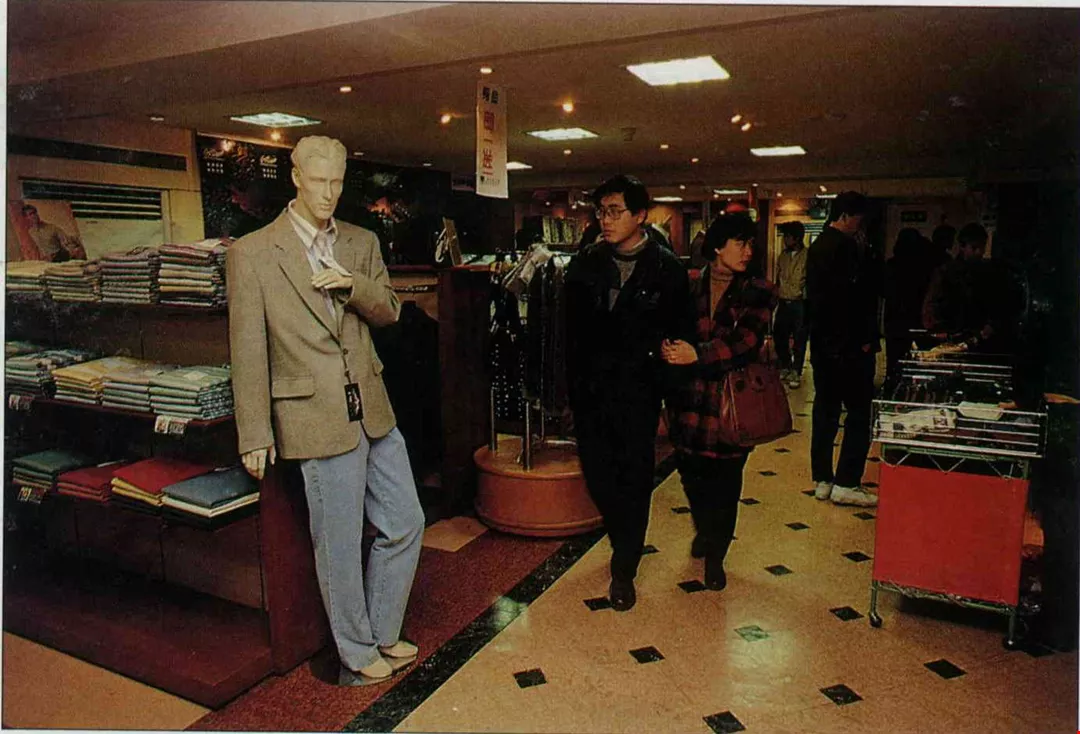
There are many familiar-looking products in mainland department stores. It turns out they are produced by Taiwan-invested enterprises and sold simultaneously on both sides of the Strait. The photo shows the Sunrise Department Store in Shanghai.
Entrepreneurship still distant
State-run firms are not products of the market economy, so naturally they are at a disadvantage. Looking back at the history of Taiwan's economic growth, the makers of the economic miracle were the small private companies that accounted for over 96% of all firms. Does this mean, then, that we should look to the mainland's private enterprises as the real competitors for Taiwan companies?
That's not such an easy status for them to achieve at the moment. Private firms with eight or more employees only achieved formal legal recognition in 1988. They are still relative toddlers in the PRC's economic structure, and the mainland's overall economic environment is not conducive to entrepreneurship.
Entrepreneurial activity requires first determination, and second cash. Early on serious unemployment in Taiwan made individual entrepreneurship essential, giving rise to slogans like "every home a factory." Given the uncertainty of finding a job, many people had no choice but to strike out on their own and create their own companies with themselves as the boss. In the PRC, however, they have had an "iron rice bowl" (guaranteed employment) system for decades. Few people have developed the skills or the willingness to take independent risks, crippling the motivation for entrepreneurship.
Moreover, capital has been fairly easy to find in Taiwan. Not only has the government offered entrepreneurial loans, most private citizens have been able to use their savings, revolving credit associations, or land or homes to acquire capital. Between 1982 and 1988, the average savings rate was 34%, while inflation was less than 1%, creating a startling rate of capital accumulation.
These conditions all are much weaker in the mainland. Land is state property, and most people live in homes owned by their work units, so that these cannot serve as collateral for "start-up capital." Another reason why private enterprise is having a hard time burgeoning is because "government policy is tilted in favor of foreign and Taiwan investors." It is still up in the air whether or not the mainland can duplicate Taiwan's development experience. "We are not worried that our employees will learn the techniques and then found their own businesses," says Christopher Chen, since the "hurdles" are harder to get over.
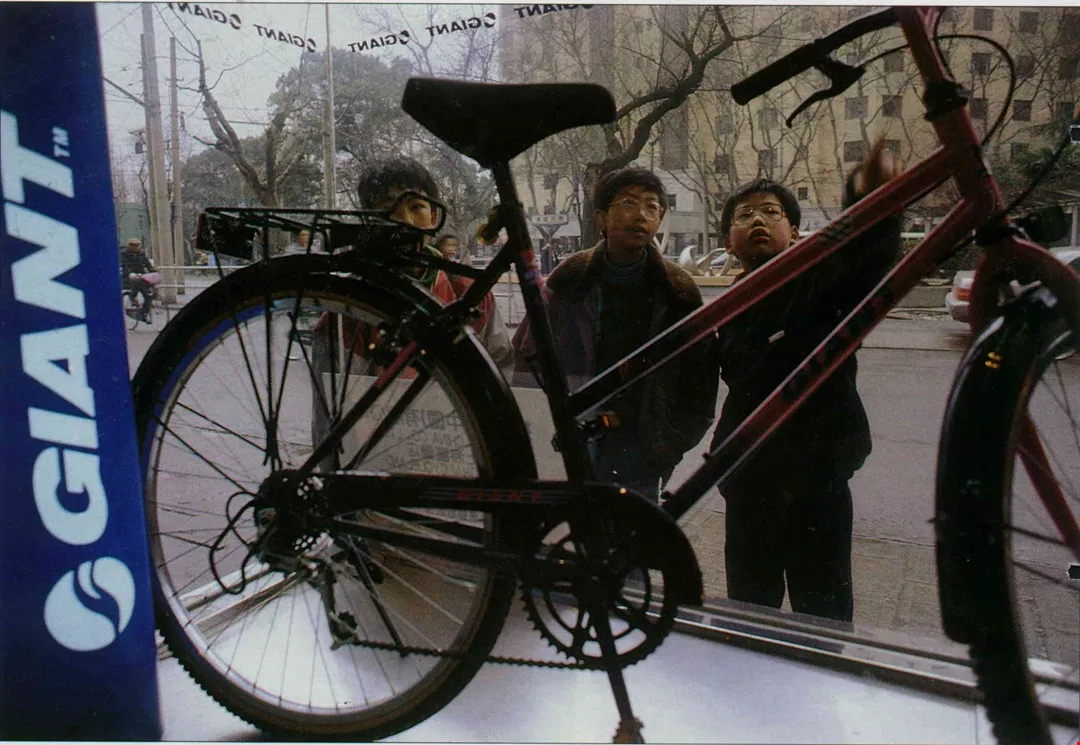
Giant brand bicycles, one of the great success stories of the Taiwan experience, has a factory in the mainland and sells in the domestic market there, creating a new whirlwind. (photo by Lin Cheng-hua of Global Views Monthly magazine)
A good man is hard to find
It's not all that unusual for Taiwanese firms concentrated in the Fujian--Guangdong belt--who hire many workers from other provinces because they are cheaper than local employees--to find that an employee has "jumped ship" during the month-long New Year's holiday. However, most employees who jump ship end up on other ships in the same fleet (i.e. also in foreign corporations). It's still too early to talk about those founding their own enterprises to compete with Taiwan firms.
Mainland employees don't take much initiative, sometimes frustrating Taiwan employers trying to "turn iron into steel." For example, when they run across a problem mainland workers often just stop and set their work aside, waiting for the Taiwan technician to come and solve it for them. "In fact, they could probably figure it out for themselves, but they are very passive," says Christopher Chen.
In fact, many Taiwan bosses will actively encourage their employees to learn the business. "Our mainland staff make money for us, so of course we hope they will learn quickly and learn thoroughly. It's impossible to try to prevent them from progressing, and unfair as well," says Lai Hsien-kung, mainland general manager for the Victoria Success Shoe Company. And Taiwan manufacturers aren't the only teachers. Some things that Taiwan companies don't teach, the mainland can learn from Hong Kong, Japanese, or South Korean companies. It's simply easier to learn from Taiwan companies because of linguistic and cultural similarities.
As for technology transfer to the mainland, Kao Chang, a researcher at the Chung Hua institution for Economic Research, says that the reason Taiwan was able to quickly absorb and disseminate technology learned from the United States or Japan was because Taiwan had several important conditions: One was that the labor market was open and competitive, so that personnel could move freely and "jumping ship" to found new enterprises was widespread. Another was that the level of education in Taiwan was generally pretty good, and in particular there was an abundance of people with industrial or technical skills. These factors led to the phenomenon in Taiwan of "each person having a skill, each person wanting to be a company boss."
Of course, in terms of sheer numbers, it is said that the PRC has 600,000 research and development personnel. Nevertheless, due to various objective and subjective conditions, they do not have a very close relationship with developing industries. Kao Chang points out that most Taiwan firms use workers from the interior of China who don't have very high educational levels. For middle and high ranking technical or managerial personnel, it is necessary to go to the universities or state-run companies in the big cities. Sometimes the unit to which the person belongs will not release them, or there are problems with residency permits, so that there is nothing the Taiwan company can do.
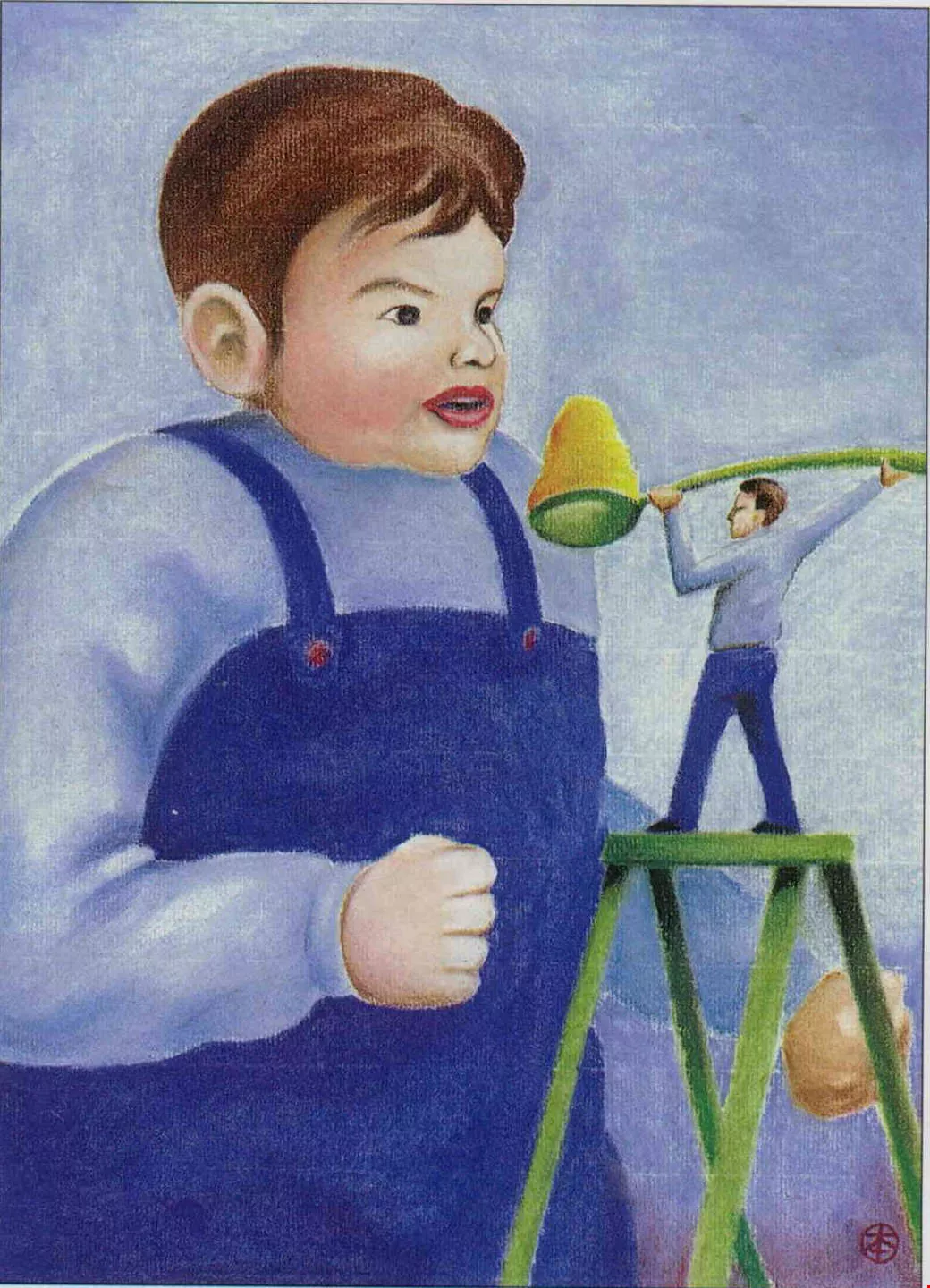
Taiwan firms have added vitality to the mainland economy, but they had best not forget to keep working to maintain their competitiveness. (drawing by Tsai Chih-pen)
Is it better to hold back?
Dealing with employees who don't appear to pose much of a future threat, will Taiwan enterprises lower their guard?
It's very possible. S.C. Yang, chairman of the Taiwan Bags Association and head of the Yuen Feng Plastics Corporation, notes that it is true that some foreign customers have already offered friendly warnings to Taiwan firms: They wonder whether Taiwan should allow the technology and know-how acquired through 20 years of arduous effort to go so easily to the PRC in a short three to five years. Isn't this shooting oneself in the foot?
"That's not an inaccurate statement. But for small factories, when the whole company moves across to the mainland, and they have to produce there and employ local people, and then in the end give everything up after a few years to their partner factory in the PRC, how can they protect themselves?" Yang has warned many factories through the Association, but with little effect.
Fortunately, Taiwan companies have been performing well in the mainland. Although it is hard to get precise figures, S.C. Yang estimates that, if you ignore the actual location of production, Taiwan is still "the world leader" in production of handbags. As supporting evidence he cites what the head of the American industry association had to say: "No matter where we American importers go, it seems we always end up doing business with you Taiwanese businessmen!"
"And it will be no problem to stay ahead for the next five years." The confidence in Yang's voice is something shared with other Taiwan businessmen.
The master learns faster than the acolyte
Despite the fact that the acolytes may have certain "learning disabilities," inevitably there will be some prodigies who are ambitious and who pick up the tricks of the trade quickly. "When we go to the joint venture Taiwan factory, we do our best to be good students and learn as much as we can," says Jiang Liuying, vice president of Shanghai Song Xing Textiles Company, a joint venture between Taiwan's Chunghsing Textiles and Songjiang County near Shanghai. Jiang, who is the county government's man, says a little bashfully, "Of course there is an ambition to compete with Taiwan, even though we can't overcome our disadvantages all at once."
Kao Chang takes a more prudent posture: "The problem of the acolyte beating on the master will gradually surface in the future." To put it another way, it took Taiwan 20 years to mature under guidance from the United States and Japan, so it's way too early to be talking about the mainland's accomplishments in this regard right now.
The way it looks right now, though the acolyte may surpass the teacher, the teacher doesn't have to take it lying down. With the help of their workers in the mainland, Taiwan's industrialists are still "number one in the world" in many traditional industries in terms of actual control of the production volume.
Moreover, in terms of qualitative upgrading, these firms have won themselves a precious transitional period. "Taiwan's parent factories don't have to worry about making low-grade products. They can concentrate instead on research and development and on marketing. This is definitely of considerable help to upgrading our competitiveness." This is a common refrain among Taiwan's businessmen in any industry, from computers to shoes. In the latest survey by the well-known economists Kao Hsi-chun and Lin Tsu-chia, it is believed that industrial upgrading and adjustment is the correct path for Taiwan industry.
It seems the timing is just right for Taiwan companies to be hurried along this path by mainland companies yapping at their heels.
[Picture Caption]
p.6
Formerly Taiwan led the world in production of many types of products; today, the "Made in Taiwan" label has been replaced by "Made in China," but Taiwanese companies Still dominate. (drawing by Tsai Chih-pen)
p.8
In February the Chinese National Federation of Industries held a "New Year's Friendship Meeting for Taiwan Businessmen Investing in Mainland China." The event attracted nearly 1,000 entrepreneurs, and many relevant government officials also attended.
p.9
When Taiwan firms invest in the mainland, they build factories and bring over capital and technology. Inevitably they will have an instructional and demonstration effect. The photo shows a Taiwan plastic bag factory in Xiamen. (photo by Pu Hua-chih)
p.10
There is often a line of people looking for work outside of Taiwanese factories, or waiting for relatives inside who have just picked up their pay to pass it out. The shoe factory in the picture is a joint venture between Taiwan's Victoria Success and Fengxian County near Shanghai.
p.11
Long streets lined with skyscrapers--it's hard to imagine that only 15 years ago Shenzhen was a sleepy fishing village.
p.12
Taiwan's Sunrise Department Store has set up a branch in the Xuhui district of Shanghai, and is trying to break into the retail network.
p.13
There are many familiar-looking products in mainland department stores. It turns out they are produced by Taiwan-invested enterprises and sold simultaneously on both sides of the Strait. The photo shows the Sunrise Department Store in Shanghai.
p.14
Giant brand bicycles, one of the great success stories of the Taiwan experience, has a factory in the mainland and sells in the domestic market there, creating a new whirlwind. (photo by Lin Cheng-hua of Global Views Monthly magazine)
p.15
Taiwan firms have added vitality to the mainland economy, but they had best not forget to keep working to maintain their competitiveness. (drawing by Tsai Chih-pen)


