Time to Understand Scientist Ovid Tseng Gets the Basics Down
Vito Lee / photos Chuang Kung-ju / tr. by Minn Song
December 2005


A few columns giving balance to an entire edifice--this notion from classical Greece seems to inform the life of Academia Sinica vice president Ovid Tseng.
Of these supporting columns, science is the first. Vowing in university to "test the depths of the mind," Tseng has traversed the disparate fields of educational psychology, general psychology, neuroscience, and linguistics.
Outside the laboratory, exercise and listening to music are two other pillars in his life. He has pursued these two interests uninterrupted for several decades. While he normally walks at a stately pace, when he enters the gym Tseng springs to life, even taking on a certain ferocity. His knowledge of his beloved badminton--from the basic moves to extremely specialized sports physiology--would be a match for any university coach. Taiwan's professional baseball league once considered inviting him to serve as commissioner because of his enthusiasm for and expertise in sports.
Though Tseng no longer plays the trumpet as he did in high school, he likes to draw out the similarities between the phonemes of linguistics and musical sounds, making music--including Peking Opera--part of his research. By bringing language and music together in his research, he is also combining his personal interests and research into a seamless whole.
Tseng's love of knowledge, whether it comes from the laboratory or not, extends to his personal life, where he also seeks to attain wisdom. Equipped with the latest knowledge about cognitive science, Tseng returned to Taiwan 15 years ago, and established the country's first cognitive science research center, where Taiwan would catch up with the advanced countries. The center, at National Chungcheng University, combined the study of the mind (cognitive science) with that of the body (neuroscience) to commence a deep exploration of the mysteries of the brain--an exploration that has yielded significant achievements.
What secrets lurk in the mind of this scientist studying the brain?
Did the Vikings of Scandinavia originate in the American state of Oklahoma? Early this year, many American students using the Internet to access information ended up reading about some bizarre ideas like this one. The students' practice of searching the Web and then copying text and pasting it into term reports that were handed into their teachers, led to many teachers shaking their heads in disappointment.
Such a situation is not exceptional. From elementary school to university, from America to Taiwan, by making the distribution of information more convenient the Internet has also turned into a channel for spreading disinformation. With the distinction lost between information and learning, between facts and hearsay, the now nearly out-of-control Internet represents a number of threats in the eyes of Tseng, who once served as Taiwan's minister of education.
"Today, children want to get access to instant knowledge on the Internet, and the way they handle that knowledge also tends to be superficial," points out Tseng. The Internet creates the impression that accurate information is always readily available, but students usually lack the ability to distinguish how reliable the information they find is, he says. They "don't have an overall framework built on a solid foundation of basic knowledge and skills; all they have is a superficial shell of knowledge, which can be blown away by the first puff of wind."
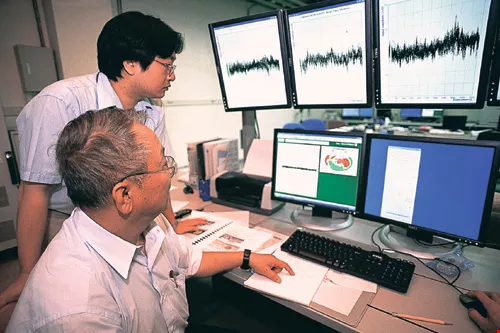
By the time Ovid Tseng returned to Taiwan, he had become the nation's greatest authority in his field. His new Motionless Electromagnetic Generator laboratory at Academia Sinica is the most advanced of its kind in Taiwan.
The scientific approach
Knowledge requires building up a framework, which sounds like cliche. However, since Tseng began with an enormous question, in his quest to construct such a framework for knowledge about that question more than 30 years have passed.
More than three decades ago, Tseng traveled north from the small town of Chishan in Kaohsiung County to study education at National Chengchi University. Although his interests were wide-ranging, Tseng had not yet staked out a direction for his future. After entering the Department of Education, Tseng spent much time every day in the library, pondering the essence of education. "My curiosity was getting stronger and stronger. I especially admired the thinking of the American education pioneer Dewey. When Dewey moved from Europe to the United States, a change seemed to occur. And what sort of change was it?" he asks, restating a question that occupied him at that time.
"Next, you encounter learning. What is learning? To answer that question means doing experiments--animal and human experiments, and experiments on memory. Does a memory only exist through the subject's cognition? Do neurons undergo some change in the process of learning? Do neural pathways change?" he asks. "Quite naturally, you want to understand these critical points. And to do that you need all the related supporting knowledge."
Like a young Edison, Tseng was stimulated to seek answers to one question after another. After completing graduate studies, he took his many questions about how "cognition"--which comes into being through an interaction between the metaphysical mind and the physical neuron--works, and decided to travel even further afield, to America.
"At the time, I was entering a phase of combining questions about 'mind' and 'body' in my thinking. These two areas of study, which were originally separate, had to be thought of in tandem from that point on," explains Tseng, recollecting how he himself became involved in answering such great questions.
Tseng's dissertation on his research combining linguistics with neurosurgery attracted scholarly attention, and after graduation he was immediately recruited to teach at a university. From that point on, academic recognition continued unabated, establishing his authority in the field of cognitive science. Later, he returned to Taiwan to establish the country's first cognitive science research center, and formally guided Taiwan's entry into this field of study.
"Basic skills are absolutely essential. For me, that is your definition of learnedness. What has happened in the universe? What do those events mean? To understand these things, you must be able to get your bearings and a framework," says Tseng, sitting in an Academia Sinica laboratory. Tseng uses martial arts novels as an analogy: "If the basic skills are very good, and if your ability read an opponent are sufficient, then when somebody tries to strike you, you'll be able to block it. And slowly, you absorb your opponent's powers as well, and they become part of you."
Asking the right questions
"Diverse study", "a civilized viewpoint" and "commitment to truth"--Tseng names just these three qualities as being necessary to pursue scientific inquiry. From the laboratory to his home, over many decades, Tseng has been honing his skills as a scientist. "Ultimately everything, including exercise and music, and even the novels I read before going to sleep, have become fodder for research, and I have incorporated them into the same framework of knowledge," says Tseng, whose wish is to be a lifelong devotee of science.
Tseng has taken ideas out of the laboratory and applied them to the broader issue of national scientific development. He says, "Where are we in the long unfolding of civilization? Where are our values? Where can this research take us?" Just as he asked himself in years past, he constantly uses these questions to press his students to look at things from the perspective of civilization's progress. He believes that only by transcending the particulars of time and place can one avoid having "a narrow obsession with the specific and thereby miss the general, which makes people unable to find a proper perspective or develop a vision," and also discover the significance of and direction for research.
In the grand sweep of time, the progress of civilization becomes evident. For education, Tseng believes, time is the most critical factor. "Establishing a larger framework for knowledge, cultivating the scientific spirit--these are things everybody agrees on. However, these basic skills require a great effort to teach, and learn. The question is whether an education system based on rote learning allows teachers to take the time to properly inculcating these skills. And do students have the patience?"
In an era when competition is growing ever more intense, and everything happens more and more quickly, "it is even more imperative that we learn how to look at the big picture," warns Tseng.
He goes on: "What about the future? Where will society be in ten or 20 years? If we want our children to be able to answer that question, then we must be more patient, and let them train themselves in the basic skills with a sense of security. Only then will they be able to see the world as it is in the grand sweep of time. And only then will we be able to see what the future holds."


@List.jpg?w=522&h=410&mode=crop&format=webp&quality=80)


