

In big cities and small towns, the streets are lined with small businesses. But who really keeps track of their waxing and waning? (Sinorama file photo)
When you walk along the streets and alleys, you are startled to discover that the shops that were there have new names. The life and death of the small shops along the street hints at the shattering of the entrepreneurial dream of some people. No wonder some people describe the entrepreneurial trend in Taiwan as "moths attracted to a flame."
Nevertheless, why are Chinese still so attracted to this "flame"? How does the "moth" feel as it winds its way along?
At present, there are over 759,000 registered companies in Taiwan and there are certainly no fewer than that number operating illegally underground. The streets are truly lined with "chairmen of the board."
"Isn't it enough just to work for someone else and have a stable, quiet life? Why would you want to found your own business?" This is the question a lot of people have in their minds.
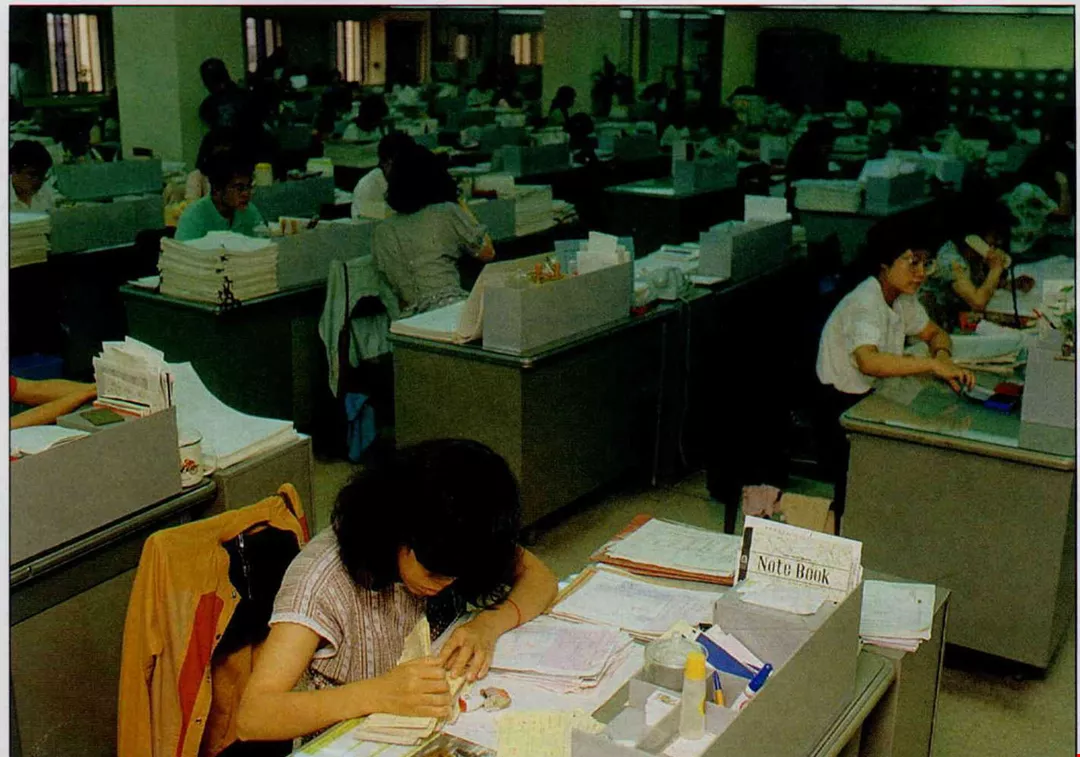
There are a great many people who found their own companies because they can't stand the drudgery of the nine-to-five lifestyle. (Sinorama file photo)
Why go to all the trouble?
It seems that the common answer is dissatisfaction with the current situation and expectations towards the future.
"At that time I was young and rash and ambitious. I wanted to carve out my own little piece of the world," says Tsai Kuo-lung, chairman of the Tai Lee Chemical Company. Tsai had graduated from National Taiwan University and worked in a large food products company for a decade. Recalling the reason for founding his enterprise twenty years ago, he says that he had worked for many years and inevitably there were things that rankled, such as not getting an evaluation as good as coworkers, or seeing someone else sent abroad for a trip and not being sent oneself. "Sometimes I just couldn't stand it and I wondered if I would just take orders from other people my whole life."
The ancient Chinese saying "I'd rather be the head of a chicken than the tail of an ox" is certainly the best footnote explaining why the Chinese love to found their own businesses. But the traditional, somewhat closed operating style also cannot escape mention. Looking out, the vast majority of companies large or small are family-style operations that only employ immediate relatives and could never bear to give power to outsiders. Even in enterprises that make it big, non-relatives that helped build it are generally passed over when it comes to succession to the top spots. No wonder many people will wonder "Why work for someone else?" and go to found a business on their own.
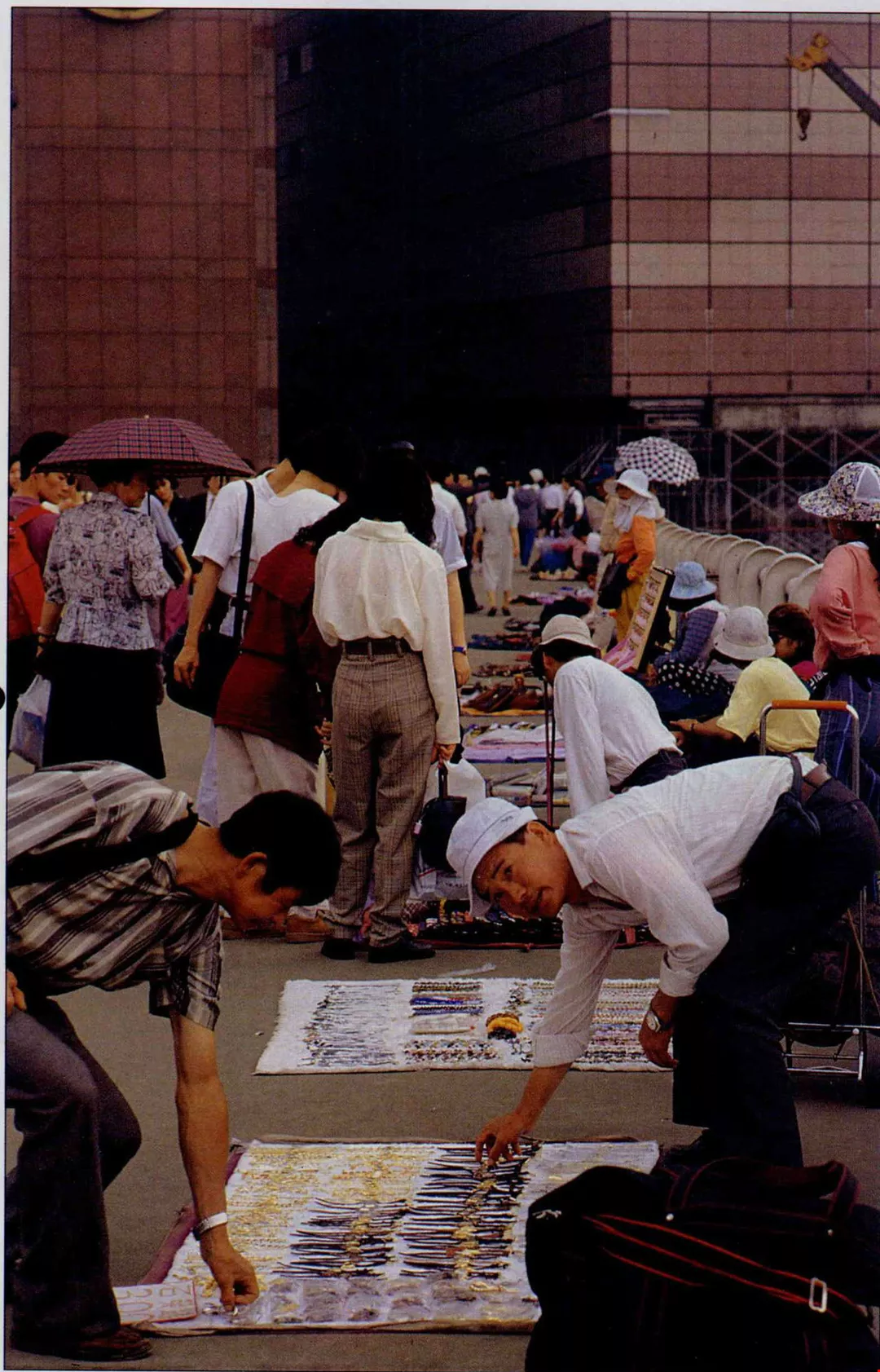
Get a load of goods, grab a space, and catch the latest trendy wave: "Those interested in starting a business would do well to learn from a street vendor," is the advice of this entrepreneur.
If you're afraid of not having a job then make your own:
Taiwan has a forest of "little temples," as these family-run businesses are known. And they are limited not merely by unwillingness to accept outsiders--even when you're inside there is always a sense of crisis that "the temple will close and the acolytes be scattered." Chen Fang-ju (a pseudonym), who currently works in the Hsintien Industrial Zone, encouraged her husband to found his own business. The videotape company in which she had worked had just closed and the new company hadn't really gotten on track; she also saw that small companies like the one her husband worked in suffered continuous losses during an economic downturn. "There is absolutely no guarantee when you work for someone else. You might as well just go out on your own, and at least if you go bankrupt you can't blame someone else," she says.
"Wanting to earn a little more money" is another important value in founding a business. Ms. Chen doesn't hesitate to say that the reason she encouraged her husband to strike out on his own is that she hopes to have her own house and move out of her in-laws' as soon as possible. This could never be achieved based just on take-home pay.
There are no guarantees in little temples, and besides you have to directly face the wrath of the temple "god." But in a large company, on the other hand, there are numerous limitations and it is extremely difficult to penetrate the many layers to the top.
Chu Chien-cheng, the assistant deputy chairman of the Morale Eagle Technology Engineering Company Ltd., who worked for ten years in an electronics factory in Shilin, points out that in the 1950's and 60's Taiwan was truly in an era of a hundred companies contending. You would see someone else putting up an office building but the highest your own path would go was mid-range middle management. "Men are always afraid they will be buried here, and their ambition suffocated." Thus, on the one hand he worked, and on the other cooperated with friends and partners to found their own business. He opened a machinery factory, a small motor factory, and an electronics factory one after the other, doing subcontracting work for upstream enterprises.
"At that time I was really full of vigor and vim. I would go to work during the day and as soon as I got off I would rush to my own factory to work without pay." Unfortunately, none of the factories lasted more than two years. If it wasn't the case that the upstream factory closed so that they could not be paid (even though they already delivered the goods), then it was being cheated by one's partners or friends who were responsible for the business. Friends would declare that they couldn't run the business and wanted to close it while they were secretly bringing out equipment and staff to open their own factory. In a short six years, Chu exhausted everything that he had accumulated, which at that time was enough to buy two two-storied houses. He got to the point where his wife would become afraid whenever she heard her husband think up a new entrepreneurial idea.
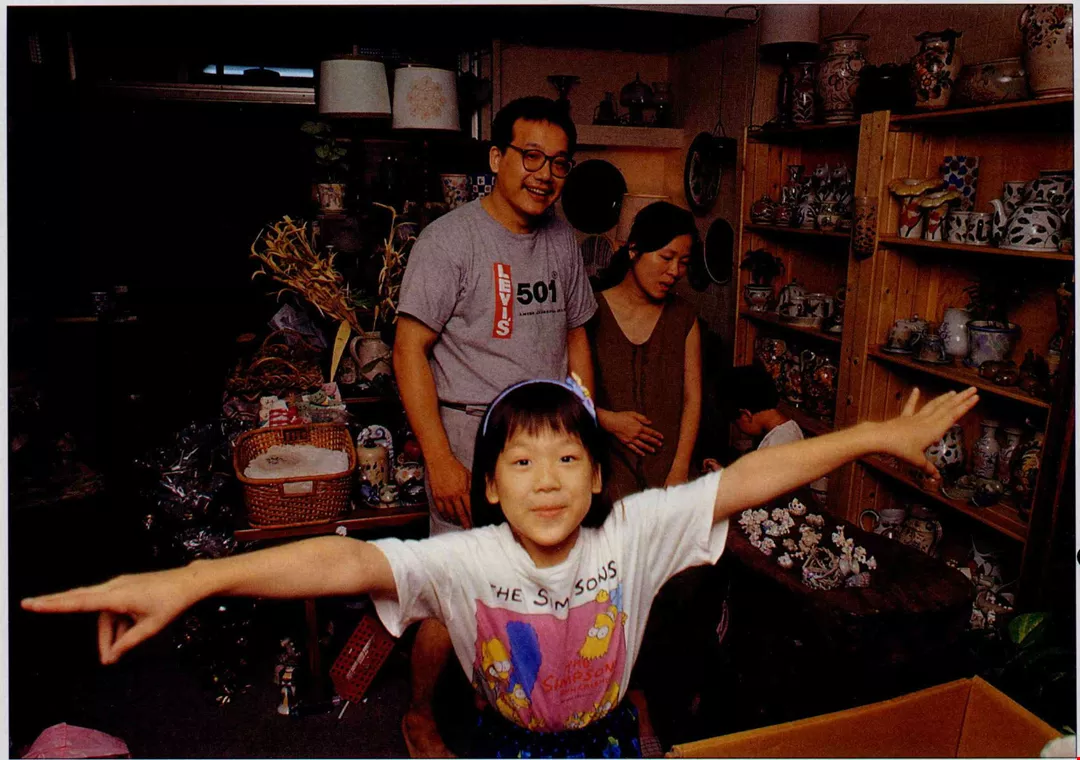
One man's business, one family's occupation. Only with the support of the wife can the husband go confidently forward. The photo is of the art products exhibit center of Chien Yung-pin.
Where does the seed money come from?
Of course the vast majority of entrepreneurs don't have much money, and their great hope is to "create a success from their bare hands." Also because every cent they have is saved through hard work or borrowed from friends and family, they can't afford to chalk up their losses to a "learning experience." When they come short there is often no place to turn, so small entrepreneurs are plagued by constant worries about money.
Chang Wei-chun (pseudonym), who is currently alone in Vietnam trying to make it, got half of his NT$2 million entrepreneurial fund by mortgaging his house and the other half by going in with his wife's uncle. Later, as the value of the house increased, he continued to borrow against it for more than another NT$1 million.
"Our principle is very simple. The money we invest in founding the business cannot exceed the value of the house. In this way, the worst that can happen is we become renters. At least we won't have a huge debt and nowhere to turn," says Wang Mei-ling (pseudonym), the wife of Mr. Chang, who admits that she rarely asks her husband about details about the business.
Why would you risk losing a home to encourage your husband to start a business? Wang Mei-ling says that when they are young they have dreams and you can only let them give it a go. Otherwise when they are old they have a sense that they missed out on something all because of restraints imposed by their families. "It's like the husband and wife in the cartoons by Old Chiung. You have nothing to do but sit around grinding your teeth and complaining to each other. It scares me just to think about it," she says.
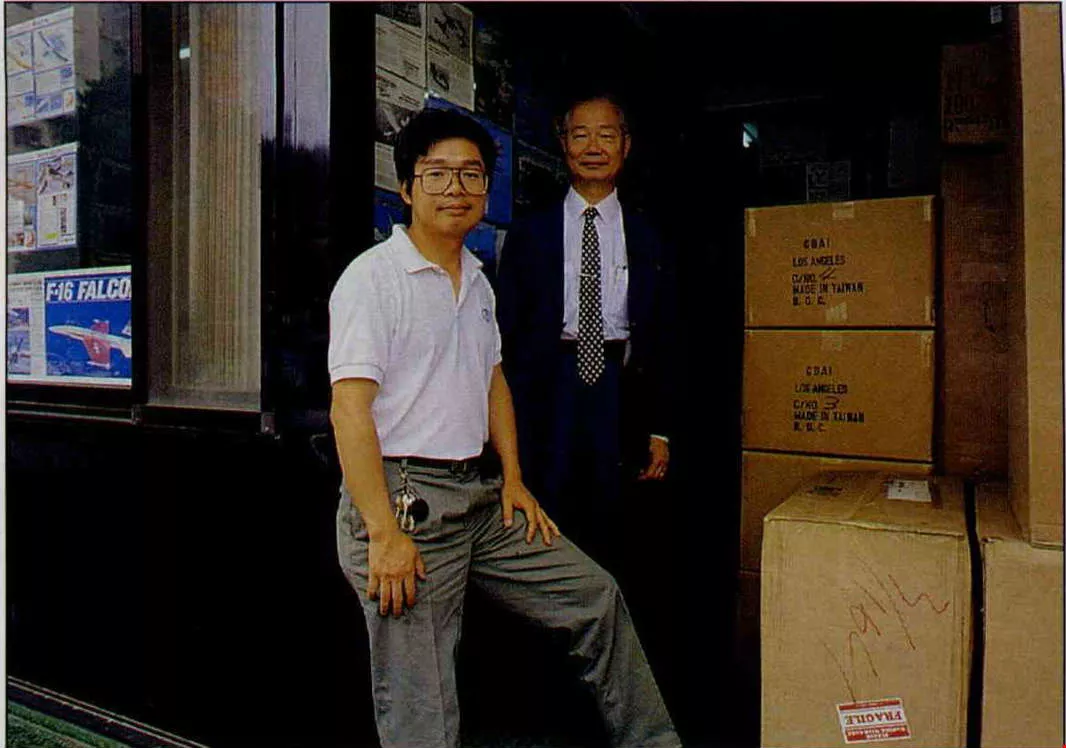
Working in his dad's company from the time he was in middle school has been very helpful to Lin Hung-wen.
Husband on the offensive while the wife holds down the fort:
What's interesting is that while the husband is out aspiring to make it in business, the wife is often the most practical. Chen Fang-ju has made her own calculations: "He founds his business but I still have to have my own job. We can't put all our eggs in one basket." In this way even if the husband can't get a grip on the situation, prior to his finding another job, she will always have enough to eat. "If you have an escape route then you aren't so really stressed out," she says.
It is obvious that the number of wives that think along the same lines of Ms. Chen are not a minority. Telix Lee, the manager of the Small Business Integrated Assistance Center, points out that when a business is first getting started it's still in a stormy period, so most wives choose to keep their own jobs. When the enterprise reaches a stable stage and needs the wife to come and take care of the finances or handle various matters, and to work together with her husband to map out the future development blueprint for the company, "madame boss" naturally enters the picture. And when the company expands, and there are many outsiders, it becomes an obstacle for the husband and wife to be working together, and the wife will then withdraw. As a result, "you only have to see the role the wife plays in the company and you can determine which stage the company is at," says Lee.
Because there is little capital, and you can't sit around living off your pile, developing business and breaking into the market are the most urgent matters in the minds of all entrepreneurs. The question is: with such a big market, how can you get your cut?
"Having a grip on the market is incredibly important," points out Tsai Kuo-lung. The line he chose was lime and crushed stone construction materials; this business does not require a great deal of capital, and is similar to his background in agrochemicals. But the problem is that he never worked in this line before, and is not familiar with the market, and there were some problems with the sales manager he hired to compensate for his own shortcoming, and as a result the first five years of operation could really be described as harsh.
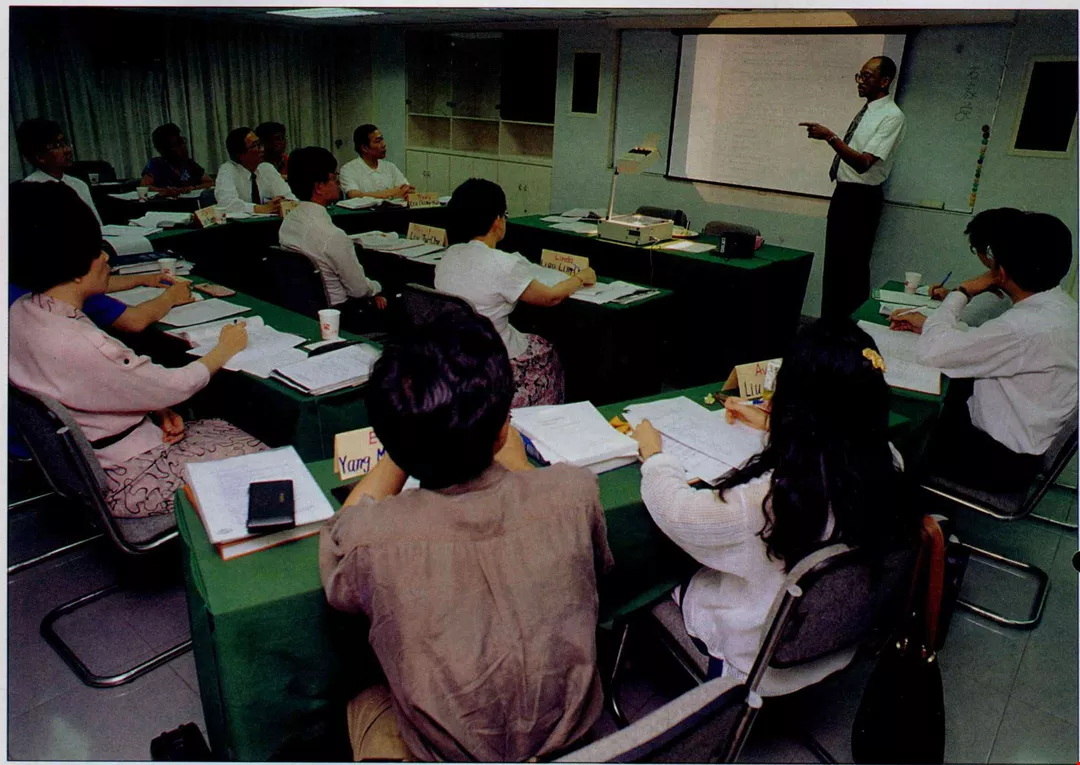
In the initial orientation period, a lot of businessmen confess they get more scared as they go along. The only thing for it is to go back to class and learn with an open mind. The photo is of the CYDA's "The Boss Goes to Class" program.
Opportunity only knocks once:
In comparison, Chien Yung-pin, the former head of the Hsiamen Photo Gallery who was one of the first in Taiwan to pioneer photography galleries, faced a different problem: "Because I studied photography myself, I was extremely envious of the photography environment when I was studying in Japan, and I wanted to bring that to this country." Unfortunately it seems that Chien was a little early, and the market for collecting photographs had not yet taken shape, besides which there were too few sources of good photography. After two years of extreme difficulty, Hsiamen had no choice but to quietly close to the sound of regretful sighs in the photographic community.
Hsiamen was a bit too early--but neither can you be too slow.
Two years ago, Chu Chien-cheng took up his brother's invitation to do design and installation of computer rooms. This was really a chance to start a business all their own to which they could be fully devoted, so he couldn't help but get sucked in: "In the past my brother just did this work for others by subcontracting and at that time the stock market was booming and securities companies were opening up one right after the other, and the profits on hooking up their computer systems were amazing," says Chu. They felt that the market was quite clear to them, and since it was so easy to do why not do it themselves? They didn't expect that as soon as they began they would go right down hill. "That's just chance -- there's nothing to do but laugh!"

To stay comfortably in a niche, or boldly go out to found an enterprise? Make sure you're clear about the potential cost first. (Sinorama file photo)
With all the ups and downs when can you feel safe?
Nevertheless it's not a total fantasy to "hit the market just right and succeed in a single blow." Hsieh Li-teh (pseudonym), who worked in a government institution, opened a coffee shop and restaurant ten years ago. Relying on meticulous and thoughtful planning and treating each customer as an old friend, and because his location is very close to the Executive Yuan and the Legislative Yuan, he attracted many office types that talked business over lunch.
"At that time making NT$200-300,000 in income every month was quite common," says Hsieh. But five years down the road, because western-style fast food restaurants as well as "all-you-can-eat cafeterias" opened in the area, the market had changed, and so he "took the money and ran." These five years of aspirations have enabled him to go from being a poor boy carrying a large debt from his mother's medical expenses to becoming a wealthy man with three houses and several cars, truly realizing the dream of creating a business from scratch.
Of course, the God of Fortune does not smile often. Three years ago Hsieh heard a rumor that the boating industry was going to be liberalized. He invested a great deal of money to become the agent of a certain American boating company and prepared to build a dock in the Kuantu area. Unfortunately, immediately thereafter a disastrous boating accident occurred on Sun Moon Lake, and the liberalization of the boating industry was postponed. Today, the large fleet of boats that Hsieh imported are still stuck in the warehouse. "Now the only thing I can do is scrape by," he says with exasperation.
First prepare:
Predictably, for face and status, most bosses carry mobile phones and drive famous brand sedans. But underneath they may be enduring hard times. This is often something that those who embrace the entrepreneurial dream are not willing to face up to.
"Those who choose to open their own business fundamentally are those who don't like to be controlled, are relatively more subjective and always feel they are smarter than the other guy," suggests Yu Tai-li, the vice-secretary general of the China Youth Development Association. "But maybe founding a business relies on just this kind of domineering and rash strength!"
Fools rush in where angels fear to tread. It seems that a common ailment affecting first time entrepreneurs is rushing in to a situation without being very clear about it. Chu Chien-cheng cannot help but give a bittersweet laugh when he recalls his previous entrepreneurial experiences. "At that time I just knew a little bit about the production technology and jumped right in. I didn't have any knowledge about personnel, finances, capital, markets, or management. Frankly, it was doomed to failure from the beginning." Unfortunately, there are still a great many people who feel like they can start a business by understanding a little about production technology or sales.
In the eyes of specialists, blindly charging in is no laughing matter: "For a lot of first time businessmen, they only develop some conception of how to handle money after the fact." Telix Lee takes the example of the small manufacturers you can see anywhere: "Many bosses think that they have got the money as soon as they have the order and think there is some guarantee. They never expect that before getting their payments they will have so many expenses--materials, wages, capital and so on. Even though they deliver their goods all they get is a postdated check that might take three or four months to turn into cash." For small-scale entrepreneurs who are always low on funds, sometimes in order to grasp market share they blindly accept orders and often are unable to make ends meet, and as a result they end up bankrupt.
No turning back:
When a company closes, does the entrepreneurial dream end with it? The answer is almost always, "No!"
"When you first resign to go start your own business, co-workers send you off in a big way, and even say that they envy and admire you. Out of embarrassment and face, after failing naturally you will only think of starting over and trying again," points out Chu Chien-cheng.
It truly is this way: Going out on your own seems like a road on which there is no turning back. Unless you're completely hopeless, when you go under you just want to start again, and therefore there are many people that have been up and down many times. Take for example Chien Yung-pin: after the Hsiamen Photo Gallery closed, he invested in the Hsiamen Life Workshop, running a combination restaurant and arts and crafts shop. A year later, he again decided to dump the store, and established the Hsia Lu Yuan International Co. to do wholesale and department store marketing of arts and crafts.
Telix Lee also points out, "Don't pay any attention to all the reports in papers and magazines on companies that have failed. If you go a little deeper you will discover that after the entrepreneurs dissolve one company, they often immediately open another, and what do they care that each time they get smaller and smaller--anyway they're always the boss."
This kind of perseverance is one of the special characteristics of entrepreneurship in Taiwan. Wu Cheng-hong, chairman of MasterMind Consultants Co. Ltd., points out that foreigners stress specialization and a refined division of labor so that when someone fails in their own field, its very difficult to change professions. However in Taiwan it's nothing at all to see someone repeatedly change from one line to another.
Nevertheless, though the grass may be tough, when it comes up against the trees, how easy will it be to get to the sunlight?
Do small enterprises have a copyright on being cheated?
"It's dog eat dog out there and things are very practical in society," notes Telix Lee. For example, Chien Yung-pin worked hard to set up three branches in major department stores. Each month the operating turnover was at most NT$1 million. But 20-30% of that had to be given over to the department store, and there wasn't much remaining in profit. Don't even mention the cash paid on the spot by the customer, which only got into his hands about a month later.
"Small enterprises are really isolated, and are always in the position of having to ask others for help. They have no standing that will enable them to get tough on prices in discussions with others," explains Lee. For example, a small manufacturer might originally have agreed to accept a two-month post-dated check from a buyer for a purchase. But after the products are actually delivered, the buyer might say that at the moment he has not enough cash on hand and will want to pay with a check that is post-dated by three months. In order to expand the business, the small businessmen have no choice but to swallow this. But on the other side of the ledger, there is no way for them to put off paying for raw materials, labor, and capital.
Further, a good innovation might just be the greatest advantage a small business has in struggling to survive. Unfortunately, today, when information travels fast and competition is extremely intense, any new innovation will immediately attract a host of imitators. Of them there will be no shortage of large enterprises with a great deal of capital who will mass-produce products to engage in cutthroat pricing to steal the market. After Chien Yung-pin brought in arts products from abroad, immediately people moved to steal away those ideas that sold the best.
If you want an enterprise to succeed, frankly speaking it's not easy. But it's an even more demanding task to reform oneself to create an enterprise.
Wang Mei-ling points out that her husband Chang Wei-chun in the past was very "openhearted." At class reunions other people would whip out their calculators to figure out their part of the bill, but Chang would just tap his chest and declare, "It's all on me today," without regard to the rather green look on the face of his wife sitting at his side. Because of his generosity, his classmates called him "Chairman of the Board Chang" in school, and he became quite intoxicated by this nickname.
Nevertheless, after founding his own business, he discovered that only an extremely small number of his many "friends" were truly sincere in their relations with him. Now as much as possible he restrains his naturally open personality and has learned to adopt a poker face and to calculate things down to the last penny. "Though I must say he still prefers himself the way he used to be," says Mrs. Chang with some dismay.
It's not a small number going through the same struggles. Lin Hung-wen, director of the Tien Chi Development Company, says that once he and a foreign client were discussing a certain order. Because he himself was not familiar with the electronics technology involved, he had no choice but to ask a friend to come in to help out with the R&D, and without thinking twice invited him to come along to speak with the foreign client. Little did he expect that when the work got to the final stages his friend would disappear with the blueprints, hoping to be able to take the order for himself. Their friendship came to an abrupt halt.
"I used to be rather naive, but even now I still tell myself not to distrust people so quickly," says Lin Hung-wen, with a look of innocence regrettably lost.
Not only are entrepreneurs under great pressure to constantly adapt themselves, their wives must learn to be especially forgiving and thoughtful. There was a time when Chen Fang-ju's husband was doing quite badly and each night would go drinking to forget his woes. After finding out, Chen didn't bring it up. "Men are really worried about their egos. And so I couldn't shatter him. Otherwise it would be like letting the air out of a balloon, and he wouldn't even have had the courage to keep on going," says this woman in full understanding of her husband's personality.
How does it feel looking back?
Looking back at the entrepreneurial dream, many people are deeply moved. Wang Mei-ling says that in the past her husband always hoped that he could be "one of those guys who flies around the world talking business carrying a 007 briefcase." Little did they expect that three years into the business, running back and forth between Taiwan and Vietnam, he would get squeamish just thinking about sitting on a plane. "That's OK too. If he can't keep on going, and wants to find a new job, who knows? We might feel more at ease and accepting of our fate," she says.
Having several times gone under and come back up for air in the sea of business, Chu Chien-cheng can't help but be a little sentimental. When he was young he loved to talk big, and always just thought it was no big deal to fail, and that there would always be chances to start over again. In a flash he is already past the half-century mark. "If I fail again now, there's really nowhere to turn," he concludes. Fortunately, he sometimes can see the bright side of things as well: "What's the big deal about making a lot of money? Big businessmen have to be surrounded by bodyguards when they go out and are always worried about being victims of extortion. It's better being free and easy like me!"
Of course, this type of talk only serves to pacify him from time to time. "You'd only be kidding yourself if you tried to claim that you don't want to succeed," says Chu. Before you become successful, you have to run up against a few sharp edges. You have to take the humiliations and unhappiness others dish out to you. There's only happiness to speak of once you are successful. But success is like a plum suspended in midair. The more anxious you are, the farther away it seems. Still, that plum hanging in the air is always there to stimulate him to struggle once more.
Is being an entrepreneur and founding a company really a dream? Perhaps. Lin Hung-wen--who today finds himself with a stack of orders thanks to the failure of so many of his Japanese competitors--makes the point that since founding his business he has been to many countries, made many good friends, and learned many things. Even if he isn't completely successful ever in his life, what's the difference? "It may be a dream, but it's one that I've been able to make very solid."
[Picture Caption]
p.72
In big cities and small towns, the streets are lined with small businesses. But who really keeps track of their waxing and waning? (Sinorama file photo)
p.74
There are a great many people who found their own companies because they can't stand the drudgery of the nine-to-five lifestyle. (Sinorama file photo)
p.75
Get a load of goods, grab a space, and catch the latest trendy wave: "Those interested in starting a business would do well to learn from a street vendor," is the advice of this entrepreneur.
p.76
One man's business, one family's occupation. Only with the support of the wife can the husband go confidently forward. The photo is of the art products exhibit center of Chien Yung-pin.
p.77
Working in his dad's company from the time he was in middle school has been very helpful to Lin Hung-wen.
p.78
In the initial orientation period, a lot of businessmen confess they get more scared as they go along. The only thing for it is to go back to class and learn with an open mind. The photo is of the CYDA's "The Boss Goes to Class" program.
p.80
To stay comfortably in a niche, or boldly go out to found an enterprise? Make sure you're clear about the potential cost first. (Sinorama file photo)


@List.jpg?w=522&h=410&mode=crop&format=webp&quality=80)


