Herald of a New Ice Age--Mao Ho-kwang, Diamond Maker
Chang Chiung-fang / tr. by Phil Newell
September 2006


You could readily make a chronol-ogy of human history based on materials, going from the remote Stone Age through eras defined by colored and black pottery, bronze, iron, and plastic, right up to silicon (for semiconductors) in the 20th century.
But what about the future? Mao Ho-kwang (David Mao), an academician in the Academia Sinica's Division of Mathematics and Physical Sciences, makes the intriguing prediction that the 21st century will be the Diamond Age.
Could diamonds, long seen as precious rarities, really be transformed into a widely used material? As he makes ever bigger and better synthesized diamonds, Mao is threatening to overturn the old market value of diamonds while creating something even more "valuable."
In July, a travel-weary Mao Ho-kwang came from the US to attend the 27th Biennial Convocation of Members at the Academia Sinica. At the conference he made a presentation entitled "A New World of Physics, Chemistry, Biology, Earth Sciences, and Materials Science as Viewed through the Window of Diamonds."
Mao is entranced by the new possibilities that he sees through diamonds. But his fellow citizens are more intrigued by his seemingly magical powers of creating ever-larger diamonds, and his prognostications of a coming Diamond Age.
"Compared to silicon, diamonds are smaller, faster, more energy-saving, more heat-resistant. Sooner or later they will replace silicon, which is so widely used in semiconductors today." At the conference, Mao, attired in a Chinese-style shirt, declared with confidence: "In the not-too-distant future, Silicon Valley will turn into Diamond Valley."
Mao Ho-kwang was a member of the 20th group of entrants into the Academia Sinica, and is currently the head of the High Pressure Collaborative Access Team (HPCAT) in Illinois, and a member of the Geophysical Laboratory at the Carnegie Institution of Washington in the US. After graduating from the Department of Geology at National Taiwan University in 1963, he gained his PhD from the University of Rochester (USA) in 1968. From there he entered the Carnegie Institution to do research in high-pressure physics.
In 2005, Mao won Italy's Balzan Prize, one of the highest honors in the global academic community, for his research into the changing nature of materials under high pressure. For his achievements in the field of mineralogy, he has also won the Gregori Aminoff Prize from the Royal Swedish Academy of Sciences and the Roebling Medal, the highest award of the Mineralogical Society of America.
Mao Ho-kwang is an internationally recognized authority in the realm of high-pressure physics. But little did he expect his recent fame would come from diamonds.

Mao Ho-kwang's return to Taiwan in mid-July for a conference at Academia Sinica sparked unexpectedly widespread public interest in synthetic diamonds.
Not just jewelry
"Diamonds are forever," it is said. And for most people diamonds represent high status and great wealth, or enduring love. But Mao Ho-kwang has a more prosaic perspective, seeing these gems as merely "the high-pressure counterpart of carbon."
Don't get him wrong. This is not a scientist who can't dig romance. Nor does Mao not understand the marketplace. It's just that diamonds in fact have a broad range of uses, of which the decorative function of jewelry is probably the least "useful."
"Using diamonds as jewels is like buying a Formula One racecar to decorate your garage." For Mao, diamonds are not just gems--they are the perfect material, because "they possess many outstanding characteristics you can't find in any other."
A few examples: Under high pressure, diamond has semi-conductive properties (conducting electricity under some conditions, and acting as an insulator under others), and it is even better than silicon for electronic chips, because silicon cannot function at temperatures in excess of 140°C, whereas diamond is heat-resistant to over 1000°C. Diamond is also an excellent conductor of heat; this is especially useful for electronic devices, which are affected by heat build-up, so that use of diamond heatsinks can significantly raise operating efficiency. Diamond is the hardest material known in nature, making it suitable for cutting tools for machining very hard materials, or for nozzles in water-jet or abrasive-jet machining (these use streams of water or water-plus-abrasives forced at high pressure through a narrow nozzle to cut materials; the nozzle themselves must be made of extremely hard material to survive). Moreover, a diamond will retain its hardness and sharpness even if it is worn down to only a single molecule, thereby also making it the best material for high-precision surgical knives.
To keep the list going, diamonds are highly resistant to chemical attack, so nothing can erode them. They have a very low friction coefficient, so, like Teflon, nothing sticks to them. They are highly wear-resistant, making them better for setting broken bones than stainless steel; they are also less likely to be rejected by the body.
You could talk forever about all the great things there are about diamonds. But so what? After all, they are rare and expensive, so it has never been possible to use them on a really large scale.

Diamond anvils
For Mao, diamonds started out just being a tool he uses in high-pressure research, and indeed his breakthroughs in synthesizing diamonds have come of the same workaday attitude.
Mao uses "diamond anvils" to compress materials under super-high pressure conditions (3.6 million atmospheres) like those found inside the earth, to observe how the various materials change in the high-pressure world. "For example," says Mao, "the elements boron, carbon, oxygen, sulfur, and iodine all change into metals under high pressure, and moreover become superconductors." We are only now learning in detail how radically the physical and chemical properties of materials can be transformed by pressure.
Over years of such research Mao has destroyed thousands of diamonds by applying enormous amounts of pressure to very minute areas. "To me diamonds are definitely not forever," he quips. The problem is that the laboratory can only afford to buy diamonds of one-third of a carat each, which still go for US$1000 apiece. A three-carat diamond would cost US$100,000, whereas the ideal diamonds for research would be 30 carats, or even hundreds of carats, which "you couldn't get for love or money," says Mao. Thus arose the idea, "Why not make diamonds ourselves?"

Mao's laboratory has figured out how to rapidly grow single-crystal diamonds using the chemical vapor deposition (CVD) process.
Starting from scratch
"Prior to the 20th century, high-pressure research was a blank," says Mao. Pressure, temperature, and elemental composition are considered the three dimensions of materials science, because these factors determine the nature of materials. In the past, researchers focused on the effects of temperature and chemical composition, but the variable of pressure was ignored, mainly because past laboratory techniques could not create a high-pressure environment. Even if high pressures could have been attained, it would have been impossible to observe and verify what changes were occurring in the materials.
It is only in the past 30 years that it has been possible to attain adequately high pressures, and the only in the last ten that adequate measuring instruments have been available. Thus one can say this is a new science of the 21st century.
As Mao Ho-kwang puts it, "When you add the variable of pressure into the mix, it's like science has to start all over again."
Take water, for example. Water can have three states--solid, liquid, or gas--depending upon temperature. If you add pressure, however, synergistic effects are produced, and water can be changed into at least 20 states, such as plasma.
To take another familiar example: under high pressure, graphite, a commonly occurring form of carbon, turns into diamond. But it is less often considered how radically different the two substances are: the former is soft, the latter hard; the former is black, the latter crystalline and translucent; the former conducts electricity, the latter insulates (at normal pressures).
Using high pressure, Mao has even discovered the only known room-temperature liquid metal apart from mercury: sodium. Under high pressure the melting point of sodium falls to below room temperature, so it remains in a liquid state.
If the discoveries of basic high-pressure research could be carried over into the normal-pressure environment, the result would be the creation of materials that could be extraordinarily valuable in a variety of endeavors. Energy is a case in point.
It is estimated that petroleum and natural gas reserves will be exhausted within 50 years, so it is already urgent to find alternative energy sources. One focus of research is on using hydrogen to make fuel.
Hydrogen (H) is the most common element in the universe, and water (H2O) is the most common compound, meaning that you can get hydrogen just by breaking up water. Thus hydrogen can be considered inexhaustible. The problem is how to turn it into fuel. For instance, the technical problems of pumping it into cars like gasoline have thus far remained instractable.
Though hydrogen-powered cars were developed a long time ago, liquid hydrogen evaporates, while gaseous hydrogen requires vast amounts of storage space, and if the gaseous form explodes, it is highly dangerous. Based on Mao Ho-kwang's research, however, when hydrogen and water are combined under high pressure to form a compound, the water becomes a cage trapping the hydrogen inside, forming a substance like ice. When you release the high pressure, and return the compound to normal pressure and temperature, the hydrogen is released and can be burned. This is known as "flammable ice."
Through high-pressure research, Mao has found a safe and efficient way to store and release hydrogen. This new technology already has been patented in the US, though there is still a considerable way to go before it can be commercialized.
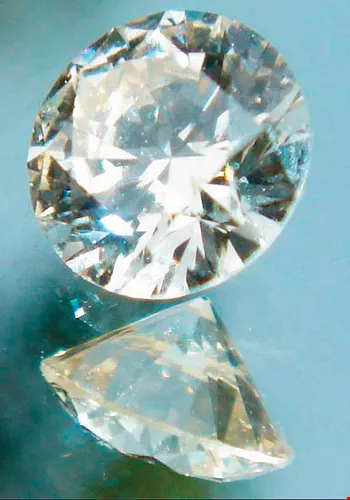
The synthetic diamonds produced in Mao's lab are nearly colorless and transparent.
For real?!
Getting back to diamonds, natural diamonds have been formed very slowly underground out of carbon under high pressure (3.6 million atmospheres) and at high temperature (6000°C). Given the cosmic time scale involved, diamonds have always been considered "gems made by the gods." But now Mao Ho-kwang has fractured this divine myth, revealing that "even cow dung can become diamond."
In May 2005 at the 10th International Conference on New Diamond Science and Technology in Tsukuba, Japan, Mao and his research team astonished the world with a ten-carat diamond made by the chemical vapor deposition (CVD) process.
The diamonds made in Mao's lab do not in any way differ in substance from natural diamonds. After being cut, they have the same optical properties of sparkle and translucence, so that even experts cannot tell the difference. But the price is only one-tenth that of Nature's own.
So good and cheap are these diamonds that it has even been suggested in news reports that the global US$60 billion natural diamond market could face collapse.
Oddly enough, as Mao points out, there is nothing new about manmade diamonds. The principle is very simple: You just need methane gas and heat. Methane, which you can even get from cow dung, includes carbon. You heat the methane to break it down, then figure out a way to make the carbon settles, and there you are. The raw materials cost nothing--you just need to pay for the electricity. These synthetic "methane diamonds" are so cheap that some people call them "junk diamonds." And they are indeed small in size and of poor quality, not to mention that production is very slow--it takes several months for a single carat.
A different process, which involves heating natural gas and hydrogen under high pressure, has also been invented, allowing one to make diamonds up to four carats in size. But for this method you need a huge compressor (as big as half a house), growth is slow, there are impurities, and production costs are excessively high.
In 1981, researchers in the USSR and China first used a high-temperature, low-pressure CVD method for producing synthetic diamonds.
In the early 1990s, research teams in a number of countries, including some at Taiwan's Industrial Technology Research Institute and a number of local universities, began similar research projects. But by 2000 there had been no breakthroughs, and many teams gave up. The main flaws were that it proved very difficult to ensure the growth of a "monocrystal" (also known as a "single-crystal diamond," meaning that the molecules arrange themselves into a single pattern as they are stacked throughout the material), and that it took three months to grow half a carat. The process consumed immense amounts of electricity and proved impractical.
But Mao Ho-kwang's research team was not deterred. Five years ago, Mao's former graduate student Yan Chih-shiue joined the team, and they set to work on figuring out how to get CVD diamonds to grow bigger and faster, as well as to grow as flawless monocrystals. (The problem with a polycrystal, which consists of more than one molecular structure, is that it has flaws and joints where the crystals intersect, so it can shatter easily under high pressure.) Mao recalls that such an ambitious project was "a big risk--it took a lot of courage and determination."
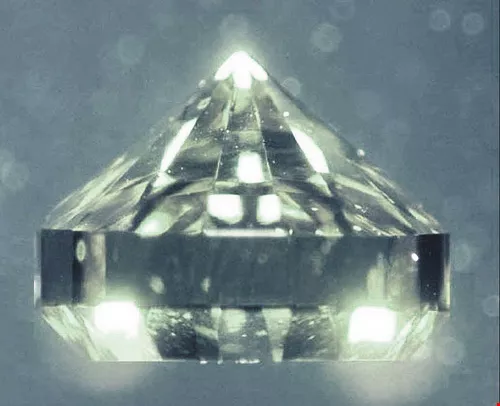
Using a seed crystal 0.45 millimeters high as the substrate, this 2.45 millimeter high, 0.28 carat diamond was grown in only one day.
Cow dung into gems
But fortune favors the bold, as they say. The recipe for the microwave plasma CVD technique (MPCVD) used by Mao's team is as follows: Select a diamond seed crystal as the substrate, and place it in a chamber. Introduce methane (CH4--one part carbon to four parts hydrogen) into the chamber. Using microwaves, heat the methane so that the carbon separates from the hydrogen. Remove the hydrogen.
The carbon molecules from the methane will "precipitate" onto the substrate. There they will "copy" the crystal pattern of the seed crystal as they "stack" themselves onto the seed in a repetitive, orderly way.
Growing diamonds this way not only is 100-300 times faster than other methods, it is very low-cost. Moreover, the resulting diamonds are very large, very hard flawless single crystals. The price of a one-carat stone is only a tenth of a comparable natural diamond, and the price difference only grows with the size of the diamond.
Although CVD diamonds are still in the experimental phase, Mao is confident that in the next year or two it will be possible to manufacture ten-100-carat gems, and that his ultimate ambition--a 1000-carat mega-anvil capable of enduring super-high pressures--is just a matter of time.
But Mao has not overlooked the possibility that his discoveries could undermine the global natural diamond market. So he has also been concerned with figuring out the best way to distinguish his diamonds from natural gems.
"It's not good if experts can't tell the difference," says Mao. Disrupting the market won't help anyone. Although manmade diamonds can be produced with the same quality as natural diamonds, the bottom line is that the two have formed in different ways, over vastly different lengths of time, so inevitably there are minute divergences. A reliable way to distinguish one from the other must be found, or the market could be thrown into chaos.
To Nature, all things are equal, and at the end of the day diamonds--merely the high-pressure counterpart of carbon--have no particular innate nobility. Mao's upsetting of the gems' mythology and mystique is not aimed at shattering their commercial value, but at creating even more value that will benefit all mankind.

Diamonds have always been a symbol of wealth and status. But will new developments in science strip them of their mystique? The photo shows a diamond wedding ring created by jewelers Harry Winston of the US.


@List.jpg?w=522&h=410&mode=crop&format=webp&quality=80)


