

Chinese people have always considered the number four to be unlucky because its pronunciation in Mandarin is similar to that of "death." But there is a company in Taiwan which doesn't give a darn, and has not only chosen the Chinese name "404 Technologies," they even have their offices on the dreaded fourth floor of the building where they are located. This fearless firm got started making serial communications equipment for industrial use, and it now sells worldwide through its own brand name Moxa. It is one of the top three manufacturers of device networking products in the world, and it is estimated that globally at least 10 million devices in industry, transportation, and infrastructure use Moxa products to connect to networks. This year the company is looking at sales of NT$2.5 billion, with 40% growth in revenues.
Twenty years ago, five young people who were classmates in Class 404 at the Affiliated Senior High School of National Taiwan Normal University rented a tiny office in the Chingmei area of Taipei City, and, taking their class number as their company name, established "404 Technologies," whose English name is Moxa. Like all of the companies in Taiwan that have started from scratch, at first this company operated on a tiny scale, with the bosses also doing duty as sales reps, accountants, and even laborers. However, 20 years later, they now have over 450 employees, and you can see offices hung with the Moxa sign scattered all over the Far Eastern ABC industrial park in Taipei County's Hsintien City.

Data on ATM transactions must be relayed immediately to banks; Moxa technology plays a key role here as well.
Serial manufacturers
Moxa got its start on manufacturing industrial-use serial communications products. The firm built its foundation 20 years ago with the first mass-produced commercial product that it invented and developed itself: the C108P multiport serial board. The design of this unprepossessing interface card is simple yet effective: on one side are ports which can be connected to equipment scattered around a factory, while the other side can be linked to the main computer. Thus is formed a small-scale closed network, through which staff in a control room can issue commands to equipment all over the factory.
"Serial communications" is a relatively early form of communications protocol. The term "serial" means the transmission of digital signal data through an interface one bit at a time, like a line of people walking single file. The transmission speed of this technology is very slow. For example, it takes transmission of seven bits of data to form the letter "I." "However, despite being slow, this technology is extremely reliable, stands up well against interference, and is easy to maintain, so it is particularly suited to long-term operation in industrial plants," explains Moxa CEO Ben Chen.

Moxa stresses that its products are industrial-grade, and can operate normally in temperatures from minus 40°C to 75°C. The photo shows wind power facilities in Kenting, at the southern end of Taiwan.
Networking to success
Information technology for networking gradually grew in importance back in the 1990s. It became possible to take computers with different hardware configurations and operating systems and create a network using TCP/IP (Transmission Control Protocol/Internet Protocol). Moxa grew with the times, and broadened its range to develop a line of serial device networking products.
As Moxa's marketing manager Amanda Wu explains: "Serial communications and TCP/IP are currently the two most widely used protocols. In order to allow equipment with different protocols to communicate with each other, you need our device networking products to play the role of 'translator,' to change commands from one language to another, so that the equipment and the computer can each understand what the other is saying, which is what permits an operator sitting at the computer to exercise ultimate control over all the connected devices."
At the moment Moxa defines itself as a supplier of "industrial device networking solutions." Its products are widely used in command and control of factory automation, retail cash-register systems, telecommunications, semiconductors, financial services, security systems, transportation automation, power company operations, "smart" buildings, medicine, luxury residential complexes, and major building projects. Famous companies all over the planet are Moxa clients, including Siemens of Germany, Toshiba, TSMC, Chunghwa Telecom, the Farglory Group, Taiwan High-Speed Rail, the ATM network of Japan's post office banking system, the metro system in Copenhagen, and ABB of the US.

Many retail cash register systems use Moxa point-of-sale networking products. Data on consumer purchases can be immediately relayed to warehouses and manufacturers to ensure a correct assessment of consumer trends and rapid replenishment of the precise number of items that are needed on retail floors.
Emphasis on R&D
Research and development is the most important operational pillar at Moxa. Besides designing and developing all of its own products in-house, the company also does its own R&D work for software operating systems, CPUs, and critical components.
As CEO Ben Chen says, operating systems for computer software have a high degree of complexity, which is why Microsoft with its Windows operating system has been able to dominate the market for so long. Moxa is currently one of the very few tech companies in the industrial communications field that has the ability to do independent R&D for operating systems.
"As for CPUs, the main reason we do our own R&D is that CPUs on the market all have a commercial life cycle. But factory equipment requires huge investment, and you can't be throwing out that equipment every three to five years just because the old processors have gone out of use," relates Ben Chen. "For this reason, we install in-house CPUs in our products, so that the life expectancy of the product is not limited by any outside manufacturer, and also because we can then provide the customer with the best possible after-sales service."
With its ability to develop software operating systems and CPUs, you know that Moxa has to have terrific programming capabilities. Amanda Wu offers the following illustration: "There are often huge differences in the operating systems used by different clients. For example, factories in some traditional industries are still running the old-fashioned DOS system, so we have to be able to write driver programs for any and all uncommon systems on the market, so that their equipment can smoothly be integrated into the network. Sometimes I feel like we are actually more like a software company than anything else!"
"Industrial-grade" networking gear is much more rugged and durable than the stuff in the ordinary consumer market. Ben Chen points out, "Our products quite routinely are used in very extreme environments. For example, they can be installed in LED signs on highways, where they have to survive strong winds and driving rain, as well as direct exposure to the intense summer sun. Those installed in ships have to withstand vibration, shock, and moisture. So that products can operate stably even in the worst environments, it is necessary to use special wiring, components, and casings. For instance, units used in high-temperature environments need specially designed heat sinks and ventilation openings, but the ventilation openings can't be too large or dust will get in and cause a short. The science of overcoming harsh environments is actually very complex."
One of the special features of which Moxa is most proud is that many of the products they make are designed with tolerance for a wide range of temperatures, from minus 40°C to 75°C. "For example," says Ben Chen, "at wind power facilities in Scandinavia, many of which use our equipment, in winter it can get down to 30 or 40° below zero Celsius. But our products just keep right on working without a hitch."
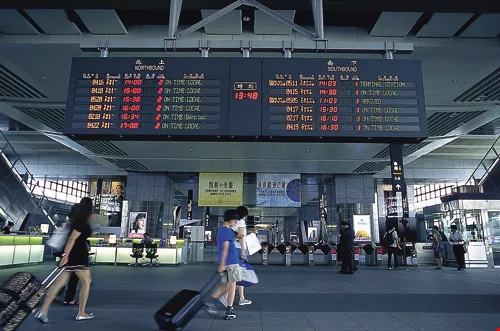
The ticket reading system of Taiwan High-Speed Rail uses Moxa networking products; when travelers insert their tickets into the machine, in an instant the data is circulated throughout the network.
There's no place like home
One thing that is especially gratifying about Moxa is that all of their products are still "Made in Taiwan."
Ben Chen quite frankly admits that they have discussed internally whether to set up operations in mainland China or some other place with cheap labor in order to lower costs. But they have decided to stay in Taiwan. "Our products have to be tailored to meet the specific needs of each client. That means we produce a wide variety of products, each in small numbers, but with high profit margins, and this is precisely the combination of characteristics most suited to development in Taiwan. If we relocated, it is likely that the local industrial chain would not be able to meet our needs, and that would be penny wise but pound foolish."
As for how "404 Technologies" got their English name, Ben Chen recalls with a laugh how-once they had decided they wanted a name of two syllables that would be easy to say and easy to remember-all the staff flipped through dictionaries furiously searching. Finally someone came up with "moxa," which is the short name for the dried mugwort leaves used in moxibustion. This herb is said among Chinese to be good for relieving distress among the ill and troubled, as well as for dispelling malevolent forces, which are ideal characteristics for the image the company wants to project.
In addition, the name reminds people that the company is rooted in Taiwan. "The US company Cisco got its name from the city where it was established, San Francisco. There is the same happy coincidence of sounds between 'Moxa' and 'Formosa,'" says Chen with a smile, recalling that Formosa was the earliest name Western navigators gave to this island.
The Moxa Group also includes three other subsidiaries, which are involved in the fields of serial communications, industrial Ethernet networking, embedded computers, and industrial wireless communications. They have also set up branch offices in China, the US, and Germany. This year group revenues will reach NT$2.5 billion, and are expected to hit NT$5.0 billion by 2009.
When you ask why the company has been so successful, Ben Chen cites "keeping focused on core operations" and "staying up to date" as the keys. He notes that when the Internet first boomed back in the 1990s, the company considered also going into the consumer electronics market, but decided not to, a decision which has been proven correct by subsequent events.
Taking care of the homies
Another competitive advantage that Moxa has is its corporate culture of concern for the well-being of its employees.
Whereas most companies emphasize sales, Moxa's philosophy "puts employees at the core." It is hoped that after employees enter the firm they not only will have a chance to use their talents fully and find financial security, but also raise their personal quality of life. Thus the company not only encourages staff to form hobby clubs, like those for photography, hiking, and softball, each year they provide one paid day for employees to engage in public service action. They have also established a foundation and a volunteer organization, subsidizing butterfly ecology education at more than 20 primary schools in Taipei and Taoyuan counties. Moreover, each Monday morning between nine and ten is set aside for employees to read. They can read any book they like, but are "strictly prohibited" from working, answering the phone, or going online. The company picks up the tab for all the books.
At present Moxa has no plans for a public offering. One reason is a concern that if its shares go on the market, stockholders might pressure the company to sharply reduce employee fringe benefits. So the bosses at Moxa prefer to keep the things the way they are and follow the beat of their own drum. Considering this year's fabulous sales numbers, employees seem to be inspired, which gives Moxa a warm and human quality that sets it apart in the silicon artificiality of the technological world.

@List.jpg?w=522&h=410&mode=crop&format=webp&quality=80)


