Cultural and Creative Industries--Wedding Commerce with Culture
Tsai Wen-ting / photos Jimmy Lin / tr. by Jonathan Barnard
April 2004


If you ask about the hottest-selling product of recent years, the answer is without a doubt the Harry Potter series of children's fantasy books that have sold 200 million copies around the world. The film adaptation of The Return of the King, the final installment of the Lord of the Rings trilogy, which also belongs to the genre of fantasy, recently picked up a record-breaking 11 Oscars, and its global box office receipts have exceeded US$1 billion. At the dawn of the new millennium, these two examples bear witness to the cultural and creative industry's boundless potential.
Over the last ten years, information technology has swept the globe, but as the industry has matured increased competition has put a crimp on both profits and the potential for future growth. On the other hand, "cultural and creative industries," which take the creative methods of art and give them rebirth by melding them with various industries, have managed to combine what were once the polar opposites of culture and commerce to create a sure winner and star for the era.
Here in Taiwan there are countless examples: Jimmy's illustrated story book Turn Right, Turn Left has been turned into a film that has grossed over NT$20 million at the box office, while licensed merchandizing of a single ink-wash painting by Qi Baishi (1863-1957) has also pulled in NT$20 million. Meanwhile, the Cloud Gate Dance Studios, founded by master dancer Lin Hwai-min, instruct more than 8000 dance lovers a month. And in Taipei County, along the Taipei-Ilan Highway, there is the Hillside Garden, a restaurant possessing a cultural aura and great culinary creativity. If you want to eat there, you've got to book a month in advance. The Ilan International Children's Folklore and Folk Games Festival, moreover, reaps more than NT$200 million in ticket sales. And if you include the effect it has on transportation, restaurants and hotels, its economic impact exceeds NT$1 billion.
Seeing this trend, the government in 2002 formally included "cultural and creative industries" in its "Challenge 2008" six-year national development plan. The plan projects investment of NT$20.8 billion in these fields over six years. Moreover, the "Ten New Major Infrastructure Projects" plan inaugurated last year designates that NT$100 billion of the NT$500 billion scheduled to be invested over the course of five years shall be in cultural and creative industries. Like a "Gandalf" aiming to protect the entertainment industry, the Executive Yuan, at the helm of this campaign, has decided to encourage the film industry to make commercial 3D films by offering NT$100 million in prize money for an industry that had seemed perpetually condemned only to help foreign studios make their films.
Facing the advent of the era of the cultural economy, politicians, scholars, cultural figures and captains of industry have been joining ranks to form pioneering interdisciplinary teams. Yet how can they get hold of a treasure map or wave a magic wand to turn culture and art into gold and allow traditional industry to add value and shine?
Cultural and creative industries are story-telling industries. So here's a story: In 1974, the American government solicited bids for a contract to dispose of waste from a cleanup of the Statue of Liberty. Yet no one was putting in a bid-because in New York State there were strict requirements about waste handling, and you could be sued if you did a poor job.
Finally, a Jewish copper dealer made a bid on it. When he was awarded the contract, he organized his workers to sort out the materials. He took the copper and smelted it into miniature replicas of the Statue of Liberty, and he took the slabs of concrete and wood and cut them into bases for those souvenir replicas. And he took the scrap lead and aluminum and turned them into key chains. In less than three months he had turned a pile of waste into US$3.5 million.
It's an extraordinary example, to be sure, but according to information released by UNESCO, total world trade in cultural products has quadrupled over the last two decades. And in the case of the US, which has long excelled at producing cultural products, in 1996 these had already surpassed aviation, automobiles, and the defense industry as the nation's largest single industry.
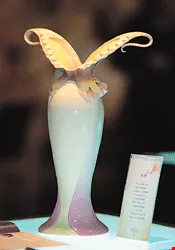
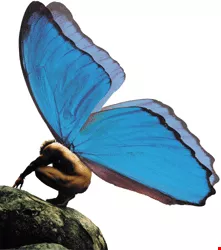
Franz's series of butterfly products, which make use of Art Nouveau lines, won a prize at an American gift show.
Culture is good business
At a time of hard economic times around the world, culturally creative industries are nonetheless quickly expanding. They hold excellent potential. Wu Se-hwa, dean of the College of Commerce at National Chengchi University, states: "Cultural and creative industries are the trend of the future, the direction that Taiwan's economy must go."
Take the example of Britain, which has many years of experience with cultural and creative industries. In 1997 the British government made encouraging the development of these industries a government policy. That year production in those industries amounted to £600 million. By 2001 production had jumped to £112.5 billion, and these industries provided employment for 1.95 million people.
Or, closer to home, check out an Asian example: Korea. Korean films and television series have been popular in Taiwan for many years now, and Korean video games have been continually dominant. In 2001 Korean cultural products amounted to US$10 billion and accounted for 22% of the nation's exports. Thus Korea has already cast off its image as a place that makes cheap cars and domestic appliances.
In industrial nations, where a single machine can do the work of hundreds of people, rising unemployment is a growing side-effect of technology. In the electronics industry, an investment of NT$10 billion generally only provides 500 new jobs. Yet a similar amount of investment in a cultural industry would provide employment for 10,000. "Think about it. How many people work backstage for just one of A-mei's concerts?" asks Wu rhetorically.
The Lord of the Rings trilogy of films took seven years to make and required an investment of US$270 million. It also required a production crew of 2,400 people, with 120 people handling special effects and makeup, and 350 animators. And just one scene shot in Wellington required 26,000 actors. More than just a magic wand for creating economic production, cultural and creative industries are also a means to reduce unemployment.
The Taiwan Institute of Economic Research estimated the value of the ROC's cultural and creative economic production in 2001 at NT$440 billion, and conservatively sees that growing to NT$1.16 trillion.
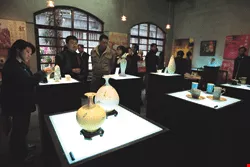
(facing page) Glass art has unexpectedly become one of Taiwan's hottest gift items in recent years. The photo shows Liuli Gong Fang's work Carefree in the Water.
Changing a cultural intangible
At the same time that culturally creative industries are "flashing the gold card," because the definition of culture is broad, and also because creativity can make use of any technology or technique, the scope and definition of these industries are vague, with no two experts describing them exactly alike.
UNESCO defines cultural and creative industries as "those industries that combine the creation, production and commercialization of content that is intangible and cultural in nature." Wu Se-hwa makes the following analogy: "Compare cultural and creative industries to an enormous kitchen: you must have cultural food materials and creative cooking methods in order to create a delicious cultural dish.
The ROC Ministry of Finance's creative industry promotion group has defined 14 different categories of cultural industry, including visual arts, performing arts, publishing, television and radio, film and advertising (see figure, p.9).
With regard to this rather all-encompassing category as defined by the government, Hsia Hsueh-li, an associate professor at Taipei National University of the Arts, believes that it's very difficult to foster internationally competitive industries overnight. He suggests, "It would be better to start with no more than five items, and then add more later."
Hsia Hsueh-li holds that such Taiwan industries as advertising, publishing, video games, or pop music are mass-market industries that took their first steps early on. From their organization and management to their marketing and packaging, these industries are complete and mature. For instance, Singaporean singing star Sun Yan-zi, Asian Time coverboy Jay Chou, and A-mei (a Taiwanese singing star who has caused a sensation in mainland China) have all been handled and created in Taiwan.
Apart from examining what advantages we already have, playing to our strong suits, and getting companies to emulate successful creativity by producing something similar, we can also create industrial centers that will increase the size of the industrial pie and make these industries mainstream.
Jan Hung-tze, an expert on trends, writes that Taiwan ought to be better suited than Korea at matching and combining these industries suitable for cultural creativity with the information technology industry (where Taiwan is already strong), creating electronic publishing, the broadcasting and marketing of digital music, and video games.
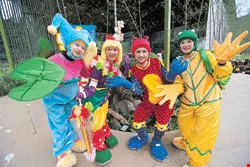
Apart from creating tangible productive value, cultural and creative industries also foster such intangible social benefits as local identity and a high quality of life. The photo shows Ilan's Green Expo.
Mysterious core
Liu Wei-kung, associate professor of sociology at Soochow University, says that rather than debate incessantly about the definition and scope of cultural and creative industries, it would be better to grasp the salient characteristic at their core, which is that content on its own is not enough. It's extremely important that the product or service creates an appealing story that will pull people in, so as to give people a joyful experience in the process of consumption.
Take, for example, Starbucks Coffee, which has taken the world by storm. The flavor of its coffee or its interior design aren't what charm people. Rather, it has achieved its dominance through "placement marketing." With stars and starlets often appearing on screen in a Starbucks, it has become a kind of status identifier for yuppies.
Or take the rage for nostalgic products in Taiwan. What people are selling is memories or feelings about an era. "The key way that cultural and creative industries create value is through feeling and aesthetics. But when you take these moving sentiments to the ultimate degree, you create remarkable value," explains Liu Wei-kung.
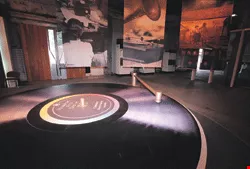
If products can tell stories, then they can provide a moving experience for consumers. The nostalgia for old products in recent years makes ample use of the core spirit of cultural and creative production.
Culture also requires capital
Since culturally creative products are a kind of "production," to do business you've got to first have cultural capital.
Wu Se-hwa states that capital for cultural creative industries includes the following: copyrighted music, literature, fine arts and animation; locations that can serve as the background for creativity, such as historic sites and natural scenery; creative talent; and language or customs that reveal the special flavor of an area.
Crouching Tiger, Hidden Dragon, for instance, which stirred up a new wave of martial arts films, relied on American-based global capital to be made; but its director Ang Lee made ample use of East Asian cultural assets, setting the expert martial arts exchanges against the magnificent backdrop of the Forbidden City, the first-rate musical score by Tan Dun with a cello performance by Yoyo Ma, and the chivalric spirit of Chinese martial arts. All combined, these allowed this not particularly well known piece of martial arts fiction to be very successful in the international market.
"The key to success is bringing together various cultural ingredients," says Wu. Taiwan has an immigrant culture and a solid foundation of Chinese culture, with the cultural impact of Japanese colonialism and the openness of an oceanic culture on top of that. All in all, it creates a nation with both a distinctive local character and an international outlook.
Capital accumulated from the development of the information industry, as well as experience with international management and technological integration, are also important parts of the formation of cultural and creative industries in Taiwan.
"Whether from the side of culture or commerce, people are converging toward the middle ground, and this is how cultural production is getting stimulated," says Wu.
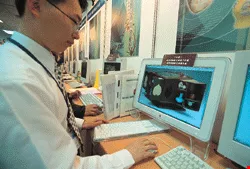
(facing page) The digitization of art allows for the rapid replication and repeated use of cultural creativity, bringing art's boundless reach before people's eyes.
Culture eyeing money?
Yet culture and industry, which in the past had seemed like polar opposites, are always going to have an inherent tension between them.
"As industries, cultural and creative industries are naturally going to be seeking profits," says Hsia Hsueh-li of Taipei National University of the Arts. "A company's main precept is to follow consumers' lead. You try to meet consumers' needs. The artist's notion of pleasing one's own fancy or listening to one's inner muse has to be turned on its head," warns Chun Cheng-chung, who was brought over from the Taiwan Institute of Economic Research by the Council for Cultural Affairs (CCA) to create its office for cultural industries.
And there's another aspect: when artistic creators, who play the role of social critics on the cutting edge of the age, see the characteristic features of commerce and industry-mass production, standardization and self-sufficiency-won't they be overcome with doubts and anger?
"Commercialization isn't necessarily a bad thing; it can get culture closer to people's lives and keep it from being so alienated and constricted," says Lin Ku-fang, dean of the Graduate Institute of Art at Fo Guang University, who is a consultant on cultural and creative industries for Taipei City.
It's just that the value of culture and arts, especially performance arts, is in the experiences and feelings taken from a performance in a moment of time that cannot be repeated. With regard to its one-of-a-kind content, how can core items of cultural industries such as performance, music and art seek mass production, standardization and self-sufficiency?
Chen Chi-nan, a minister without portfolio who is a leading figure in the push for cultural and creative industries, says that from inside to outside there are three key layers to cultural production: at the core are the arts (the fine arts, theater, music, literature and so forth); the second circle includes advertising design, architecture, the media and so forth; and the outer circle represents extended services and tourism-this is the most easily commercialized portion. Chen explains further: "Focusing on the artistic creativity at the core, the role played by the CCA is like that played by the National Science Council for technology, putting the nation's power into the cultivation of culture.
"If there's no original value, there can't be any added value," points out Lin Ku-fang. Only if the "purity" of art and culture is high can you have an unending supply of creativity that can cultivate thriving industry and thereby create high-value-added products.
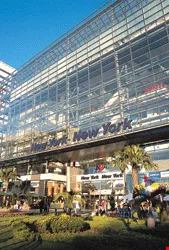
In Taiwan's consumer markets, foreign cultures and values are everywhere in evidence. Developing culturally creative enterprise not only can "turn sow's ears into silk purses," it's also a way of rebuilding our culture and self-confidence.
Cloud Gate's productive value
Take the example of the Cloud Gate Dance Company, which occupies an important place in Taiwanese performance art and is virtually synonymous with modern dance in Taiwan.
Lin Hwai-min, its founder, says that in 2002 revenue totaled NT$122 million. Almost half of that came from ticket sales and half from government assistance and donations from private individuals. Merchandizing and licensing revenue totaled NT$3.6 million, but this was little more than a drop in the bucket. When you deduct expenses of NT$124 million, there is a deficit of more than NT$1.8 million. It's a long way from "getting rich on creativity."
Yet according to statistics on government-supported dance troupes, of the nation's 96 professional dancers, 35 work for Cloud Gate. Moreover, Taipei Crossover Dance Company's Luo Man-fei, Contemporary Legend Theater's Wu Hsing-kuo, Taigu Tales Dance Theater's Lin Hsiu-wei, Taipei Dance Circle's Liu Shao-lu, and U Theater's Huang Chih-wen are all former Cloud Gate dancers, a fact that bears witness to the great contribution Cloud Gate has made to cultivating dance talent in Taiwan.
(courtesy of Taipei National University of the Arts)
Drinking with Qi Baishi
In performance arts, where you need a lot of people and production costs are high, licensing and merchandizing can only cover a small portion of expenses. Yet for those cultural and creative industries where the sensation of live performance is less important, such as fine arts or publishing, a combination of printed materials, recordings, films and Internet sales can bring outstanding profits.
Whether appearing in TV advertisements for automobiles, on rapid transit cards, on the cup in one's hand or on the sheets on one's bed, copyrighted characters from the illustrator Jimmy's books-which can be found in every corner of Taiwan, mainland China and Hong Kong-bring in an average of NT$300 million a month.
Hsia Hsueh-li cites this example: once he watched a student playing a video game and noticed to his surprise that when he accurately shot down an airplane the music that would play was the classical melody "Turkish March." "When making good use of culture, cultural industries not only don't defile the sanctity of art, they can serve as the elixir for cultural revival."
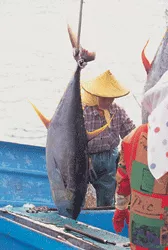
The Pingtung Bluefin Tuna Cultural Festival, which combines local products with cultural creativity, has done an outstanding job of attracting tourists and consumers.
Selling poignancy
And for traditional industries that have already tried OEM (original equipment manufacturing), ODM (original design manufacturing) and OBM (own brand manufacturing), cultural creativity enables the sun to rise on sunset industries: it can be the key to adding value and revival.
Such traditional industries as ceramics, clothing and industrial arts have created a foundation for mass production in the excellent execution of their OEM work. In the future these industries will move toward ODM work, groping for international trends and market directions. Yet in refreshingly creating its own brands, Franz is perhaps Taiwan's best example of how an OEM company can use cultural creativity to add value and transform itself.
Franz is owned by Seagull Decor Company, which had for three decades worked as an OEM and ODM for major European and American brands. It has produced more than 200 million teddy bears alone. Yet unhappy always playing a supporting role, in 2001 it created its own brand: Franz.
In 2002 Franz first took on America, and it won the prize for best collectible gift item at the New York International Gift Fair and succeeded in being placed in such high-end department store as Neiman Marcus in the United States and Harrods in London, thus taking its place among the world's fine brands of china. Currently, Franz china is sold in 4000 retail locations around the world. The brand employs more than 6000 people, and expects to make US$20 million this year.
In shifting from OEM work to launching the company's own brand, CEO Chen Li-heng believes that the most important thing is "giving the product the meaning of a story." He says, "Only by so doing can one move people's hearts and create a dream." Franz's "Butterfly" series of products that won first prize at the gift fair feature three-dimensional hand-painted colorful butterflies that have alighted delicately on the mouth of a bottle or the handle of a cup. These butterflies with their elongated tails show the flowing lines of Art Nouveau; and they also somewhat resemble the fairies dancing in the murals of the Dunhuang Caves.
"Having selected Art Nouveau as our main style and having gained market experience from releasing 1000 new products in a year, we know that its flowing, elegant lines put people at ease and meet the needs of modern people who are under a lot of stress," explains Chen. And through product salespeople and company brochures, the bird of paradise, the little red cranberry and the other designs all have moving stories connected to them.
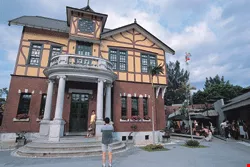
Because of creativity, because of stories, the urban style is unique and very competitive. And cities are the principal stages for the blending of various kinds of cultural creativity.
Who takes the challenge?
After the government began pushing cultural and creative industries, the CCA has begun to sponsor such activities as a biennial ceramics exhibition and a "Taiwan Fashion Party," and has launched a government project to promote cultural and creative industries by providing tax incentives, loans and legal advice. In March a store opened in Taipei's Huashan Arts District that specializes in selling cultural and creative industry products that are made in Taiwan.
Minister Chen Chi-nan believes that at first you've got to "provide a concept." Indeed, when culture is becoming an industry, the challenge posed is not only to culture. Traditional industries are also facing a test of redefining themselves.
"For a long time, the government's and the people's understanding of value has been totally based on the standards of manufacturing," says Liu Wei-kung of Soochow University. For instance, the government lists antique dealers and art galleries in the miscellaneous category of "other," which is the same category that undertakers fall into. What's more, various kinds of economic assistance, loans and insurance require real estate to be put up as collateral, but for creative and cultural industries, for which creativity and talented personnel represent their true capital, these requirements are entirely inappropriate. Everyone is going to have to come up with new ways to appraise the intangible nature of creative industry assets.
"The government should also go about providing an arena for different industries to gather and meld creatively," argues Wu Se-hwa. For instance, international arts festivals, local expos, film festivals and the like allow for people from different realms to interact and come in contact with each other, encouraging an environment conducive to the development of new creative industries.
Taiwan's wedding photo industry, for example, is a unique Taiwanese phenomenon, an industry that combines clothing design with photography. By combining romantic weddings with creative travel, why couldn't Taiwan become a favorite destination for newlyweds from around the world?
Since 1997, when the government first began promoting community development, localities have been slowly getting the hang of promoting traditional industries. Currently there are more than 100 different annual local festivals, including the Ilan International Children's Folklore and Folk Games Festival, the Pingtung Bluefin Tuna Cultural Festival, the Taiwan Flower Expo, and the Kungliao Ho-Hai-Yan Rock Festival.
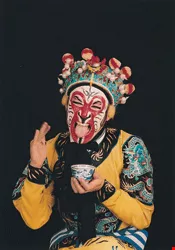
(photo by Li Ming-hsun)
Created in Taiwan
Cultural and creative industries sound like something unfamiliar, but they are very much part of all modern people's lives. When children get out of bed in the morning, their clothes are adorned with images of Mickey Mouse and Hello Kitty. Office workers stop into Starbucks for a cup of coffee. After a hard day's work, you relax in a recliner from Ikea, drinking a Coke, using the remote to switch between a Korean dramatic series, a Japanese cartoon, and a Hollywood movie, all the while thinking about taking a vacation in Bali.
Think about it. Most of the products people consume on a daily basis are cultural and creative products. It's just that they are all from other countries. Behind these "Made in" marks there is much intangible culture, and they have earned consumers' sense of intimacy and identification.
Although Taiwan has enjoyed a reputation as a dominant manufacturing "kingdom" for various products, we have almost completely lost out to competitors in the realm of culture. It's a serious problem when even a traditional Chinese story like "Mulan" is capitalized on by Disney rather than a company from Taiwan. How can one help but groan in frustration?
For the sake of economic development, Taiwan became a "workshop to the world" for numerous goods. In so doing, apart from developing high-value exports, we have also destroyed much of our environment and scenery. On the other hand, cultural and creative products, while creating economic value, can also bring refinement, taste, and a sense of ease and surprise for consumers, as well as raising the quality of the society, creating a win-win situation for culture and industry. The pioneers of cultural and creative industries may hoist the "Made in Taiwan" flag to flutter in the wind once again.

@List.jpg?w=522&h=410&mode=crop&format=webp&quality=80)


