Learning Afresh to Breathe
Chang Chiung-fang / photos Chuang Kung-ju / tr. by Scott Williams
December 2010


Sudarshan Kriya has become hugely popular in Taiwan over the last few years. Developed by Indian spiritual leader Gu-ruji (Sri Sri Ravi Shan-kar) to bring body and mind into harmony and alleviate the stresses of modern life, the breathing technique is said to be invigorating and to promote physical and spiritual health. Introduced to Taiwan 17 years ago, more than 10,000 Taiwanese have studied Su-dar-shan Kriya to date, some traveling as far as Bangalore to learn from the master himself.
In September 2010, psychiatrist Dr. Guo Yu-hsiang published Avoid Illness by Controlling Your Autonomic Nervous System, which describes autonomic nerve dysfunctions and offers readers an easy, effective and free prescription for dealing with them: abdominal breathing.
What kinds of problems can breathing help overcome? Isn't it a basic function of being alive? Why should we go to the trouble of learning to do it differently?
Calm down. Just relax and take a deep breath. The answers are here!
"The first thing we do when we're born is take a breath. The next is cry. The last things we do when we die are exhale, then make everyone else weep!" -Guruji
People's lives begin and end with breathing. It is life's sine qua non. In Gu-ruji's words: "There is no life without breath. Understand breathing and you understand life!"
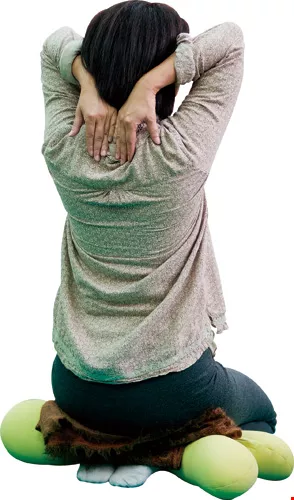
The Sudarshan Kriya breathing exercises created by Indian spiritual leader Guruji teach students to regulate the rhythm of their breathing and harmonize their energies. Pregnant women, victims of heart disease, and glaucoma sufferers should not practice the exercises, nor should anyone learn from a teacher only partially versed in the techniques.
On a laid-back Saturday evening in late October, men and women of all ages squeeze into a corner of the Dun-hua branch of Eslite Books to hear psychiatrist Guo Yu-hsiang lecture on autonomic nerve dysfunctions. At one point, Guo even lies on the floor to demonstrate abdominal breathing. He then asks his audience to place books on their chests and abdomens and breathe in such a way that the books on their abdomens rise and fall while the books on their chests remain still.
In mid-November, 50-some students of Su-dar-shan Kriya gather at the Yun Hsien Holiday Resort in Wu-lai, Tai-pei County, where they close their eyes, kneel in the diamond pose, and inhale and exhale as their teacher Jian Liwan directs them. As a powerful energy rises within them, they feel their minds, bodies, and spirits being purified.
"I used to be a very passionate person," says 45-year-old Chen Shixin. "But a number of unhappy events caused me to close up." Chen lost a number of close relatives in succession beginning when she was in her 20s. In an effort to overcome her sorrow, she began studying Buddhism. "It provided me with a superficial calm," she says, "but I wasn't happy."
Chen thought for a time that her health had been ruined. She had heart palpitations and blood pressure that alternated between too high and too low. She was calling for an ambulance almost every day and saw doctors of both Western and Chinese medicine. The former said she was suffering from panic disorder, the latter, from a lack of qi. Though 161 centimeters tall, Chen wasted away to just 40 kilograms. "I frightened myself in the shower," she recalls and says she felt as if she were soon to breathe her last.
Introduced to Sudarshan Kriya by her yoga teacher, "I felt doorways open again inside me," she says. Over the last year, her energy levels, mood, and health have all noticeably improved. And, after several years of being unable to maintain her weight, she has put on 5 kg. Her low blood pressure and tolerance for cold have also improved.
Chen's experience greatly increased her confidence in the breathing techniques, which she practices for 30-40 minutes virtually every day. "Sometimes I even laugh while practicing," she says, explaining that the laughter emerges from an uncontrollable inner joy.
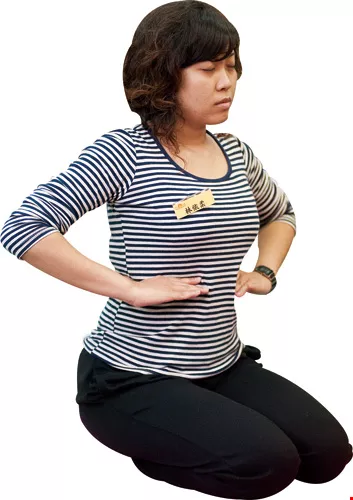
The Sudarshan Kriya breathing exercises created by Indian spiritual leader Guruji teach students to regulate the rhythm of their breathing and harmonize their energies. Pregnant women, victims of heart disease, and glaucoma sufferers should not practice the exercises, nor should anyone learn from a teacher only partially versed in the techniques.
Breathing exercises have long been used both in China and abroad to promote good health and cultivate the spirit.
Breathing also occupies an important place in Chinese philosophies of healthy living. Sources as early as The Yellow Emperor's Inner Canon, thought to have been compiled during the Warring States Period or the Western Han Dynasty, discuss breathing techniques.
From the standpoint of Traditional Chinese Medicine (TCM), qi ("breath") is life's energy and motive force. Working from its theory of meridians, TCM seeks to guide and circulate qi. Coordinating with the time and season, it strives to expel the old and stale and bring in the fresh and new.
Guruji, the creator of Su-dar-shan Kriya, says: "Breathing is an endeavor with profound implications. Every idea in the brain, every rhythm has a corresponding rhythm in the breath. Every rhythm in the breath has a corresponding emotion. Therefore, when you are unable to control your mind directly, you can do so indirectly through breathing."
Jian Li-wan, who teaches Gu-ruji's Su-dar-shan Kriya through the headquarters of the Taiwan branch of the Art of Living Foundation, explains: "Most people regret the past and are anxious about the future. Their minds drift between pasts they cannot redeem and futures they cannot predict. This being so, they are unable to live in the moment and they miss out on that which is before their eyes." Their hearts race and their thoughts wander beyond their control. But breathing exercises bring heart and mind together. "The heart and mind are like a kite. Breathing is the string that controls their flight."
In his book Emotions-Freedom from Anger, Jealousy and Fear, the renowned Indian spiritual leader Osho wrote: "Every person has a pile of garbage in their belly because it is the only place the body has in which to repress emotions. These repressed feelings prevent you from breathing [properly], allowing you to breathe only shallowly. Once you take a deep breath, the wounds from those repressed emotions release their energy. You are afraid, everyone is afraid, so you don't permit your breath to enter your belly.
"When too many repressed feelings enter the belly, the body splits in two, into upper and lower halves. In that event, you are no longer a single entity and lose that sense of wholeness." [Retranslated from the Chinese.]
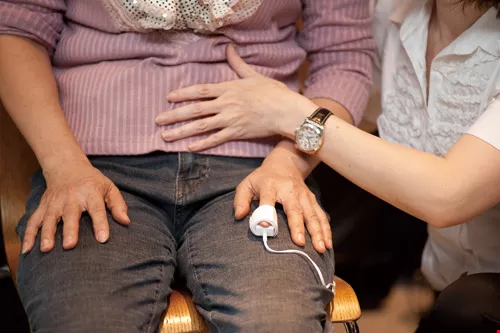
Guo has developed a device that helps people adjust the rhythm of their breathing, helping patients find their ideal rate of breathing by measuring changes in the strength and rate of their pulse.
Abdominal breathing is a constant across multiple schools of breathing and meditation, Gu-ruji's, Osho's, Guo's, the Buddhists', and the Daoists' alike. Unlike quick, shallow chest breathing, abdominal breathing is deep and slow.
Both TCM and Western medicine offer theories as to why abdominal breathing works.
Practitioners of abdominal breathing take six deep breaths per minute and do their best to press their diaphragm down into their abdominal cavity, causing the abdomen to swell. When exhaling, they draw in their abdomen, expelling all the accumulated qi. "Exercising the diaphragm also exercises the liver, spleen, stomach, and intestines, helps blood flow, and improves organ function," says Guo.
The exercises encourage slow breathing because it promotes longevity.
In his book, Guo cites the rates at which chickens, dogs, cows, elephants, tortoises, and human beings breath and demonstrates that species which breathe more slowly have longer average life expectancies. For example, chickens take 28 breaths per minute and live 10 years. Tortoises, on the other hand, take just two breaths per minute and have average life expectancies of 200 years. For this reason, Guo sets his own breathing at six to 10 breaths per minute, only half the rate of most people.
Chen Chih-kuang, executive director of the Chinese Qigong Association and head of the Liu-li-guang Herbal Health Temple, says that TCM places the dantian 2.5 inches below the navel and regards it as the source of qi. When breathing, practitioners focus on their dantian and keep their chest still, taking slow, deep breaths at a rate of four to six per minute. This exercise stimulates nine meridians, including those of the stomach, spleen, liver, and intestines, invigorating the meridians and helping conditions ranging from high blood pressure and diabetes to insomnia.
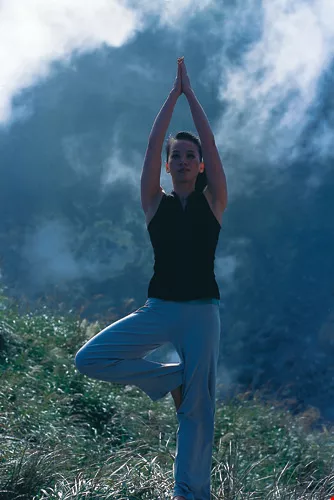
Breathing regimens are common in many schools of physical-spiritual practice, including yoga, Taiji, and Zen Buddhism.
Western medicine has a similar view of the practice.
Guo, who specializes in treating autonomic nerve dysfunctions, says that the autonomic nervous system regulates more than 90% of organ functions, including peristalsis, blood pressure, body temperature, and muscle relaxation. While these functions cannot be directly controlled by the mind, they can be adjusted through breathing exercises.
"How you breathe can affect your pulse rate," says Guo. Inhalation stimulates the sympathetic nervous system, making you excited and emotionally aroused. Exhalation stimulates the parasympathetic nervous system, calming you and prompting feelings of joy and peace. You can use conscious changes to the rhythm and depth of your breaths to modulate your autonomic nervous system and bring it into balance.
"Proper breathing is a convenient, effective, and cost-free prescription to good health," says Guo. He adds that practitioners of yoga who perform the poses beautifully but make no changes to their breathing are doing nothing to harmonize their autonomic nervous systems.
Guo stresses that those who learn the proper breathing technique and find an appropriate rhythm can improve the function of the autonomic nervous system. He has applied his theories to patients in treatment and achieved very good results.
His most impressive case to date involves a 50-some businessman who was spending virtually all his time in the emergency room. Frightened of having a heart attack, he gave up flying, riding high-speed trains, and traveling anywhere at all that was more than a 20-minute drive from a hospital. He ultimately had to work from home. But a treatment regimen that combined anti-anxiety medication with training in abdominal breathing brought about a marked improvement in his condition in just two months. Nowadays, he's excited to have found relief, but a little upset at having wasted five years living in fear. "I had no idea that I could find relief in just two months."
In another instance, a woman in her sixties who weighed 80 kg in spite of being just 150 cm tall lost 20 kg by practicing abdominal breathing for six months. The weight loss reduced the burden on her heart and knees, enabling her to give up her walker.
How does deep breathing help you lose weight? Guo explains that people suffering from autonomic nerve dysfunction eat all kinds of things to relieve anxiety. Fullness initiates peristalsis, stimulating the parasympathetic nervous system, which causes you to relax. But overeating often leads to obesity, which reduces both self-confidence and activity levels, leading to depression and more overeating. This kind of vicious circle cannot be broken by diet drugs, but can be turned around by breathing techniques that link body, mind, and spirit.
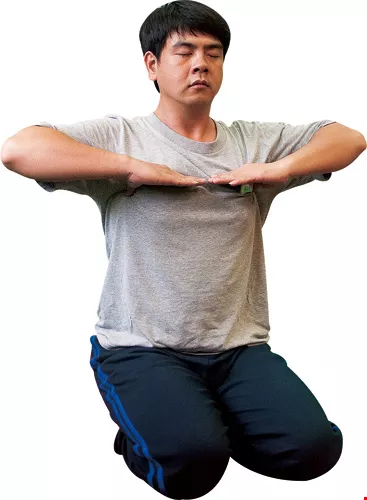
The Sudarshan Kriya breathing exercises created by Indian spiritual leader Guruji teach students to regulate the rhythm of their breathing and harmonize their energies. Pregnant women, victims of heart disease, and glaucoma sufferers should not practice the exercises, nor should anyone learn from a teacher only partially versed in the techniques.
In addition, training in abdominal breathing can prevent hyperventilation syndrome. Due to imbalance in their autonomic nervous system, people who suffer from this disorder often feel they are suffocating and anxiously try to suck in more oxygen. Their breathing becomes shallow and rapid, purging carbon dioxide (CO2) and causing its concentration to fall. This in turn results in vasoconstriction and still more panicky rapid breathing.
Guo says that hospitals used to treat the condition by having sufferers breathe into a bag. CO2 would collect in the bag and be inhaled again. But Guo says that abdominal breathing also causes rapid slowing of the respiration rate. He jokes that everyone in the old days knew to hold their breath if they encountered a jiang-shi (a blind "Chinese vampire" said to sense the breath of its victims) because hyperventilating would make you still more nervous, leave you gasping for breath, and cause you to tremble uncontrollably from head to toe.
Similarly, the reason smokers relax when they take a drag on a cigarette is that they inhale deeply and exhale slowly. Smokers take drags on their cigarettes at about the same pace that students of abdominal breathing breathe. "It isn't the nicotine that relaxes a smoker, but the pace of their breathing," says Guo.
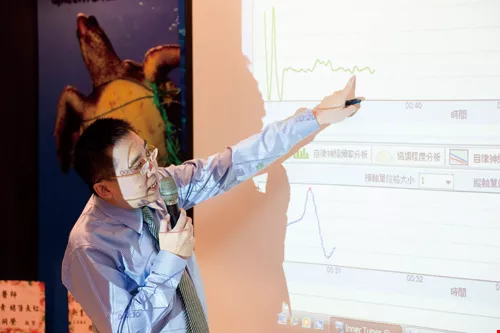
Breathing is the only mechanism we have with which to modulate the autonomic nervous system. During a lecture at Eslite Books, Dr. Gou Yu-hsiang teaches his audience to alter the depth and rhythm of their breathing to bring their autonomic nervous systems into balance.
Breathing can change your heart rate, which can influence your blood pressure. All three are closely connected. The conversion of internal energy requires a tremendous amount of power. If you can synchronize your breathing with your brainwaves, heart rate, and blood pressure, it creates a kind of resonance that puts the body's energy to the most effective use.
Guo illustrates his point with a swing. When playing on a swing, you don't want your legs moving at random, but together in rhythm. When they do, it takes little effort to swing high. He argues that synchronizing one's breathing with pulse, blood pressure, etc. works in much the same fashion. But it takes a great deal of practice to bring them together when all are resonating at different and variable rates.
Guo says that yoga, meditation, and qigong all address this. Practitioners who spend five or 10 years working on their technique are doing so in search of their own rhythm and to unite their breathing with mind and spirit. But Guo recognizes that people today are chronically busy, and he is therefore seeking to patent a device that aims to speed the process of finding this rhythm. The device measures the rate of change in a person's heart rate and uses it to help the individual find his or her resonant frequency.
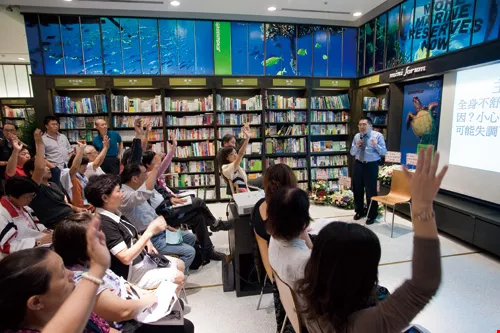
Breathing is the only mechanism we have with which to modulate the autonomic nervous system. During a lecture at Eslite Books, Dr. Gou Yu-hsiang teaches his audience to alter the depth and rhythm of their breathing to bring their autonomic nervous systems into balance.
Gu-ruji's Su-dar-shan Kriya breathing exercises also focus on finding this rhythm.
Jian says that the biggest difference between Su-dar-shan Kriya and yoga- or Taiji-style breathing exercises is its "rhythm." She says that just as Nature and human life have their seasons, so breathing and every other activity have their rhythms.
Su-dar-shan Kriya consists of three techniques, all oriented around rhythm.
The first of these is Ujjaye breathing, or "victory breathing": "Focus your attention on your throat, take a deep breath, then slowly exhale, emitting a low, harmonious sound from the throat, like the sound of distant waves," says Jian, explaining the technique. The frequency at which the throat resonates stabilizes the sympathetic nervous system and invigorates the parasympathetic nervous system, moving them towards balance.
"This is the gentlest and subtlest way of breathing, and you already know how to do it," says Jian. "You just don't remember." She explains that infants breathe this way when sleeping deeply, as do adults who are just falling asleep.
The second technique is Bhas-trika, or "bellows breathing." As the name suggests, this technique involves breathing with great force, like a bellows, which quickly delivers a large burst of energy. Children typically utilize as much as 90% of their cardiopulmonary functionality, whereas adults, whose muscles tend to be tense and tight, utilize only 20-30%. The Bhas-trika technique opens up the entire lung.
Importantly, "pregnant women, glaucoma sufferers, and persons with cardiovascular disease should not practice the technique because it generates too much force," warns Jian. "It overstimulates the cardiovascular system, which can be dangerous for such individuals."
The final and most unique of the three techniques is "purifying breathing," which utilizes three different breathing rhythms to relieve stress and boost energy levels.
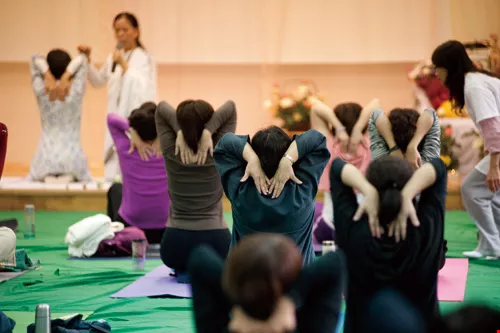
Guruji says that life is an eternal celebration. Guided by Jian Liwan (standing, with microphone), students strive to "see themselves" and "catch their breath."
The Art of Living Foundation has some 40,000 volunteer teachers worldwide. Jian, who received a teaching certification from the organization in February 2009, began teaching classes in May and has trained 500-600 students to date. She says the changes she sees in their lives are what motivate her to keep teaching.
Jian says that students gain different things from the process of learning Su-dar-shan Kriya. Some find their bodies purified, while others undergo changes in their thinking. Some weep in class, while others laugh, and still others have no obvious reaction, but everyone feels an emotional stirring and sense of release.
According to Chen Chih-kuang, a doctor of TCM, both laughter and tears are completely normal reactions. He says that the lacrimal glands are closely connected to the sympathetic and parasympathetic nervous systems, and that TCM also links the seven emotions and six appetites to the five viscera and six bowels. Learning the breathing exercises stimulates the autonomic nervous system, affecting the five viscera and six bowels, and thus the emotions.
Even more interesting is that the practice of Sudarshan Kriya leads to the release and expulsion from the body of heavy metals, toxins, and pigments that accumulate in the nervous system.
Chen's own experience with steel pellets provides a fascinating example.
Chen, a martial artist who has also won individual awards in Taiji and sword performances from the Beijing Martial Arts Research Society and from national martial arts competitions in China, has been practicing Iron Fist kungfu for the last four or five years. Training in this martial art includes striking bags of steel pellets with the hands. When Chen began a Sudarshan Kriya class in Miaoli in November of 2009, he noticed that the insides of his elbows were exuding a fine black powder. He wiped it off, but it kept returning. He later realized that his practice of Iron Fist had allowed steel from the pellets to get under his skin and pass through his body along his meridians. He concluded that his practice of Sudarshan Kriya was causing his body to expel this steel. Chen has since become a Sudarshan Kriya volunteer, providing students with TCM consultations and services whenever Jian Li-wan conducts a class.
Breathing classes at exercise studios may be expensive (a beginner's Su-dar-shan Kriya class runs about NT$7,000 for new students), but its principles are easy to grasp: inhale, exhale, focus your mind, and make yourself calm. As your body exchanges CO2 for oxygen, you connect with yourself, learn to "let go," and let joy and serenity arise naturally from within. That's the secret of breathing and the essence of life. Why not give it a try!


