Who cares what others say?
Speaking about inventions, Hsu stresses that an inventor's perseverance is vital. When grand ideas are first broached, they are often met with scorn. The only recourse is to rely on one's own determination if a new invention is to have any chance of being completed. This principle is illustrated by his discovery more than 20 years ago when playing basketball that if air could be injected into the soles of his shoes he would be able to jump higher and better; or when he was crossing the street and had the walk signal turn red before he had made it to the other side, making him wonder why a timer could not be placed under the pedestrian walk signal. However, these two ideas were laughed at by classmates and teachers as impractical. Looking now at the many people on the street wearing air-cushioned shoes and the traffic signs with countdown timers annoys Hsu no end.
According to statistics, for every 100 ideas produced by inventors, only 20 to 30% can be made into actual products. Of these, only about 10% are ever mass produced and commercialized. After commercialization, less than 10% likely ever appeal to consumers and earn large profits. These facts show that the path from initial idea to successful product is long and difficult.
"Laypeople have many misconceptions about 'inventions'-for example, that they must be made into a product in order to be called an invention. But that's not right," says Hsu, who teaches industrial design at National United University in Miaoli County. He often encourages students by telling them they need only present their idea clearly in text or drawings to apply for a patent. However, before doing so, they must first make online queries to determine if someone has already come up with a similar idea either in Taiwan or abroad, and then decide whether to relinquish the effort or follow through.
Hsu tells an anecdote: more than ten years ago, local inventor Huang Ying-chun devised an air-cushioned shoe. Unfortunately, due to the fact that at the time accessing relevant information was problematic, he did not scrutinize foreign patents and applied only for a domestic patent, with the result that this patent was later challenged and overturned by Nike. On the bright side, Huang also invented a next-generation air cushion design that uses blow moulding. After confirming that the idea had not been patented either in Taiwan or elsewhere in the world, he actually produced the air cushions, leading Nike to hire him as a technical consultant.
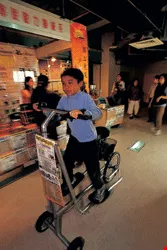
The inventions expo held in Taiwan every year is a hotbed for nurturing and stimulating student creativity. The easy-riding bicycle shown in the photograph was the idea of a student from National Huwei University of Science and Technology.





@List.jpg?w=522&h=410&mode=crop&format=webp&quality=80)


