A Stroll through the Global Garden
Chang Chiung-fang / photos Chuang Kung-ju / tr. by Chris Nelson
January 2011


Located in the Fine Arts Park Area, the 1.2-hectare Global Garden Area is an international arena of gardening and landscaping competition. The organizers invited domestic and overseas judges to give point ratings on opening day and the day before closing of the Taipei International Flora Expo, and the champion garden will win a US$60,000 prize.
Eager competitors from 22 countries and 26 cities in Europe, Asia, the Americas and Oceania have created 35 exhibits in the Global Garden Area. The romance of Europe, the refinement of Asia and the passion of the Americas: the Global Garden Area is like a global village that can all be taken in during one visit.
The meanings and distinguishing features of each country's garden designs are expertly presented via the detailed narration of Jeff Chen, director of the Taiwan Florists' Transworld Delivery Association. Here we introduce several of these impressive gardens. Why not first take a tour on paper before taking a guess at which garden has the most potential of winning?
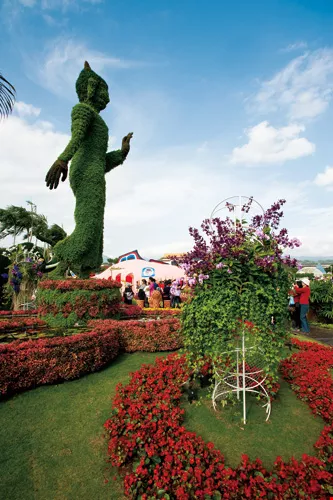
A six-meter-tall topiary Buddha is a landmark of the Thai Garden.
The first thing you see after crossing the pedestrian bridge from the Yuanshan Park Area to the Fine Arts Park Area is the Taiwan Garden, hidden within a bamboo grove.
Flanking the exterior of the Taiwan Garden are mini-plantations of the tea cultivars Taiwan Tea No. 12 (Jinxuan) and Taiwan Tea No. 18 (Red Jade), symbolizing the tea-sharing hospitality of the Taiwanese. Also here are betel palms, a common sight in Taiwan's landscapes: the betel nut is still used for dowries by the Aborigines, and bears the meaning of "welcome."
The first thing you see upon stepping into the garden is a display case reminiscent of a shipping container, in which are displayed pure-white Phal-aen-op-sis aph-ro-dite orchids endemic to Taiwan, as well as some lovely Pa-phi-o-pe-di-lum and Cat-tleya orchids.
The display gives an account of Taiwan's orchids and the process of shipping them to Europe, North America, and Japan. Within the display window are special storage units and LED lights developed to simulate natural lighting in order to prevent the 15% loss of orchids that occurs when they are being shipped. These devices help the orchid seedlings grow while in transit-there's no need for them to lay dormant-and have opened a major door for Taiwan's flower export industry.
Next is a path of rounded stones, a common sight in Taiwan, inviting visitors to slow their pace as they walk through a tunnel of woven bamboo. Sunlight filters through the bamboo groves on either side; when it reaches you through the hand- woven bamboo walls it's comfortable and not harsh to the eye, giving folks the impression of country life in old-time Taiwan.
The tunnel ends in a granary-shaped bamboo dome, symbolizing the fall harvest. At the entrance and exit of the granary are vase-shaped doorways, symbolizing safe passage.
In the roof of the dome is a round hole, through which you can see the sky. Every 15 minutes or so a plane flies directly overhead on its way to land at nearby Song-shan Airport. We have no idea whether this mix of ancient and modern is the designer's ingenuity or just a fortuitous accident.
Outside the bamboo dome is a semicircular pool. Within are two sculptures; the first with five water droplets standing for the passing on of tradition; the second consists of twin water drops standing for love. Surrounding the pool is a rest area built of southern pine, surrounded by a two-meter-wide bamboo grove sheltering it from outside noise. Here, visitors can enjoy a brief moment of peace and quiet amid calla lilies, white ginger, Japanese hedge parsley and other aquatic plants.
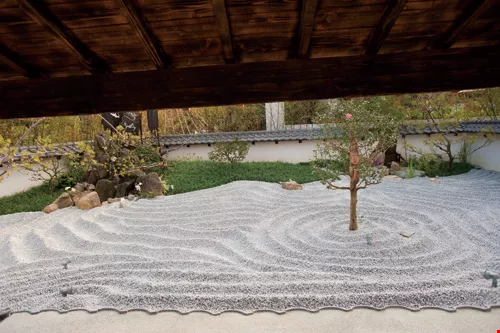
Japanese designer Ryuji Ando's Garden of Dragon features pebbles raked into ripple patterns.
Take a journey through the Korean drama series Dae-jang-keum. The Jang-keumi Garden displays the residential garden of the commoner family of a Korean maiden, Jang Keum, who became a physician at the royal palace.
At the entrance stands a red arch, a gift bestowed by the king as a symbol of utmost trust. Welcoming visitors to the garden are statues of Jang Keum and her husband Min Jeong-ho, bringing smiles to most visitors who have watched Dae-jang-keum.
A specially imported Korean water-wheel and gazebo are the most eye-catching foci of the garden: the waterwheel symbolizes water resources, and the gazebo is an important resting place for common folk.
The Koreans consider the autumn to be the most joyous time of year. Kimchi pots are placed in the yard, squashes and gourds dry on the roofs, and strings of persimmons hang from the eaves of the pavilion: these are all symbols of the fall harvest.
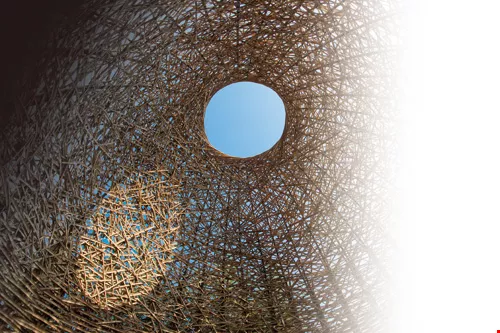
Three different bamboo weaving methods were employed to build the Taiwan Garden.
Mineral-rich Vietnam is known for its rocky landscapes, so the two large, costly stones at the entrance make a fitting greeting to visitors to the Vietnam Garden.
The Vietnam Garden showcases a southern Vietnamese ba gian (farmhouse) scene. All the elements-the building, the wooden bed, the ladies clad in ao dai, the young farm boy riding a water buffalo-are quintessential scenes of southern Vietnam. Vietnam is also the country that produces and uses the most conical hats, so visitors seeing the hat-shaped lanterns will instantly recognize this unique feature of Vietnam.
The garden's Vanda and Den-dro-bium orchids and staghorn ferns are all common plants in Vietnam. However, the bright yellow Vietnamese plum blossoms are artificial, because root-bearing plants cannot be imported into Taiwan.
It's worth mentioning that women keep things running in matriarchal Vietnam. Therefore the hulls and oars of the Vietnamese wooden boats displayed in the garden are built small for easy use by women.
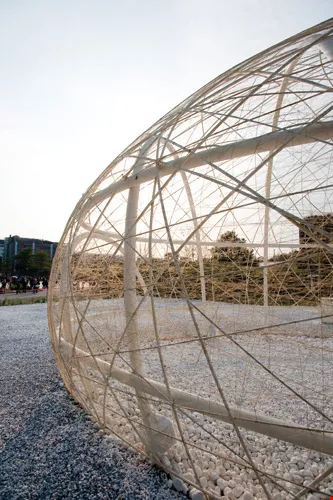
The Spanish Garden's Captured Nymph: nary a plant in sight.
The three features of the Thai Garden that immediately stick out are the resplendent royal barge, the six-meter-tall topiary Buddha, and the delightful topiary elephant, presenting to visitors the aura of the devout faith of the Thai people.
The king, the Buddha and the elephant are essential symbols of Thailand. The king of Thailand enjoys a position of highest esteem in the eyes of the Thai people, the elephant symbolizes wealth, and the Buddha represents the religious faith central to Thai society. The Buddha's thumb-to-fingertip hand gesture (the jnana mudr?) seems to be giving the OK to the Flora Expo.
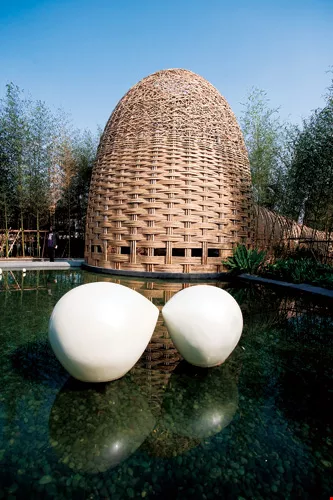
Three different bamboo weaving methods were employed to build the Taiwan Garden.
The Bhaisajyaguru Garden, within the Bhutan Garden, is brimming with a religious and herbal air. In the main pavilion are offerings of water, flowers, incense, light, balm and fruit to Bhaisajyaguru (the Medicine Buddha), and the fennel, madder and other herbs growing in the garden have medicinal qualities.
Bhutan is ranked seventh in the world and first in Asia in terms of happiness. Visitors to this garden are enlightened of the four mainstays of Bhutan's society: equitable and sustainable socioeconomic development, conservation of the environment, preservation and promotion of traditional culture, and good governance.
Amazingly, with the exception of the concrete structures, every brick, tile and wooden article in the Bhutan Garden was fashioned in Bhutan and shipped over here for assembly. Moreover, to share the power of Bhutan's happiness with Taiwan and spread it far and wide, Buddhist monks quietly chanted auspicious verses from the Sutras as they painted the structures.
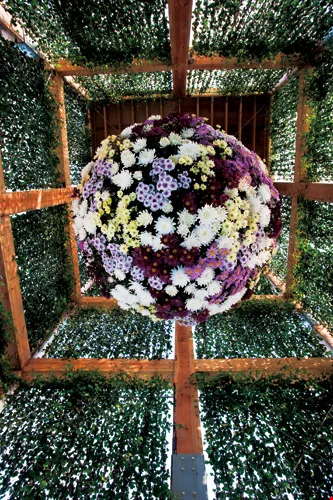
The walls of the structures in the Holland Garden are formed with ivy, and inside flower balls of different kinds hang down.
Japan has three private groups competing in the Global Garden Area competition. One of them, the Garden of Dragon, designed by Ryuji Ando, holder of Japan's top horticulturist rating, is an other-worldly fantasyland for visitors to lose themselves in.
Ando memorializes Typhoon Morakot via traditional Japanese garden landscaping. There's a hole in the wall through which water flows onto the earth, and the pebbles in the rock garden are carefully raked into ripple forms, symbolizing landslides.
A solitary pink flower on a camellia tree is set off by the white pebbles: a scene of sorrowful beauty. The Buddha carved into the camellia tree represents the rebirth of the disaster victims through faith.
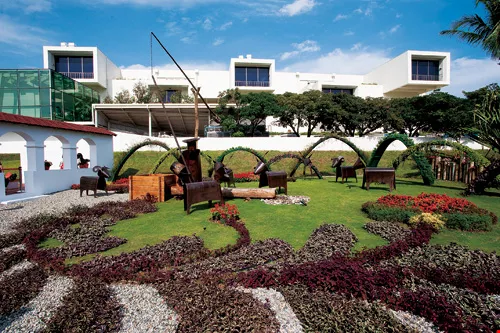
The Hungarian Garden features embroidery images on a lawn, blown up to 100 times their original size.
The Spanish Garden stands out in the Global Garden Area for being the only garden with no plants.
With white gravel covering the ground and a hollow cocoon-shaped structure of woven, pure-white material, visitors stepping inside are bathed in light and sound.
Amid the white steel frame wrapped in silk-like threads and the spraying mist, people standing inside the hollow cocoon are given the impression of being wrapped inside layers of glass as they look toward the heavens.
Mixed Borders: The RHS British GardenThe prosaic-looking mixed-border British Garden of the Royal Horticultural Society is in fact exquisitely designed. The vegetation is planted in multiple layers, with lofty trees and flowers low on the ground so visitors don't need to look up to view them. Strolling through the garden, you will happen across occasional floral scents.
The RHS British Garden includes a deck made of grey southern pine, with the aim of soothing the human mind. From the tranquil pond comes the sound of murmuring flowing water, giving a comfortable and pleasant feeling.
There are many more besides these gardens, such as the Bali-themed Indonesia Garden, Canada's Exponics, Oman Garden with its roses, the urban garden landscape of Singapore Garden, the yoga-themed India Garden, and the romantic Hawaii Garden. All are worth a look.
A full visit to the entire Global Garden Area takes about two and a half hours. Jeff Chen, who walked the area until his feet were sore, says perceptively that rain or shine, day or night, the gardens of the Global Garden Area each have their charm and appeal.
Indeed, this kaleidoscope of international allure cannot be missed!


