Synnex--A Brand Built on Innovation and Service
Yang Ling-yuan / photos Hsueh Chi-kuang / tr. by Anthony W. Sariti
October 2006


In October 2005 Interbrand, an inter-national branding consultancy, published its list of Taiwan's Top Ten Global Brands. Most of those named were high-tech manufacturing companies--but not all: Synnex Technology International Corporation, which owns no retail outlets or dedicated factories, but relies entirely on its worldwide logistics fleet and its meticulous planning and management, placed eighth with a brand value of some US$239 million. The only service-industry company to make its way onto the list, it ranked second for growth in brand value, and its reputation continues to advance.
Starting originally as a sales agent for IC components, Synnex gradually developed a three-in-one model for sales, logistics and maintenance, and ignited a conceptual revolution in high-tech product distribution in Taiwan. To provide customers with the convenience of multiple brands, multiple products and one-stop shopping, Synnex products span information technology, communications and consumer electronics with over 300 well-known global brands, including Intel, Microsoft, IBM, HP, Seagate, Nokia, Motorola and Ericsson, and more than 5,000 individual items.
Besides maintaining its firm leadership position in Taiwan, in the last ten years Synnex has actively deployed overseas, with operations located in 141 cities in 16 countries worldwide. The company's total operating revenue for 2005 was NT$368 billion, the highest for a 3C high-tech distributor in the Asia-Pacific region, and third in the world.
Synnex's talent for the "unobstructed flow of goods" has given the development of Taiwan's high-tech industry a big boost, and the boldness and judgment of President and CEO Evans S.W. Tu, always anticipating the future and willing to swim against the stream of industry trends, along with his strong and meticulous management style, have become a textbook for Taiwan's high-tech industry.
A few years ago a series of ads appeared in newspapers and on TV. They featured some thieves who were caught and sent to jail. What left the deepest impression was they only stole "Synnex" goods. Why? Because among products of the same type, those with the Synnex label had the best warranty and after-theft service--discerning villains naturally only stole the best!
These humorous ads actually represented a real case encountered by a Synnex retailer. After the ad was widely aired in the media, not only did the Synnex name gain prominence, the company's boldness and creativity also attracted public attention.
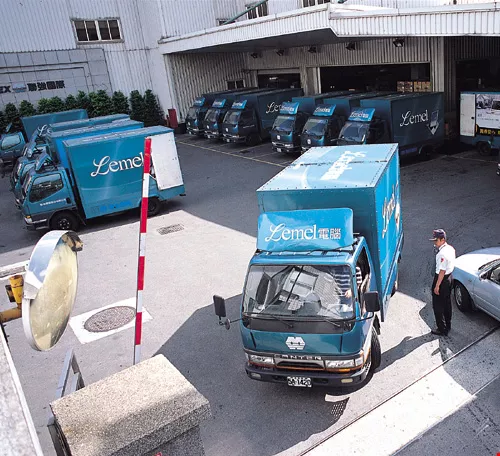
Synnex depends upon a super-efficient information management system and logistics fleet. From receipt of an order to delivery of the goods takes only half a day. Every link in the chain is meticulously crafted and painstakingly thought out.
Bitter lessons
In 1975 the MiTAC corporation introduced the first microprocessor to Taiwan and raised the curtain on Taiwan's information industry. MiTAC's microprocessor division, which had exclusive marketing rights for Intel products, gradually also became a sales agent for various electronic components (including memory chips, resistors, capacitors, etc.) and peripherals like monitors and printers. In 1980 MiTAC set up Synnex (named MSI until 1997) as a subsidiary to exclusively focus on distributing IT products. Tu took the reins as CEO.
Tu recalls that during those start-up years Taiwan's primary computer companies were all really games console makers copying the products of the Japanese electronic games industry. Because product turnover was very rapid, if firms could not get their consoles assembled and onto the market in the shortest time possible, no one would want to buy them. Thus they became extremely sensitive to the importance of getting product out quickly.
In 1982 the government cracked down on the use of electronic games machines for gambling, and the industry collapsed overnight. Synnex suffered crushing losses. With the support of board chairman Matthew Miao the company weathered the storm, but from then on it was painfully aware of the importance of credit risk management and inventory control.
At the time distributors, with no unique "core values," were squeezed between wealthy, powerful international companies and big domestic manufacturers. It was a risky business to be in. For example, when Synnex lost the distribution rights to two star products--Japanese Epson printers and Amercan S3 chipsets--it was almost forced out of business.
Distribution rights were apt at any time to be taken back by the manufacturer, or big customers would jump over the distributor and hook up directly with the manufacturer. Ultimately, Tu decided not to "knuckle under" to the big international brands, and reoriented Synnex from being a mere distributor, dependent on the whims of others, to being a multi-brand, multi-product, open and autonomous "marketing channel."
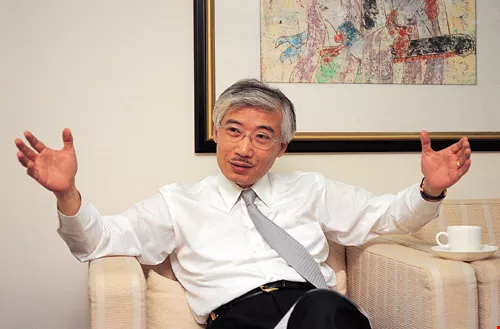
Evans Tu is the key man in Synnex's market dominance. He is a man capable of thoroughly analyzing the big picture and one who starts any task from the details up. Recently he wrote of his management experiences in Synnex EMBA and made the paper publicly available on the Internet. It has become reference material for managers from all sectors of business.
Service provider
Talking about transformation is one thing--but to get results you need tremendous vision and boldness, as well as meticulous execution. These are the very three qualities for which people later praised Tu.
In a book chronicling the rise of Synnex, The Ever-Galloping Courier Horse, Taiwan Semiconductor Manufacturing Company chairman Morris Chang, who has worked with Synnex over many years, says the firm's first step toward success was to get an extremely clear and forward-looking understanding of its position in the marketplace. In an era when "market channels were just for buying and selling goods, making money from price differentials," Synnex had already positioned itself as a "service provider," providing excellent service to original brand manufacturers, domestic manufacturers, and retailers, and thus creating new value for a new generation of market channels.
In 1990 when Synnex first began to transform itself, Tu already could see the future of marketing channels. At that time PCs had just entered the era of chaotic, breakneck change. Prices were not falling as fast as today, but Tu foresaw that the IT industry would continue to mature in the future, that prices would drop rapidly and the entire industry chain would experience a major contraction in profits.
Under these circumstances the only way for the industry chain to co-exist and prosper was carefully to think through each link and task in the chain, as well as "giving work to the most appropriate person" and putting the whole thing on a rational foundation. The "marketing channel" that links producer and consumer had an important role to play and could take on multiple tasks--and it would be the ultimate winner in the future marketplace.
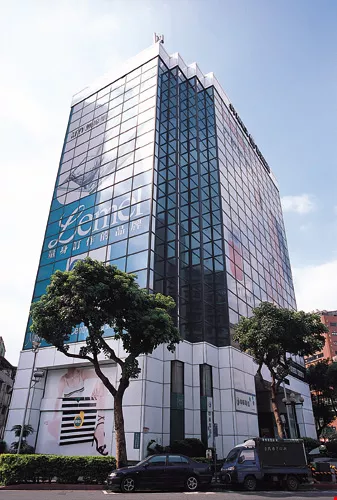
Service is not a physical object and establishing a service brand is far more difficult than creating one for a manufactured product. So Synnex put forward many revolutionary types of services, and ultimately the "Synnex" label became a guarantee of quality for 3C products. The picture shows Synnex's headquarters on Minsheng East Rd, Taipei.
Revolutionary concept
Given all this, Synnex's first thought was how to provide service to its own downstream customers--retailers. In Tu's thinking it was better first to get its existing distributorships operating well rather than fight for new distribution rights by toadying up to major international manufacturers. All you needed was a large number of distribution points and a high market share and then the major international companies would naturally want Synnex to distribute their products.
When people talked about marketing channels then, they thought of retailers like 7-Eleven convenience stores or Wellcome supermarkets. As for moving goods, this taks was contracted out to freight transport companies. At the time, however, Synnex was still a small-scale operation and could not keep a large variety of items in stock for consumers to come and buy in its stores, nor could it handle the enormously complex task of retail outlet operations. Besides, no matter how many retail outlets you opened up, you couldn't possibly consume the whole "market pie."
After much deliberation, Tu thought, "Why not give up the idea of our own stores and concentrate on our role as the middleman?" He felt that open and excellent service that cut through the layers of large and small wholesalers to directly deal with retail outlets and share in their profits was the way to go.
In servicing retailers Synnex steadfastly refused to set up its own retail outlets and compete against its own customers. Nor did it force retailers to sign contracts promising not to use other suppliers. On the contrary, it pushed itself to develop better service to retain its customers' loyalty.
An even more important reform reflected the painful lessons learned by Synnex about market collapse and large inventory that had almost brought the company down. In contrast to the then-current practice whereby large wholesalers would "load up" a retailer with goods and make him fill his warehouse to the ceiling, Synnex advised retailers to be careful about inventory control and promoted a program of "restock only what you sell"--even if all a retailer needed was a single motherboard or hard disk drive, Synnex would guarantee to deliver!
The slogan "restock only what you sell" had great appeal, but implementation was enormously difficult and not in the least cost-effective. This was especially true at a time when the Internet and mobile communications were not yet fully developed and the company could not even get enough telephone lines. To respond to immediate orders with immediate shipment, billing, and inventory management, and to get goods delivered to retailers as fast as possible while avoiding traffic jams, Synnex invested a great deal of money and effort, learning as they went with great strength of purpose and perseverance. Today not only is Synnex able to offer excellent service, it is able to keep operating costs under 3%, only half of the 5-7% of the average marketing channel. Thus it has established a leading position difficult for others to surpass.
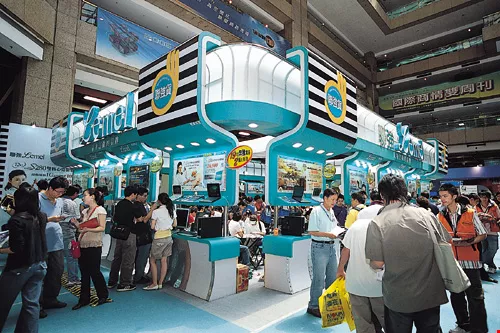
In the mobile information age, a cell phone breakdown means losing touch with the world and is enough to drive a user crazy. Synnex boldly promoted a "30-minute repair, two-year warranty" service that rocked the industry. The picture shows the Synnex booth at this year's Taipei Expo.
The digital nervous system
Citing the example of the way Synnex takes delivery of goods from its suppliers, Tu recalls that although in 1993 the company spent a great deal of money to build a warehouse and logistics center in Taipei County's Linkou Township and to set up a precision information management system, getting it up and running still proved extremely difficult.
Because overall quality of operations in Taiwan was not very high at the time, upstream manufacturers would often not deliver goods on time. Goods originally scheduled for next-day delivery might arrive ahead of time the same day or show up two days later. Very often one could see a long line of delivery trucks piling into the center of Linkou around 11 a.m. The result was that some drivers waited over three hours and still could not unload, even getting so mad that fights broke out.
How does Tu account for this? He laughs and says because most people procrastinate if they can, if the goods cannot be packed up the day before delivery, they wait until they get to work the day of delivery itself to start putting things together and packing them up. Naturally, the result is a major traffic jam. Afterwards Synnex introduced a strict "registration number" system and this problem was gradually overcome.
As for goods shipment, the entire procedure--from automatic product sorting (for example, top-selling items are placed on shelves close to the shipping bay for convenience), order picking and packing, to moving items at the rate of one box a second to the areas (differentiated according to destination) where delivery trucks are waiting to load them--is done without need of human intervention.
The details involved in logistics are extremely complex and they perfectly suit Tu's "picky" and perfectionist personality. Other people might open one eye, shut the other and just fake going over the small things, but Tu insists on facing issues squarely and debating them, locating the crux of a problem and then thoroughly solving it by adjusting the whole system.
For example, to put an end to retailer allegations of shortfalls in deliveries, with the attendant disputes and aspersions cast on employees, Tu introduced an oversight method he had seen in casinos in Las Vegas. The entire Synnex warehouse was outfitted with over 100 security cameras. Workers doing packing and shipping followed standard operating procedures (like lining items up before putting them in the boxes) so the cameras could get a good shot of the quantities. If there was a dispute, the tapes were pulled out as evidence. This not only took care of suspicions on each side, it also successfully reduced the false claims of undershipment that had been costing tens of millions of NT dollars.

Lemel--come on in!
After more than ten years of practice and adjustments, the Synnex operations center in Linkou has been expanded for the third time and logistics centers have been added in Taichung and Kaohsiung. The company handles some 5,000 different items with a delivery fleet of 130 vehicles. Each retail outlet can receive two to three deliveries a day for total of almost 6,000 deliveries in all. This represents one delivery every six minutes. Synnex's fleet is known as "fast and fierce" on the nation's freeways, and to raise drivers' sense of quality and pride the company always refers to them as "logistics service representatives."
Synnex's operating and delivery system, which promises delivery within half a day after receiving an order from anywhere in the country, is the firm's biggest advantage as a market channel. Building on this, it offers "configure-to-order" computer production whereby computers are assembled to customers' specifications, unlike standardized brand computers. These computers are sold under Synnex's own Lemel label. The company has also developed another major service niche--maintenance.
As early as 1990 when Synnex moved into the IT industry with its marketing channel service it contemplated offering a maintenance service, but encountered resistance from retailers. The reason? Retailers had themselves always made money from doing repairs and maintenance for their customers. But Tu didn't give up, because he guessed that PCs would become increasingly popular and products ever more complex and varied. Wouldn't maintenance then involve having a sufficient number of replacement parts on hand, including legacy components, and providing speedy, high-quality maintenance service? It was certainly not something the average retailer was capable of responding to.
The situation developed just as Tu had anticipated. Maintenance for IT products became increasingly important and increasingly difficult. Using its advantage in rapid delivery, in 1997 Synnex unveiled its rapid repair service: "In tonight--out tomorrow." This let consumers avoid the anxiety and frustration of not being able to work if their PCs went on the blink. It also made people think about buying goods bearing the Synnex brand sticker.
Finding the silver lining
The rapid repair service really came into its own after Synnex got into the cell phone business. Their advertisement in 2000 of "cell phone repair in 30 minutes with a two-year warranty" hit the market like a bombshell and consolidated the company's position as cell phone market leader.
It should be mentioned that Synnex's No. 1 position in the cell phone business actually came unexpectedly. Originally the company had focused on IT products exclusively, missing the first wave of the domestic cell phone/mobile communications boom. In 1995, however, when Chunghwa Telecom released the 0932 cell phone numbers, the quantity available fell far short of market expectations. As consumers were not going to buy phones they would not be able to use, the cell phone market collapsed due to oversupply. The distributors for the big manufacturers as well as small and large wholesalers were stuck with full warehouses, going crazy trying to unload their product, and they sought out Synnex with its many outlets. This gave the Synnex an unexpected advantageous entry position in the market and led to a sharp rise in its sales volume.
A similar situation occurred in 1998. This time long-term data management and careful analysis enabled Synnex to "predict" another collapse that was about to be caused by oversupply. When everyone else was busy stockpiling, Synnex went against the common wisdom and warned its business partners to clear out their stock as soon as possible. As a result, they escaped the whole collapse. Not only did the company avoid major damage, but by assisting its partner businesses, it significantly expanded its sphere of influence.
When in Rome
By 1997 Synnex's Taiwan base was secure and it began to expand into the international market. Prior to this its parent company, MiTAC, had already merged with the American company Synnex, which now became the subsidiary's English name. Since 1997 Synnex has moved into the Asia-Pacific region in Hong Kong, mainland China, Australia and Thailand; in 2004 it invested in India's second-largest IT marketing channel, the Redington Group; and, going with the momentum, moved its "battle lines" into the Middle Eastern and African markets, forming Synnex's international presence with its primary base in the Asia-Pacific market and its two "wings" in North America and India. And because its internationalization has proceeded succesfully, it has maintained its brilliant performance despite the huge downturn in the Taiwanese economy these last several years.
As for Synnex's going international, Tu has acquired a huge reservoir of experience to pass on, experience he has gained in his travels around the globe that take up over 25% of his time every year.
First of all, internationalization is expensive. Thus Tu believes only "countries with large populations" are worth getting into. Secondly, when you look for local partners you must find firms that are close to you in business culture and thinking, and observe them for at least a year before making a final decision.
It is especially in the marketing channel industry, a service industry where goods are moved from person to person, that people's feelings and culture play the leading role in success or failure. For this reason Synnex has made it a rule to hire locals to run their operations overseas. If headquarters sent people out, it was in a supporting role. This was done to avoid having "outsiders" giving direction to "insiders."
As for the idea of "when in Rome, do as the Romans do," Tu's secret of success was to "start from the level where they're at." And the "speed" of which Synnex was so proud? Well, there are some regions where the pace of life is quite slow and being on time is considered an intrusion. Customers complain, "What's the idea of sending that stuff so quickly!" At times like those Synnex had to listen to the locals, and with a little cultural communication, gradually help them come up to speed.
Market channel leader
In the process of internationalizing, Synnex has had two great advantages. One is their standard operating procedures, which leave nothing to chance, combined with a really first-class information management system. Partner firms have only to "duplicate" the Synnex model, thus eliminating the fuzziness and inefficiency of a "person-based" management system. Secondly, because of Synnex's amazing success in Taiwan, the many international manufacturers with which they do business are only too happy to introduce the company to overseas distributors.
"With an overseas manufacturer serving as 'matchmaker,' both we and the prospective partners feel at ease, and frequently we click right away," says Tu. For example, Synnex's first step on the road to internationalization was the purchase of its Hong Kong subsidiary, was completed with Intel acting as honest broker.
Looking ahead, Tu, who has always had a deep insight into the future of the industry, has begun to map out the next steps, with the same foresight as he showed when the company changed its Chinese name in 1988. Tu did not want to use the then very popular words "technology" or "information" in the new name, but instead chose "international," a word not looked upon with much favor at the time. In his mind, all that is necessary is to set up a well-functioning channel network and anything can be distributed and sold. Future developments are not limited to science and technology products.
Having established its position as industry leader, what will Synnex "sell" in the future? And what industry revolutions will it spearhead? We are all waiting to see.

@List.jpg?w=522&h=410&mode=crop&format=webp&quality=80)


