Green Consumption: No-Guilt Shopping?
Teng Sue-feng / photos Huang Li-li / tr. by Jonathan Barnard
January 1993


The green color of environmental protection is sweeping the world in the '90s, and even the market for consumer products in Taiwan has been imbued with its leafy shades. Wherever the consumer turns are products bearing green marks. The question is will this green wave really bring a better tomorrow?
Turn on the radio, and you'll hear an ad pitch like this: "Our teacher says that we should love and protect the planet--everyone drink X brand Oulung Tea." Go into a department store, and the environmental counter in the stationary department will be offering diaries and notebooks made out of recycled paper and frames made out of real wood.
And the fashion industry, which is especially sensitive to the latest trends, has come up with a whirlwind of green product lines to suck the fat out of your wallet. On the streets of Taipei modern men and women are wearing green from foot to head. Yes, they're even wearing green hats, traditionally the sign of the cuckold.
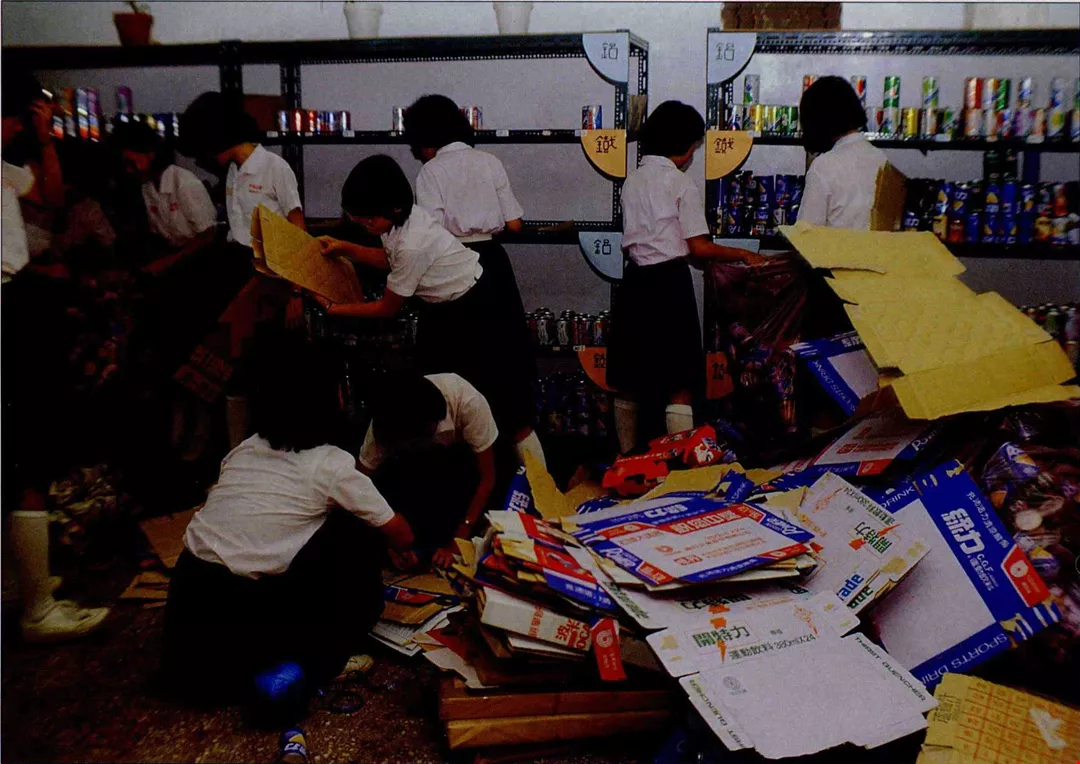
Only by respecting the three R's--reducing consumption, recycling and reuse--will we create less garbage. (photo by Vincent Chang)
First environmentalism, then consumerism:
Advertisements for name-brand clothes guarantee that clothes are made of all natural fibers, 100 percent cotton or pure wool. Blue and green shades of cosmetics are being pushed as "the natural tones of sunlight on the sea." And even popsicles are laying claim to "an environmental conception"!
Overwhelmed by this barrage of claims, environmentally minded consumers can't help but ask in doubt: Can it really be that buying these products will mean the end to environmental degradation?
The Bible of the movement, The Green Consumer, was published in England in 1989. The book defined green consumerism as buying environmentally friendly products in daily life. The concept has evolved where today it is described in more exact terms as the principle of "the three R's": reducing consumption, recycling and reuse.
But according to this principle, is stimulating consumers--and thus consumption--in itself green behavior?
Jay Fang, the head of Taiwan's Green Consumer Foundation, points out that the world' environment is a circular environmental structure composed of production, consumption and decomposition. The global environmental mess has come about because nature's capacity of decomposition is no match for the strength of man at producing and consuming. In an age when the environment and the economy are wrapped up together, "It can be said that environmental problems are entirely a projection of economic problems," he argues. "Civilization has tied itself into a complicated knot. You can't immediately pull it apart and you can't just cut away the tangle with one whack of the knife." Hence, you've got to approach the problem at its roots.
Precisely because the economy and the environment are so intertwined, green consumerism encourages producers and consumers at the same time--producers not to waste resources or damage environmental resources in the production process and consumers to take active steps to be green, selecting products that are environmentally friendly.
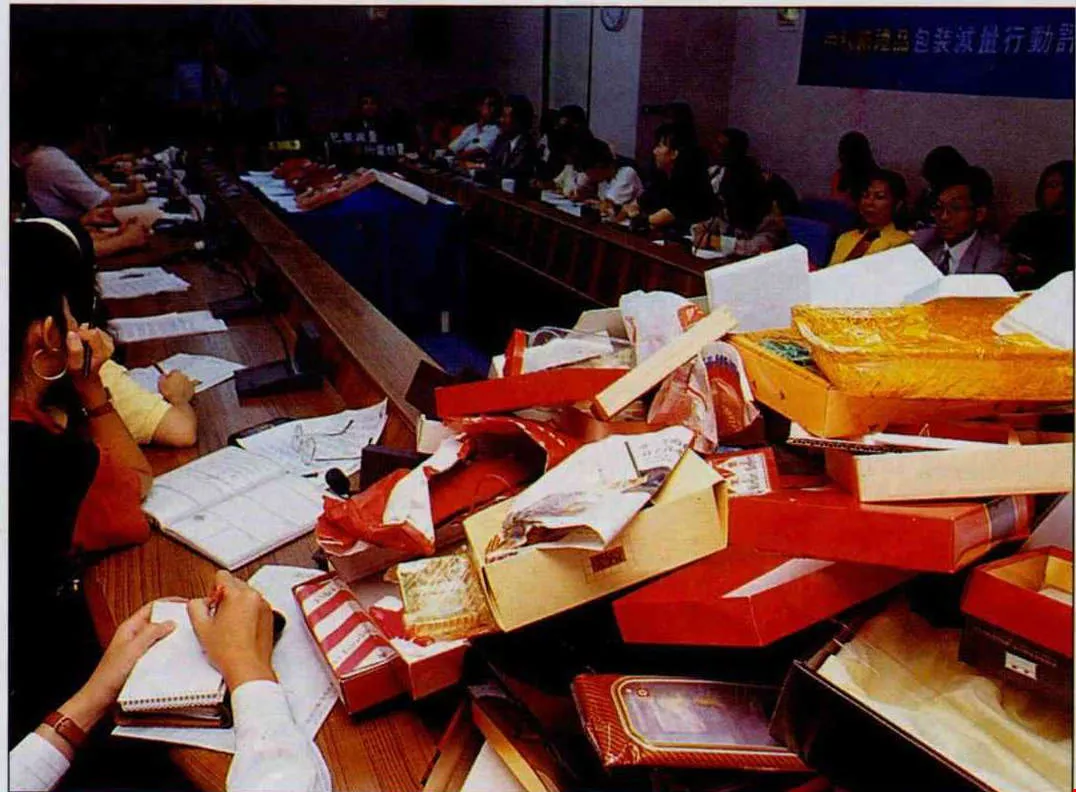
To be sanitary, products need wrappings, but excessive, duplicative packaging not only creates garbage--its wasted expense is passed onto the consumer. (photo by Pu Hua-chih)
Good prospects for the green market:
Seven years ago, Yuen Foong Yu brought out its "Culture" line of recycled paper. Attracting little interest, 200 metric tons of the stuff sat in the warehouse for four or five years before being sold out. But later, as people made calls for environmental protection, the market for recycled paper took off, and last year the company averaged sales of 400 metric tons a month.
In 1989, I Mei Foods broke ground by wrapping popsicles in paper instead of plastic and in not supplying a styrofoam box. By the summer of 1990 no popsicle manufacturers were offering styrofoam boxes.
China Petroleum's unleaded gasoline has already garnered a market share of about 60 percent. Recently, Acer Computers has boasted that it's already been successful in researching how corrugated paper can be used to replace styrofoam in its packaging. Beginning in January of this year, all of Acer's computers and monitors will be packaged in corrugated paper.
Multi-national corporations have also been in on the act. Philips, for example, has introduced energy saving light bulbs and green alkaline batteries. The 3M Corporation has replaced its organic-based sticking solution with a water-based one.
According to the Gallup Organization's "Green Marketing Strategy Survey" carried out last year under commission from the Executive Yuan, 69.5 percent of consumers interviewed said that they would actively select environmentally friendly products. Of businesses questioned, 57.4 percent said they would sell more products designed with the environment in mind.
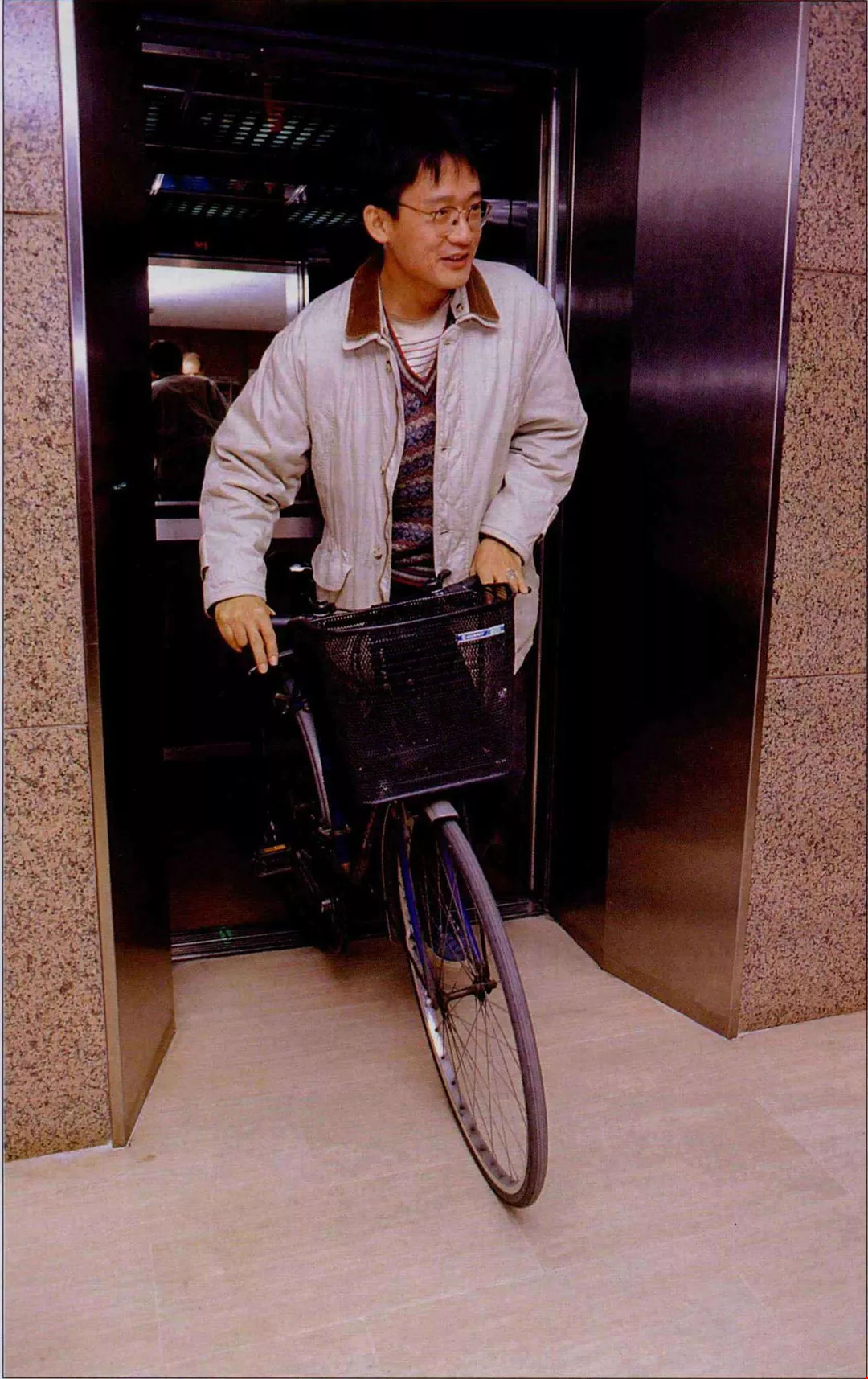
Only a small number of people are willing to sacrifice their pleasures and do the utmost to reduce pollution--riding bicycles to work if the distance isn't great.
Environmentalism is "In"?
A sales strategy aimed at preserving the environment can indeed help sell the goods. King Car three years ago began a series of advertisements entitled "Protecting our feathered friends" to market its drinks. Response was enthusiastic, and sales grew 50 percent.
Professing to use only natural ingredients and not to conduct experiments on animals, The Body Shop began to import its products through an agent in 1989. Under a principle of not spending money on advertisements and packaging, it hasn't been beating its breasts in promotion. Yet by the end of last year it had already opened eight stores across the island, and last year sales doubled--results that represent a major victory in the green sales war.
But a green label worn for sales does not necessarily mean that the product is environmentally friendly, and so-called green consumerism is aimed only at getting consumers to change their purchasing habits.
Ting Tien-kuei, the executive director of the Beautiful Taiwan Foundation, says that a small number of people are willing to be inconvenienced and will take active steps to show their support for the environment. They ride bicycles, use soap instead of detergent, and do their best to walk whenever possible. But the vast majority of people make up for their environmentally destructive behavior by showing a willingness to pay a little extra for environmentally friendly products.
Consumers are willing to sacrifice a bit of convenience and even pay a slightly higher price. The problem is, how are consumers to know if a product's manufacturing process really conforms to the "three R's?"

Consumers one and all, shouldn't we be willing to sacrifice a bit of convenience and actively seek to replenish resources after consumption?
New books in old covers:
Builders, for instance, claim that they are making buildings with cold-storage garbage treatment systems, central dust collection systems and non-oxidizing copper pipes for the sake of the environment. Those in the industry stress that cold-storage garbage treatment systems are provided largely for garbage with a high water content in places with a warm, wet climate. For a large cold-storage container, a space of about 500 square feet is set aside in the basement of a building. Every day the residents put the garbage in this storage area so it doesn't stink up the place before the garbage truck comes. And the stainless steel pipes installed in most households easily rust through oxidation. Hence, some builders have been switching to non-oxidizing copper pipes to prevent rust from affecting water quality and safety.
Jay Fang of the Green Consumer Foundation points out that while cold storage can certainly solve the problem of garbage stench, large containers consume a lot of electricity, breaking the environmental principle of conserving resources. In fact, in one famous district in central Taiwan, a builder once advertised that a building would be equipped with cold storage for garbage, only to find that once the building was completed, the residents were unwilling to foot the extra electricity charge.
Lin Chun-yi, a professor of biology at Tunghai University, holds that sales of green consumer products will only increase if they simultaneously benefit the producer and the consumer. While the displaying of environmental consciousness through green consumerism will gradually increase, this kind of consumerism is "self-interested behavior."
To put it another way, the things that consumers are willing to spend money to buy are largely those that are beneficial to the consumers themselves and are not those that exclusively benefit the environment. As Lin Chun-yi sees it, water purifiers and air filters are not green products: We don't need these things as long as the quality of drinking water and air is improved. While "the garbage may not be piled at the door of our house," once you open your door, the outside environment hasn't changed.

Taiwan's rate of recycling paper is the world's highest. Recycled paper products are made from pulp that contains at least some proportion of used paper.
Spending money to buy the environment:
The Small Green Consumer, which has been translated by the Green Consumer Foundation, points out that a claim to be a "green detergent" can mean many different things. Some brands have simply replaced the phosphates, whereas others have really made substantial changes to the ingredients.
"Though it is hard to say to what degree these green detergents are better for the environment than regular detergents," the book emphasizes, "it is still worth buying them because they force those manufacturing detergents to find ingredients that do not harm the environment."
"Nevertheless, because green consumerism makes use of social resources," Ting Tien-kuei says, "when manufacturers are promoting a green product, they've got to have experts attest to its level of greenness."
As for the paper recycling that has been forcefully pushed by environmental advocacy groups and the EPA, in reality 80 percent of all paper made in Taiwan is made from partially recycled pulp. It's just a question of the proportion.
The raw material of recycled paper is paper waste. In recent years over half of paper used domestically has been recycled, a rate that is the highest in the world. Yet in spite of this high rate of return, because of the mistaken policy of "limiting the amount of paper accepted," junk dealers have had to resort to public protest. In March of last year, 70 to 80 collection trucks full of paper lined up in front of a paper mill in Taoyuan. Protestors argued that limiting the amount of waste paper accepted locally while importing large amounts from abroad was the equivalent of "disposing of other countries' garbage."

Helping the environment is as easy as lifting a finger--or a hand, anyway. Preserving an expanse of green land isn't an impossibility. (photo by Vincent Chang)
Needing certification:
Now let's look at the problem of pollution caused by paper mills. Nearly every paper mill listed on the stock exchange is on the EPA's list of water polluters. And the environment is threatened when the ink-removal or pulp-making processes for recycled paper are handled improperly.
Focusing on these phenomena, Jay Fang asserts that environmental organizations must diagnose the longevity of a product and not overlook pollution to the land when certifying a product as green, instead of only concerning themselves with profit for the manufacturer.
There has also been great debate abroad about the testing of green products. As reported in the American Magazine Advertising Age, Mobil Chemical in 1989 introduced a biodegradable plastic bag, which was greeted enthusiastically by consumers. But half a year later, the U.S. Environmental Defense Fund called a boycott of products promoted as "biodegradable." Because of the process of compression and blackening, wherein as much air as possible is removed from garbage, it is difficult even for hot dogs or paper to decompose, let alone plastic. As a result, seven states including California sued Mobil for misleading advertising, and a green sales campaign turned into a sales nightmare.
The support consumers give to green-labeled products has helped some products' sales. Yet whether or not green products really are of benefit to the environment requires scientific certification. Hence, reliable institutions are needed to handle long-term assessment of these products for consumers.
In 1990 the Green Cross Certification Co. of the United States was the first to begin to authorize the use of its green cross by qualified manufacturers on bleach containers, shopping bags, diapers, napkins and toilet paper, tissues and plastic bags made out of recycled materials. The head of Green Cross points out that they are just judging and certifying a company's environmental claims and not whether a product is really "green."
A focus on daily necessities:
At the same time, Earth Day has also developed its own green seal, but before carrying out inspections on tissues, toilet paper, light bulbs, paint and detergent--five products needed in everyone's daily lives--it is first asking the opinions of advertising companies, consumers and environmentalists about the standards.
Environmental organizations all hope that issuing these marks will help consumers judge if products are really environmentally friendly, but because different standards are applied, consumers don't know who to believe. According to the report in Advertising Age, although Green Cross and Earth Day often consult and exchange information, the heads of the two organizations are unwilling to talk about their own assessment methods.
Without a unified standard, American companies have been lethargic in doing much about their products. Procter & Gamble says that reducing consumer consciousness of the environment to looking out for green marks on labels will perhaps even make things worse.
The U.S. Congress has also instructed the U.S. EPA to make clear definitions of such green sales terms as "degradable," "biodegradable," "recyclable," and "environmentally friendly." Major U.S. manufacturers and unions have already asked the Federal Trade Commission to make a unified set of standards for green products.
Both winners or both losers?
Now that the winds of green consumerism have finally blown our way, we are taking our first steps relatively late. The EPA has commissioned the Industrial Technology Research Institute to handle certification of green products, but environmental action groups are worried that the Industrial Technology Research Institute will give priority to benefiting the manufacturers. Hence, these groups are also preparing to make environmentally conscious recommendations to consumers.
"Being pro-environment doesn't mean being anti-business," say environmentalists. The bickering between business and environmentalists will abate in the '90s, and more cooperative and resolution-oriented attitudes will be adopted so that we can use our fragile planet forever.
The problem of green consumerism, which involves the economy and the environment, isn't a question of right or wrong but rather a question of choice. Before a purchase, you can't be certain you've made the right choice from the color of a product's wrapping. What you can be certain of is that everyone hopes that consumer behavior won't be both a monetary and environmental loss.
[Picture Caption]
p.87
Are the spots of a leopard or another wild animal printed on clothes or accessories the mark of a green consumer?
p.88
Only by respecting the three R's--reducing consumption, recycling and reuse--will we create less garbage. (photo by Vincent Chang)
p.89
To be sanitary, products need wrappings, but excessive, duplicative packaging not only creates garbage--its wasted expense is passed onto the consumer. (photo by Pu Hua-chih)
p.90
Only a small number of people are willing to sacrifice their pleasures and do the utmost to reduce pollution--riding bicycles to work if the distance isn't great.
p.91
Consumers one and all, shouldn't we be willing to sacrifice a bit of convenience and actively seek to replenish resources after consumption?
p.91
Taiwan's rate of recycling paper is the world's highest. Recycled paper products are made from pulp that contains at least some proportion of used paper.
p.92
Helping the environment is as easy as lifting a finger--or a hand, anyway. Preserving an expanse of green land isn't an impossibility. (photo by Vincent Chang)


@List.jpg?w=522&h=410&mode=crop&format=webp&quality=80)


