Competition and Coexistence--Seeking Primacy in Chinese-Language Publishing
Eric Lin / photos Jimmy Lin / tr. by Paul Frank
October 2003


In recent years, Taipei, Hong Kong,Beijing, and Shanghai have all been competitive in holding international book fairs, trying to take the lead in the Chinese-language publishing market on both sides of the Taiwan Strait. From the Taipei International Book Exhibition in the early spring, to the Shanghai Book Fair, the Hong Kong International Book Fair, and the Beijing International Book Fair in the mid-fall, publishers are continuously on the road from one book fair to the next.
The stiff competition and close exchanges among these four cities on both sides of the Taiwan Strait has been widely noted. As feelings of cultural pride intertwine in complex ways with political and business interests, Taipei, Hong Kong, Beijing, and Shanghai are only just beginning to compete for the title of "center of the Chinese-language publishing industry." What are these cities' respective strengths? How is the situation likely to develop?
Starting this year, the Beijing International Book Fair is being held annually rather than every two years. At the beginning of September, even before the fair opens, publishers from around the globe descend on Beijing to network and get a feel for the business environment. Every breakfast, lunch, coffee break, and dinner is used to talk business. As soon as the fair opens, publishing houses and big names from the Taiwanese and Hong Kong publishing industries converge on Beijing.
The fair's organizers feel especially self-satisfied about the rise in copyright trading volume. Copyright trading volume has nearly doubled every year up to the 10th Beijing International Book Fair. During the first fair, 97 copyright deals were concluded; by the ninth, the figure had risen to 8106 deals, earning the Beijing International Book Fair the nickname "Chinese-language copyright trading center."
"Copyright trading center" certainly sounds enticing. For Taipei, which ten years ago aimed to be precisely such a center, the probability that Beijing will become the focal point for this lucrative trade is dispiriting. But what exactly does copyright trading center mean?
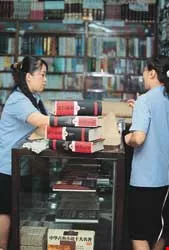
Beijing is mainland China's political and cultural center, and remains the axis of its planned economy: Half of China's publishing houses have their main offices in Beijing and a large number of provincial publishing companies are vying to set up offices in the city. Beijing therefore has considerable business potential as a publishing center.
An obstinate illusion
The largest and most important book fairs in the world, including the Frankfurt Book Fair, the Bologna Book Fair, and the London Book Fair, have mainly functioned as copyright trading centers. The Taipei International Book Exhibition-which allows visitors to buy books, regularly draws crowds of more than 300,000, and boasts attendance of 600-700 publishers from up to 50 countries-at one point aspired to become "the Asian copyright trading center," and in particular a center for trading in Chinese-language books. However, because of their dominant position, Western publishers account for most book-export deals made at major international book fairs, and the Taipei International Book Exhibition has been unable to promote Chinese-language books to the international market.
While Taipei has gradually given up on the idea of becoming the center of global publishing through its book exhibition, other cities in the Chinese-speaking world have picked up the very idea. The PRC government and the organizers of the Beijing International Book Fair are delighted by the fact that its volume of trade has continued to rise every year.
Yet all this may not matter any more anyway. "Once the Internet appeared on the scene, big publishers around the world set up auction platforms where book publishing bids could be made. Traditional book fairs lost their role as venues where book deals were made-a function that became merely ceremonial-though they still draw crowds like religious festivals and stimulate book publishing," comments a publisher intimately familiar with the international publishing industry. Even the Frankfurt Book Fair is gradually losing its copyright trading function. It's an out-of-date idea for cities trying to become publishing centers to think they can corner the copyright trading function for their region.
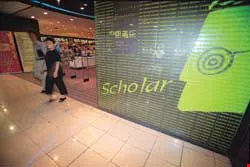
Shanghai has always had a keen nose for business. The photo shows China's first 24-hour bookstore, Scholar, located in Shanghai.
Added Value
Chen Hsin-yuan, an expert on the publishing scene, thinks that if we give up the assumption that being a copyright trading center is the only way to become the center of the publishing industry, we will realize that the market is able to accommodate several centers with different functions and characteristics.
"The Chinese book market is still divided into the traditional characters used in Taiwan and Hong Kong and the simplified characters used in the mainland. Separate book deals are therefore the rule," says Chen Hsin-yuan. He notes that because almost 1.3 billion people in mainland China and Southeast Asia use simplified characters, and a far smaller number, in Taiwan, Hong Kong, and North America, use traditional characters, simplified characters have overwhelming dominance.
But an analysis of book sales presents a different picture: Mainland Chinese book sales total approximately US$5 billion a year, Taiwan's US$1.8 billion, and Hong Kong, Macau and North America's US$500 million. In terms of turnover, the traditional Chinese character market therefore accounts for more than one third of Chinese-language book sales worldwide. Looking at purchasing power, in Taiwan every person buys an average of US$80 worth of books a year, ten times more than book buyers in mainland Chinese cities. In other words, the purchasing power of Taiwan's 23 million people is equivalent to that of the 230 million people in China's urban market.
Market influence is not measured in terms of population. Each city in the Chinese-language publishing market plays a flexible and variable role. Su Shih-pin, Vice President of the Cite Publishing Group, says that although there is the difference between simplified and traditional characters, Chinese speakers everywhere can still communicate with each other. Taipei, Hong Kong, Beijing, and Shanghai ought to find the role that suits them best in the Chinese-language publishing market, to figure out how to put the industry's strengths to good use, and to continuously increase them even in times of crisis.
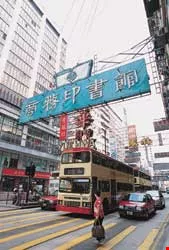
Hong Kong has abundant business capital and is a bold investor. It is the most important provider of capital for the creation and integration of the Chinese-language publishing market.
Taipei
Next year's Taipei International Book Exhibition will promote Taiwan as the "center of the art and craft of Chinese-language publishing" and there will be a section called "the art and craft of Italian publishing." The organizer of next year's event intends to promote Taiwan's advantages in Chinese-language publishing and also to find a connection to the Western publishing industry.
"The Beijing International Book Fair cannot be at the same time an effective copyright trading center and a publishing techniques center. If anything, Shanghai stands a better chance than Beijing as a publishing technology center. But as things stand now, publishing quality in mainland China has a long way to go to reach Taiwan's level." Su Shih-pin says that it may be possible to buy printing-press technology and start operating it immediately, but publishing concepts grow out of a place and culture. It's no surprise that the mainland will need several years to develop such a publishing culture. What matters is that Taipei took the lead early on and that it must now go all out to surge further ahead.
There is more to publishing technology than a printing press and design work. Publishing process know-how is also essential: whoever excels in product packaging, marketing, market interaction, forecasting market trends, and discovering and promoting new writers will gain a lead of several years.
In the Taiwanese publishing scene, other than Cite Publishing Ltd., which enjoys enormous capital backing from TOM, a Hong Kong investment group that recently acquired it, most publishers are small and medium-sized companies. "Small but beautiful" is a distinctive quality of Taiwanese publishing. Whoever is creative can expect to do well as a publisher. For example, Locus Publishing Company turned Jimmy Liao, Chang Miao-ju, and Hsu Mei-i into bestselling authors and triggered an upsurge in Chinese-language publishing. Long before Gao Xingjian won the Nobel Prize for Literature, Linking Publishing Company published his works for several decades without any guarantee that the investment would pay off. PsyGarden Publishing Company publishes only a few dozen books a year, but each one of them is a minor masterpiece of popular psychology.
"The literary level of its readers has an influence on a publishing company's ambition," says Wu Hsing-wen, Beijing representative of Yuan-Liou Publishing and long-time observer of the publishing scene on both sides of the Taiwan Strait. Taiwanese readers are punctilious in their choices, but they are also very receptive, which is why local publishers can make bold and experimental market forays. It is also the reason Taiwanese books are successful in terms of content and set trends for the Chinese reading public around the world.
Hong Kong
Hong Kong also used to play a decisive role as a content provider in the world of Chinese-language publishing. Years ago, at a time of political turmoil in China, a generation of newspapermen emigrated to Hong Kong, where they ran newspapers and started a martial arts fiction craze that would eventually give rise to a whole film and television industry.
But Hong Kong authors have became ever less influential over the years. The works of writers Shen Xue, S.H. Cheung, and Liang Wang Feng have recently caused an urban literature storm in the city, but they have nonetheless been unable to broaden their fan-base beyond Hong Kong. Ngan Shun Kau, deputy chief editor of Cosmos Books, surmises that the rhythm of Hong Kong literature follows the fast pace of city life and is incompatible with subtle discussions of emotions. In this respect, Hong Kong literature is far removed from the reading habits of typical Chinese readers.
"Hong Kong people are not deep readers, which is why newspapers and magazines are much more popular than books," says Ngan Shun Kau. Moreover, in recent years Taiwan has dominated the publishing field and Hong Kong publishers even find it difficult to obtain the copyrights for the traditional-character translation of non-Chinese-language books. Printing costs are also higher than in Taiwan. The Hong Kong publishing industry is largely sustained by the efforts of idealists who still believe in culture.
In the past, the Hong Kong publishing industry served as a cultural mediator between mainland China and Taiwan. Taiwanese writers Chiung Yao and San Mao and mainland writers like Mo Yan and Wang Anyi were introduced by Hong Kong publishers to readers on the other side of the Taiwan Strait. But just like old writers, old mediators can easily become anachronisms. Taiwanese publishers often visit the mainland nowadays without relying on Hong Kong as a go-between. What strikes them is that although Hong Kong is now part of the PRC, in the mainland Hong Kong publishers are still treated like outsiders, just like the Taiwanese, and don't get any preferential treatment whatsoever.
Yet, the last thing that ought to be underestimated is the commercial strength of Hong Kong publishers. Although Hong Kong publishers' profitability is low, Hong Kong's investment companies are making bold efforts, both overtly and covertly, to invest in every area of mainland publishing, including newspapers, magazines, and books. None has attracted more attention in this regard than the TOM investment group.
Beginning in 2001, TOM took the lead by acquiring the Taiwanese publishing houses PC Home, Nong Nong Magazine Co., Sharp Point Publishing Company, Business Weekly Media Group, and Cite Publishing Ltd., and merged them into the Cite Publishing Group. TOM then set up a joint venture company with tha mainland's SDX Joint Publishing Company, which launched a book and magazine publishing, advertising, and international copyright trading business with an aggregate investment of RMB50 million. SDX Joint Publishing Company Ltd. turned over the management of its four magazines Sanlian Shenghuo Zhoukan ("Lifeweek"), Dushu ("Reading"), Aile ("Philharmonics"), and Jingzhengli ("Competitiveness") to the new company. This summer, TOM's publishing division obtained from Singapore's DBS bank a revolving and fixed-term syndicated loan in the amount of NT$1.8 billion to undertake a major assault on the Chinese-language publishing market.
Beijing
The simplified-character book market in mainland China comprises more than 560 publishing houses, 40% of which are located in Beijing, which provides half the books sold in mainland China.
Beijing is known as China's twin political and cultural capital. If a book is well received by the Beijing media, it will sell nicely all over mainland China. Sun Qingguo, vice general manager of the Beijing Open Book Market Consulting Center, explains that more than 70% of the books published in the mainland are teaching materials put out by provincial publishing houses. The remaining 30% of the market is comprised of books on culture, popular science, literature, and the arts, most of which are published in Beijing.
"In the past couple of years, numerous mainland publishers merged. Although the government has clearly stipulated that only Shanghai Century Publishing Group, the Nanyang Wenhua publishing company in Guangdong, and Bailu Yuan publishing company in Shanxi may do business in Beijing on a pilot basis as "culture companies," provincial publishing groups as well as specialized publishing houses are competing to set up offices in Beijing to facilitate their operations," says Sun Qingguo. Even publishers who do not have an office in Beijing often travel there to talk business and market their publications.
Beijing dominates the field because it is mainland China's publishing center. But from a purely commercial point of view, Beijing should not be overestimated. Cheng Sanguo, president and editor-in-chief of China Book Business Report, notes that all mainland Chinese publishing houses are run by the state. Although in recent years there has been a gradual shift toward commercialization, a large number of publishing houses specializing in liberal-arts titles continue to receive financial support from the state and therefore choose to publish books that do not turn a profit, such as encyclopedias, large dictionaries, and collected literary works.
"Such books are not particularly profitable over the short term," says Cheng Sanguo, "but big dictionaries can give birth to small dictionaries. Over the long-term, these sorts of books promise to pay a handsome commercial and cultural dividend."
Shanghai
Given that Beijing has already established itself as mainland China's foremost publishing center, what place can Shanghai, which has tried in recent years to assert its position, secure for itself?
Because the Shanghai Book Fair this August was the first major exhibition held in mainland China following the SARS outbreak, more than 300 publishers and 100 magazines set up stands on its limited fairgrounds. Orders totaling RMB750 million were placed during the course of the fair, including RMB200 million from Shanghai publishers. The mainland media spoke of "establishing a foothold in East China and opening up to the entire country" and concluded that the Shanghai Book Fair has already become a key platform for the mainland Chinese book trade.
Before the ROC government moved to Taiwan in 1949, Shanghai was the center of mainland China's publishing industry, but during the political vicissitudes of the years that followed it lost its dominant position. In recent years, Shanghai has been rousing itself to catch up with Beijing. Thanks to the keen business sense of Shanghai's people, publishers in the city can concentrate on distribution operations, an area in which the rest of the country is rather weak. Shanghai's largest publisher, the Century Publishing Group, has joined forces with Taiwan's Choice Lithograph Inc. to set up a book distribution center to facilitate business.
The Century Publishing Group is the industry's flagship in Shanghai. In the past two years, it has developed a system that greatly speeds up book distribution. In June of this year, the Century Publishing Group had 12 titles rank in the top 30 in the Chinese bestsellers list published by the Beijing Open Book Market Consulting Center. Because literature has always been Shanghai's strongpoint, the business-savvy Taiwanese popular fiction writer Wang Wenhua chose the Century Publishing Group to distribute his books.
Unification vs. localization
With four cities vying for their place in the common publishing market, top Taiwanese and Hong Kong publishers Chan Hung-chih and Chan Man-Hung have independently suggested that the Chinese-language publishing scene on both sides of the Taiwan Strait will be characterized by parallel processes of unification and localization.
At numerous publishing forums, Chan Man-Hung has repeatedly underscored that the Chinese-language publishing market needs to integrate, but this does not mean that there has to be only a single publishing center. If Taipei, Hong Kong, Beijing, Shanghai, and even Singapore can concurrently expand and find their own local niche, this will over the long-term be to the mutual benefit of the publishing industry as a whole and of local publishing markets.
Every publisher must find his own path, determine his own strengths and his competitors' shortcomings, as well as what role he should play and where others should stand. Chen Hsin-yuan says that the Chinese-language publishing landscape is only beginning to take shape and that it is too early to tell with certainty what role each city will play. What's certain is that publishers love books: if they act a little less like crafty merchants and care a little more about culture, future readers of Chinese books will count themselves fortunate.
To readers everywhere, books are at the same time like windows that afford a view to the outside world and like eyeglasses make it possible to inspect the ground below. Let us imagine a day when, like Teresa Teng's songs, books will reach every city and village in the Chinese-speaking world without hindrance, a day when culture will not only break down political barriers but will reach deep into the heart of every man, woman, and child.


